
B2B Marketing Budget: How Much to Spend, How to Set It, and Where It Should Go

Ask how big a B2B marketing budget should be and the answer is usually a percentage of revenue: 2 to 5 percent on many agency websites, 7.8 percent in Gartner's latest survey. Neither number was built for a company doing $10 million a year. The 2026 survey data shows smaller companies spend a larger share of revenue on marketing than big ones, not a smaller one. And a percentage only says what other companies spent. Below are the benchmarks by company size, how to set your own number from the revenue you need, and where the money should go.
How Much Should a B2B Company Spend on Marketing?
Most B2B companies spend between 5 and 10 percent of revenue on marketing. The two largest annual surveys of marketing leaders put the 2026 average at 7.8 percent and 9 percent. Within B2B, companies that sell services spend more than companies that sell products.
| Survey | Who answered | Marketing as a share of revenue |
|---|---|---|
| Gartner CMO Spend Survey, 2026 | 401 marketing leaders in North America, the UK and Europe, most at companies with over $1 billion in revenue | 7.8% average, up from 7.7% in 2025 |
| The CMO Survey, 2026: all companies | 154 US companies | 9.0% average, 5% median |
| The CMO Survey, 2026: B2B product companies | 61 US companies | 7.0% average |
| The CMO Survey, 2026: B2B services companies | 41 US companies | 10.1% average |
Gartner's 2026 CMO Spend Survey was run between January and March 2026. The CMO Survey, run by Duke University's Fuqua School of Business with Deloitte and the American Marketing Association, asked 308 US marketing leaders in January 2026, and half of them answered this question.
Two things in these numbers matter more than the averages. First, the median in The CMO Survey is 5 percent: half the companies spend 5 percent of revenue or less, and a few heavy spenders pull the average up to 9. Second, most of Gartner's respondents work at companies with more than $1 billion in revenue. Its figure is a fair marker for large companies and a poor one for a company a hundredth of that size.
The figures also depend on what is counted. Gartner's budget includes marketing salaries, which took 24.5 percent of the average budget in 2026. When you compare your own spend with a benchmark, count marketing salaries, agencies, software and programs, and leave the sales team out, so you compare like with like.
B2B Marketing Spend as a Percentage of Revenue, by Company Size
Smaller companies spend a larger share of revenue on marketing, not a smaller one. In The CMO Survey's 2026 breakout by revenue, companies under $100 million averaged 11 to 17 percent, while companies between $100 million and $10 billion averaged about 6 to 7 percent.
Read the chart with care. The breakout by company size covers every company in the survey, business and consumer together, and each size band has only 15 to 34 answers, so one band can move several points from one year to the next. The pattern is what holds: below $100 million the share is roughly double.
The reason is arithmetic. A marketing function has a floor: a website that explains the offer, a CRM, someone to run campaigns, and enough activity to be noticed. On $8 million of revenue that floor is already several percent. Smaller companies are also usually trying to grow faster, and growth costs more than holding a position.
This is why the common advice that smaller B2B firms should spend 2 to 5 percent of revenue deserves a second look. A company that follows it while trying to grow 25 percent a year is usually underfunding its own plan, and then blaming marketing when the plan falls short.
How to Set a B2B Marketing Budget From Your Revenue Goal
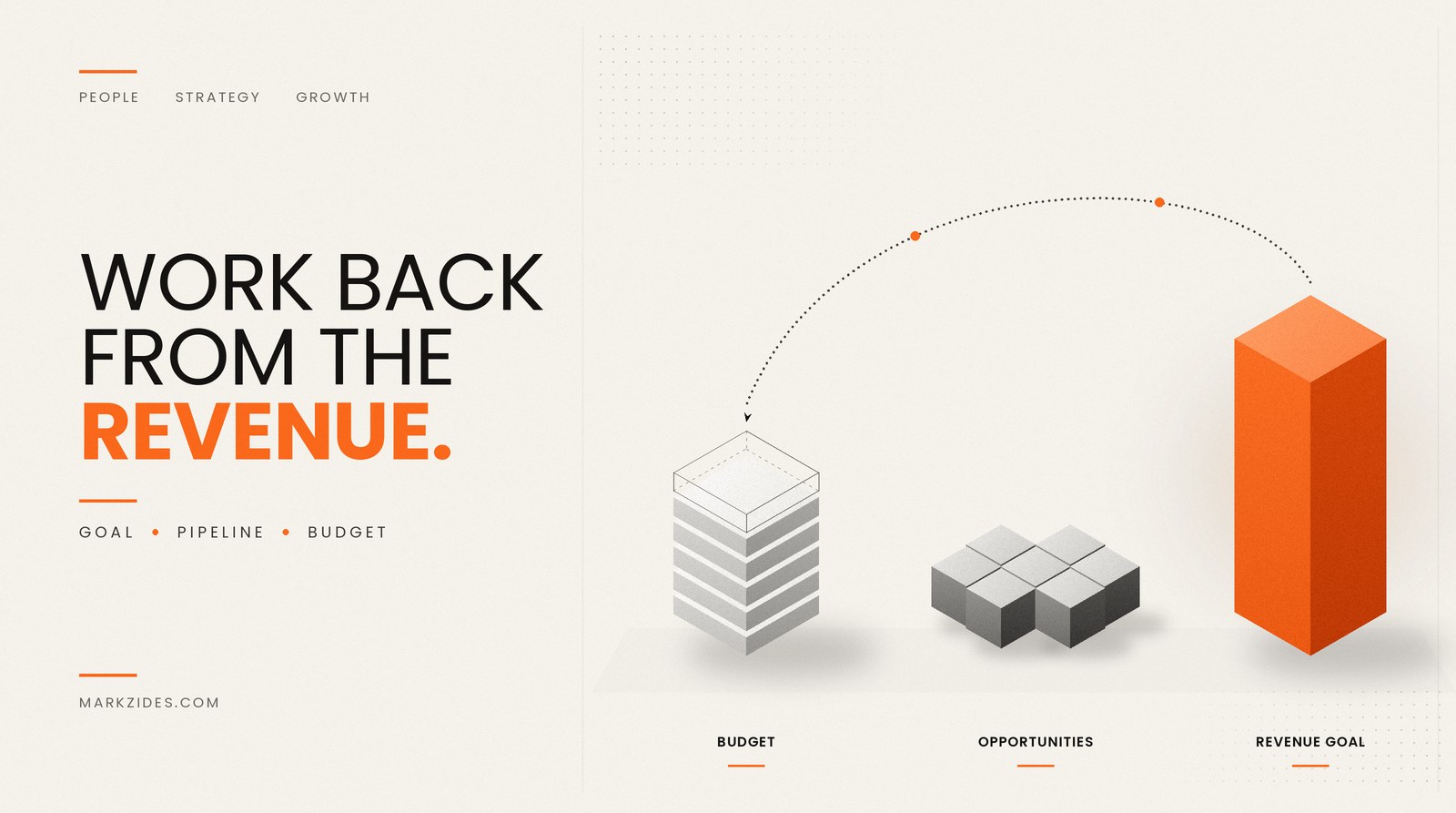
Start with the revenue you need, not with a percentage. Work back from the goal to the number of new customers, from customers to sales opportunities, and from opportunities to what it costs to create them. Then check the total against companies your size. Six steps do it.
1. Decide how much revenue must come from new customers
Take next year's revenue target and subtract what existing customers will bring in, after allowing for the ones you expect to lose. What is left has to come from new customers. A $10 million company aiming for $13 million, whose existing customers will hold steady overall, needs $3 million from new ones.
2. Turn revenue into customers
Divide by what a new customer is worth in the first year, not over their lifetime, because the target is for one year. At $50,000 a customer, $3 million means 60 new customers.
3. Turn customers into opportunities
Divide by your win rate on qualified opportunities. If the sales team wins one in four, 60 customers need 240 qualified opportunities. Use last year's real win rate. A hoped-for one makes every later number too small.
4. Agree how many opportunities marketing must create
Some opportunities will come from referrals, partners and the sales team's own outreach. Agree with sales how many marketing must produce. If it is two-thirds, that is 160. Putting this one number in writing does more for sales and marketing alignment than any shared meeting.
5. Put a price on an opportunity
Divide last year's program spend, meaning ads, events, content and sponsorships, by the qualified opportunities marketing created. If $300,000 produced 120 opportunities, each cost $2,500. At that price, 160 opportunities need $400,000 of programs.
6. Add people and tools, then check the total
Add the cost of the people who run marketing, any agency, and the software. Then divide the total by revenue and compare it with companies your size.
| Step | Assumption | Result |
|---|---|---|
| New-customer revenue | $13 million target, existing customers flat | $3,000,000 |
| Customers | $50,000 first-year value | 60 new customers |
| Opportunities | 25% win rate | 240 qualified opportunities |
| Marketing's share | Two-thirds | 160 opportunities |
| Programs | $2,500 per opportunity | $400,000 |
| People, agency and software | Two marketers, a part-time agency, tools | $450,000 |
| Total | On $10 million of revenue | $850,000, or 8.5% |
At 8.5 percent, this budget sits inside the 5 to 10 percent range most B2B companies spend, and below the 11 to 17 percent that companies under $100 million averaged in the survey. That gap deserves a question before the plan is approved. Either the company creates opportunities more cheaply than most, or the $2,500 is optimistic. If an opportunity really costs $4,000, programs need $640,000 and the total rises to $1.09 million, about 11 percent of revenue.
The cost per opportunity moves the budget more than any other number, so it has to come from your own records rather than an agency's estimate. If nobody can tell you what a qualified opportunity cost last year, find out before setting next year's budget. It is the most useful single figure a founder can ask marketing for.
B2B Marketing Budget Allocation: Where the Money Goes
A B2B marketing budget pays for three things: the people who run marketing, the programs that reach buyers, and the tools that track what happens. At large companies, Gartner found paid media took 31.4 percent of the average budget in 2026 and people took 24.5 percent, with paid media growing as spending on agencies was cut. A smaller company can lay its budget out in seven lines.
| Line | What it covers | How to size it |
|---|---|---|
| People | In-house marketers, and the share of a leader's time spent on marketing | The roles the plan needs, not last year's headcount |
| Capturing demand | Search ads, review sites, retargeting, fast follow-up on inquiries | Enough to be found by every buyer already looking |
| Creating demand | Content, events, webinars, podcasts, the founder's and experts' own posts | The opportunities from step 4 that capture alone will not produce |
| Customer marketing | Renewals, expansion and referral programs for existing accounts | In line with the share of revenue that comes from existing customers |
| Tools | CRM, marketing automation, analytics, the website | Only what someone uses every week |
| Agencies and freelancers | Work you do not do often enough to hire for | A fixed scope, reviewed every quarter |
| Reserve | Tests of new channels and messages | About a tenth of programs, released when a test earns it |
Creating demand vs capturing it
Capturing demand means being found by buyers who are already looking: search ads, review sites, a quick reply to an inquiry. Creating demand means reaching the much larger group who will buy later and are not looking yet, so your name is on their list when they start. Small B2B companies often spend almost everything on capture, because it is the easiest to measure. Then they compete for the few buyers in the market at any moment, against rivals whose names those buyers already know.
The best evidence on the split comes from Les Binet and Peter Field, who studied two decades of B2B campaigns in the IPA Databank for The B2B Institute's 2019 report The 5 Principles of Growth in B2B Marketing. They found B2B marketing worked best with about 46 percent of the budget on building the brand and 54 percent on activity aimed at an immediate response, and warned that their small sample only allows a rough estimate. Treat it as a direction rather than a rule: if creating demand gets almost nothing today, move toward half. It is the same divide as the one between lead generation and demand generation: one collects the interest that exists, the other creates more of it.
Keep money for existing customers
Large companies are moving money away from the customers they already have. Gartner's 2026 survey found spending on loyalty and retention fell 29 percent between 2024 and 2026, to less than 15 percent of media spend. For a B2B company whose existing accounts bring in most of each year's revenue, following that trend is a mistake. Renewals and expansion are revenue the company has already half won, and a budget for keeping and growing existing accounts belongs in the plan.
How the Budget Changes as the Company Grows
The right budget changes with the stage of the company, because the job marketing does changes. Three stages cover most B2B companies.
| Stage | What the budget is for | The common mistake |
|---|---|---|
| Founder-led, up to about $5 million | The founder's own reach, a website that explains the offer, one person or agency to run the basics | Paying for a large set of tools before the message is proven |
| Building the engine, about $5 million to $50 million | A marketing leader, a repeatable source of opportunities, and the numbers to prove it | Hiring a senior marketer and giving them nothing to spend |
| Scaling or preparing to sell, $50 million and up | Pipeline that does not depend on the founder, with a cost per customer that a buyer can check | Cutting marketing to lift profit before a sale, which shows up in the next year's pipeline |
At the first stage, founder-led marketing is usually the cheapest channel the company will ever have, and the budget should mostly support it. By the third, the question changes. A buyer or investor wants to see that growth will continue without the founder, and a pipeline that marketing produces on a known budget is part of a business that runs without you.
Six Mistakes That Waste a B2B Marketing Budget
- Last year plus 10 percent. A budget rolled forward keeps paying for whatever was there, whether or not it produced anything. Rebuild it from the revenue goal each year.
- Comparing yourself with giants. A figure drawn mostly from companies with $1 billion in revenue tells a $10 million company little. Compare with companies your size, and treat even that as a check, not a target.
- Paying for software nobody uses. Tools are easy to buy and slow to cancel. Each one should have an owner and a reason to be opened every week.
- Measuring leads instead of opportunities. A lead target rewards volume and leaves sales chasing names that will never buy. Count the qualified opportunities sales accepts.
- Cutting marketing first when sales slow. The cut saves money this quarter and empties the pipeline one sales cycle later, when the cause is harder to see.
- Locking the whole year in January. Fund in quarters, keep a reserve, and move money toward whatever is producing opportunities. Gartner gives large marketing teams the same advice for 2026: funding that shifts with performance.
How to Tell Whether the Budget Is Working
Judge the budget by what it does to the pipeline, measured the same way every month. Four numbers are enough.
| Measure | How to work it out | What it tells you |
|---|---|---|
| Cost per qualified opportunity | Program spend divided by the opportunities sales accepted | Whether each channel is getting cheaper or dearer |
| Pipeline per dollar | Value of new opportunities divided by marketing spend | Whether marketing creates more value than it costs |
| Customer acquisition cost | All sales and marketing cost divided by new customers | What a customer really costs to win |
| Payback period | Acquisition cost divided by the monthly gross profit from a customer | How many months before a new customer has paid back |
Look at them by channel each quarter and move money accordingly. Pulling these numbers together every month is part of revenue operations, and a company that cannot produce them has a reporting problem to fix before it has a budget problem.
Frequently Asked Questions
What percentage of revenue should a B2B company spend on marketing?
Most B2B companies spend 5 to 10 percent of revenue. In 2026, Gartner found an average of 7.8 percent and The CMO Survey found 9 percent, with B2B services companies at 10.1 percent and B2B product companies at 7.0 percent. Smaller and faster-growing companies usually need more.
What is the average marketing budget for a small B2B company?
In The CMO Survey's 2026 breakout, companies with under $10 million in revenue averaged 13.3 percent of revenue and those with $10 million to $25 million averaged 17.4 percent, across business and consumer companies. Each band had 20 answers or fewer, so treat the figures as a range, not a target.
Should salaries be included in the marketing budget?
Yes. Count marketing salaries, agencies, software and programs together, so you can compare your spend with a benchmark and see what an opportunity really costs. Gartner's 2026 survey found people took 24.5 percent of the average marketing budget. Keep the cost of the sales team separate.
How should a B2B marketing budget be allocated?
Between people, programs and tools, with programs split between buyers who are already looking and those who will buy later. Binet and Field's B2B research suggests about 46 percent on building the brand and 54 percent on activity aimed at a response, as a rough guide. Keep a reserve for tests.
How often should a B2B marketing budget be reviewed?
Set it once a year from the revenue goal, then review it every quarter. Move money toward the channels producing qualified opportunities at the lowest cost, and away from those that are not. A budget locked for twelve months keeps paying for whatever stopped working in March.
Final Thought
A B2B marketing budget is a plan written in money: the revenue you need, the opportunities that takes, and what each one costs to create. A percentage of revenue is a useful check on that plan and a poor substitute for it. Putting the money where the opportunities are is the L of the UNLOCK Method: leverage the right opportunities. If your marketing spend is not turning into pipeline you can count, Mark's demand generation work starts from the same arithmetic.
Ready to build a revenue engine that runs without you?
Mark works alongside founders as a player-coach — not a slide deck.
Book a 30-minute call