
Which Industries Use Fractional Executives the Most? What the Data Shows

Ask about the industries that use fractional executives most and you will get a confident list. Healthcare first, then software, then fintech. Or technology first and healthcare second, depending on who wrote it. Most of those lists come from firms that place fractional leaders, and many lean on figures nobody can trace. That matters if you are deciding whether a part-time executive makes sense for a company like yours. The real answer depends on what you count: who advertises the roles, who already works this way, or how fast the model is spreading. Each gives a different ranking.
Which Industries Use Fractional Executives the Most?
By job postings, healthcare and healthtech use fractional executives the most, at 14 percent of fractional roles advertised between January 2024 and May 2026. AI and machine learning, e-commerce, fintech and B2B SaaS follow at about 5 percent each. Postings came from more than 60 industries, and the largest sixteen made up about half.
Those figures come from the Fractional Work Report 2026, which a fractional jobs board commissioned and a third-party research firm carried out. It covers 1,447 job postings on that board, plus a survey of 1,733 current, past and aspiring fractional workers. It is the most detailed public data on who hires fractional executives, but it describes one board's customers, not the whole market.
| Industry | Share of fractional job postings |
|---|---|
| Healthcare and healthtech | 14% (healthtech 11%, healthcare outside tech 3%) |
| AI and machine learning | 5% |
| E-commerce and direct-to-consumer | 5% |
| Fintech | 5% |
| B2B SaaS | 5% |
| IT consulting, edtech | 3% each |
| Marketing agencies, professional services | 2% each |
| Media, biotech, consumer packaged goods, HR tech, manufacturing | 1% each |
Source: Fractional Work Report 2026 and its publisher's industry breakdown, January 2024 to May 2026.
Why the Answer Depends on What You Measure
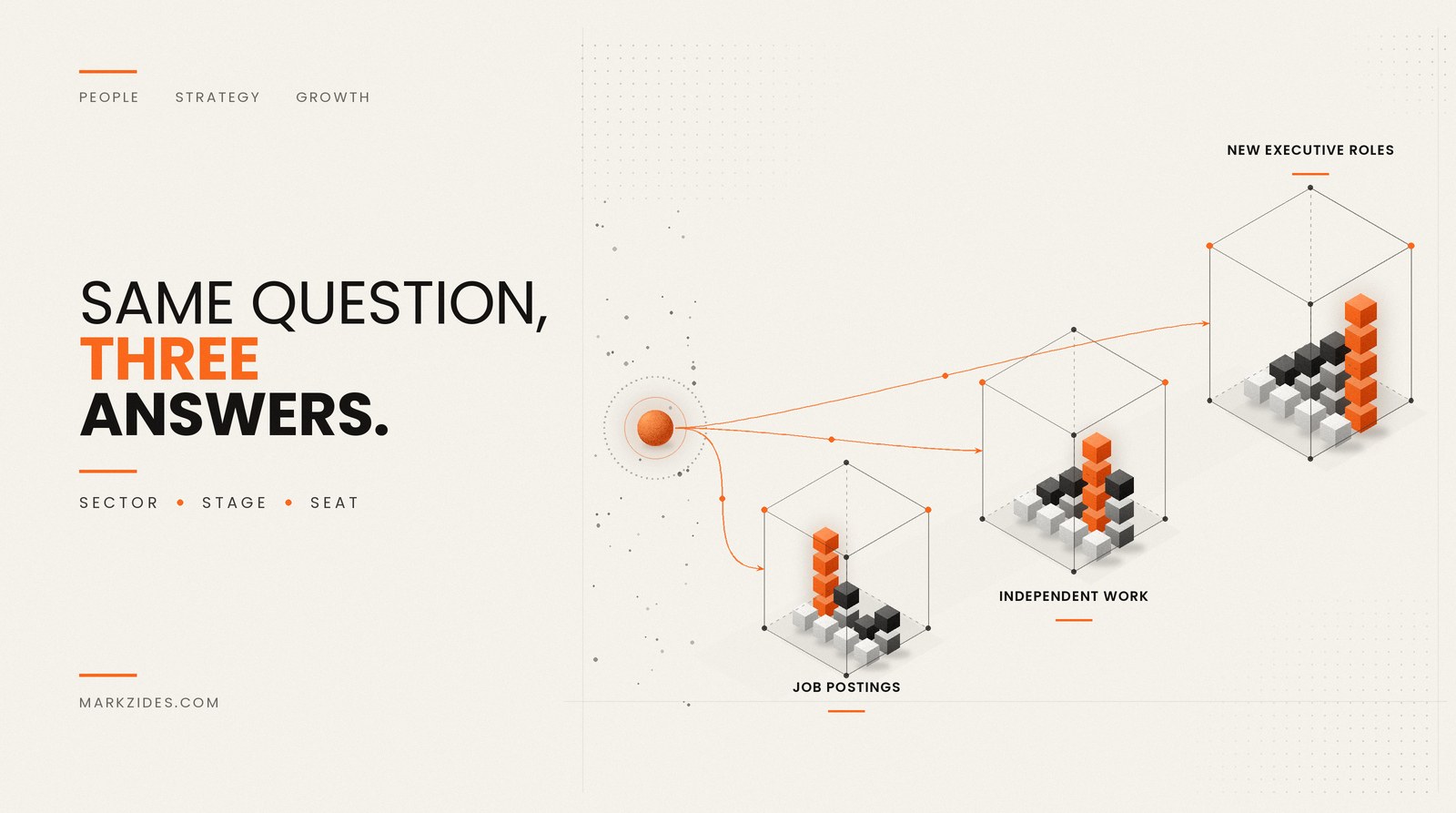
Job postings show who advertises fractional roles on one board. They do not show which industries rely on independent senior talent across the economy. Three measures, read together, give a fuller picture of fractional executives by industry.
| Measure | What it shows | Who leads |
|---|---|---|
| Fractional job postings, 2024 to 2026 | Who advertises part-time executive roles | Healthcare and healthtech, then AI, e-commerce, fintech and SaaS |
| Independent contractors by industry, July 2023 | Who already works this way, across the whole economy | Professional and business services, financial activities and information, among office-based industries |
| New executive roles that mention fractional work, 2018 to 2024 | How fast the model is spreading among executives | Up from 5 to 18 in every 1,000 |
The second measure is the only official one. The Bureau of Labor Statistics found that 7.4 percent of US workers, 11.9 million people, were independent contractors in their main job in July 2023. It counts every kind of contractor, not just executives, but it shows where working independently is normal. Among management, business and financial occupations the share was 9.6 percent, above the average.
The two measures disagree about healthcare, and the reason is useful. Eleven of the fourteen points in the postings figure are healthtech: startups building software and services for the health sector. Hospitals, clinics and schools mostly employ their people directly: only 2.9 percent of workers in health and education services are independent contractors. "Healthcare leads" mostly means health startups lead.
The third measure comes from Revelio Labs, a workforce data company that reads public employment records. In 2018, 5 of every 1,000 new executive positions mentioned fractional work. By 2024 it was 18. Still uncommon, but more than three times as common in six years.
The Industries That Lead, and What They Hire For
Each of the leading industries has its own reason for hiring part time, and that reason usually decides which seat comes first.
Healthcare and healthtech
Health startups need senior judgment on regulation, reimbursement and fundraising long before they can afford a full leadership team. A part-time finance leader who has raised money in a regulated market, or a commercial leader who knows how hospitals and insurers buy, can cover that gap for a few days a week. The work is specialised and the hours are not yet full time, which is exactly the shape a fractional role suits.
AI and B2B software
Software companies are usually venture-backed and short of time. Early on the need is technical, and engineering is the largest share of fractional demand at early-stage companies, at 24 percent. Once the product works, the need moves to marketing and then to revenue, as the company tries to turn a founder's early sales into something repeatable. Part-time leaders let it buy each kind of experience in the order it needs them.
Fintech and financial services
Fintech pairs startup speed with banking rules, so it needs finance and compliance experience early and in short, intense bursts. Financial services as a whole is already used to independent work: 10.8 percent of workers in financial activities are independent contractors, well above the national average.
E-commerce and consumer brands
Consumer brands live or die on marketing, and many are bootstrapped. Bootstrapped businesses put 26 percent of their fractional demand into marketing, against 20 percent across all companies. The finance seat usually follows once inventory and cash flow get complicated.
Professional services
Professional services post only 2 percent of fractional roles, yet 13.5 percent of workers in professional and business services are independent contractors, well above the national average. The two figures fit together. Fractional work runs largely on referrals: 94 percent of fractional workers in the same survey have won clients through their network, so a job board sees only part of it. Many fractional leaders also come from consulting themselves: 24 percent of fractional executives have a consulting background, according to Revelio Labs.
Stage Matters More Than Industry
Company stage predicts a fractional hire more reliably than industry does. More than a third of fractional postings come from early-stage, venture-backed companies, and almost none from public ones.
| Company stage | Share of fractional postings | Seats reported |
|---|---|---|
| Early-stage, venture-backed | 36% | Engineering 24%, marketing 20%, finance 16% |
| Bootstrapped or privately held | 13% | Marketing 26% |
| Growth-stage, venture-backed | 11% | Finance and marketing, 18% each |
| Non-profit | 7% | Not broken out |
| Private-equity backed | 2% | Not broken out |
| Public, and late-stage private | 1% each | Not broken out |
The pattern follows the money. An early-stage company has a board that wants senior experience and a budget that cannot carry a full executive team. A public company can, and its governance expects full-time officers. In between, the useful question is not "what industry are we in" but "which seat needs senior decisions that do not yet fill a week".
The Seats Companies Fill Part Time
Finance is the most common fractional role, at 22 percent of postings, followed by marketing at 20 percent and engineering at 17 percent. Together they make up nearly 60 percent. The rest is spread across sales, operations, growth, people and analytics. Revelio Labs finds the same order in how fractional leaders describe themselves: CFO is the most common title in their headlines, at 18.8 percent, and CMO is next at 14.3 percent.
- Finance comes first because fundraising, reporting and cash planning need senior judgment in bursts, not every day. A part-time CFO still deserves a proper interview, and these questions to ask a CFO candidate apply either way.
- Marketing is next because strategy and positioning can be set in a few days a week while a team or agency does the work. The part-time marketing leader is the second most common fractional title.
- Operations is harder to do part time, because an operations leader needs authority over full-time staff every day.
Sales leadership is about one fractional role in ten, smaller than finance or marketing because the revenue number has to be carried every week. It fits when the sales motion needs designing rather than running: a founder still closing most deals, no forecast the board trusts, no process a new hire could follow. That is the work of a fractional chief revenue officer, and it ends when a full-time leader can take the seat.
Where Fractional Hiring Is Heading
On the same jobs board, monthly fractional postings rose five times between 2024 and the first quarter of 2026, and demand grew 149 percent between the first quarters of 2025 and 2026. Those are big numbers from a single board whose own membership grew 83 percent in 2025, so part of the rise is the board itself growing. The report puts the number of fractional workers in the US at about 150,000 in 2026, within a range of 100,000 to 300,000, and projects growth of 15 to 25 percent a year to 2030. That last figure is a forecast, not a measurement.
The independent measure moves more slowly. Fractional work more than tripled as a share of new executive roles between 2018 and 2024, a clear trend from a small base.
The Numbers to Treat With Caution
Some of the most repeated figures about fractional executives have no traceable source. These turn up on page after page, and none of them could be traced to a published method or original data:
- A fractional executive market worth $5.7 billion and growing 14 percent a year.
- Forty percent of small and mid-size US firms using fractional leaders by the end of 2026.
- Fractional profiles on LinkedIn growing from 2,000 in 2022 to 110,000 in 2024.
- Healthcare and fintech paying fractional leaders a 25 to 40 percent premium.
They may be right. But a number with no method behind it is a poor basis for a hiring decision. When a figure matters to your plan, ask who measured it, how, and when.
Does Your Industry Need a Fractional Executive?
Your industry matters less than three questions about your company:
- Is there a seat that needs senior decisions but not a full week? Fractional work suits judgment in bursts, not daily management.
- Are you at a stage where this is normal? Early-stage and bootstrapped companies use it most. Public companies almost never do.
- Can you name the result you want in six to twelve months? That is how long most engagements run, and a clear result is what makes the hire work.
If the answer to all three is yes, the next step is choosing the right person, and knowing how to evaluate one matters more than which industry they have worked in.
Frequently Asked Questions
Which industry hires the most fractional executives?
By job postings, healthcare and healthtech, at 14 percent of fractional roles on one large board between January 2024 and May 2026, mostly from health startups. By the share of workers who work independently, professional and business services leads the office-based industries, at 13.5 percent in July 2023.
Do startups or established companies hire more fractional executives?
Startups, by a wide margin. Early-stage, venture-backed companies post 36 percent of fractional roles and growth-stage ones 11 percent, while bootstrapped businesses post 13 percent. Private-equity backed companies post 2 percent, and public companies 1 percent.
What is the most common fractional executive role?
Finance. It accounts for 22 percent of fractional job postings, and CFO is the most common title fractional leaders use, at 18.8 percent of their profile headlines. Marketing is second on both measures, with CMO at 14.3 percent.
Do manufacturing companies use fractional executives?
Less than most industries. Manufacturing makes up 1 percent of fractional job postings, and only 2.2 percent of manufacturing workers are independent contractors. A part-time leader suits a manufacturer best when there is a defined job, such as rebuilding finance reporting or setting up a first sales process.
How many fractional executives are there in the US?
About 150,000 fractional workers in 2026, within a range of 100,000 to 300,000, according to the Fractional Work Report 2026. There is no official count of fractional executives. The Bureau of Labor Statistics counts all independent contractors: 11.9 million people, or 7.4 percent of workers, in July 2023.
Final Thought
The industries that use fractional executives most are the ones with senior decisions to make and no budget yet for a full leadership team, which is why startups dominate every list. The better question for any company is which seats need a full-time owner and which need senior judgment for part of the week. That is the O in Mark's UNLOCK Method, organize for growth: build the leadership team in the order the company needs it, not all at once.
Ready to build a revenue engine that runs without you?
Mark works alongside founders as a player-coach — not a slide deck.
Book a 30-minute call