
Account-Based Marketing: How a Small B2B Team Runs It

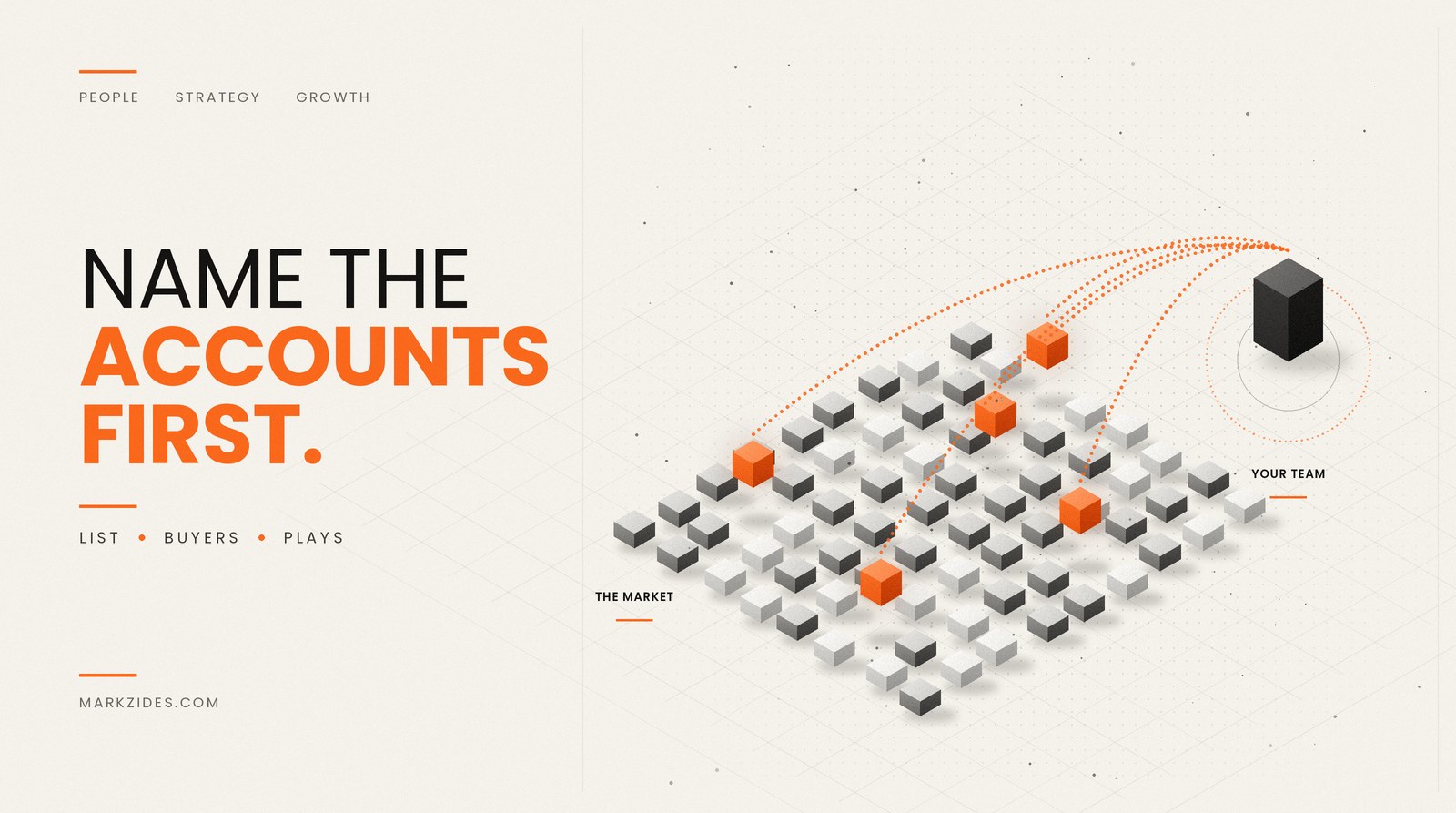
Ask a founder which companies would change the business if they became customers, and most can name them in a few minutes. Thirty, perhaps forty. The people at those companies are known, the problems they have are known, and in many cases someone on the team has met them. Then look at where the marketing budget goes. Almost all of it is spent reaching people who will never buy, in the hope that a few of the right ones notice. Account-based marketing turns that around. It starts with the names and works backward to the marketing.
What Is Account-Based Marketing?
Account-based marketing (ABM) is a B2B approach that starts with a named list of companies and aims every message, campaign and sales conversation at the people who buy inside them. Instead of attracting as many leads as possible and sorting them later, sales and marketing agree on the accounts first and work them together.
It is usually run at three levels. One-to-one means a plan written for a single account. One-to-few means one message for a small group of similar accounts, and one-to-many means lighter, broader work for a longer list.
How to Run Account-Based Marketing in Six Steps
Most ABM guides assume a large marketing team and software built for it. Neither is needed to start. These six steps work for a firm with one marketer and two or three sellers, using a shared list, the CRM you already have and one meeting a week.
1. Pick 25 to 50 Accounts
Start from your ideal customer profile and your last twenty won deals. Look for the companies that look like your best customers: the same size, the same industry, the same situation. Then cut the list to what your team can actually work. For most small teams that is 25 to 50 accounts in total, with the top 10 given personal attention.
Sellers must agree to every name. An account list marketing builds alone becomes a list sales ignores. If a seller would not chase an account, it comes off.
Do this: Put the list in one shared sheet with four columns: account, tier, owner and why it is on the list.
2. Map the Buying Group at Each Account
A B2B purchase is rarely one person's decision. Four to six people usually have a say, and each one is weighing something different. Find them by name and role, starting with the top 10 accounts.
| Role | What they care about | What they need to hear |
|---|---|---|
| The user | Whether daily work gets easier | How it works in practice, from someone like them |
| The budget holder | Whether the problem gets solved and who gets the credit | The result, the timeline and the risk of doing nothing |
| Finance | Cost, payback and contract terms | A plain business case with numbers they can check |
| Technical or operations | Whether it fits what they already run | How it connects, what it replaces, who supports it |
| The final approver | Whether this is the right priority now | One page on why now and why you |
Reaching the whole group early is also how deals move faster. Most stalled deals stall because someone with a say was met late, which is one of the main ways to shorten the sales cycle without discounting.
Do this: For each top account, write the names you know in each role and mark the gaps. The gaps are the first job.
3. Find the Problem and the Trigger
For each account, write one sentence about the problem you would solve for them, based on what you can see: their growth, their hiring, what they say publicly, what their customers complain about. Then look for a trigger, an event that makes now the right time. A new leader in the role that buys. A new site or a new market. A rule change that affects them. A supplier that has failed them or left the market.
An account with a trigger goes to the front of the queue. An account with no visible problem and no trigger stays on the list, but gets the lighter work until something changes.
Do this: Add two columns to the sheet: the problem in one sentence, and the latest trigger with its date.
4. Write One Message per Tier, Then One per Top Account
Write one message for each group of similar accounts: the problem they share, what you have done about it for companies like them, and the next step you are offering. Then, for each of the top 10, rewrite it around that account's own problem and trigger. Personal does not mean long. It means the reader can tell it was written for their company.
Do this: Test each top-account message on the seller who owns the account. If they could send it to a different company with only the name changed, it is not personal yet.
5. Run the Plays Together Each Week
A play is one coordinated move on an account. The seller writes to the budget holder; the same week marketing shows that account a short case study through targeted ads; a week later the seller sends something useful by post, or invites two people from the account to a small event, or asks a current customer for an introduction. No single touch does the work. The sequence does.
Hold one 30-minute meeting a week with sales and marketing together. Go down the list: which accounts moved, which went quiet, which have a new trigger, what happens next and who does it. That one meeting, around one list, is what sales and marketing alignment looks like in practice.
Do this: Plan the first four weeks of plays for the top 10 before anything goes out, so nobody improvises on the most valuable accounts.
6. Measure Accounts, Not Leads
ABM breaks the usual lead count, because the aim is a few deep relationships, not many names. A form fill from the wrong company counts for nothing, and three people from a target account reading the same case study counts for a lot. That is also why a lead rule that works for inbound, such as the line between a marketing qualified lead and a sales qualified lead, needs a different measure here. Track four numbers each month:
- Engaged accounts: accounts where at least two people from the buying group have responded or met you.
- Meetings: first meetings held with target accounts.
- Pipeline: the value of open deals with target accounts.
- Won: deals closed with target accounts, and their size against your average.
Do this: Report the four numbers on the list itself, so the weekly meeting and the monthly report are the same document.
A 90-Day Account-Based Marketing Plan
A first round of ABM fits in one quarter. Expect engaged accounts and first meetings inside it; won deals follow the length of your normal sales cycle.
| Weeks | Work | Done when |
|---|---|---|
| 1 to 2 | Build the list from the profile and won deals; agree tiers and owners with sales | 25 to 50 accounts, every one with an owner |
| 3 to 4 | Map buying groups for the top 10; note problems and triggers for all | Named people in at least three roles at each top account |
| 5 to 6 | Write tier messages and top-10 messages; plan four weeks of plays | Every top account has a written plan |
| 7 to 8 | Run the first plays; start the weekly meeting | Every top account touched in at least two ways |
| 9 to 10 | Follow up on responses; book first meetings; swap dead accounts for new ones | First meetings held |
| 11 to 13 | Review the four numbers; keep what worked, drop what did not, plan the next quarter | A decision on the next 90 days |
Account-Based Marketing Example
An illustrative company: a software firm with $10 million in revenue that sells stock-control software to regional building-supply distributors. Its best customers have 50 to 300 staff, several warehouses and a stock problem they can measure. The firm has one marketer and three sellers.
- The list. Forty distributors that match its best customers, agreed with the sellers. Ten go in the top tier; thirty are grouped by region into one-to-few campaigns.
- The buying group. At each top account, the operations director (budget holder), a warehouse manager (user), the finance director and whoever runs their systems.
- The triggers. Two top accounts have just opened new warehouses. One has a new operations director. One lost a large contract after delivery failures.
- The plays. Sellers write to each operations director about their own trigger. Marketing runs a short case study, from a distributor of similar size, as targeted ads to the four roles at each account. The firm hosts a small breakfast for warehouse managers in two regions.
- After 90 days. In this illustration, eight of the top ten are engaged, five have held first meetings and two have deals open. The one-to-few tier produced fewer meetings but surfaced three new triggers, and two of those accounts move up for the next quarter.
Account-Based Marketing vs Lead Generation vs Demand Generation
The three are not rivals. They answer different questions, and most growing B2B firms use more than one.
| Account-based marketing | Lead generation | Demand generation | |
|---|---|---|---|
| Starts with | A named list of companies | People who raise their hand | The whole market you could serve |
| Aims to | Win specific accounts | Capture interest that exists | Create interest that does not yet |
| Measured by | Engaged accounts, meetings, pipeline | Qualified leads and pipeline | Reach, recall and future pipeline |
| Fits best when | Deals are large and buyers are few | Buyers already search for the problem | Buyers do not yet know they need you |
ABM works the names you choose. Demand generation works the wider market, so that when an account on your list finally looks for help, it has already heard of you. For the customers you already have, the same discipline becomes key account management.
When Account-Based Marketing Is the Wrong Choice
- Small deals. If a typical deal is small, the effort per account will cost more than the account is worth.
- Nobody to work the accounts. ABM needs a seller who will follow up within days. Marketing to a named list with no one to call it is just expensive advertising.
- No list worth naming. If your best customers have nothing in common, there is no profile to build from. Fix the profile first.
- A market of thousands of small buyers. Where many buyers each spend a little, broad lead generation reaches more of them for less.
Frequently Asked Questions
What is the difference between ABM and lead generation?
Lead generation waits for people to raise their hands and then sorts them. Account-based marketing starts with a named list of companies chosen in advance and goes to the people who buy inside them, with sales and marketing working the same list.
How many accounts should an ABM program target?
For a small team, 25 to 50 accounts in total. Give the top 10 personal attention with plans written for each, and handle the rest in groups of similar companies with a shared message.
How long does account-based marketing take to work?
Expect engaged accounts and first meetings within one quarter. Won deals follow the length of your normal sales cycle, so a business with a six-month sale should judge revenue over two or three quarters.
Do you need ABM software?
No. A shared account list, the CRM you already use and one weekly meeting are enough to start. Software helps once you run more accounts than a team can track by hand.
Who owns account-based marketing, sales or marketing?
Both. There is one account list and one weekly review. Marketing runs the campaigns and the content, and sales owns the conversations. If either side drops out, the program stops working.
Final Thought
Account-based marketing is not a software category. It is a decision to spend most of your effort on the companies that matter most, and to have sales and marketing work them together. Name the accounts first, learn who buys inside them, wait for the moment that makes now the time, and count accounts instead of leads. That is the L in Mark's UNLOCK Method: leverage the right opportunities, so a small team's effort goes where the return is largest. Building the list and running the first quarter of plays with a growing team is a core part of demand generation work.
Ready to build a revenue engine that runs without you?
Mark works alongside founders as a player-coach — not a slide deck.
Book a 30-minute call