
How to Shorten the Sales Cycle: 12 Ways to Close Deals Faster

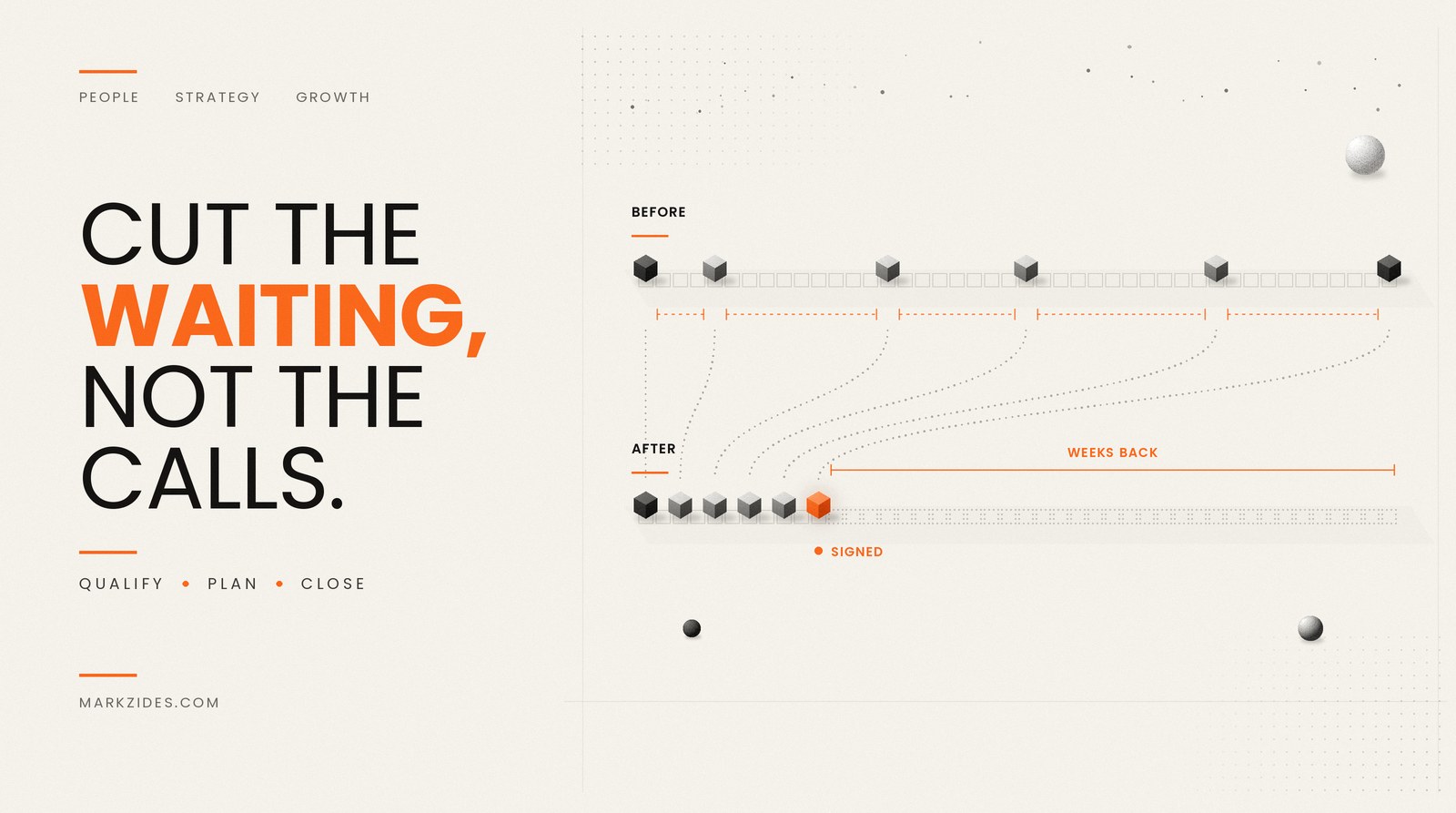
The demo went well. The buyer said all the right things, asked for a proposal and promised an answer by the end of the month. Then the month ended. A polite email bought two more weeks, someone new appeared with questions, and a deal that looked certain in the forecast slid into next quarter. Most sellers respond by pushing harder in every conversation. That rarely helps, because the conversations are not where the time goes. Learning how to shorten the sales cycle starts with seeing where the weeks in a deal actually disappear.
How Do You Shorten the Sales Cycle?
You shorten the sales cycle by removing the waiting between steps, not by rushing the steps themselves. Disqualify weak deals early, meet everyone who signs, agree a dated plan with the buyer, run legal, security and procurement alongside the evaluation, and cut the delays on your own side, from slow proposals to discounts that need three approvals.
The twelve ways below follow the order a deal runs in. Most companies need four or five of them, not all twelve.
12 Ways to Shorten the Sales Cycle
1. Disqualify in the first call
A deal that was never going to close does more damage than one you lose quickly. It sits in the pipeline for months, takes time from deals that could close, and stretches your average when it finally dies. Use the first call to find four things: a problem the buyer wants solved, a date it needs solving by, money that could pay for it, and the people who approve it. One missing is a question for the second call. Two missing usually means the buyer is researching, not buying.
Say this: "If this isn't a priority this quarter, it's fine to tell me now. I'd rather know than keep chasing you."
2. Find out who signs, and meet them before the proposal
The person who found you is rarely the only one who decides. Finance, the team that will use what you sell, IT and often a senior executive each get a say, and each can stall a deal the first person loves. Research published in Harvard Business Review in 2015 by Karl Schmidt, Brent Adamson and Anna Bird found that the chance of a purchase fell from 81 percent when one person decided to 31 percent when six did. The average buying group in their study was 5.4 people.
Those people rarely reach the decision together. A buying group moves at different speeds, so a deal can look close to your champion and still be months away for the person who signs. Ask early who has to say yes, and meet the ones you have not met before you send a price.
Say this: "Apart from you, who has to say yes to this, and who could say no?"
3. Work back from the buyer's date, not your quarter end
Your quarter end means nothing to a buyer. Their own dates do: a system that has to be live before the busy season, a budget that must be spent by year end, a board meeting where the decision has to be shown. Find that date in the first or second call and plan every step back from it. If nothing on the buyer's side depends on a date, the deal has no urgency yet, and no discount will create it.
Say this: "What has to be working by when, and what happens if it isn't?"
4. Agree a written close plan in week one
Once the buyer confirms the problem and the date, write down every step between now and a signature: what it is, who owns it and by when. Send it after the second meeting and ask the buyer to correct it. The plan shows the buyer steps they had not thought of, such as a security review or a reference call, while there is still time to start them. It also tells you early when a date slips, because a missed step on a shared plan is a fact, not a feeling. The template further down has eight rows to start from.
Say this: "Here's how I think we get to your date. Can you fix anything I've got wrong?"
5. Book the next step before every call ends
"I'll follow up next week" is where most of the gaps in a deal begin. Every email that has to find a slot in two calendars adds days, and often a week. Before any call ends, agree what happens next and who will be there, and put it in both calendars while you are still talking. If the buyer will not commit to a next step, you have learned something about the deal that is worth knowing now.
Say this: "Shall we put the next call in now? Thursday at 10 or Friday at 2?"
6. Put the price on the table early
A deal that runs for three months and ends with "that's not in our budget" was lost in the first month, and nobody said so. Give a range in the first or second call, once you know enough to be honest about it. A buyer who flinches at the range has told you to change the scope or walk away. A buyer who accepts it can start finding the money while the evaluation runs, instead of after it.
Say this: "Projects like this usually run between $X and $Y, depending on scope. Is that in the right range for you?"
7. Start legal, security and procurement now, not after the yes
Many deals are agreed in principle in week six and signed in week fourteen. The gap is the work that only starts after the verbal yes: the contract review, the security questionnaire, setting you up as a supplier, the reference calls. None of it needs a decision to begin. Ask who runs each one in the second or third meeting, then send your standard contract, security answers and supplier forms while the buyer is still evaluating.
When the decision comes, the paperwork is already moving, and the weeks that used to follow the yes have mostly gone.
Say this: "Who reviews contracts and security on your side? I'd like to send them our pack this week, so they're never waiting on us."
8. Give your champion a one-page business case
Your champion has to sell the decision in meetings you will never attend. Many do it badly, not because they are unconvinced but because they are busy and have nothing to show. Write them one page they can forward unchanged: the problem in the buyer's words, what it costs each month to leave it, the result expected, the price, the risks and how they are handled, and the date it has to start.
Say this: "What will your finance director ask first? Let's make sure the answer is on the page."
9. Offer a smaller first step, with the next step written in
A large commitment to a new supplier gets a long review, and a smaller one gets a short review. Offer a first phase or a paid pilot that one budget holder can approve. Before it starts, agree in writing what success looks like and what happens when it is reached: the measures, the date, and the price and terms of the full contract. A pilot without those terms is a free trial that turns into a second sales cycle. Money also tests intent, because a buyer who pays for a pilot has shown more than any number of keen meetings.
For example: a 60-day pilot for one team, with three agreed measures, that becomes a two-year contract at an agreed price if two of the three are met.
10. Send standard terms with the proposal, and decide concessions in advance
Contract changes can add weeks, and most argue over the same few clauses every time: payment terms, liability, termination, data. Send your standard terms with the proposal, not after the yes. Then keep a short list of what you will give if asked, each item traded for something back. A seller who has to check every request with a manager adds a day each time, and the buyer learns that asking works.
For example: 60-day payment terms in return for a two-year commitment, or an extra user in return for signing by the end of the month.
Say this: "We can do that if you can sign by the 30th. Does that work for you?"
11. Remove your own delays
Look at your own side before blaming the buyer. A proposal that takes a week to write, a discount that needs three approvals, a technical expert who is only free on Fridays: each one adds days the buyer did not cause. Set standards and keep them. Send proposals within one working day of the request, give one person the authority to approve a discount, and give every deal one owner. If every large deal still waits for the founder's diary, that is a sign founder-led sales has become the bottleneck.
Say this: "You'll have the proposal by noon tomorrow."
12. Make the cost of waiting plain, not a fake deadline
End-of-quarter discounts shorten some deals, once. Then buyers learn that waiting pays, and every deal slides into the last week of the quarter. The urgency that lasts is the buyer's own: what the problem costs them for each month it stays unsolved. Work that number out with the buyer in their own terms, such as hours lost, orders missed or staff time, and put it in the business case. A buyer who can see that two months of delay cost more than your price rarely needs a deadline from you.
Say this: "From what you've told me, each month this waits costs you about $X. Does that sound right?"
What to Say to Keep a Deal Moving
Most stalled deals stall at one of six moments. The words below are written to get a real answer rather than to push, because a clear no in week four is worth more than a maybe in week twelve.
| The moment | What to say |
|---|---|
| They go quiet after the demo | "It's been two weeks since we spoke, and I don't want to keep emailing if this has dropped down your list. Should I close the file for now, or is there a next step?" |
| "Send me a proposal" | "Happy to. So it's right the first time, can we take 20 minutes to agree what it needs to cover and who else will read it?" |
| "We need to think about it" | "Of course. Which part are you still unsure about? If I can answer it now, it saves us both a week." |
| The person who signs won't meet | "I understand they're busy. Could I send three short questions for them, so the proposal answers what they care about?" |
| "Let's revisit next quarter" | "That's fine. What changes between now and then? If nothing does, it may be worth deciding now, even if the answer is no." |
| "It's with legal" | "Thanks. Who is reviewing it, and would it help if our lawyer spoke to them directly? Most questions settle faster on a call." |
A Close Plan You Can Copy
A close plan, often called a mutual action plan, lists every step from the first serious meeting to a signed contract, with an owner and a date for each. Build it with the buyer, share it, and update it after every meeting.
| Step | Owner | By |
|---|---|---|
| 1. Confirm the problem, the cost of waiting and the date it must be solved by | Both sides | Week 1 |
| 2. Meet everyone who signs or can say no | Seller, with the champion | Week 2 |
| 3. Agree what success looks like and how it will be measured | Buyer | Week 2 |
| 4. Send the standard contract, security answers and supplier forms | Seller | Week 2 |
| 5. Demo or pilot for the people who will use it | Seller | Weeks 3 and 4 |
| 6. Present the business case to the budget holder | Champion | Week 4 |
| 7. Finish the contract and security reviews | Buyer's legal and IT | Week 5 |
| 8. Sign, and put the start date in the calendar | Buyer | Week 6 |
The weeks are an example for a mid-sized deal. Yours will differ, but the order rarely does: anything that can start before the decision appears before it in the plan.
Find Where Your Deals Lose Time
Your own deals show where the cycle goes. Take the last ten deals you won and list the date of every meeting, proposal, contract draft and signature for each one. Then measure the gap between each step and the next.
In most companies the long gaps fall in the same two or three places across all ten deals: waiting to meet the person who signs, waiting on legal or procurement, and waiting on your own proposal. Those are the gaps to attack first, with whichever of the twelve ways fits them.
This measures how long deals wait. Where deals stop altogether is a separate question, answered by counting the stage each lost deal stopped in. Together, the two show most of what is slowing your sales.
How to Measure Sales Cycle Length
Sales cycle length is the average number of days from a qualified opportunity to a signed contract, across the deals you won in a period. Add up the days each won deal took and divide by the number of deals.
Sales cycle length = total days from qualified opportunity to signature, for won deals ÷ number of won deals
Three rules keep the number honest. Count from the same point every time, usually when the deal is qualified rather than first contact. Track lost deals separately, since a long average for losses usually means deals are dying slowly instead of being disqualified early. And read the median beside the average, because one deal that took a year can hide a cycle that is getting faster.
Days matter because they set how fast the pipeline turns into revenue.
Pipeline value per day = open deals × win rate × average deal size ÷ cycle length in days
Forty open deals with a 25 percent win rate and a $30,000 average deal, closing in 120 days, bring in $2,500 a day. Close the same deals in 90 days and it is $3,333 a day: a third more revenue from the same pipeline, with no new leads and no change in price.
Frequently Asked Questions
What is a short sales cycle?
A short sales cycle is one where a deal goes from the first serious conversation to a signature in days or a few weeks, usually because one person can decide and the price fits their own budget. Cycles grow longer with the size of the deal, the number of people who approve it and the cost of getting it wrong.
What is the average B2B sales cycle length?
There is no reliable single average. Cycle length depends on deal size, how many people approve the purchase and how new your product is to the buyer, and most published figures come from software vendors' own customer data. The benchmark that matters is your own: the median for deals you won over the last twelve months.
Does offering a discount shorten the sales cycle?
Sometimes, once. A discount tied to a date can pull a ready deal forward, but used routinely it teaches buyers that waiting for the end of the quarter pays. The urgency that lasts is the buyer's own cost of delay. Trade any concession for something in return, such as an earlier signature or a longer term.
What is the difference between the sales cycle and the sales process?
The sales process is the set of steps your team follows to win a deal. The sales cycle is the time those steps take. A documented sales process is often the first thing that shortens the cycle, because every seller then asks the same questions in the same order and fewer deals drift.
Final Thought
A shorter sales cycle rarely comes from one heroic seller or a better closing line. It comes from the same questions asked in every first call, the same plan sent after every second meeting, and the same paperwork started before the decision instead of after it. That is the C in Mark's UNLOCK Method: codify what works, so speed becomes how the whole team sells, not a habit of its best person. Finding where your deals wait, and building the process that removes those waits, is the first job of sales consulting.
Ready to build a revenue engine that runs without you?
Mark works alongside founders as a player-coach — not a slide deck.
Book a 30-minute call