How AI Is Changing Startup Culture: Six Shifts, and What Still Has to Be Human

A handful of people can now build what once took a floor of engineers, and most founders count that as a saving. It is also a change to the company, and it rarely arrives as a decision. It arrives as a shortcut taken on a busy afternoon, a hire nobody gets round to making, a late night that becomes the norm. That is how AI is changing startup culture: by default, before anyone has said what the culture should be. By the time a founder notices, it is already set, and changing it costs far more than shaping it.
What Is Actually Changing in Startup Culture?
AI is changing startup culture in six ways: teams are smaller, fewer junior people are hired, work feels faster than it is, long hours are back in fashion, selling has become the hard part, and every piece of AI work needs a named owner. Each one changes what the company rewards.
Culture is what a company rewards, who it hires and how it decides. Most of those habits grew up around one fact: making things was slow and expensive. AI made it quick and cheap, so the habits built around that cost are moving, in AI startup culture first and everywhere else close behind.
| Shift | What it looks like | What to decide |
|---|---|---|
| Smaller teams | One founder builds what once needed a team | Which jobs always get a person |
| Fewer junior hires | The work juniors learned on is done by AI | Who you will train |
| A feeling of speed | More drafts and features, not more customers | What counts as done |
| Longer hours | The 72-hour week sold as a strategy | Whether hours are a hiring test |
| Selling is the bottleneck | A product is copied in weeks, a customer is not | Who owns the next twenty customers |
| Owned output | AI work that nobody checked or answers for | The rules you write down |
Six Shifts AI Is Making in How Startups Work
Each shift below is real, each has a cost the hype leaves out, and each ends on the decision it puts in front of a founder.
1. Smaller teams, and more founders going it alone
The most visible change is size. One person with good AI tools can now build a working product, write the website, answer support and draft the investor deck, work that used to need a small team before the first hire. Many of these companies call themselves AI-native: built from day one around AI doing work that people used to do, rather than adding it to an older way of working.
Investors still prefer teams. Carta's 2025 Founder Ownership Report found that solo founders led 35 percent of the startups incorporated on its platform in 2024, but only 17 percent of the startups founded that year that had raised venture money by the end of it.
Size also changes culture in a less obvious way. In a team of five there is no middle layer to absorb the founder's habits, so they become the company's habits within weeks. A founder who never writes anything down builds a company that never writes anything down. Working alone leaves blind spots nobody else can see, which is why a second founder who covers the skill the first one lacks matters more, not less, when much of the team is software.
What to decide: which jobs in your company will always be done by a person, and why.
2. Fewer junior hires, and nobody learning the trade
The second change is who gets hired. The first work AI takes over is the work juniors used to learn on: first drafts, research, simple code, routine support. That makes the junior hire the easiest one to skip.
The pattern shows across the economy, not only in startups. The Stanford Digital Economy Lab reported in August 2026 that employment of 22 to 25 year olds in the jobs most exposed to AI stood about 19 percent below where it would have been had it kept pace with people the same age in less exposed jobs. The gap came mainly from fewer hires, not from more people leaving.
For a startup, skipping juniors saves a salary now and costs a senior later. Today's junior is the person who knows your customers and your systems in five years, and who trains the next one. A company that only hires experienced people has to buy every senior it will ever need, at the market price, from someone else. Skipping that seat is one of the mistakes that cost little now and a lot later.
What to decide: keep at least one seat for someone you will train, and give them real work, not only what the AI leaves behind.
3. Faster output, and the feeling of being faster
AI makes work feel fast, and the feeling is not a reliable measure. In the first half of 2025, the research group METR ran a controlled trial with 16 experienced software developers working on 246 real tasks. With AI tools allowed, they took 19 percent longer. Afterwards, they estimated the tools had made them 20 percent faster.
That result has aged. In February 2026, METR said the finding no longer held: newer tools now seem likely to speed developers up, although changes in how developers work made its new numbers unreliable. So the lasting lesson is not that AI is slow. It is that capable people misjudged their own speed by nearly 40 points, in the direction that felt good.
A startup culture built on the feeling of speed rewards visible activity: more drafts, more features, more messages. None of that is the same as a customer problem solved.
What to decide: what counts as done in your company. Measure that, not output.
4. Long hours are back in fashion
Through 2025, reports from San Francisco described AI startups asking for "996": 9am to 9pm, six days a week, 72 hours in all. One local outlet called the city the ultimate 996 city. The argument for it is that the AI race is short and the winners will be the teams that work hardest through it.
A well-known study of hours and output points the other way. John Pencavel, a Stanford economist, studied British munition workers in the First World War. Below 49 hours a week, output rose in step with hours. Above that, each extra hour added less, and output at 70 hours differed little from output at 56.
Factory work a century ago is not software today, and it should be read that way. But it is measured output, which is more than the case for the 72-hour week usually brings. AI startup work culture has a further reason for caution: tired people are the likeliest to stop checking what the AI produced.
What to decide: long hours can be a founder's choice. Make them a hiring test and you hire for stamina, not judgment.
5. Building got cheap, so selling is the bottleneck
When a prototype takes a weekend, so does a competitor's copy of it. The product is no longer the hard part, which moves the advantage to what cannot be generated: customers who trust you, a name in your market, and relationships that make a buyer take your call.
This is the change founders notice last, because building feels like progress and selling feels like rejection. AI widens the gap, since it is now easy to spend a month adding features nobody asked for. Meanwhile, in a team of six, the founder stays the seller for longer than any plan assumes, because there is no sales team to hand to.
A culture that celebrates shipping and never talks about customers will build quickly and sell slowly. The fix is to give selling the same status as building: the same place in the weekly meeting, the same attention from the founder, the same celebration when it goes well.
What to decide: who owns the next twenty customers, by name.
6. A person owns every piece of AI work
The last shift is about responsibility. When AI drafts the proposal, writes the code or answers the customer, someone still has to answer for it. Without that rule, a mistake belongs to nobody: the tool wrote it, so nobody checked it.
Three rules cover most of it. Every piece of AI work has a named owner who reviewed it before it left the company. There is a short, plain rule about what goes into AI tools, so that customer data, contracts and anything shared in confidence are handled differently from public material. And reviews assume AI output can be confidently wrong, because it can.
None of this needs a policy manual. It needs one page, written by the founder, that the team actually reads.
What to decide: the three rules you will write down this month.
What AI Has Not Changed
For all of that, the parts of a startup that decide whether it survives look much as they did. Customers still buy from people they trust. Cash still runs out on a date you can work out. Deciding what to build is still a judgment, and the wrong senior hire is still one of the most expensive mistakes a small company can make.
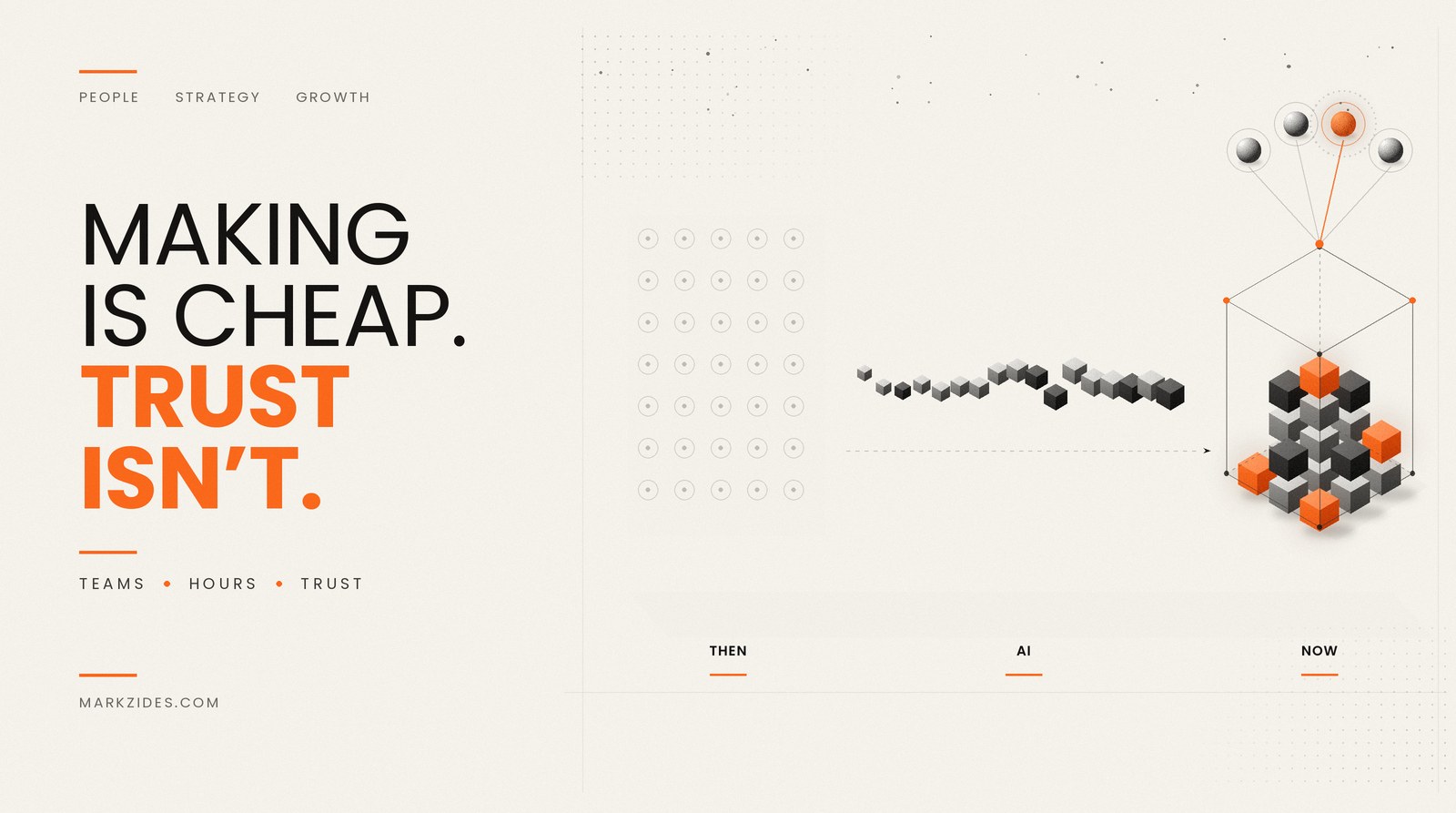
The useful way to read the change is as a shift in what is scarce. AI made making things cheap. It did not make trust, judgment or relationships cheap, and because everything around them got cheaper, they are worth more than they were. A startup culture that protects them on purpose has understood the change. One that treats them as overhead has not.
What a Buyer Will Ask About AI When You Sell
Culture shows up in a sale as paperwork. When a buyer looks at a company built on AI, the questions go well beyond whether the tools work, and each of the five below becomes part of the checks a buyer runs before making an offer.
| The buyer asks | Why it matters | What to have ready |
|---|---|---|
| Who owns what the AI made? | Code, content and anything built on customer data has to belong to the company | Contracts and tool terms, reviewed with your lawyer |
| What customer data went into outside tools? | A customer contract may not allow it | A list of tools and what each one sees |
| How much rests on one provider? | A change in price or terms can hit the margin or the product | What it would cost to switch, and how long it would take |
| Does it run without the founder? | A small team run through one person's tools often depends on that person | The work written down, and someone else who can run it |
| Do the margins hold? | High revenue per person means little if AI costs eat the margin | Gross margin with AI costs included, month by month |
The fourth question catches founders out most often. A team of six built around the founder's accounts, prompts and judgment is the opposite of a business that runs without its founder, and a buyer prices that in. Mark has founded six companies and exited three, and held the CEO seat at an MIT-founded AI company that he turned around and took to a transaction. Every one of these answers is far cheaper to prepare years ahead, which is the point of planning an exit long before there is a buyer.
How to Shape Your Startup's Culture Around AI
Culture forms whether or not a founder shapes it. Five steps shape it on purpose.
- Decide what stays human. Selling, hiring, and the final call on anything a customer sees. Write the list down.
- Write the AI rules on one page. Who owns AI work, what data goes into which tools, and how work is checked.
- Keep a seat to train. Hire at least one person who is still learning, and give them real work.
- Measure finished outcomes. Customers won, problems solved and money collected, not hours worked or drafts produced.
- Review the rules every quarter. The tools change faster than the company does, so the page has to keep up.
Frequently Asked Questions
Is AI making startups smaller?
Yes, at the start. One founder with AI tools can now build and launch work that once needed a small team, and many companies reach their first customers with fewer people. Investors still back teams more often than solo founders, so the smallest companies are not always the easiest to fund.
What is an AI-native startup?
A company built from its first day around AI doing work that people used to do, in the product, in operations or both. It differs from a company that adds AI tools to an older way of working. The label describes how the company runs, not what it sells.
Is 996 culture common at AI startups?
It has been widely reported among AI startups in San Francisco since 2025, but there is no reliable count of how many companies run it. The schedule is 9am to 9pm, six days a week. Research on long hours suggests output per hour falls well before 72.
Should a startup still hire junior people?
Yes, if it wants senior people later. AI now does much of the work juniors used to learn on, so the junior seat is the easiest to cut. A company that never trains anyone has to buy every experienced person it needs from somewhere else, at full price.
Does AI make founders more productive?
At making things, usually: drafts, code, research and analysis are far quicker. It does less for the work that decides whether a startup survives, such as winning customers and choosing what to build. Measure finished outcomes rather than how fast work feels, because the feeling is unreliable.
Final Thought
AI did not give startups a new culture. It removed the cost that used to shape the old one, and left founders to decide what replaces it. That is the C in Mark's UNLOCK Method, codify what works: write down what stays human, who owns the work and what counts as done, then repeat it until it is simply how the company behaves. A culture that is written down can be taught, checked and handed to the next hire, which is why a growth plan for a small team starts with it.
Ready to build a revenue engine that runs without you?
Mark works alongside founders as a player-coach — not a slide deck.
Book a 30-minute call