
How to Raise Prices Without Losing Customers: 10 Ways That Work

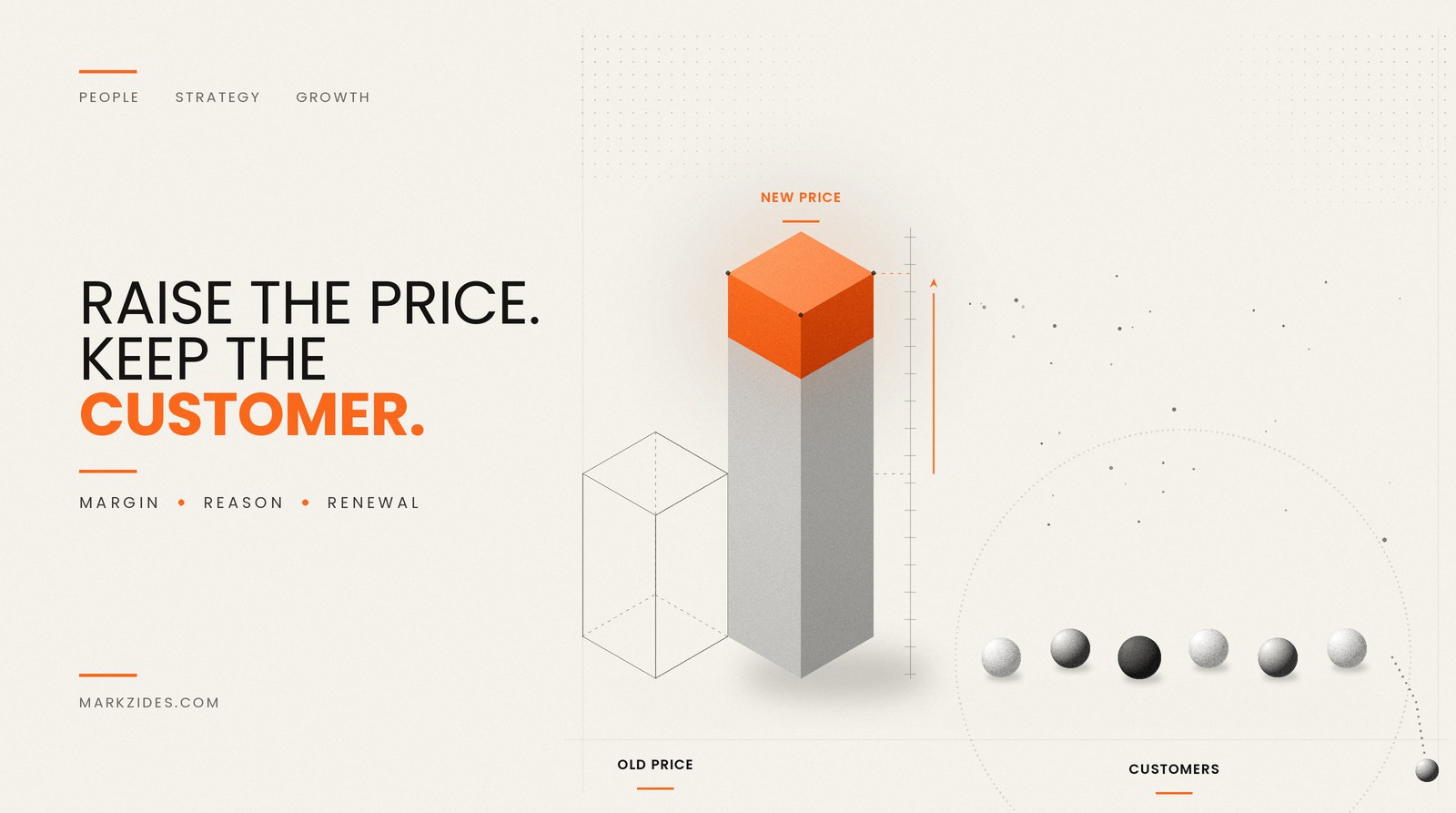
Many owners know their prices are too low a long time before they do anything about it. The fear is specific: the email goes out, your best customer reads it, and a relationship that took years to build starts looking elsewhere. So the price waits another year, and the margin pays for the delay. Knowing how to raise prices without losing customers takes less nerve than it seems. It takes a plan for each account, the right words ready before anyone asks, and one simple sum checked before anything is sent out.
How Do You Raise Prices Without Losing Customers?
You raise prices without losing customers by controlling who pays more first, how the increase lands, and what customers get in return. Charge new customers first, end old discounts, give existing customers notice and a choice, explain the real reason, and talk to your most valuable accounts in person before any letter goes out.
The ten ways below run from the lowest risk to the ones that need the most care. You will usually use several at once.
10 Ways to Raise Prices Without Losing Customers
1. Charge new customers first
New customers have never paid the old price, so a higher one costs you nobody. Put every new proposal on the new price from a fixed date, and leave existing accounts alone until their renewal. A quarter of new deals tells you how buyers with no history react. If your win rate barely moves, the price had room. If it falls sharply, you learned that on deals you had not yet won.
2. End discounts before you raise the list price
A discount that has outlived its reason is the gentlest price rise you have. Customers take the loss of a discount more kindly than a higher price, even when the money is the same. In a 1986 study of fairness in pricing, Daniel Kahneman, Jack Knetsch and Richard Thaler found that a car dealer who stopped giving a $200 discount was judged acceptable by 58 percent of 123 people, and one who charged $200 over list by only 29 percent of 130. List every account paying below list, with the reason it was given. Where the reason has expired, the discount goes first.
3. Lock in a smaller rise for a longer commitment
Keeping loyal customers on the old price forever, often called grandfathering, feels kind and quietly builds a base of accounts paying far below list. Trade instead. An account paying $4,000 a month moves to $4,400 at renewal, or to $4,200 fixed for two years if it signs a two-year renewal now. The customer gets certainty and a smaller rise. You get the commitment, and nobody is surprised next year.
4. Phase a large rise over two renewals
If your prices have fallen far behind, close the gap in steps and say so at the start. A 20 percent correction becomes 10 percent this year and 10 percent next, agreed now. Each step is smaller, the second one is already expected, and the customer can budget for both.
5. Add a cheaper option, and a better one
A customer who cannot pay more should be able to trade down instead of out. Offer three versions: a smaller one near today's price with less included, the main one at the new price, and a fuller one above it. The research supports the shape. In a series of choice studies, Itamar Simonson and Amos Tversky found that an option becomes more attractive when it sits in the middle of the choices on offer, so a top option makes your main one look like the sensible pick. Changing how the offer is bought often does more than changing the number.
6. Pair the rise with something customers will notice
A rise lands better beside an improvement the customer can see: a faster response time, a quarterly results review, a named senior contact, a report they have asked for. It should cost you far less than the rise brings in, and it has to be real. Customers can tell an improvement from a cover story, and a cover story does more harm than no reason at all.
7. Charge for what you give away
Many companies give away more than they realize: extra rounds of changes, rush jobs, work outside the agreed scope, out-of-hours support, extra users. Write down what the price includes and set a rate for everything else. That raises revenue without touching the headline price customers compare. Apply it to new contracts first, then to existing ones as they renew.
8. Raise a little every year, and write it into the contract
A small rise every year is easier to accept than a large one every few years, because customers expect it and budget for it. Put it in the contract so next year's rise is a term both sides signed, not a conversation you have to start. An annual increase clause often reads along these lines: "Fees increase on each renewal date by the greater of [3] percent or the change in [a named inflation index] over the previous 12 months, up to [7] percent." Have your lawyer draft the wording for your contracts.
9. Sort accounts by value and risk before anyone hears
Not every account should get the same message. Sort customers on two questions: how valuable is this account to you, and how likely is it to leave? The signs of risk are usually visible: they use less of what you sell, they had a recent service problem, you deal with one contact who might move on, they bought on price, or a competitor is already talking to them.
Fix the open problem before you raise the price of an account at risk. A rise that lands on top of an unanswered complaint is the one that loses customers.
10. Hold the line in sales and service
A price rise can be undone quietly by the people who sell and serve. Tell the team the reason before customers hear it, give them the words, and make every exception need sign-off from one named person, with an end date. Then track the average discount on new deals every month. Holding price is part of owning the revenue number, not only hitting this quarter's target.
How to Explain a Price Increase to Customers
Explain a price increase with the real reason, in one or two plain sentences a buyer could forward to their finance team. Customers accept a rise that covers a real cost or pays for more value. They resent one that looks like taking advantage, and when you give no reason at all, they supply one of their own.
In the same 1986 study, 79 percent of people accepted a grocer passing on a rise in its own wholesale cost, while 82 percent called it unfair when a hardware store raised the price of snow shovels the morning after a storm. Margaret Campbell's 1999 research found the other half: people judged an identical rise less fair when they inferred a bad motive for it, and a seller with a good reputation got the benefit of the doubt.
| Your real reason | How to say it |
|---|---|
| Your costs went up | "The cost of delivering your work, mainly the people on your account, has risen over the past two years, and our prices have not. This change covers that." |
| You now deliver more | "Since we last set prices, we have added quarterly reviews and same-day support. The new price reflects what the service now includes." |
| The old price was a starting price | "We set this price when we started working together. The new price is what new customers pay today." |
| You are investing in the service | "We are adding two people to the team that supports you. The new price pays for them." |
| Demand is high | Do not use it. A rise that looks like cashing in on a busy season or a shortage reads as unfair. If it is the only reason, raise prices for new customers instead. |
Price Increase Email and Call Script
Your most valuable accounts should hear about the rise in a call, then get the same words in writing. Everyone else can get the email, with a named person to call.
The call takes four lines. Then stop talking and let the customer answer.
- Start with the results: "Before anything else, here is what we delivered for you this year."
- Say the change plainly: "From March 1, your monthly fee moves from $4,000 to $4,400."
- Give the reason: "Our cost of delivering your work has risen, and our prices have not."
- Offer the choice: "If a two-year renewal suits you, we can fix it at $4,200 for both years."
The email, sent after the call or on its own for smaller accounts:
Subject: Your pricing from March 1
Hi Sam,
From March 1, the monthly fee for your account moves from $4,000 to $4,400.
The cost of delivering your work has risen over the past two years, and our prices have not. This change covers that and keeps the same team on your account. Nothing else in your service changes.
If you would prefer a smaller rise, we can fix your fee at $4,200 for two years with a two-year renewal.
I will call you this week. You can also reach me directly at any time.
Thank you for working with us.
Leave out apologies, the word "unfortunately" and comparisons with other suppliers. An apology invites a negotiation.
What to Say When a Customer Pushes Back
Decide your answers before the first call. Expect five kinds of pushback. Each one has a better answer than a discount.
| They say | What it often means | What to say |
|---|---|---|
| "That's too much." | They want to see if the price moves. | Repeat the reason, then offer the choice: the new price, the smaller locked-in rise, or the smaller option. |
| "Your competitor is cheaper." | They are comparing a fee, not a result. | Ask what the cheaper offer includes, and compare what each delivers. |
| "We didn't budget for this." | The timing is the problem, not the amount. | Start the new price at their next budget year, or phase it over two steps. |
| "We've been loyal for years." | They want the loyalty recognized. | Recognize it with a lock-in or a phased rise, not a permanent exception. |
| "We'll have to leave." | Sometimes a bluff, sometimes not. | Offer the smaller option. If they still go and the account made you little, let it go. |
What not to do is cut the price to keep the account. A discount to save it usually only delays the loss to the next renewal, and the next rise then starts from a lower base.
How Many Customers Can You Afford to Lose?
You can lose a share of revenue equal to the price rise divided by your gross margin plus the rise, and still earn the same gross profit as before. At a 50 percent margin, a 10 percent rise can lose about 17 percent of revenue before it costs you anything.
Share of revenue you can lose = rise ÷ (gross margin + rise)
Gross margin here is revenue minus the costs that grow with each sale, as a share of revenue. The higher it is, the fewer customers you can afford to lose, because each one who leaves takes more profit with them. The sum assumes the customers who leave are of average size, so run it again for your largest account.
Then track revenue lost, win rate and average discount for each group of accounts over two renewals. If the revenue lost stays under the share in the grid, the rise paid. It is also why price comes second only to keeping customers among the places next year's growth comes from: a rise reaches profit almost untouched.
Frequently Asked Questions
How much should I raise my prices?
By at least as much as your own costs have risen since the last rise, and by up to the value customers get compared with their next best option. No percentage suits every company. Test a new price on new customers for a quarter before you apply it to the ones you already have.
How often should you raise prices?
Once a year, at renewal, suits most business-to-business companies. It matches how customers set budgets and how contracts run, and it keeps each rise small. Waiting several years and then raising sharply is harder on customers, and the margin you gave up in the years between does not come back.
How much notice should I give before a price increase?
At least what the contract requires, and more for your largest accounts. Business customers set budgets ahead of time, so a rise they know about before the budget is set is easier to accept than one that arrives after it. A call before the letter does more than extra weeks of notice.
Should I grandfather existing customers?
For a while, and in return for something, but not forever. Keeping an old price for a set period, or in exchange for a longer commitment, rewards loyalty. Keeping it indefinitely builds a base of accounts paying well below list, and the rise you eventually need gets larger every year.
Final Thought
Price is often the cheapest growth a company already has. It needs no new hires, no new market and no new product, only a plan for each account and the words to go with it. That is the L in Mark's UNLOCK Method, leverage the right opportunities, starting with the ones already within reach. Finding which lever is cheapest for your company, and the order to pull them in, is the first job of a growth advisor.
Ready to build a revenue engine that runs without you?
Mark works alongside founders as a player-coach — not a slide deck.
Book a 30-minute call