
Go-to-Market Strategy: The Six Decisions That Actually Matter

Try this before you read any further. Ask your head of sales who you sell to, write the answer down, then ask marketing the same question separately. Most founders are surprised by how far apart the two answers sit.
That gap is expensive. It shows up as campaigns aimed at people who never buy, reps improvising a different pitch in every meeting, and three channels each funded just enough to prove nothing. None of it looks like a strategy problem from the inside. It looks like execution being slightly off, everywhere, all the time.
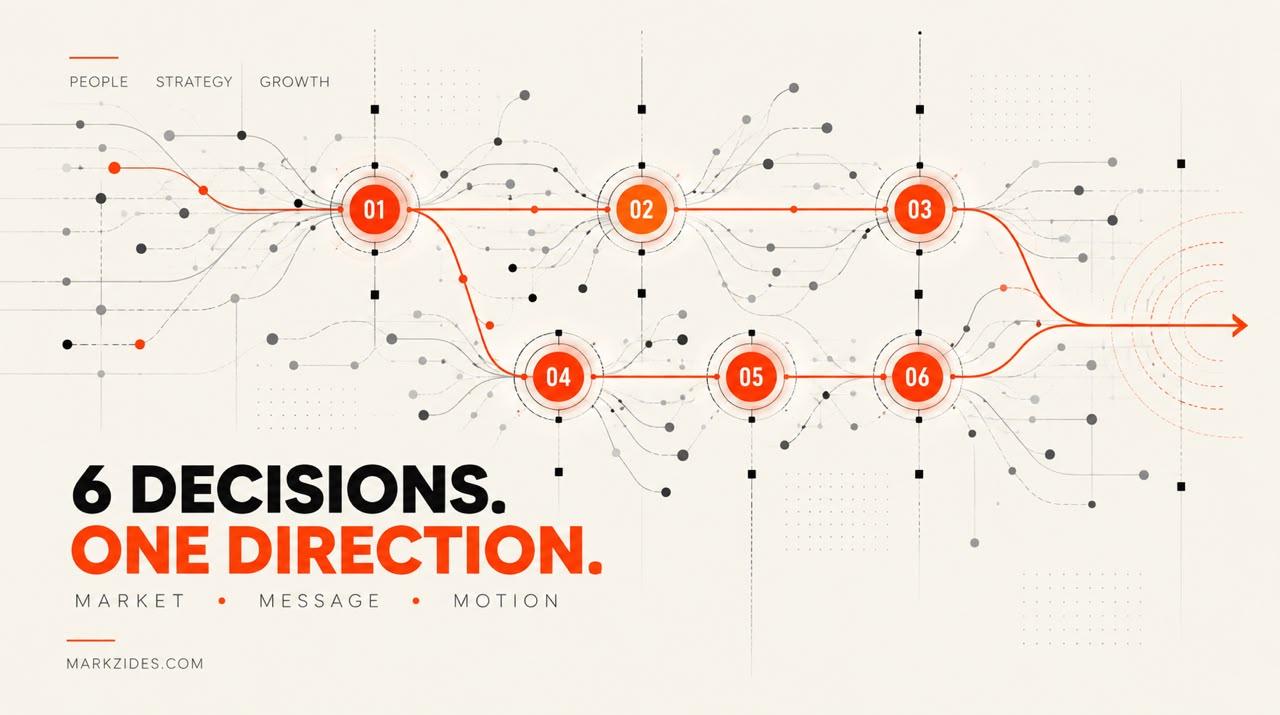
The fix is a small number of decisions, made explicitly and written where people can disagree with them. There are six of them. This is what each one is, how they constrain each other, and how to tell whether yours are actually decided or just assumed.
What Is a Go-to-Market Strategy?
A go-to-market strategy is the set of decisions that determine how a company reaches buyers and turns them into revenue: who you sell to, what problem you solve, what you promise, what you charge, which channel carries it, and how you will know it worked.
The distinction matters because activity is easy to generate and decisions are not. Running ads is an activity. Deciding that mid-market operations leaders are the buyer, that the problem is unplanned downtime, and that partners rather than paid search will carry the message, is a strategy. The ads either serve those decisions or they do not.
A useful test: if two people in your company wrote down who you sell to and why they buy, would the answers match? When they do not, there is no strategy. There is a set of habits.
Why Founder Intuition Is Not Enough
Early on, the founder is the strategy. They know who buys because they sold to them, and they adjust the pitch in real time because they can feel what is landing. It works, and it is genuinely hard to replace.
It breaks in a specific way. The first salesperson is hired and cannot reproduce the judgement. Marketing writes for a buyer nobody has defined. Two channels get funded because both seemed promising. Six months later revenue has grown a little and nobody can say which decision caused it.
Writing the strategy down does not make it better. It makes it arguable, which is what turns it into something a team can execute and improve.
The same problem appears at deal level as founder-led selling, and the fix there is the same: write the sales process steps down.
The Six Decisions Inside a Go-to-Market Strategy
Every framework in the category is a rearrangement of these six. The order matters, because each one constrains the next.
1. The target market
Not "mid-market B2B". A profile narrow enough to disqualify against: industry, size, the role that feels the pain, and the trigger that makes it urgent this quarter rather than next year.
The test of a good target definition is how much it excludes. If it excludes almost nobody, it will not sharpen a single downstream decision.
2. The problem
What is actually broken for that buyer, in their language, with the cost of leaving it alone. Companies routinely describe the problem their product solves rather than the problem the buyer already knows they have.
Those are not the same sentence, and the gap between them is why good products get ignored.
3. The value proposition
What changes for them, why you rather than the alternative, and what they give up. A promise with no trade-off in it reads as marketing rather than as a claim.
The alternative is usually not a competitor. It is doing nothing, or building it internally, and a value proposition that does not beat inertia will lose to it.
4. Pricing and packaging
How the thing is bought, not just what it costs: per seat, per outcome, per site, tiered or flat. Packaging decides who can say yes without a committee, which decides your sales cycle.
Pricing is a go-to-market decision, not a finance one. It sets the buyer, the cycle length and the channel that can carry it.
5. The channel
Direct sales, self-serve, partners, or a mix. The rule of thumb is that price and complexity choose the channel: a high-consideration purchase cannot be carried by self-serve, and a low-price product cannot fund a direct sales team.
Where channel partners carry it, the mechanics of tiers, margin and enablement matter more than the strategy deck.
6. The measure
One number that tells you whether the strategy is working, agreed before the spend. Pipeline created, cost per opportunity, payback period, or net revenue retention, depending on the model.
Choosing it in advance is what stops the post-hoc argument in which every party selects the metric that flatters their function.
B2B and B2C Go-to-Market Strategies Are Not the Same
The six decisions are identical. What changes is how many people have to agree.
- Number of decision makers. A consumer decides alone. A B2B purchase over a certain size involves a user, an economic buyer, a security reviewer and a procurement process.
- Cycle length. Consumer decisions are minutes to days. B2B decisions are weeks to quarters, which changes what marketing has to sustain.
- Channel economics. B2C can carry paid acquisition at volume. B2B usually cannot, because the addressable buyer count is too small.
- Proof. Consumers accept reviews. Committees need references, security documentation and a business case they can forward.
Most go-to-market advice online is written for B2C and quietly assumes a single buyer. Applying it to a committee purchase is one of the more expensive mistakes a founder can make.
How To Write Yours
Do not start with a template. Start with the deals you have already won, because your real strategy is whatever produced them.
- Take your last twenty won deals and write down who bought, what problem they named, and what they compared you to.
- Look for the pattern that separates them from the deals you lost. That is your target market, whether or not it is the one on your website.
- Write the six decisions in one page. If any of them takes more than a paragraph, it is not decided yet.
- Name the evidence that would prove each decision wrong.
- Give it to your sales and marketing leads separately, and see whether they describe the same company back to you.
The last step is the real test. A strategy that survives being read by two people who did not write it is a strategy. Anything else is a preference with formatting.
Mistakes That Undo a Go-to-Market Strategy
- A target market that excludes nobody. If everyone is a buyer, no message can be sharp and no channel can be chosen.
- Funding two channels at once. Neither gets enough investment to prove itself, and the learning from both is contaminated.
- Confusing the plan with the strategy. A content calendar is not a decision about who you sell to.
- Changing it quarterly. Strategy needs long enough to produce evidence. Most are abandoned before the data arrives.
- No owner. When the strategy belongs to everyone it is edited by everyone, which is the same as belonging to nobody.
Go-to-Market Strategy Checklist
- The target buyer is specific enough to disqualify most of the market.
- The problem is written in the buyer’s words, not the product’s.
- The value proposition names what the buyer gives up as well as what they gain.
- Pricing and packaging match the way the buyer is allowed to buy.
- One channel is properly funded rather than three being sampled.
- One measure is agreed in advance, and someone owns it.
- Two leaders, asked separately, describe the same strategy.
Four Shapes a Go-to-Market Strategy Takes
The six decisions combine into a small number of recognisable models. Naming yours is useful, because each one fails in a different way and each demands a different first hire.
Sales-led
A direct team carries the message, usually for a considered purchase with a committee behind it. Expensive per deal, and the only model that reliably works for high-price enterprise products.
Fails when the process lives in the founder’s head and the first reps cannot reproduce it.
Product-led
The product does the selling: self-serve trial, usage-based expansion, sales arriving later for the larger accounts. Cheap to scale, brutal on activation and onboarding.
Fails when a product built for a committee purchase is sold as though one person can decide.
Partner-led
Someone else’s relationships carry you into accounts you could not reach. Slow to start, durable once it works.
Fails when the vendor recruits channel partners before it has a motion worth teaching them.
Community or founder-led
Distribution comes from an audience the founder has built. Cheapest of the four to start, and the hardest to transfer, because the asset is a person rather than a system.
Fails at the point the founder wants to stop being the channel.
Signs the Strategy Has Drifted
Strategies rarely get cancelled. They erode, and the erosion is visible before the revenue reflects it.
- You are winning deals outside the stated target. Either the target is wrong or the strategy is being ignored. Both need a decision, not a celebration.
- Marketing and sales describe different buyers. The most reliable early symptom, and the cheapest to fix.
- The pitch changes by rep. A value proposition that has not been written down gets rewritten in every meeting.
- Every channel is "working a bit". Usually means none is funded enough to prove anything.
- Nobody can name the measure. If the metric that would prove the strategy right is not on a wall somewhere, the strategy is decorative.
The fix is rarely a new strategy. It is deciding which of the six decisions actually changed, and either committing to the new one or returning to the old.
Frequently Asked Questions
What is the difference between a go-to-market strategy and a marketing plan?
The strategy decides who you sell to, what you promise and which channel carries it. The plan is the campaigns, content and budget for a given period. A plan without a strategy is motion.
Does a go-to-market strategy change for a new product?
Usually yes, and founders often assume otherwise. A new product frequently has a different buyer, a different trigger and a different channel, even inside the same company.
How long should a go-to-market strategy be?
One page. Six decisions with a paragraph each. Length is a reliable signal that the decisions have not been made.
Who owns the go-to-market strategy?
The founder or the revenue leader, not marketing alone. It spans product, pricing, sales and marketing, so it has to sit with someone accountable for the number.
How do you know if it is working?
The measure you chose in advance moves, and the deals you win start to look like the ones you said you wanted. If you are winning business outside your stated target, the strategy is wrong or the target is.
When should a founder get outside help with it?
When revenue has flattened and nobody can say which of the six decisions is the reason. That diagnosis is the first part of sales consulting.
Final Thought
A go-to-market strategy is not a deck you present. It is six decisions you can defend, written where other people can disagree with them.
When growth stalls, the instinct is to add activity. Almost always the problem is upstream: one of the six decisions was never made, or was made once and never revisited. Finding which one is cheaper than another quarter of effort spent in the wrong direction.
Ready to build a revenue engine that runs without you?
Mark works alongside founders as a player-coach — not a slide deck.
Book a 30-minute call