How to Validate a Startup Idea: Sell It Before You Build It

Twenty people tell you they would use it. A few say they would pay for it. One asks to hear the day it launches. So you spend six months and most of your savings building it, you launch, and the people who were so keen go quiet. Nothing they said was a lie. It just was not a decision, and you treated it as one. Learning how to validate a startup idea means learning to tell the two apart before you build, while changing course still costs a week rather than a year.
What Does It Mean to Validate a Startup Idea?
Validating a startup idea means getting evidence, before you build, that a specific type of buyer has the problem, already spends time or money living with it, and will commit something real to your fix. The commitment is the evidence. Interest, compliments and email signups are not.
Startup idea validation is narrower than market research and comes earlier than product-market fit. It asks one question of one buyer: will you commit to this? The other two ask bigger questions, at different times.
| Work | The question | When | What proves it |
|---|---|---|---|
| Market research | Is there a market, and how big is it? | Before or alongside | Counts of companies, spending data, industry reports |
| Validation | Will this buyer commit to this fix? | Before you build | A commitment that costs the buyer something |
| Product-market fit | Do customers keep paying and bring others? | After launch | Renewals, repeat orders, referrals |
A large market tells you the prize is real. It does not tell you that anyone in it will buy from you.
Why "I Would Use That" Is Not Evidence
The most common way to validate a business idea is to describe it and ask people what they think. It is also the least reliable, because answering costs them nothing and saying yes is polite.
Economists have measured the gap between saying and paying. A 2005 review of 28 studies by James Murphy and colleagues compared what people said they would pay with what they paid when the money was real. At the median, people stated about a third more than they paid, and in some studies far more. The studies come from valuation research rather than startup sales, so read it as a direction, not a discount to apply.
A second line of research explains why the gap is worse for founders. Vicki Morwitz, Joel Steckel and Alok Gupta studied when purchase intentions predict sales, and found that intentions track real buying less closely for new products than for existing ones, and over long time horizons than over short ones. A startup idea is a new product with a launch months away: the weakest case on both counts.
The cost of mistaking one for the other shows up at the end. In CB Insights' 2026 study of 385 venture-backed shutdowns with known reasons, poor product-market fit was behind 43 percent. Words are cheap to give and expensive to believe, which is why building before anyone has paid is the first mistake worth ruling out.
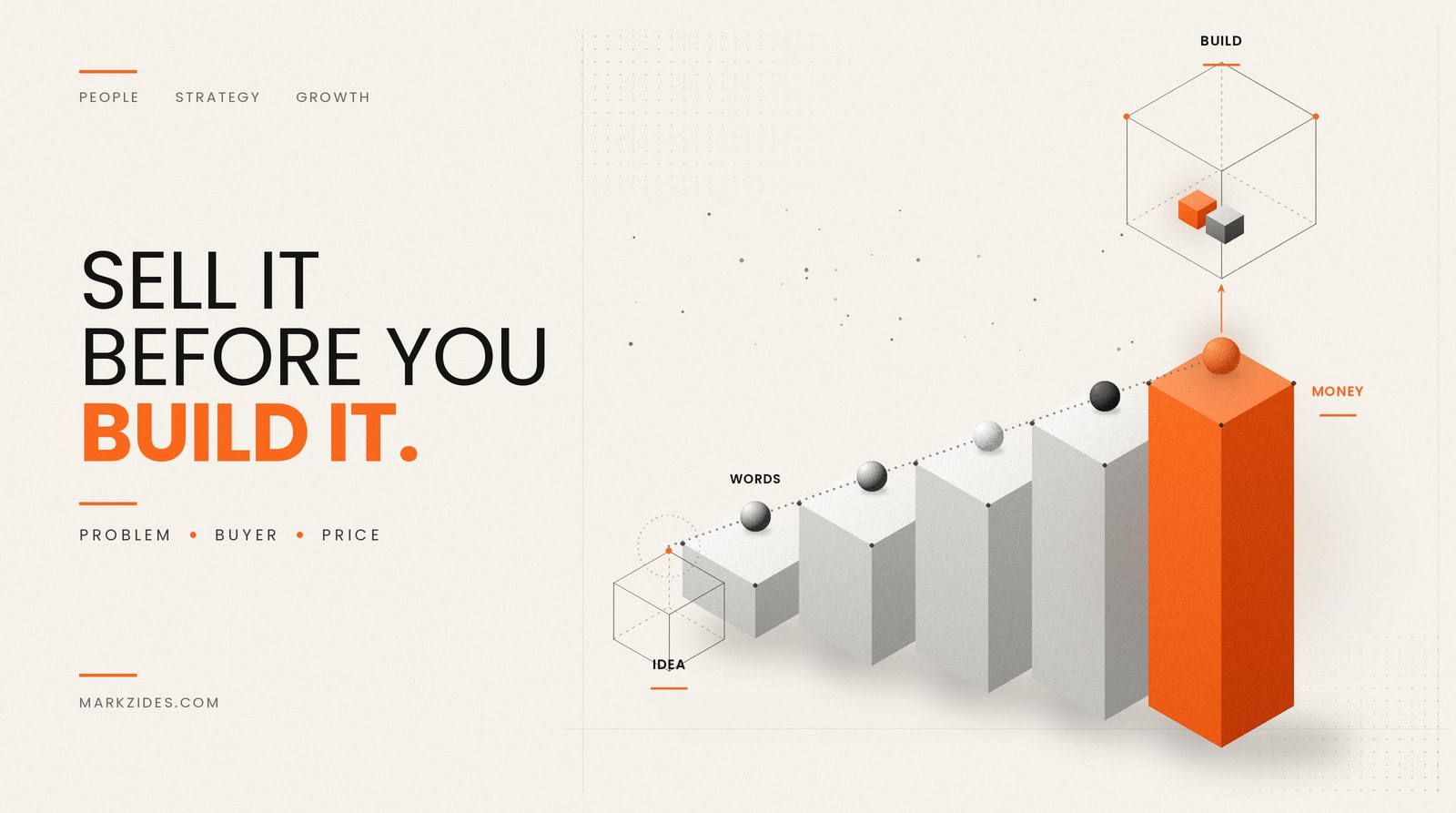
The Proof Ladder: From Words to Money
Evidence comes in grades, and the grade is set by what it costs the buyer. A compliment costs nothing. An hour of their time costs something. Money costs the most, which is why it is the strongest signal there is.
Aim for the highest step you can reach this month. Each step below money is progress toward it, not a finish line. And a buyer who will not take even the next step is telling you more than anything they say.
How to Validate a Startup Idea in Seven Steps
The seven steps below take a few weeks rather than months, and they cost mostly time. Each one ends on a pass mark, so you know whether to move on to the next.
1. Write down the buyer, the problem and the pass mark
Before the first conversation, write three sentences: who the buyer is, what problem they have, and what result would mean go. The third is the one founders skip, and it is the one that stops a weak result being read as a strong one.
There is research behind this. In a randomised trial of 116 Italian startups, published in Management Science in 2020, Arnaldo Camuffo and colleagues gave every founder the same ten training sessions on getting feedback from the market, and taught half of them to set hypotheses and test them the way a scientist would. Over about a year, that half performed better and was more likely to pivot to a different idea, and it was no more likely to give up.
Do this: write one sentence each for the buyer, the problem and the pass mark, with a number and a date. "By 15 November, three finance leads at companies of 50 to 200 people agree to a paid pilot" is a pass mark. "People like it" is not.
Pass mark: all three sentences exist, in writing, before the first call.
2. Find people who have the problem now
Friends and family want you to succeed, which makes them poor judges of whether you will. The people worth talking to have the problem today and have no stake in you.
Do this: build a list of people who match your buyer sentence: contacts one step removed from your own, members of industry groups, people at events, people who have complained about the problem in public. Ask for twenty minutes to learn how they handle it, not to show them anything.
Pass mark: keep booking until the answers start repeating and a new conversation teaches you little you had not already heard.
3. Ask about the last time it happened
Questions about the future invite polite guesses. Questions about the past get facts. "Would you use a tool that did this?" gets answered with kindness. "Tell me about the last time this happened" gets answered with what actually took place.
- When did this last happen, and what did you do about it?
- What have you already tried, and why did you stop?
- What does it cost you now, in money, hours or lost customers?
- Who else gets involved when it goes wrong?
- If it were fixed tomorrow, what would change for you?
Do this: talk about the problem, never your solution, until the last few minutes. Write down their words, not your summary of them.
Pass mark: most people describe a recent, specific case without prompting. A problem nobody can remember having is not one worth solving.
4. Find what they already pay to live with it
A problem people care about already has a budget, even if nobody calls it one. It shows up as a spreadsheet somebody maintains, hours of staff time, an outside agency, or a rival product they half like.
Do this: for every conversation, note the current fix and roughly what it costs. That figure is the ceiling on what you can charge, and the current fix is the competitor you actually have.
Pass mark: most buyers already spend money or real time on the problem. If none of them does, the problem may be genuine but not urgent, and urgent is what gets bought.
5. Ask for a next step that costs them something
At the end of a good conversation, ask for something that costs the buyer a little: a second meeting with a colleague, a sample of real data, a look at how they work today. A buyer who will not give an hour now will not give a budget later.
Do this: ask for one specific next step with a date, every time. Record who said yes and who said "keep me posted".
Pass mark: a clear share of the people who described the problem agree to a next step that takes their time or their access.
6. Ask for money before it exists
This is the step founders avoid and the one that settles the question. Ask for a commitment in money, sized to the stage: a refundable deposit, a pre-order, a paid pilot with a price for what follows it, or a letter of intent that names a price and a start date.
A no here is the most useful answer you will get, because it comes with a reason. "Too expensive", "not this year" and "my boss decides" are three different problems, and each is far cheaper to learn now than after launch.
Do this: say the price out loud, then stop talking. If the answer is no, ask what would have to be true for them to pay it.
Pass mark: the number you wrote down in step one, in money or signed commitments with a price, from the buyers you named.
7. Decide on the date you set
Validation needs an end date, or it turns into a reason not to decide. On the day, read the evidence against your pass mark and take one of three paths.
Changing one thing means one: the buyer, the problem or the price. Change all three and you are starting a new idea. That is fine, but call it a new idea and give it a new date.
Do this: put the decision date in your diary on day one, and keep it.
Pass mark: a decision made on the day: go on, change one thing, or stop.
How to Validate a B2B Startup Idea
Selling to businesses adds a trap: the person who loves the idea is rarely the person who pays for it. A business purchase usually involves a user who feels the problem, a buyer who owns the budget and someone who signs, and on larger deals a finance, legal or security review as well.
So a keen user is a starting point, not a result. The test of a business idea is whether the user will take you to the person with the budget, and whether that person will commit. In sales, enthusiasm without access to the decision is not a pipeline. It is a list of people being nice to you.
| Sounds like a yes | Is a yes |
|---|---|
| "Send me some information" | "Let's book time with our finance lead" |
| "We'd try it for free" | "We'd pay for a 90-day pilot" |
| "My team would love this" | A meeting with the person who owns the budget |
| Signing a confidentiality agreement | Sharing real data under it |
| "Call me next quarter" | A date in both diaries |
| A like on your post | An introduction to a peer, by name |
A paid pilot is the strongest test a business buyer can give you, if it is set up properly: a fixed length, one success measure agreed in advance, and a price for what happens when it ends. A free pilot with no success measure is a favour, and favours end quietly.
Can You Validate a Startup Idea With AI?
Partly. AI is useful for the desk work around validation and no use for the part that counts, because the evidence has to come from a buyer, and an AI is not one.
| Use AI for | Not for |
|---|---|
| A first pass at market size and the current options | Deciding whether people will pay |
| Drafting questions about the past | Answering them in place of buyers |
| Summarising call notes and spotting repeated themes | Scoring your idea out of ten |
| A first draft of the offer or a one-page proposal | Being the yes you are looking for |
There is a further reason to distrust an AI verdict on your idea. In a 2023 study, Mrinank Sharma and colleagues found that five leading AI assistants consistently tended to tell users what matched their stated views, a habit researchers call sycophancy. Ask one whether your idea is good after making it clear you hope it is, and you are asking something that leans toward yes.
The bigger shift is that AI made building cheap. Once a working version takes a weekend, the hard question moves from whether you can build it to whether anyone will pay, which is why selling has become the bottleneck rather than the code. Validation is that question, asked before the build instead of after it.
Common Validation Mistakes
- Asking people who want you to succeed. Friends, family and well-wishers are kind, not informative.
- Pitching instead of asking. Ten minutes on your solution teaches you nothing about their problem.
- Counting likes, signups and waitlists as demand. They cost nothing to give.
- Testing the fix before the problem. A good answer to a problem nobody has is still a bad business.
- Never naming a price. The one answer that matters never gets asked for.
- Validating forever. Without a decision date, "more research" becomes the reason not to choose.
Keep the Evidence: It Is Your First Sales Playbook
Keep a simple record of every conversation: who it was, what they said the problem costs, what they agreed to, what they paid, and why the others said no. That record is more than proof. It is the first draft of how the company sells: which buyers say yes, which objections come up, which price holds. In the early years the founder makes the first sales anyway, and a founder who wrote down the validation calls already has half of what a first salesperson will need.
Frequently Asked Questions
How long does it take to validate a startup idea?
A few weeks for most ideas, not a day. Desk research and the first conversations can start within days, but a buyer's commitment depends on their calendar, not yours, especially in business sales. Set a decision date a few weeks out, and work toward it.
How do you validate a business idea without spending money?
Spend time instead. Conversations, a one-page description of the offer and a request for a deposit or a letter of intent cost nothing but effort. Founders who sell before they market learn the same thing: a direct request for a commitment gets a clearer answer than any amount of advertising.
How many customer conversations do you need?
Enough that the answers start repeating. When a new conversation tells you little you had not already heard, you know enough about the problem. The number of commitments matters more than the number of conversations, so set it in your pass mark before you begin.
Is a landing page enough to validate an idea?
Not on its own. An email signup costs the visitor nothing, so it measures curiosity, not demand. A landing page becomes useful when it asks for something that costs: a deposit, a pre-order, or a booked call that you then turn into a commitment.
What if someone is already doing it?
That is usually good news. A competitor proves that people pay to solve the problem, which is the hardest thing to establish. The questions become what buyers dislike about the current option, and whether enough of them would switch to yours for a reason you can name.
Final Thought
An idea is a guess about other people, and the only way to test a guess about people is to ask them for something. That is the U in Mark's UNLOCK Method, uncover the real constraints: find out what actually stands between the idea and a paying customer before months and money go into building around it. Sometimes it is the problem, sometimes the buyer, sometimes the price. Finding it early is cheap, and it stays the first job at every later stage, which is why growth advisory work starts with the constraint rather than the plan.
Ready to build a revenue engine that runs without you?
Mark works alongside founders as a player-coach — not a slide deck.
Book a 30-minute call