
Product-Led Growth vs Sales-Led Growth: Which Motion Fits Your Company

Two job posts sit in your drafts. One is for an onboarding engineer, someone to make the product easy enough to buy without a call. The other is for your first seller, someone to take over the demos you still run at $8 million in revenue. You can fund one of them this year. Each one commits the company to a different way of winning customers, and the wrong one takes a year to undo. Product-led growth vs sales-led growth is usually argued as a matter of fashion. For you, it is a hiring decision.
What Is the Difference Between Product-Led Growth and Sales-Led Growth?
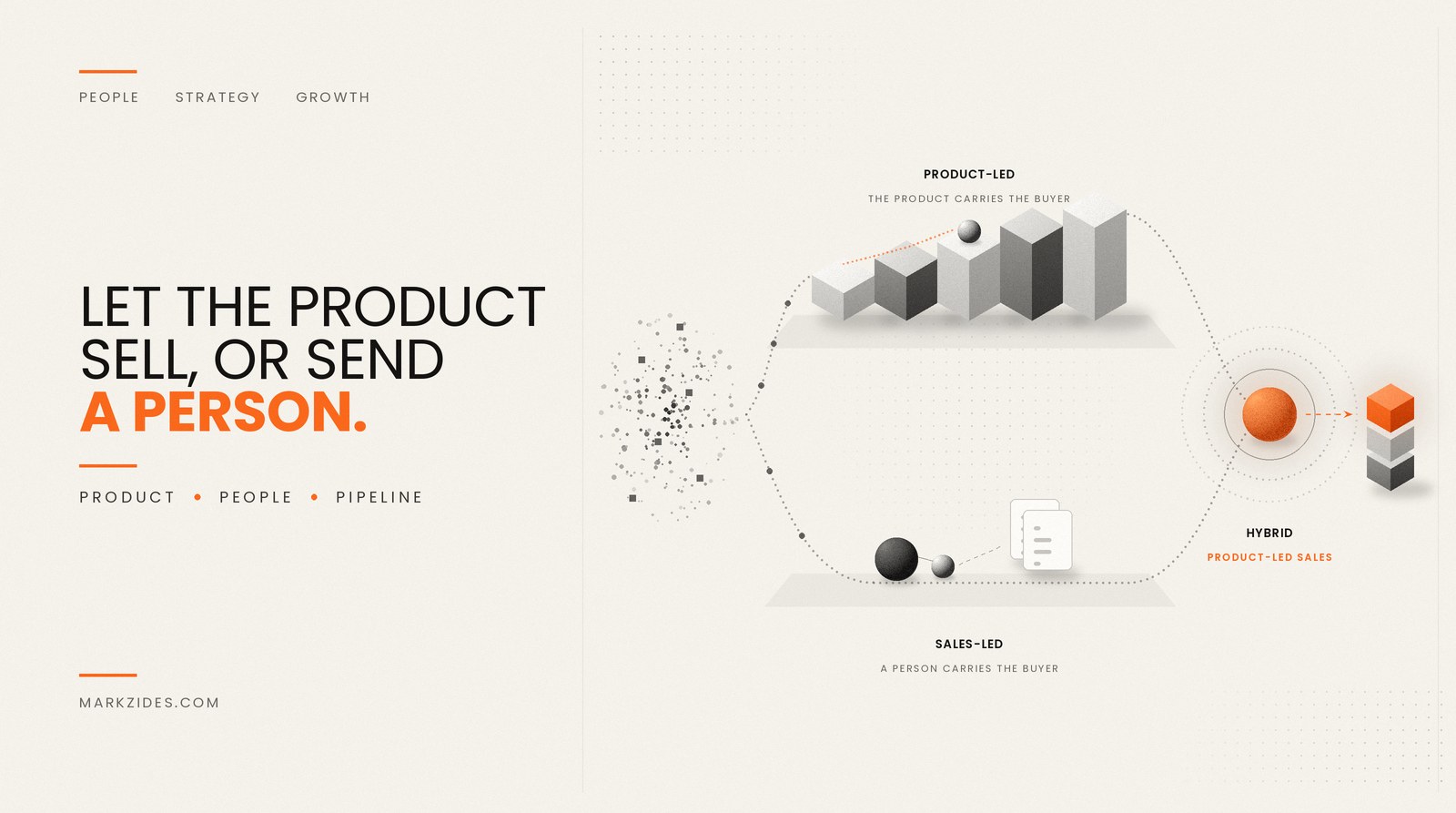
The difference is who convinces the buyer: in product-led growth the product does, as people try it and pay without speaking to anyone, and in sales-led growth a person does, by running the meetings and closing the deal. A third motion, product-led sales, joins them, with the product winning the first users and a seller turning the most active accounts into contracts.
| Product-led | Sales-led | Product-led sales | |
|---|---|---|---|
| Who convinces the buyer | The product | A seller | The product, then a seller |
| First touch | A free plan or trial | A meeting | A free or low-priced plan |
| Typical first-year deal (illustrative) | Under $5,000 | $25,000 and up | Small, then $25,000 and up |
| Who signs | The user, on a card | A buying committee | A user first, a committee later |
| Cycle length | Minutes to days | Months | Days to start, months to expand |
| Main measure | Active accounts | Pipeline, win rate and deal size | Expansion revenue |
| First hire | An owner of onboarding and activation | A seller who can repeat the founder's process | A seller who works from product signals |
| What breaks it | A product that needs setup or a committee | A sale only the founder can make | Two teams paid to chase the same accounts |
Each column sets the price, the channel and the measure, which are three of the six decisions behind a go-to-market plan.
What product-led growth means
Product-led growth means the product is the main way you find, win and grow customers. A user signs up, gets value in the first session and pays when they hit a limit or invite their team. A self-serve design tool is the typical case: no demo, a card on file and a price one person can approve.
What sales-led growth means
Sales-led growth means people find, win and grow the customers. Sellers choose the accounts, shape the proposal and steer it through the buyer's approvals, because the buyer cannot judge the product alone. A $40,000-a-year compliance platform is the typical case: several people sign off, legal reviews the contract and nobody buys it on a card.
Where Marketing-Led Growth Fits
Marketing-led growth sits underneath the other two motions, not beside them. Marketing decides who hears about you and why they care. The motion decides what happens once they arrive: in a product-led company marketing hands over at a signup, and in a sales-led company at a booked meeting.
Founders who call their company marketing-led usually mean inbound interest fills the funnel. That still leaves the question that sets your hiring plan: once a buyer arrives, does the product convince them, or does a person?
The test is where a new lead goes next. If it goes to a trial, you are product-led. If it goes to a seller's calendar, you are sales-led. Building demand that fills either a free trial or a seller's calendar is much the same work in both cases until the handoff, which is where the waste sits: leads that wait days for a call, and trial users nobody notices.
Do this: write down the one place every new lead goes next and who owns it there. If the answer is "it depends", settle it before you spend more on campaigns.
What B2B Buyers Say They Want
B2B buyers say they want to buy on their own and still have a person to check with. In Gartner's survey of 645 B2B buyers, run in August and September 2025 and published in May 2026, 70 percent preferred a fully digital, self-service purchase. In the same survey, 69 percent preferred to check AI-generated insights with a sales rep.
The two answers do not conflict. Buyers want to do the reading, comparing and paying themselves. They want a person when a wrong answer would be expensive. Gartner found that reps were still the most important source at three moments: researching the problem, choosing a supplier and getting internal support, and finalizing the purchase. Buyers used seven sources on average, and 45 percent used generative AI along the way. The 69 percent figure is about checking what a tool told them, not about wanting a pitch.
Gartner's March 2026 release, from the same fieldwork with 646 buyers, put the share preferring a rep-free experience at 67 percent. Read together, the figures do not say buyers want no seller. They say buyers want no seller they did not ask for.
For a founder, that is the case for a hybrid. Let buyers serve themselves through research, pricing and a first use, and put a person at the three moments Gartner names. A buyer choosing a supplier wants answers about fit, a buyer getting internal support wants material to take to their boss, and a buyer finalizing wants terms from someone who can change them.
Do this: map your buying process against those three moments. Wherever a buyer must wait for a meeting to learn price, scope or how it works, put that online. Wherever a buyer is alone at one of the three moments, put a person there.
Does Product-Led Growth Grow Faster?
Only when it is run well, and it costs more to run. McKinsey's 2023 study of 107 public B2B software companies found that the best product-led firms did outgrow the best sales-led firms. They grew annual recurring revenue ten percentage points faster and reached valuation multiples 50 percent higher. They also spent ten percentage points more of their revenue on sales, marketing, and research and development combined. Average product-led firms spent more too, and got only slightly better results.
In founder terms, the free trial is not free. A product that sells itself needs more engineering, so a stranger gets value without help, and more marketing, so enough strangers arrive. As an illustration, ten more points at $10 million in revenue is about $1 million a year, and only the firms that execute well get the faster growth back.
Mind the scope: public software companies in 2023, most far larger than a $1 million to $50 million firm. The study shows what the winners looked like, not what made them win, and it says nothing about services firms. It does show that product-led growth is a bet with a higher entry price, not a cheap way to avoid hiring sellers.
Do this: price product-led growth before you choose it. Add the engineering for onboarding, the tools to see usage and the marketing to fill the top, then compare the total with two sellers for a year. If the product-led total is smaller, something is missing.
When Product-Led Growth Fits
Product-led growth fits when the product can prove itself to one person, quickly, at a price that person can approve. Check five things:
- One user gets value alone in the first session. No IT help, training call or colleague needed to see the point.
- A price one manager can approve. As an illustration, a few thousand dollars a year, inside a manager's budget and below any purchasing review.
- The user is the buyer, or close to them. The person who likes it can get it paid for in one conversation.
- Many small accounts. Thousands of possible buyers, each too small to be worth a seller's time.
- No setup services needed. If every customer needs your team to configure it, the product is not selling itself.
Four or five of these make product-led growth worth testing. With two or fewer, users sign up and stall.
The proof buyers expect also changes by category. In McKinsey's survey of software buyers, 59 percent of enterprise infrastructure buyers put a free trial first, against 10 percent who put a proof of value or pilot first. In cybersecurity, the order was reversed. A fair reading is that the cost of a mistake decides the proof: cheap mistakes invite a trial, risky ones a guided pilot.
Do this: ask your last ten buyers what they wanted to test before they signed. Their answers tell you whether a trial or a pilot is your front door.
When Sales-Led Growth Fits
Sales-led growth fits when the buyer cannot judge the product alone or cannot buy it alone. Check four things:
- A buying committee. Finance, IT, legal and the users all have a vote, and someone has to bring them to one answer.
- A high price. When the first-year deal runs to tens of thousands of dollars, buyers expect a person to stand behind the promise.
- Integration or compliance risk. If a bad choice breaks other systems or fails an audit, the buyer wants someone accountable by name.
- Custom scope. Each deal is shaped to the account, so there is no standard version to try.
Any two of these usually make a person necessary. A sales-led motion then runs on a steady supply of qualified first meetings, so sellers spend their week with buyers instead of searching for them.
Services firms can still borrow the product-led idea as a proof step. A buyer of consulting, training or managed services cannot trial a relationship, but they can buy a small piece of it: a paid diagnostic, a fixed-price assessment or a short pilot. It lowers the risk of the first yes and gives your seller something concrete to expand from.
Do this: design one paid proof step with a fixed scope, price and end date, and make it the standard next step after a first meeting. Track how many become full engagements.
Product-Led Sales: When a Hybrid Fits
A hybrid fits when the product can win the first users but not the full contract. McKinsey reports that most public software companies that started purely product-led now have sales teams. In its survey of 625 software buyers across five categories, 65 percent strongly preferred both kinds of experience.
The working unit is a product-qualified lead: an account whose use of the product shows it is ready to buy, or to buy more. Ten people from one company on a free plan, a team that keeps hitting its usage limit, an admin reading the security page: each is a signal a seller can act on. A single signup is not.
The handoff has four parts, and each needs a written answer:
- Signal. Define the usage that makes an account worth a call, and test it against the accounts that already upgraded.
- Owner. Name who gets the account and how fast they call. An account flagged Monday and called Friday has gone cold.
- Offer. Decide what the seller brings: a team plan, an annual contract, help with a security review. Never a pitch for what the user already has.
- Pay plan. Pay sellers on growth in accounts that came in through the product, not on upgrades the product would have won anyway.
The hybrid breaks when nobody owns the number between the product and the contract. Marketing counts signups, product counts active users, sales counts closed deals, and the account that stalls in between belongs to no one. The fix is one leader who owns both the self-serve number and the sales number, so the handoff becomes one person's job.
Do this: pull the last 20 accounts that moved to a larger plan and list what they did in the product the month before. That list is the first draft of your signal.
Product-Led Growth vs Sales-Led Growth: A Scorecard To Choose
Score your company on eight questions and count which way the answers lean. Answer for today, not for two years from now. This scorecard is a judgment aid, not research.
| Question | Product-leaning answer | Sales-leaning answer |
|---|---|---|
| Can one user see value alone in under an hour? | Yes, without help | No, it needs setup or training |
| Who signs? | The user or their manager | A committee with finance or legal |
| What is the first-year deal? (illustrative) | Under about $5,000 | Over about $25,000 |
| Does setup need your team? | No | Yes, for most customers |
| How many possible buyers? | Thousands or more | Hundreds or fewer |
| Do buyers search for the solution? | Yes, they know the category | No, they must be shown the problem |
| Can the product show its own value? | Yes, the result shows in the product | No, it shows months later |
| How costly is a wrong purchase? | Cheap to undo | Expensive, risky or public |
Count the answers. Six or more product answers means product-led growth. Six or more sales answers means sales-led growth. Anything in between means product-led sales.
Take the $40,000-a-year compliance platform. A committee signs, setup needs your team, a wrong purchase fails an audit and nobody sees value in the first hour. That is four sales answers before price and market size are counted. A self-serve design tool scores the other way: one designer sees value in minutes, pays on a card and brings in the rest of the team.
A services firm will usually score sales-led, and should. Its product-led move is the paid proof step, not a free plan.
Score each product and customer segment separately, since a company can be product-led with small teams and sales-led with large ones. Score again after any price change, which can move three answers at once.
Do this: have your sales lead and your product lead fill in the scorecard separately, then compare. Where they disagree is where your motion is unclear.
The Motion Decides Your First Hire
Each motion calls for a different first hire: a seller, an owner of onboarding, or a seller who works from product signals. The table is illustrative: the usual order, not a rule.
| Motion | First hire | Second hire | Do not hire yet |
|---|---|---|---|
| Sales-led | After the founder, a seller who can repeat the founder's process | A second seller, to tell whether the process or the person works | A sales leader with no team to lead |
| Product-led | An owner of onboarding and activation | Someone who tracks where users stall and fixes the steps | Any seller |
| Product-led sales | A seller who works from product signals and is paid on expansion | Someone who keeps the usage data and signal accurate | Enterprise sellers paid on first-deal size |
In a sales-led company, the first hire works only if the founder's way of selling is written down first. That is most of the work of moving deals off the founder's desk: write the process, hand over a share of the pipeline and check whether the new seller wins at a similar rate.
In a product-led company, the first hire, before any seller, owns onboarding and activation: the share of new signups who reach their first real result. Measure them on active accounts, not signups.
In a hybrid, the first seller reads usage data, calls the accounts that are ready and is paid on expansion, not on first-deal size.
Back to the founder with two job posts at $8 million. Run the scorecard first. If it comes out sales-led, post the seller. If it comes out product-led, post the onboarding owner. If it lands in between, rewrite the seller post around product signals and expansion pay.
Do this: make the first line of your next job post name the motion and the one number the person will be measured on.
Mistakes When Choosing or Switching
Most mistakes come from mixing parts of two motions without changing the people, pay or measures behind them.
- A free trial bolted onto a committee sale. The user likes it, the committee never sees it and the trial ends unsold. Offer a guided pilot instead.
- Enterprise reps paid on first-deal size inside a self-serve base. They chase a few large accounts and ignore hundreds of small ones that are ready to grow. Pay them on expansion, or keep them on the largest accounts only.
- One pay plan for two motions. A self-serve upgrade and a negotiated contract are different work, and one plan pays for the wrong behavior in one of them. Write a plan for each motion and say which accounts it covers.
- Counting signups instead of active accounts. Signups measure marketing. Active accounts show whether the product is doing the selling. Set the target on those.
- Copying a software playbook into a services firm. A free version of a service is unpaid work. The services version is a paid diagnostic or pilot with a fixed end.
Frequently Asked Questions
Is product-led growth better than sales-led growth?
Neither is better in every case. Product-led growth suits products one user can try and buy alone at a low price. Sales-led growth suits committee purchases, high prices and custom scope. McKinsey's 2023 study of 107 public software firms found product-led firms grew faster only when they ran it well, and they spent more to do it.
Can a services company be product-led?
Not in the software sense, because a free version of a service is unpaid work. A services firm can borrow the idea: let the buyer test before they buy. A paid diagnostic, a fixed-price assessment or a short pilot gives the buyer a low-risk first step and gives your seller something to expand from.
What is product-led sales?
Product-led sales is a hybrid. The product wins the first users through a free or low-cost plan, and sellers step in when an account's usage shows it is ready to buy more. Those accounts are called product-qualified leads. Sellers are usually paid on the growth of accounts that came in through the product.
When should a product-led company hire its first seller?
When accounts start asking for things the product cannot sell by itself: annual contracts, security reviews, invoices instead of card payments, or plans for a whole department. Before that point, hire for onboarding and activation. When the seller arrives, give them usage signals to work from and pay them on expansion.
What is the difference between sales-led and marketing-led growth?
Marketing-led growth describes where demand comes from: campaigns and content bring buyers to you. Sales-led growth describes who convinces them once they arrive, which is a seller. The two often run together. Marketing fills a seller's calendar in a sales-led company and fills a free trial in a product-led one.
Final Thought
Choosing the motion is the easy part. It becomes real only through who you hire, how they are paid and who owns the handoff between the product and a person. A company that chooses product-led growth and hires enterprise sellers is sales-led in practice, with a free plan nobody upgrades. A company that chooses sales-led growth and never writes down the founder's process stays founder-led. Get the people, the pay and the handoff right, and the motion you chose is the one the company runs. That is the O of the UNLOCK Method: organize for growth. Mark is a 6x founder with three exits. His sales consulting work builds the process, the roles and the pay plan so your first sellers can repeat what you do, whichever motion the scorecard picks.
Ready to build a revenue engine that runs without you?
Mark works alongside founders as a player-coach — not a slide deck.
Book a 30-minute call