
Sales Process Steps: The 7 Stages That Make Revenue Repeatable

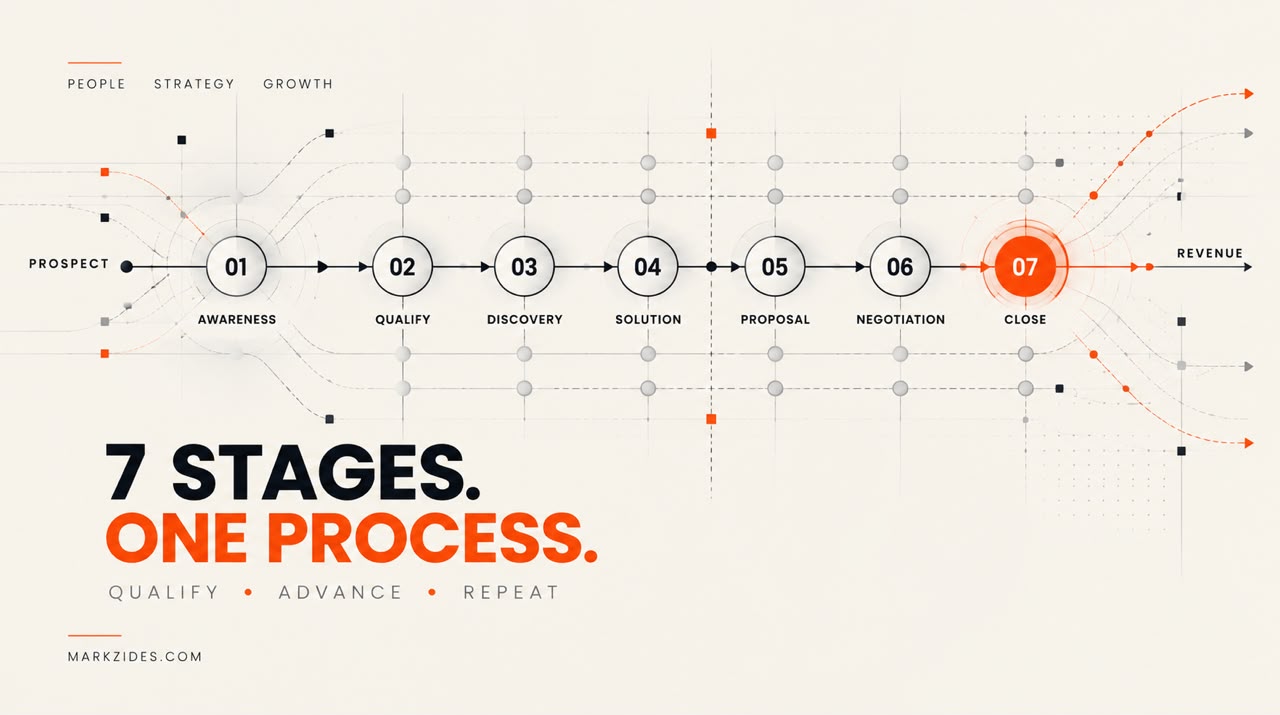
The first sales hire almost always fails in the same way. Not because they cannot sell, but because they were asked to reproduce something nobody had written down. The founder closes on instinct built from four hundred conversations. The new rep has had six.
You can see it in the pipeline within a month. Deals sit in stages that mean different things to different people, the forecast is whatever the most optimistic person said on Monday, and every loss gets explained away as price.
What fixes it is unglamorous and it is not a training course. It is deciding what the stages are, and what has to be true for a deal to leave one. Below are the seven that most B2B companies land on, the exit rule for each, and how to build a version your team will actually use rather than route around.
What Are the Sales Process Steps?
The sales process steps are the defined stages a deal moves through, in order, with entry and exit criteria attached to each one. The stages describe what is true for the buyer, not what the seller has done.
That distinction is the whole thing. "Sent a proposal" is an activity. "The economic buyer has confirmed budget and a decision date" is a condition. Activities make people look busy. Conditions make a forecast worth reading.
Most B2B companies use seven stages. The names vary, the sequence rarely does, because it follows how buying actually happens rather than how a CRM was configured.
Why a Documented Process Beats Talented Improvisation
A founder selling on instinct can carry a company a surprisingly long way. The instinct is real: years of pattern recognition compressed into a judgement call nobody can explain. The problem is that it does not transfer.
Three things break at once when the founder is the only person who can close. The forecast becomes a feeling. New hires ramp by shadowing rather than by reading. And growth is capped by one person’s calendar.
A documented process fixes all three, and it does something else that founders underrate: it makes losing informative. When every deal passes through the same stages with the same criteria, the pattern in the losses becomes visible.
- Forecasts stop depending on who is optimistic that week.
- A new rep has something to learn from other than watching you.
- Loss reasons become data rather than anecdote.
- Coaching gets specific, because you can see which stage deals die in.
The Seven Sales Process Steps
Each stage below has an exit rule. If a deal cannot meet it, the deal does not move, regardless of how the call felt.
1. Prospecting
Finding accounts worth a conversation. The work here is subtraction: a target list built from the deals you have actually won, then cut until it excludes most of the market.
Exit rule: the account matches the profile and there is a named person with the problem you solve.
2. Qualification
Establishing that a real problem, a budget and a decision path exist. This is where most pipelines are quietly destroyed, because a meeting that should have been disqualified becomes a deal that lingers for two quarters.
Exit rule: the buyer has described the problem in their own words and confirmed who decides.
3. Discovery
Understanding the situation well enough to be useful. Not a feature interview, a diagnosis: what is broken, what it costs, what has been tried, and what happens if nothing changes.
Exit rule: you can state the buyer’s problem back to them in their language and they agree with it.
4. Presentation
Showing how the problem gets solved, in their context, with their numbers. A generic demo at this stage signals that discovery did not happen.
Exit rule: the buyer has seen the specific answer to their specific problem and asked about implementation.
5. Handling Objections
Objections are the buyer doing their job. Price, timing, incumbent, risk, and internal politics all surface here, and they surface faster when the rep invites them rather than deflects them.
Exit rule: every stated objection has an agreed answer, and the remaining ones are named rather than hidden.
6. Closing
Agreeing terms and getting signature. If the previous five stages were done properly, this stage is administrative. If it feels like persuasion, something upstream was skipped.
Exit rule: the contract is signed. Nothing else counts, and no CRM stage should pretend otherwise.
7. Follow-Up
Onboarding, first value, and the referral conversation. The cheapest pipeline in any B2B company is the customer who already bought, which is why this stage belongs in the process rather than after it.
Exit rule: the customer has reached first value and has been asked who else has this problem.
What Has To Be True To Move a Deal Forward
The stages are the easy part. The exit criteria are what make them work, and they are where most implementations quietly fail.
A useful test: could two reps look at the same deal and agree which stage it is in, without discussing it? If not, the criteria are too vague and the forecast built on them is guesswork.
- Write the criterion as something the buyer does or says, not something the rep does.
- Make it binary. "Budget confirmed" passes or fails. "Good engagement" does not.
- Put it in the CRM as a required field, not in a document nobody opens.
- Review it quarterly against closed-won and closed-lost deals, and change what does not predict.
How To Build Your Own in Five Moves
You do not design this in a workshop. You reverse-engineer it from deals you have already won.
- Take your last twenty wins and ten losses, and write down what actually happened in each, in order.
- Find the moments that separated them. Those moments are your stages.
- Write an exit rule for each stage in buyer language, then test it against the same deals.
- Configure the CRM to match, and delete every stage nobody can define.
- Run it live for a quarter, and edit it every time reality disagrees with it.
That last step is the one companies skip. A process written once and never revised becomes a compliance exercise within two quarters. A process edited in weekly pipeline reviews becomes the way the company sells.
Mistakes That Break a Sales Process
- Stages that describe seller activity. "Demo delivered" tells you nothing about whether the buyer intends to buy.
- Too many stages. Seven is plenty. Twelve means reps guess, and guessing destroys forecast accuracy.
- No disqualification. A process with no exit for bad deals fills the pipeline with work that will never close.
- Built by leadership alone. If the reps who use it were not in the room, they will run their own version anyway.
- Never revisited. Markets move. A process that has not changed in two years is describing a company that no longer exists.
Sales Process Checklist
Run this before you call the process finished.
- Every stage has one written exit rule, in buyer language.
- Two reps would independently place the same deal in the same stage.
- The CRM enforces the criteria rather than suggesting them.
- A new hire could read it and run a deal in week two.
- Loss reasons are captured on a fixed list, not free text.
- Forecast accuracy is reviewed against it every quarter.
How the Steps Change by Deal Type
The stages hold. What changes is where the risk sits, and therefore which exit rule you should be strictest about.
Inbound deals
The buyer arrives already educated, which tempts everyone to skip qualification. Resist it. Inbound interest proves attention, not budget, authority or urgency, and inbound deals that stall usually stalled because nobody asked who decides.
Outbound deals
You created the urgency, so it is fragile. Discovery has to do more work here, because the buyer has not yet convinced themselves the problem is worth solving this quarter.
Competitive displacement
The buyer already owns a solution. The real objection is switching cost, and it appears late unless you raise it early. Add an explicit exit rule at discovery: the buyer has named what breaks if they stay.
Expansion into an existing account
The relationship is warm and the process gets skipped, which is why expansion forecasts are so often wrong. A renewal is not a commitment to buy more, and it should not be treated as a later-stage deal.
Partner-sourced deals
You are a step removed from the buyer, so your qualification depends on somebody else’s notes. Agree with the channel partner what must be true before a deal is handed over.
What the CRM Should Enforce
A process that lives in a document is a suggestion. A process configured into the CRM is a rule, and the difference shows up in forecast accuracy within a quarter.
- Stages named exactly as the process names them, with no informal extras.
- One required field per stage that captures the exit criterion, not five that capture activity.
- A close date that a rep has to justify rather than default to the end of the quarter.
- A fixed list of loss reasons. Free text produces sentiment, not data.
- Deal age in stage, visible, because the deals that quietly rot are the ones nobody looks at.
Two warnings. Do not add fields faster than reps will fill them, because half-filled data is worse than none. And do not change the stage names every quarter, or you lose the ability to compare anything year on year.
Frequently Asked Questions
How many sales process steps should there be?
Five to seven for most B2B companies. Fewer than five usually means a stage is doing two jobs. More than seven and reps stop being able to tell them apart, which defeats the point.
What is the difference between a sales process and a sales methodology?
The process is the map: the stages a deal passes through. The methodology is how you drive: the questions you ask and the way you qualify. MEDDIC, SPIN and Challenger are methodologies. They sit inside the process, not instead of it.
Who owns the sales process?
Whoever owns the number. In practice that is the sales leader, with the reps who use it involved in writing it. A process handed down without their input is a document, not a practice.
How do you stop reps ignoring the process?
Make it useful rather than mandatory. If following the stages makes their forecast defensible and their deals easier to get help on, they use it. If it is a reporting tax, they will not.
How often should it be reviewed?
In every pipeline review informally, and formally each quarter against what actually closed. The version that survives contact with real deals is the one worth keeping.
Can a founder-led company do this before hiring reps?
It is the best time. Writing the process while you are still the one selling means you are documenting something that works rather than inventing something you hope will.
Final Thought
A sales process is not paperwork. It is the difference between a company that can only sell when its founder is in the room and one that can teach anybody to sell.
If the number currently depends on one person’s instinct, the fix is not more effort. It is a process that makes the instinct transferable. That is the work in sales consulting, and it usually starts by reading the last thirty deals rather than by writing a new plan.
Ready to build a revenue engine that runs without you?
Mark works alongside founders as a player-coach — not a slide deck.
Book a 30-minute call