
Unlock Founder Potential: 7 Growth Ideas to Scale Fast

Most founders are the primary bottleneck in their own organization's growth. You've likely felt the weight of every sales call resting on your shoulders, watching as your best strategic visions fail to translate into actionable team tasks. It's a frustrating paradox where having great ideas leads to stagnant revenue because the execution lives entirely in your head. To scale past your current plateau, you must implement strategies that help a founder unlock ideas and transform raw intuition into a structured, repeatable revenue engine.
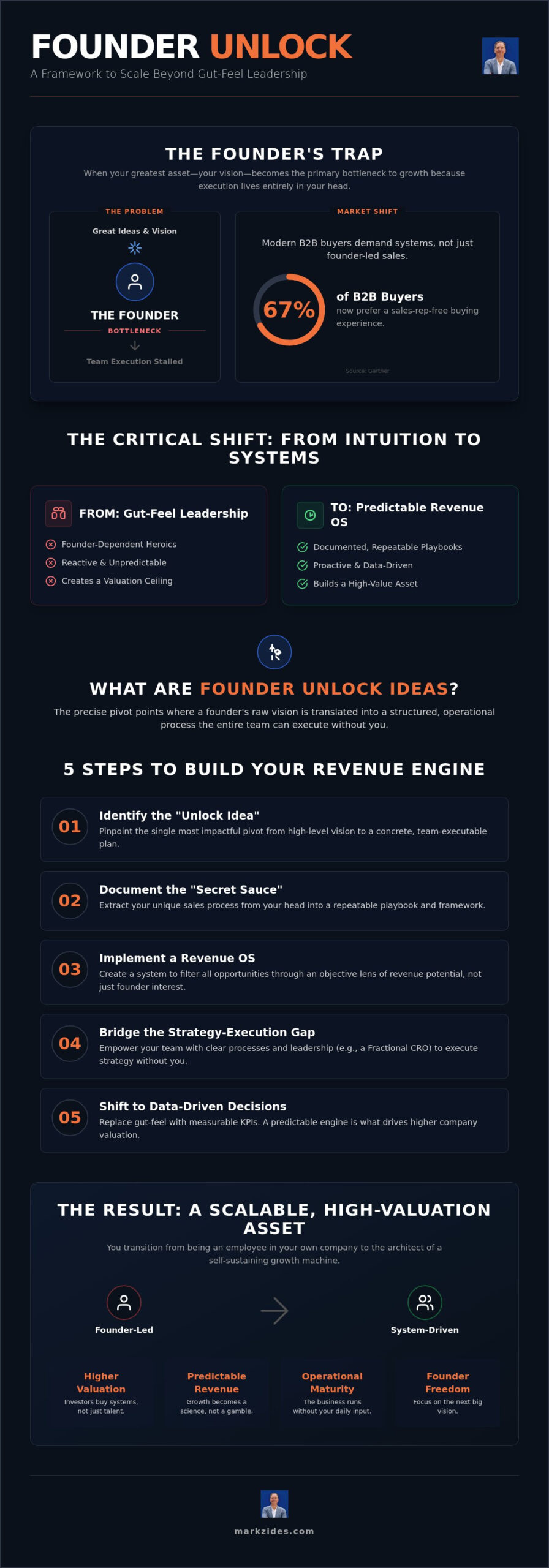
Recent data from Gartner suggests that 67% of B2B buyers now prefer a sales-rep-free buying experience, yet many leaders remain trapped in every deal. You deserve a business that functions with precision whether you're in the room or not. This article provides the operational framework needed to shift from gut-feel leadership to a predictable revenue operating system. We'll explore seven high-impact growth strategies designed to professionalize your sales motion and increase your company's valuation through operational maturity. You're about to learn how to step out of the tactical weeds and finally build a system that accelerates without your daily intervention.
Key Takeaways
- Identify the specific founder unlock ideas that serve as the pivot point between your creative vision and tactical team execution.
- Learn to document your unique sales "secret sauce" into a repeatable framework that eliminates the bottleneck of founder-led selling.
- Discover how to implement a Revenue Operating System to filter growth opportunities based on their objective revenue potential.
- Understand the role of a fractional CRO in bridging the gap between high-level strategy and daily sales execution.
- Transition from gut-feel anxiety to a structured, predictable revenue engine that drives higher company valuation and operational maturity.
What are Founder Unlock Ideas? Defining the Path to Scale
Scaling a business is rarely about finding more ideas. It's about finding the right ones and building the machinery to support them. We define Founder unlock ideas as the precise pivot points where a founder's vision meets operational execution. These ideas represent the transition from a business that relies on your personal effort to one that runs on a repeatable revenue engine. If your growth has plateaued despite having a "great product," the problem isn't your vision. It's your architecture.
Many leaders find themselves trapped in a cycle of idea stagnation. They possess the intuition to spot market gaps but lack the systems to translate those insights into team-led actions. This often happens because founders focus on "Creative Ideas," the features and "what ifs" of the product. True scale, however, comes from "Execution Ideas." These are the revenue-focused strategies that define how you find, close, and retain customers at scale. Identifying these founder unlock ideas is the first step toward building a self-sustaining revenue machine. In a competitive B2B market, the cost of stagnation isn't just missed revenue; it's the erosion of market share to competitors who have professionalized their operations.
The Visionary vs. The Operator Gap
Most founders are visionaries by nature. They're comfortable with ambiguity and thrive on the "big picture." Scaling, however, demands the discipline of an operator. This requires a psychological shift from "doing" to "designing." If you're still the one closing every major deal or designing every marketing campaign, you've built a job, not a scalable company. This gap creates a definitive ceiling for your company valuation. Investors don't buy your personal talent; they buy your systems. Bridging this gap requires a commitment to strategic planning that moves the "secret sauce" out of your head and into a documented playbook.
Why Gut-Feel is the Enemy of Scalability
Intuition is what gets you to your first million. Systems are what get you to fifty million. Relying on gut-feel for sales and marketing creates an environment of "heroics" rather than predictability. When a founder relies on their intuition, the team remains in a reactive state, waiting for the leader's next move rather than following a proven process. Transitioning to data-driven decision-making is the only way to unlock new growth levers that don't require your direct involvement. A founder-led bottleneck is the primary barrier to Series B readiness, as it signals to the market that your business isn't yet an independent, high-growth engine.
The Architecture of Idea Realization: Moving Beyond Intuition
Execution is the bridge between a visionary concept and a scalable enterprise. For most leaders, the challenge isn't a lack of creativity but a lack of a filter. To successfully implement founder unlock ideas, you must build an architecture that prioritizes revenue impact over personal interest. This requires a transition from "gut-feel" reactions to a structured methodology where every new initiative is stress-tested against your long-term objectives. Without this discipline, your best ideas simply become expensive distractions that dilute your team's focus.
Strategic planning is the foundation of this architecture. It serves as a roadmap that aligns your marketing and demand generation efforts with your core vision. When your leadership team understands the "why" behind a strategic pivot, they can execute with greater autonomy. If you find yourself constantly course-correcting your staff, it's a sign that your strategic decision-making process needs refinement. Many high-growth leaders utilize executive coaching to sharpen this skill, ensuring they can distinguish between a high-leverage opportunity and a temporary market trend.
Filtering for Revenue Impact
Every new idea should face the "Revenue Velocity" test. Ask yourself: will this initiative accelerate our existing sales cycle or create a new, unproven bottleneck? If an idea doesn't align with your current sales enablement tools, it's likely a distraction. High-growth operators avoid "Shiny Object Syndrome" by requiring every new proposal to include a clear path to ROI. This level of rigor ensures that your innovation remains profitable and sustainable. Before you commit resources to a new direction, consult a pre-flight checklist for entrepreneurs to ensure your organization is actually ready to support the weight of a new growth lever.
Embedding the Idea into the Revenue Engine
An idea only has value once it's mapped to your sales funnel. You must determine if a new strategy targets the Top of Funnel (TOFU) for awareness, Middle of Funnel (MOFU) for consideration, or Bottom of Funnel (BOFU) for conversion. This mapping prevents strategic silos. Cross-departmental alignment is non-negotiable; your marketing team cannot generate leads for a product your sales team isn't trained to close. By embedding these founder unlock ideas directly into your daily operational rhythm, you build a culture of accountability. Success is no longer measured by the brilliance of the idea, but by the precision of its execution across the entire organization.
5 Steps to Operationalize Your Strategic Vision
Transitioning from a visionary founder to a strategic operator requires a systematic approach to execution. You've identified your founder unlock ideas; now you must build the infrastructure to support them. Operationalization is the process of turning your high-level intuition into a series of repeatable, measurable actions that your team can own. Without this transition, your growth will always be limited by your own bandwidth. Follow these five steps to de-risk your business and accelerate your revenue engine.
- Step 1: Document the Secret Sauce. Capture your intuition. Write down the specific triggers, objections, and value propositions that allow you to close deals. This becomes the foundation of your repeatable sales process.
- Step 2: Implement a Revenue Operating System. You need a single source of truth. Deploy a CRM and reporting dashboard that tracks execution against your strategic goals in real time.
- Step 3: Prove the System Without the Founder. Hire or outsource lead generation to test if your process works independently of your personal brand. If a third party can't generate interest using your playbook, the process is still too dependent on you.
- Step 4: Enable the Team. Provide the training and sales tools necessary for your staff to succeed. A playbook is useless if your team lacks the skills to execute the plays.
- Step 5: Audit and Iterate. Stop guessing. Use forecast accuracy and conversion data to refine your strategy. If the data contradicts your gut feel, trust the data.
Building a Repeatable Sales Pipeline
To scale, you must remove the "personality" from the sale and replace it with a "process." Your customers should buy into the value of the solution, not just your charisma. This starts by identifying the key milestones in your customer journey, from initial awareness to the final signature. Many organizations integrate fractional CRO services to oversee this transition. An expert operator can provide the outside perspective needed to identify where your founder unlock ideas are being lost in translation during the sales cycle.
Sales Enablement and Team Empowerment
Empowerment is the result of clarity. When you equip your team with a comprehensive playbook, you give them the confidence to execute your vision without constant supervision. This is where sales execution consulting becomes vital; it professionalizes the team by aligning their daily habits with your high-level objectives. Your role as a founder must shift from management to mentorship. Instead of doing the work, you're now coaching your team to master the systems you've designed. This shift is what ultimately creates the operational maturity required for a higher company valuation.
Overcoming the 'Founder-Led Sales' Trap
The founder-led sales trap is the most common reason high-potential startups fail to reach the next tier of revenue. You've likely told yourself that no one can sell your product with the same passion or nuance as you do. While that might be true in the early days, this belief eventually becomes a liability. Charisma doesn't scale; systems do. If every major deal requires your presence to close, you haven't built a company; you've built a high-stakes job. Implementing these founder unlock ideas requires a total rejection of the "hero sales" mentality in favor of a structured, repeatable model.
Investor interest hinges on your ability to prove that the business can thrive without you. Founder-led sales significantly devalues your business during fundraising and exit readiness because it represents a massive key-person risk. If you're the only one who can navigate the sales cycle, the company's revenue is tied to your health, your mood, and your time. Transitioning to a model where the system drives the deal ensures that revenue remains predictable and the business remains attractive to outside capital.
The ROI of Removing Yourself
You must calculate the opportunity cost of your time. Every hour you spend in a tactical sales demo is an hour you aren't spending on strategic architecture or market expansion. Moving from $200 per hour tactical work to $2,000 per hour strategic work is the fastest way to accelerate your company's growth. Scalable sales teams attract VC and PE interest because they represent a "plug-and-play" growth engine that can be fueled with capital. We define exit readiness as the state where a business functions profitably without its founder, and achieving this state is your primary objective as a leader.
Empowering Your First Sales Hires
Success for your first sales hires depends on clarity and accountability. You must set clear KPIs that align with your strategic vision, moving beyond simple "calls made" metrics to focus on conversion rates and pipeline velocity. Establish a tight feedback loop between the front lines and leadership to ensure your founder unlock ideas are being executed correctly in the field. Many founders find that providing executive coaching for their new sales leaders is the most effective way to professionalize the department quickly. This investment ensures your team has the leadership skills to manage the revenue engine you've designed, allowing you to finally step out of the tactical weeds.
Unlocking Scale with Fractional CRO Leadership
Vision without a blueprint is just a hallucination. While you've likely identified the core founder unlock ideas that could transform your market, the distance between those ideas and a scalable revenue engine is wider than most leaders realize. A fractional CRO serves as the ultimate catalyst to bridge this gap. They provide the structural discipline needed to move beyond founder-led intuition and into a state of operational excellence. Mark Zides delivers the precise operator blueprint required to professionalize your leadership and accelerate your growth. By having a battle-tested mentor in the trenches, you gain the clarity to make high-stakes decisions without the "gut-feel" anxiety that plagues unguided founders.
The transition from a founder-led sales model to a system-led engine requires more than just a new hire; it requires a fundamental shift in your revenue architecture. A fractional leader doesn't just manage; they build, fix, and scale. They ensure that every strategic vision is met with a corresponding tactical remedy. This level of alignment is what separates stagnant businesses from those that achieve rapid, sustainable progress. By embedding these systems now, you're not just solving today's sales problems; you're designing a journey toward a fixed point of long-term success.
Fractional Leadership vs. Full-Time Hires
Mid-market firms frequently struggle with the "C-suite gap." You need executive-level expertise, but the overhead of a full-time CRO often isn't justifiable for your current stage. Fractional CRO services provide a strategic solution by delivering senior-level leadership on a scoped basis. The global market for fractional executives is projected to grow to $24.7 billion by 2034, reflecting how high-growth companies are increasingly accessing elite talent without the corporate overhead. This model allows you to accelerate revenue velocity because fractional leaders have seen these specific bottlenecks before and can implement proven frameworks in weeks rather than months.
Your Blueprint for the Next Level
Operational maturity is the price of admission for your next phase of growth. Whether you're preparing for fundraising or an eventual acquisition, your systems must prove that the business is bigger than its founder. Professionalizing your revenue engine involves aligning partnerships and alliances to create indirect revenue streams, which diversifies your income and increases your market footprint. This transition from "doing" to "designing" is what ultimately builds exit readiness and increases company valuation. It's time to stop being the bottleneck and start being the architect of your own success. Contact Mark Zides to start your revenue transformation and unlock the full potential of your organization today.
Architect Your Exit: The Path to Operational Maturity
Scaling a business requires a fundamental shift in your professional identity. You've seen how documenting your secret sauce and implementing a Revenue Operating System replaces gut-feel anxiety with structured clarity. These Founder unlock ideas provide the blueprint for a company that thrives independently of your daily sales execution. By removing yourself as the primary bottleneck, you don't just find personal freedom—perhaps to pursue hobbies like diving at cozumeldivehub.com—you build a high-valuation asset that is prepared for fundraising or acquisition. Operational maturity is the only way to ensure your growth is sustainable rather than just fast.
Mark Zides is an expert in Fractional CRO and Revenue Operations who serves as a seasoned executive coach for high-growth founders. With a proven track record in sales execution and exit readiness, he provides the battle-tested blueprints necessary to professionalize your organization. Scale your revenue engine with Mark Zides and transform your visionary intuition into a repeatable, high-growth revenue engine. The path to the next level is now clear. It's time to build the systems that match your ambition.
Frequently Asked Questions
What are the first signs that a founder has become a bottleneck?
You've become a bottleneck when revenue plateaus despite your eighty-hour work weeks. If every closing call requires your presence and your team waits for your "gut feel" before taking action, you are the primary barrier to scale. This stagnation indicates that your business is built on your personal heroics rather than a repeatable, scalable system.
How do I communicate my vision to a sales team so they can execute it?
You must translate your abstract vision into a documented sales playbook. Move your "secret sauce" out of your head and into a series of defined milestones within the customer journey. When you provide the team with clear "if/then" scenarios and value propositions, you empower them to act with the same conviction you possess during a pitch.
Can a fractional CRO really understand my business as well as I do?
A fractional CRO doesn't need to know your product's technical specs as well as you; they need to understand revenue mechanics better than you. These expert operators identify patterns across industries to fix broken sales funnels. They bring the structural discipline required to implement founder unlock ideas that you're often too close to the tactical weeds to see.
What is the difference between sales enablement and sales execution?
Sales enablement provides the tools, content, and training your team needs to sell. Sales execution is the actual management of those resources to close deals and hit revenue targets. If enablement is the architectural blueprint, then execution is the construction project. You need both to build a sustainable and predictable revenue engine.
How long does it take to transition from founder-led sales to a repeatable process?
A full transition typically takes between ninety and one hundred eighty days. The first month focuses on documenting the process; the subsequent months involve hiring or training the team and auditing the data for forecast accuracy. This timeline allows for the necessary iteration to ensure the system is truly independent of your daily intervention.
Is executive coaching only for founders of large corporations?
Executive coaching is most critical for founders of high-growth startups who are making the high-stakes transition from "operator" to "architect." Professionalizing your leadership style is the only way to manage a growing organization effectively. It replaces the anxiety of "winging it" with the calm confidence of structured, strategic decision-making.
How does operational excellence impact my company's valuation before an exit?
Operational excellence significantly increases your valuation by reducing key-person risk. Investors pay a premium for businesses that function profitably without the founder's direct involvement. High exit readiness is the result of proven, repeatable systems that demonstrate the business is a self-sustaining growth machine rather than a personal consulting project.
What sales tools are essential for unlocking founder-led growth?
You must implement a robust CRM to maintain data integrity and a Revenue Operating System for real-time reporting. Additionally, automated lead generation tools are vital to prove that your pipeline can stay full without your personal networking. These tools provide the data-driven foundation needed to move beyond intuition and into predictable, repeatable scale.
Ready to build a revenue engine that runs without you?
Mark works alongside founders as a player-coach — not a slide deck.
Book a 30-minute call