
Consultative Selling: The Seven Steps, the Questions to Ask, and Examples

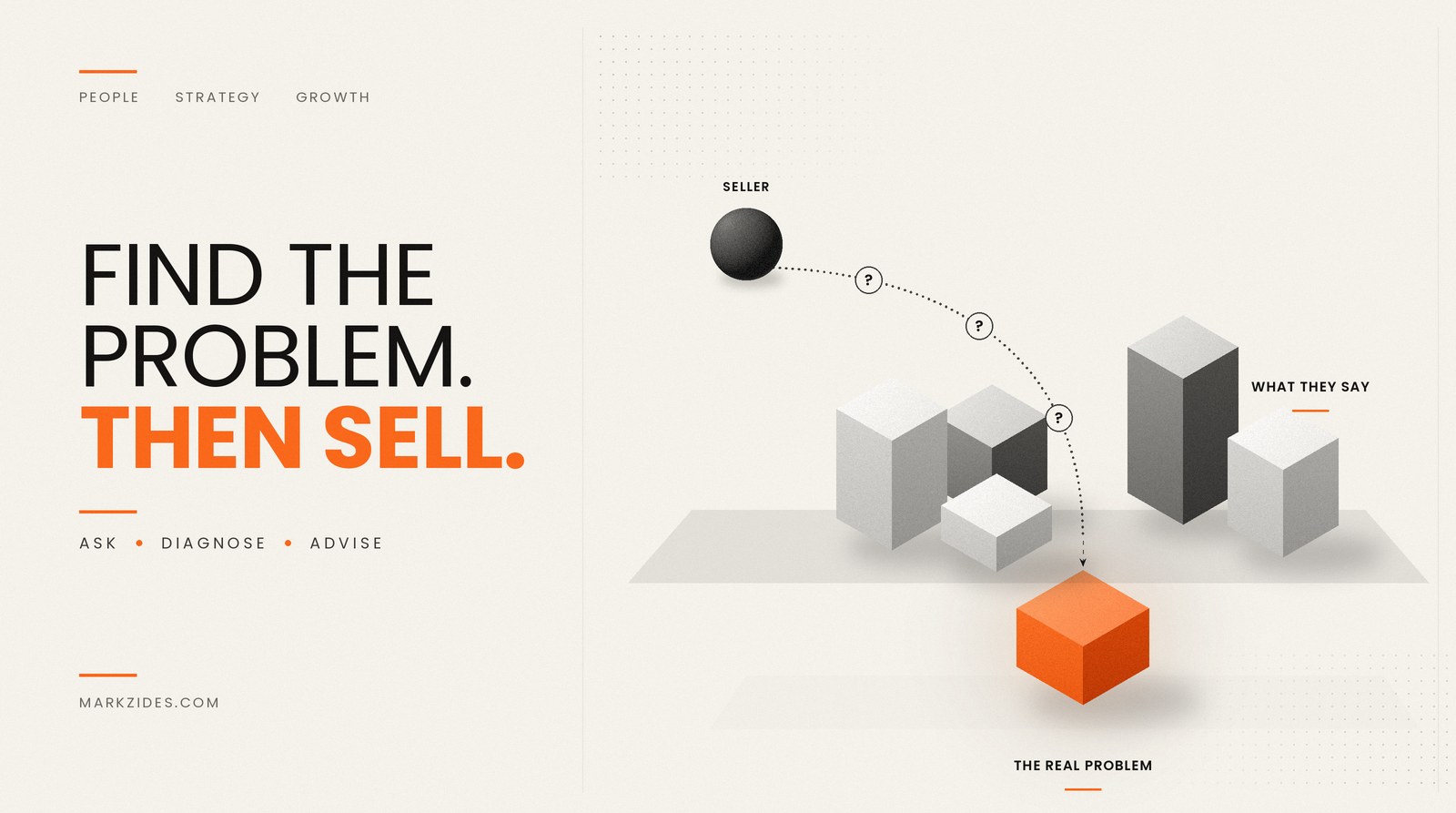
Most sales calls are lost in the first ten minutes. The seller opens the deck, walks through the features and waits for a reaction. The buyer has already read the website and asked an AI tool for a shortlist, so they hear nothing new and quietly decide the call was about price. The best sellers run that first call another way, and always have. The method is called consultative selling, and it can be taught. Below are the seven steps, the questions that do the work, and the words to use at each point.
What Is Consultative Selling?
Consultative selling is a sales approach in which the seller diagnoses the buyer's problem before recommending anything, then recommends only what fits, the way a good doctor or adviser would. The conversation is about the buyer's situation, goals and the cost of the problem, not about the product.
Three things set it apart from ordinary selling:
- The seller asks before telling. Most of the first meeting is questions and listening.
- The recommendation is built from the buyer's own words and numbers, so it reads as their plan, not your pitch.
- The seller is willing to say no to a bigger deal, to the wrong product, or to any deal at all when it does not fit.
The approach is often mistaken for being friendly. Building rapport helps, but it is not the method, and a warm seller can still pitch. Consultative selling is defined by what happens in the conversation: a diagnosis, a cost the buyer agrees with, and a recommendation the buyer could defend to their own boss.
The Consultative Selling Process: Seven Steps
A consultative sale runs in seven steps. The first happens before the call and the last at the end of it. The diagnosis in the middle takes the most time.
1. Prepare a guess, not a pitch
Before the call, read what you can about the company: its website, recent news, the jobs it is hiring for and the buyer's own role. Then write down three guesses about the problem they might have, and the one thing you most need to learn. For a manufacturer hiring three sales engineers at once, a fair guess is that orders are growing faster than the team can quote them. Guesses give your questions a direction. A pitch deck gives them nowhere to go.
2. Open with an agenda
Say how the time will be used and agree it, so the buyer knows they are not about to be pitched for 45 minutes.
Say: "We have 45 minutes. I'd like to spend most of it understanding what you're trying to change and why now. If it looks like we can help, I'll show you how. If it doesn't, I'll tell you, and point you somewhere better if I can. Does that work?"
The last offer matters most. Being willing to walk away is what makes the rest of the call honest.
3. Diagnose
Ask about the situation, then the problem, then what it costs, then what a good result would look like. Go one layer deeper than feels comfortable, because the first answer to "what's the problem?" is usually a symptom. Keep your share of the talking to about a third, and play back what you heard before moving on.
Say: "So quotes are taking nine days, and you think you lost two large orders to faster competitors this quarter. Have I got that right?"
4. Put a number on the problem
Work out with the buyer what the problem costs in a year if nothing changes. Use their figures, not yours.
Say: "If you lose two orders a quarter at around $150,000 each, that's $1.2 million a year in revenue. Does that sound right, or am I overstating it?"
A problem with a number attached gets a budget. A problem without one gets put off until next year.
5. Teach one thing they did not know
Buyers can find product facts on their own. What they cannot find is judgment: what companies in their position have tried, what worked and what went wrong. Offer one insight that changes how they see the problem.
Say: "Most companies in your position hire more engineers to quote faster. The ones that fix it usually standardize their twenty most common quotes first, because those are most of the volume."
If the buyer learns something, the call was worth their time, whatever happens next.
6. Recommend, in their words
Lay out what you would do, tied to what the buyer told you: the problem, the cost and the result they said they want. Give two or three options with the trade-offs, and say which one you would choose and why.
Say: "You said speed matters more than price on the large orders. So I'd start with the twenty standard quotes, which gets most of your volume out in under three days, and leave the custom work for a second phase."
If what you sell does not fit, say so here. A clear no is remembered longer than a deal that went wrong.
7. Agree a dated next step
End every call with a next step that has a date, an owner and the people who need to be in the room.
Say: "Who else will weigh in on this? Could we get thirty minutes with them next Tuesday to go through the numbers together?"
Open-ended follow-ups are where deals stall, and a dated next step is one of the simplest ways to shorten the sales cycle.
Consultative Selling Questions to Ask
Good consultative questions are open, specific to the buyer, and asked in the order of the diagnosis. These twenty work in most B2B sales.
Situation
- "Walk me through how this works today, from start to finish."
- "What has changed in the business in the last year?"
- "Who is involved in this day to day?"
- "What have you already tried?"
Listen for: what they take for granted, and what they tried and dropped.
Problem
- "What isn't working the way you'd like?"
- "Where does it break, and how often?"
- "What happens next when it does?"
- "Why is this a priority now, rather than last year?"
Listen for: the gap between the symptom they name first and the cause underneath it.
Cost
- "Roughly what does this cost you in a year?"
- "Who else feels it: customers, the team, the board?"
- "What happens if nothing changes for another twelve months?"
- "What is it costing you personally?"
Listen for: a number, and the person who owns it.
Outcome
- "If this were fixed, what would be different in six months?"
- "How would you measure that?"
- "What would make this a success in your boss's eyes?"
- "What would you do with the time or money it frees up?"
Listen for: the measure they will judge you on.
Decision
- "Who else will have a view on this, and what will they care about?"
- "How have decisions like this been made here before?"
- "What could stop this from going ahead?"
- "When do you need it working by, and why that date?"
Listen for: the people and the deadline that decide whether there is a deal at all.
Never ask a question the buyer's website could have answered. It tells them you did not prepare, and it spends their time on your homework.
Consultative Selling Examples
Three examples show the approach at the moments it is most often tested. The companies are illustrative.
Example 1: the same first call, two ways
A company sells customer service software. The head of operations at a 200-person online retailer books a demo.
| Moment | Product pitch | Consultative |
|---|---|---|
| Opening | "Let me show you the platform." | "Before I show you anything, what made you book this call now?" |
| Problem | Runs through the features that cut response times | Learns that refunds take eleven days and the backlog doubles after every sale |
| Cost | Not discussed | Agrees with the buyer that slow refunds cost about $400,000 a year in lost repeat orders |
| Recommendation | The full plan, with a discount for signing this month | Start with refunds only, the part of the product that touches the $400,000 |
| Next step | "I'll send over some information." | A call next week with the finance director to check the $400,000 |
The pitch ends with a buyer comparing three price sheets. The consultative call ends with a buyer who has a business case, and a seller who helped write it.
Example 2: the buyer who asks for the price first
An early price question is fair, and dodging it costs trust. Give a range, then earn the right to ask.
Say: "It depends on scope. Most companies your size spend between $40,000 and $90,000. Where you'd land depends on two or three things I don't know yet. Could I ask a few questions so I can give you a real number rather than a range?"
The buyer gets a straight answer and a reason to keep talking.
Example 3: recommending less than you could sell
A consulting firm is asked to rebuild a client's whole sales function. The diagnosis shows a narrower problem: the team closes well once a proposal goes out, but half of its deals stall before one is sent.
Say: "You could buy the full program, and I'm not sure you need it. Your team closes well once a proposal is out. The problem is getting there. I'd fix the first two meetings, measure it for a quarter, then decide on the rest together."
A smaller first project that works is how a supplier becomes the adviser who is trusted with the next three.
Consultative Selling Skills and Techniques
Six skills carry most of the approach, and all of them can be practised.
- Preparation. Three guesses and one question to answer, before every call.
- Questioning. Open questions, asked in order, one layer deeper than the first answer.
- Listening. Playing back what you heard, in the buyer's words, before you move on.
- Business sense. Talking in revenue, margin, cost and time, the language the buyer's boss uses.
- A point of view. Something worth teaching, drawn from what you have seen across many customers.
- Candor. Saying what you think, including "this isn't the right fit", and saying it early.
Why Consultative Selling Matters More Now
Buyers need sellers less for information than they used to, and more for judgment. In Gartner's survey of 645 B2B buyers, published in May 2026, 67 percent said they prefer to buy without a sales rep. Yet 69 percent said they prefer to check what AI tools tell them with a sales rep. Buyers also named reps their most important source at four points: working out the business problem, choosing a preferred supplier, winning support inside their own company and finalizing the purchase.
That is the consultative seller's job, described from the buyer's side. A seller who repeats the website adds nothing a search cannot. A seller who can diagnose the problem, put a number on it and say what to do about it is the part of buying that buyers still want a person for.
Consultative Selling vs Transactional, Solution, Challenger and Value Selling
Each approach starts from a different place, and each fits a different kind of sale.
| Approach | Starts with | The seller's role | Fits best when |
|---|---|---|---|
| Transactional selling | The product and the price | Takes the order quickly | The buyer knows what they want and the price is low |
| Product selling | Features and benefits | Explains the product | The product is new and clearly better |
| Solution selling | A problem the buyer already knows | Matches the problem to a solution | The buyer has named the problem and wants a fix |
| Consultative selling | The buyer's situation and the cost of the problem | Diagnoses and advises | The problem is unclear or costly, or there are several ways to fix it |
| Challenger selling | An insight that questions the buyer's view | Teaches and pushes back | The buyer is stuck on an approach that is not working |
| Value selling | The financial return | Builds the business case | The decision rests on a measurable return |
| Relationship selling | Trust built over time | Stays close to the buyer | The buyer purchases again and again over many years |
The approaches overlap more than their names suggest. Consultative selling borrows the challenger's teaching and the value seller's business case. What sets it apart is the order: diagnosis first, everything else after.
When Consultative Selling Is the Wrong Choice
Consultative selling takes time on both sides, so it does not suit every sale. Leave most of it out when:
- the purchase is small, frequent and well understood, such as supplies or a standard subscription;
- the buyer already knows exactly what they want and has compared the options; or
- the deal is a renewal with nothing to change.
In those sales, be quick, accurate and easy to buy from. Keep the full diagnosis for sales where the problem is unclear, getting it wrong is expensive, or the buyer has several ways to solve it. The same diagnosis belongs in the regular review of your largest accounts, because their problems change faster than their contracts.
How to Build Consultative Selling Into Your Sales Team
Founders usually sell this way without being taught. They know the problem because they lived it, and they are not afraid to tell a customer they are the wrong fit. That is much of why founder-led sales works so well early on, and why it often stops working when the first sales hires take over: the method lives in the founder's head. Five steps move it into the team.
- Write the diagnosis down. Turn the questions above into a one-page call guide for your market: the three or four problems you see most, and the questions that uncover each one.
- Make it a stage. Build the diagnosis into your sales process as a stage with exit criteria. No proposal goes out until the problem, its cost and the people who decide are written down.
- Review one call a week. Pick one recorded call per seller and score it against the checklist below.
- Hire for it. When you interview a sales leader or a seller, have them run ten minutes of a first call with you as the buyer. You will learn more than from an hour of questions.
- Pay for it. A commission plan that rewards volume and discounts teaches sellers to pitch. Reward what diagnosis improves: win rate, deal size and the share of deals closed at full price.
| Check | What good looks like |
|---|---|
| Agenda agreed | Time and purpose set in the first two minutes, with the offer to walk away |
| Talk share | The seller talks for a third of the call or less |
| Cause, not symptom | At least one follow-up question past the buyer's first answer |
| Cost in the buyer's numbers | A yearly figure the buyer agreed with |
| One insight | Something the buyer said they had not considered |
| Dated next step | A date, an owner and the people who need to be there |
Frequently Asked Questions
Is consultative selling the same as solution selling?
No, though they overlap. Solution selling starts from a problem the buyer already knows and matches a product to it. Consultative selling starts earlier, by working out with the buyer what the real problem is and what it costs, and it can end with a recommendation that is not your product.
What are the steps of consultative selling?
Trainers count anywhere from four to eight. A practical version has seven: prepare a guess about the buyer's problem, agree an agenda, diagnose, put a number on the problem, teach one insight, recommend in the buyer's words, and agree a dated next step.
What is an example of consultative selling?
A seller asked for a software demo first asks why the buyer booked the call. They learn that slow refunds cost the buyer about $400,000 a year, recommend starting with only the part of the product that fixes refunds, and book a call with the finance director to check the figure.
Does consultative selling still work when buyers research online?
It matters more than before. Buyers find product facts on their own, so a seller who only repeats them adds nothing. What buyers still want from a person is help defining the problem, checking what they have read, and building the case inside their own company. That is the consultative seller's job.
What is consultative selling in marketing?
It is the same idea applied before the first call: content that helps buyers understand their problem before they are shown a product. A diagnostic checklist, a cost calculator or an article that answers the questions a buyer would ask a seller all work this way.
Final Thought
Consultative selling is simple to describe and hard to do every day: ask before you tell, put a number on the problem, and recommend only what fits. Most companies already have one person who sells this way, and it is often the founder. The work is getting the method out of that person's head and into how everyone sells, which is the C of the UNLOCK Method: codify what works. If you are still the only person in the company who sells like this, sales coaching for founders is the quickest way to pass it on.
Ready to build a revenue engine that runs without you?
Mark works alongside founders as a player-coach — not a slide deck.
Book a 30-minute call