
How to Find Product-Market Fit, and How to Know When You Have It

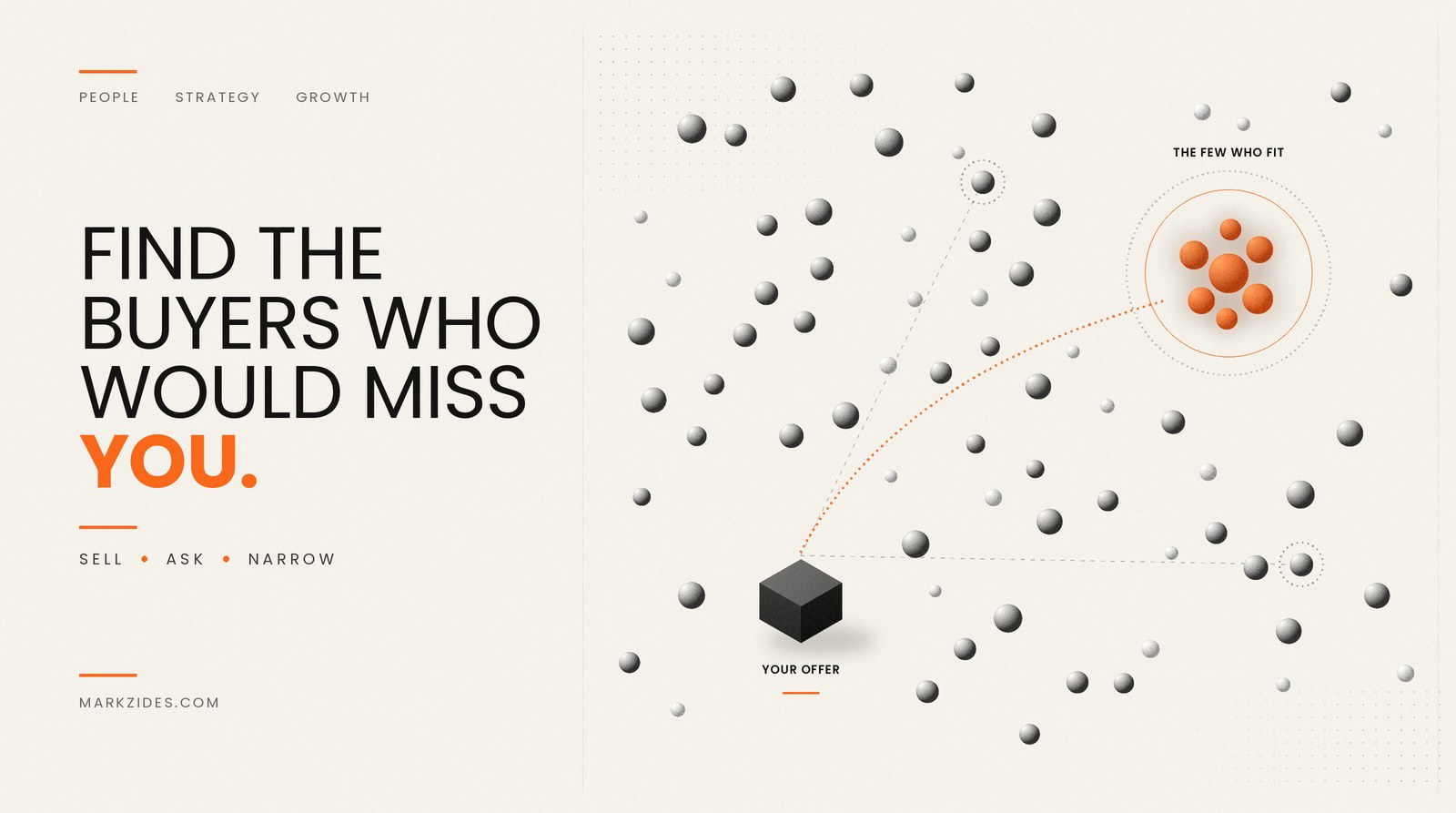
You have customers. Most came through people you know, a few are pilots you discounted to win, and all of them say kind things on calls. So you hire a salesperson to find more like them, and by the end of the quarter the pipeline looks exactly as it did before. Nothing is wrong with the salesperson. Your customers were buying you, not what you sell, and strangers do not. That is what missing product-market fit feels like from the inside, and it is fixed by narrowing, not by selling harder.
What Is Product-Market Fit?
Product-market fit is when a specific group of buyers pays full price for what you sell, keeps paying without being chased, and tells others like them. All three have to be true, and they have to be true of people who did not buy as a favour to you.
Fit belongs to a group, not to a product on its own. The same product can fit one group perfectly and fit nobody else. That is why the search for fit is mostly a search for the right group, and why the steps below spend more time on who than on what.
How to Find Product-Market Fit in 6 Steps
After the first step, the steps run in a loop. You sell, ask, sort the answers, narrow and measure again, until the group that would miss you is large enough to build a company on.
1. Name One Buyer and One Problem
Write one sentence that says who the buyer is and what problem they will pay to solve: their role, the size of their company, and the moment the problem hurts enough to act. "Mid-sized companies that want to grow" is not a buyer. "Operations leads at logistics firms of 50 to 200 people, in the month after they lose a large contract" is. Without a customer you can describe in one sentence, every later step measures a crowd and tells you nothing.
Do this: write the sentence, and next to it write the result that would tell you it is wrong.
2. Sell It for Money to People Who Do Not Know You
Fit is measured on customers who pay and who did not buy because they like you. Friends, former colleagues and free pilots tell you whether people are polite. They do not tell you whether strangers will pay. Getting a buyer to commit before you build proves the problem is real. This step proves the offer works on people with no reason to be kind.
Do this: sell to strangers at full price before you measure anything, and keep the customers who came as favours out of the count.
3. Ask Who Would Miss You
Ask every active customer one question: how would you feel if you could no longer use what you sell? Offer three answers: very disappointed, somewhat disappointed and not disappointed. Then ask what the main benefit is for them, and what would make it better.
Sean Ellis, who benchmarked nearly a hundred startups with this question, found that the line sits at 40 percent of customers answering "very disappointed", according to a founder's account of using his test. The line was set on startups, so in a B2B or services firm, check it against behaviour as well.
Do this: send the question to every customer who has used what you sell recently, and count the very disappointed as a share of everyone who answered.
4. Find What the Very Disappointed Have in Common
Sort the very disappointed answers and look for the pattern: the same role, the same size of company, the same trigger, the same main benefit in their own words. That pattern is your real buyer, and it is usually narrower than the one you wrote down in step 1.
The founder of an email software company published how this works in that account. His first survey scored 22 percent, well short of the line. Counting only the customers who matched the very disappointed group lifted the score to 33 percent before anything in the product changed. Work aimed at that group took it to 58 percent within three quarters.
Do this: put the very disappointed answers in one list and write one sentence that describes those customers, in their own words.
5. Narrow to Them
Rebuild the offer, the price and the pitch for that group alone. Use their words for the main benefit in every sales conversation. Do more of what they value most, and fix what stops similar customers from valuing it as much.
Then decide whose requests you will set aside. Customers who would not be disappointed are telling you they are the wrong buyers, however large they are. Among the somewhat disappointed, listen only to those who named the same main benefit: they are one fix away. The rest are asking you to build a different product.
Do this: for one quarter, chase new customers only inside the group, and rewrite your sales pitch in the group's own words.
6. Measure Again Every Quarter
Run the same survey every quarter and watch the score move. Watch behaviour alongside it, because people say kinder things than they do. Are customers renewing without being chased? Are new ones arriving through referrals? Are deals closing at full price? When the survey and the behaviour both say yes, you have fit with that group, and you can start widening it, one similar group at a time.
Do this: put the survey score and three behaviour numbers on one page, and review them at the same meeting every quarter.
How to Know When You Have Product-Market Fit
You have it when the market starts doing work you used to do. Buyers arrive already understanding the problem, renew without a reminder and send people like them. The table sets the signs side by side.
| Signal | Before fit | With fit |
|---|---|---|
| The survey | Under 40% would be very disappointed | 40% or more, and rising |
| Customers kept | Each group of new customers keeps shrinking | The share still paying levels off |
| Renewals | You chase them, often with a discount | They renew without being asked |
| Price | Discounts are needed to close | Full price holds |
| Sales cycle | Getting longer | Getting shorter |
| New customers come from | The founder's network | Referrals and strangers |
| On sales calls | You explain the problem | The buyer explains it to you |
No single row proves fit. Three or four moving together does. The strongest sign is the last one: when buyers describe their problem in your words before you have said them, the market has learned what you sell. The next question is whether each customer earns more than it cost to win, because fit tells you what to sell, not whether selling more of it will pay.
Finding Fit in B2B and Services Firms
A firm with fifteen clients cannot run a survey that means much: one answer moves the score by almost seven points. Judge fit by behaviour instead, and hold it to a stricter standard, because each client matters more.
Three tests work at any size. Strangers pay full price, with no discount and no favour owed. Clients renew or buy again without being chased. Clients refer others like them without being asked. If all three hold for one type of client and not for the others, that type is your market.
Watch for the trap that catches most founder-run firms: fit that exists only while the founder sells. Clients who bought because they trust the founder renew for the same reason, which looks like fit and is not. The real test is selling it without the founder in the room: the same offer, sold by someone else, to strangers, at full price. Until that works, the company has a founder who fits the market, not a product that does.
How Long Does It Take?
Longer than you plan for. The Startup Genome Report, built in 2011 on data from more than 650 startups, found that startups need two to three times longer to validate their market than most founders expect. Fit comes after validation, so it takes longer still.
That has two practical consequences. Raise or keep enough cash to run the loop above several times, not once. And do not hire for scale until the sale repeats: hiring a sales leader before the sale repeats is among the most expensive early mistakes, because the leader is judged on a sale that does not exist yet.
Product-Market Fit vs Problem-Solution Fit, MVP and Go-to-Market
These four come in order, and each answers a different question. Confusing them is how companies scale something that was only ever proved on paper.
| Stage | The question it answers | Evidence that it is done |
|---|---|---|
| Problem-solution fit | Do buyers have this problem, and would they pay to solve it? | Buyers commit time or money before the product exists |
| Minimum viable product | What is the smallest thing we can sell that solves it? | Someone pays for it |
| Product-market fit | Does one group keep buying and bring others? | Full price, renewals without chasing, referrals, 40% very disappointed |
| Go-to-market | How do we reach many more of the same buyers, profitably? | A channel that brings in customers at a cost the business can carry |
A go-to-market plan is the plan for how you reach more of the same buyers. Written before fit, it is a plan to reach people who may not want what you sell.
What to Do If You Do Not Have It
Change one thing at a time, in this order, and measure again after each change.
- Narrow who you sell to. Most companies without fit are selling to too many kinds of buyer. Pick the group with the best answers and serve only them.
- Change the main benefit. If no group is very disappointed, the problem you solve may not hurt enough. Go back to the buyers who came closest and ask what they would pay to have solved.
- Change the price or how it is sold. Sometimes the product fits and the deal does not: too expensive to start, too slow to buy, or sold to the wrong person in the company.
- Change the market. If none of the first three moves the numbers, the same product may fit a different industry or a different size of company. That is a pivot, and it costs less than another year of hoping.
What not to do: hire salespeople, raise marketing spend or add features for everyone. Each makes the company bigger without making it fit, and growing before the company can carry it is how a fixable problem becomes a fatal one.
Frequently Asked Questions
What is the 40 percent rule for product-market fit?
It comes from Sean Ellis's survey. Ask customers how they would feel if they could no longer use your product. If at least 40 percent answer "very disappointed", you probably have product-market fit. Ellis set the line after benchmarking nearly a hundred startups, so a B2B or services firm should check it against renewals, price and referrals as well.
Can you lose product-market fit once you have it?
Yes. Buyers' needs change, competitors copy the main benefit, and a company that widens too fast starts selling to groups it does not fit. Keep running the survey and watching renewals every quarter after you find fit. A falling score in one group is the earliest warning you will get.
Is product-market fit only for startups?
No. Any company launching a new product, entering a new market or selling to a new type of buyer faces the same question. An established firm can have fit in its core market and none in a new one, which is why expansion often stalls where the old customers end.
What comes after product-market fit?
Scaling what works: a repeatable way to reach more of the same buyers, a sales process that works without the founder, and customers who each earn more than they cost to win. Fit tells you what to sell and to whom. What comes after decides how fast you can grow without running out of cash.
How many customers do you need to test product-market fit?
Enough that one answer does not swing the result. With a few dozen active customers, a survey percentage starts to mean something. Below that, judge fit by behaviour: full price, renewals without chasing and referrals from strangers. Either way, count only customers who have used the product recently.
Final Thought
Product-market fit is not found by building more or selling harder. It is found by narrowing to the buyers who would miss you, then making the company about them. Until you have it, it is the constraint that matters, and every other fix makes the company bigger without making it work. That is the U of the UNLOCK Method: uncover the real constraints. If your sales have stalled and you suspect the problem sits upstream of the sales team, Mark's work as a growth advisor starts by finding the constraint that is really holding growth back, then stays through the work of fixing it.
Ready to build a revenue engine that runs without you?
Mark works alongside founders as a player-coach — not a slide deck.
Book a 30-minute call