
Operating Rhythm: The Five Meetings That Run a Growing Company, With a Template

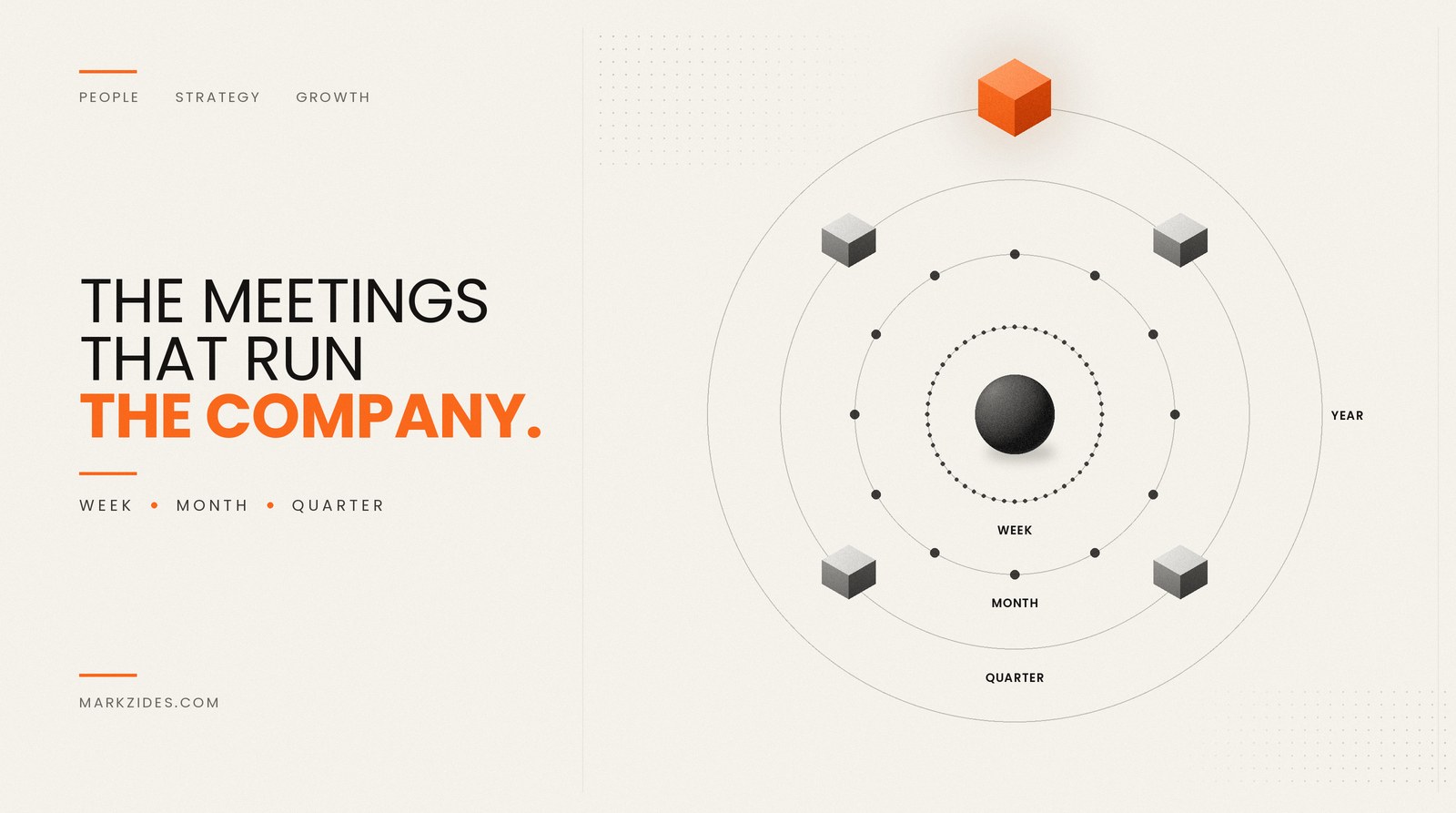
Most companies between $5 million and $50 million do not have too few meetings. They have meetings without a system. The same issues come back every Monday, decisions wait for the founder, and the quarter's priorities are forgotten by week three. An operating rhythm fixes that: a fixed set of meetings, each with one job, its own numbers and the decisions it is allowed to make, on a calendar fixed a year ahead. Below is what an operating rhythm is, the five meetings most growing companies need, a template to copy, and how to install one in a quarter.
What Is an Operating Rhythm?
An operating rhythm is the fixed calendar of meetings and reviews through which a company sets goals, checks progress and makes decisions, usually on a weekly, monthly, quarterly and annual cycle. Each meeting has one job, a set list of attendees, the numbers it reviews and the decisions it is allowed to make. The same idea is also called an operating cadence, a business rhythm or a meeting cadence.
Three things set a real operating rhythm apart from a busy calendar:
- Every meeting owns decisions. If nobody can say what a meeting is allowed to decide, it is a status update, and status updates can be written.
- The numbers come first. Each meeting starts from the same few figures, defined the same way every time, so the time goes on what to do about them rather than on what they mean.
- The dates are fixed a year ahead. The meetings happen on the same day and at the same time, and they do not move when someone is busy.
Operating rhythm vs operating model
An operating model is how the company is built: its structure, roles, processes and systems. An operating rhythm is when and where that company makes its decisions. A good operating model with no rhythm drifts, because nothing forces the decisions it was designed to support. A rhythm with no operating model behind it produces meetings with nobody clearly accountable for what they decide.
Why an Operating Rhythm Matters
Because most of a leadership team's working time goes into decisions, and much of that time is wasted without a structure. In a McKinsey survey of 1,259 respondents, respondents spent 37 percent of their time making decisions, 61 percent said most of that time was used ineffectively, and only 20 percent said their organization excelled at decision making.
In a founder-led company the cost is easy to see. Decisions go to whoever is in the room, which is usually the founder. Problems are raised in hallways and solved twice. Priorities set at the start of the quarter are replaced by whatever is loudest that week. An operating rhythm decides in advance where each kind of decision gets made, so it stops waiting for one person's diary.
The Five Meetings of an Operating Rhythm
Most companies between about 20 and 500 people need five meetings, at four speeds. Two weekly meetings run the week, a monthly review checks the numbers against the plan, and quarterly and annual planning set the priorities that the weekly meetings then run.
1. Weekly leadership meeting
The leadership team meets for an hour, on the same day and at the same time each week. It opens with the one-page scorecard and the commitments each person made last week, which is the fifteen-minute weekly check that keeps a plan alive. The rest of the hour goes on the two or three issues that most need a decision. Each one leaves the room with an owner and a date.
The rule: updates are written and read before the meeting, never presented in it.
2. Weekly pipeline review
The sales leader, the sellers and the marketing lead go through the deals that moved, stalled or slipped, and the new pipeline created that week. Every deal discussed ends with a next step, a decision to drop it, or a change to the forecast. The review is also where the stages of the sales process are enforced: a deal sits in a stage only if it has the evidence that stage requires.
The rule: discuss the deals that need a decision, not every deal on the list.
3. Monthly business review
Within ten days of each month end, the leadership team and finance spend two to three hours on the month's results against the plan: revenue, margin, cash, customers and hiring. This is the meeting that moves money and people, because a month is long enough for a trend to show and short enough to act on it.
The rule: every number that is off plan comes with the owner's explanation and proposal, sent in advance.
4. Quarterly planning
Once a quarter the leadership team takes a day to review the last quarter's priorities, check the plan against what has changed, and set three to five priorities for the next 90 days, each with one owner and a measure. Quarterly planning replaces that month's business review.
The rule: no more than five priorities. A list of twelve is a wish list, and the weekly meeting cannot track it.
5. Annual planning
Once a year, usually in the last quarter, the leadership team spends two days on strategy, next year's targets, the budget and the organization, and the board approves the result. This is where the revenue goal is set and where a budget such as the marketing budget is worked back from that goal. Annual planning replaces the fourth quarterly session.
The rule: next year's calendar of meetings is fixed before the session ends.
Two more meetings sit around these five. Each leader holds a weekly one-to-one with each direct report, and a company with a board meets it, usually quarterly. Schedule board meetings a week or two after quarterly planning, so the board sees the plan rather than the scramble to write it.
Operating Rhythm Template
The template below covers a company of about 20 to 500 people. Copy it, then cut or merge anything your company does not need.
| Meeting | How often | Length | Who | Reviews | Decides |
|---|---|---|---|---|---|
| Leadership meeting | Weekly, same day and time | 60 minutes | CEO and the head of each function | The scorecard, last week's commitments, the top issues | What gets fixed this week, by whom, by when |
| Pipeline review | Weekly | 45 to 60 minutes | Sales leader, sellers, marketing lead | Deals that moved, stalled or slipped; new pipeline; the forecast | The next step on each deal, which deals to drop, the forecast |
| Business review | Monthly, within ten days of month end | 2 to 3 hours | Leadership team and finance | Results against plan, cash, customers, hiring | Where money and people move |
| Quarterly planning | Three times a year | One day | Leadership team | Last quarter's priorities, the plan, the market | Three to five priorities, each with an owner and a measure |
| Annual planning | Once a year | Two days, then the board | Leadership team, then the board | Strategy, targets, budget, organization | Next year's targets, budget, first-quarter priorities and calendar |
For a leader who attends all but the pipeline review, the template costs about 111 hours a year: 52 in weekly meetings, 24 in monthly reviews, 21 in quarterly planning and 14 in annual planning. That is just over two hours a week to run the company on purpose.
What Goes on the Weekly Scorecard
The scorecard is one page of about ten numbers that tell the leadership team whether the business is on track this week. Each number has one owner and a target, and only the numbers that are off target get discussed. Choosing those few numbers well is the core of data-driven decision making, and the list below is a starting point for a B2B company.
| Area | Number | Owner |
|---|---|---|
| Revenue | Bookings this month against plan | CEO or finance lead |
| Sales | New qualified pipeline created this week | Sales leader |
| Sales | Forecast for the quarter against target | Sales leader |
| Marketing | Qualified opportunities created | Marketing lead |
| Customers | Renewals in the next 90 days flagged at risk | Account or customer success lead |
| Delivery | Orders or projects delivered on time | Operations lead |
| Quality | Customer escalations opened this week | Operations lead |
| Cash | Cash in the bank | Finance lead |
| Cash | Receivables more than 30 days overdue | Finance lead |
| People | Open roles and days each has been open | CEO or people lead |
Keep the definitions fixed. If "qualified" means something different each month, the team will spend the meeting arguing about the number instead of acting on it.
Operating Rhythm Examples
The five meetings flex with the size and stage of the company. Three illustrative examples show how.
| Company | The rhythm | Why it is shaped that way |
|---|---|---|
| A 25-person consulting firm, founder still selling | A 45-minute weekly leadership meeting that includes the pipeline, a monthly review, a half-day each quarter | Too few people for two weekly meetings, and the founder is in every deal anyway |
| A 150-person software company with a sales team | All five meetings, plus a quarterly board meeting two weeks after planning | Separate sales and leadership agendas, and investors who expect a plan each quarter |
| A manufacturer preparing for a sale | All five, with the month closed and reviewed within ten days and a monthly board update | Buyers will test whether the numbers are reliable and whether the company runs without its owner |
The third example matters more than it looks. A buyer reads a steady operating rhythm as evidence of a business that runs without its owner, and a company that closes its month late and runs on the founder's memory is valued accordingly.
How to Build an Operating Rhythm in One Quarter
Install it in stages over about 90 days, starting with the weekly meeting. Trying to launch all five at once usually produces five new meetings and no change in how decisions are made.
- Week 1: list every recurring meeting. For each, write down who attends, how long it takes and what it decided in the last month. Most companies find several that decided nothing.
- Week 2: cut, merge and assign decisions. Drop the meetings that decide nothing. Write down which decisions belong in which of the five meetings, including what the founder no longer decides alone.
- Week 3: build the scorecard. Agree about ten numbers, their definitions, owners and targets, and who prepares the page each week.
- Week 4: start the weekly leadership meeting. Same day, same time, same agenda. Run it for a month before adding anything else.
- Month 2: hold the first monthly business review, and start the weekly pipeline review if sales has its own leader.
- Month 3: run the first quarterly planning day, and put the next twelve months of meetings in everyone's calendar before the day ends.
Then review the rhythm itself at each quarterly planning day. Ask which meetings produced decisions, which ran over, and which numbers nobody acted on, and change the system rather than adding to it.
Signs Your Operating Rhythm Is Broken
- The same issues come back every week. Nothing was closed, or the owner was never named.
- Meetings are status reports. People present what could have been read.
- Decisions get reopened. Someone who was not in the room overturns what was agreed, often the founder.
- The numbers are argued about, not acted on. The definitions have drifted, or there are too many numbers.
- The quarter's priorities are forgotten by week three. The weekly meeting does not check them.
- Meetings move or get cancelled when people are busy, which is exactly when the decisions matter most.
Where the Founder Sits in the Rhythm
At first the founder usually chairs every meeting, and that is fine while the rhythm is new. The goal is to chair fewer of them each year. The pipeline review goes to the sales leader as soon as there is one. The weekly leadership meeting can go to a president or COO, or to a fractional COO, who typically owns the operating cadence. The founder keeps the quarterly and annual planning, where the direction is set.
This is one of the harder parts of the move from founder to CEO. A founder who still sits in every weekly meeting has built a calendar, not a rhythm, because the decisions still wait for them.
Frequently Asked Questions
What is an operating rhythm in business?
It is the fixed set of recurring meetings through which a company reviews its numbers and makes decisions, usually weekly, monthly, quarterly and yearly. Each meeting has a defined purpose, attendees, the figures it reviews and the decisions it owns, so decisions get made on a schedule instead of whenever the founder is free.
What is an example of an operating rhythm?
A common example for a growing company is a one-hour weekly leadership meeting, a weekly pipeline review, a monthly business review of results against plan, a one-day quarterly planning session that sets three to five priorities, and two days of annual planning followed by a board meeting.
What is the difference between an operating rhythm and an operating model?
An operating model describes how a company is organized: its structure, roles, processes and systems. An operating rhythm describes when and where it makes decisions: the meetings, their timing and what each one decides. A company needs both, and the rhythm is what makes the model work week to week.
Is an operating cadence the same as an operating rhythm?
Yes. Operating cadence, operating rhythm, business rhythm and meeting cadence are used for the same thing: the repeating schedule of reviews and decisions that runs a company. Some teams use cadence for how often a single meeting happens and rhythm for the whole system.
How long should a weekly leadership meeting be?
About an hour for most leadership teams. Fifteen minutes on the scorecard and last week's commitments, then the rest on the two or three issues that need a decision. If it regularly runs over, the updates are being presented rather than read in advance, or too many issues are on the list.
Final Thought
An operating rhythm is not more meetings. It is fewer meetings, each with a job, running on dates that do not move. The companies that grow past the founder are usually the ones whose decisions stopped depending on who happened to be in the room. That is the O of the UNLOCK Method: organize for growth. If the same issues keep coming back to your Monday meeting, Mark's work as a growth advisor stays through execution, from the process build to the pipeline reviews, until your leadership team runs the rhythm on its own.
Ready to build a revenue engine that runs without you?
Mark works alongside founders as a player-coach — not a slide deck.
Book a 30-minute call