
Sales Compensation Plan: How to Build One Your Reps Trust

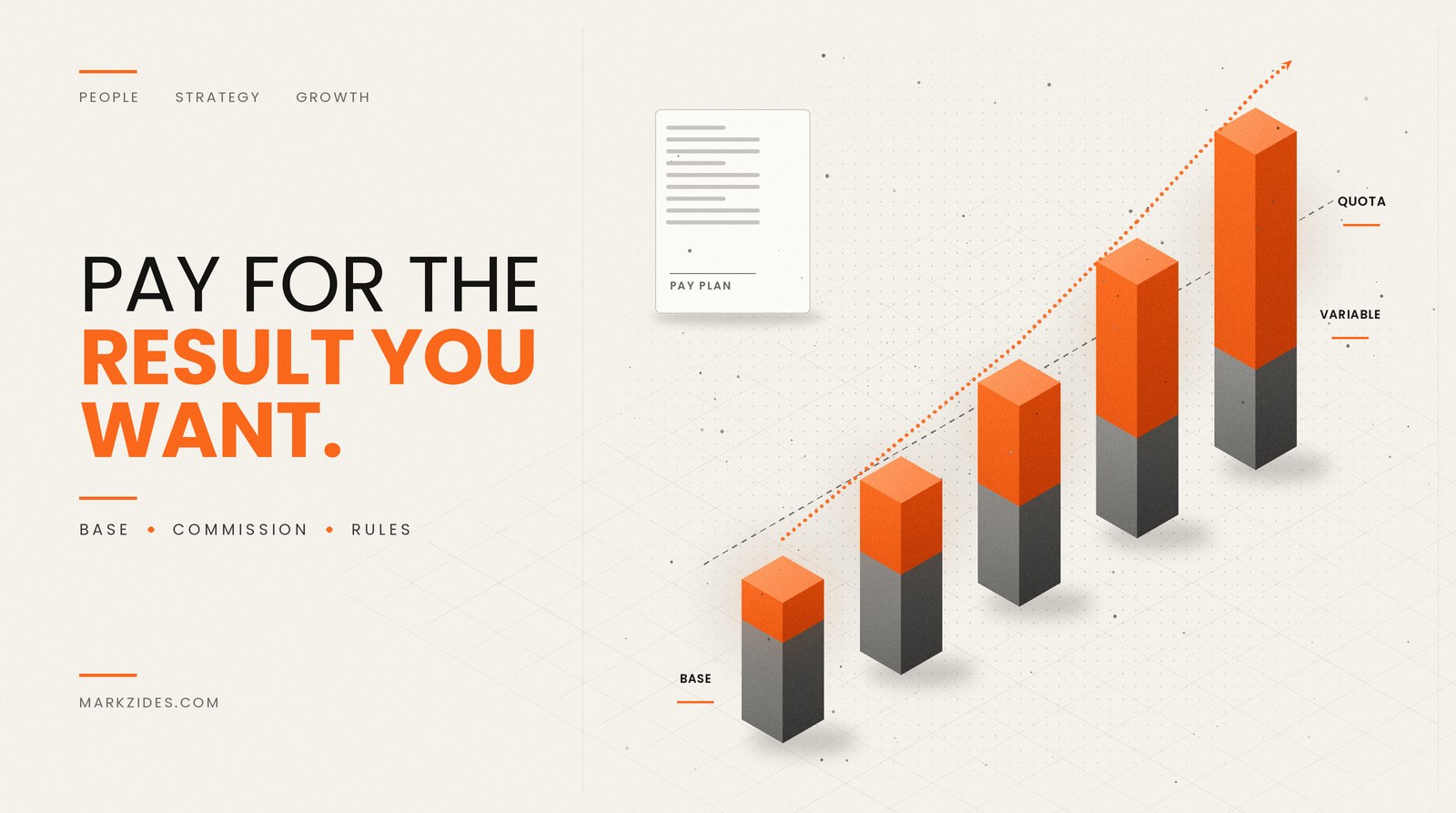
The founder hires two sellers and needs a way to pay them, so they borrow a sales compensation plan from a friend's company and change the numbers. It looks fair on paper. Six months later one seller is collecting commission on deals the founder closed alone, and the other has worked out that the quota cannot be reached and stopped trying. Nobody did anything wrong. The plan simply paid for things the company did not need and ignored the things it did. Pay plans do that quietly, because sellers read them more carefully than anyone who writes them.
How to Build a Sales Compensation Plan in Six Steps
Most broken plans were built in the wrong order. Someone picked a quota from the board plan, then a commission rate that felt generous, and only then asked what the job was for. Work the other way round. Each step below fixes one number, and each number depends on the one before it.
1. Decide What the Role Must Do
Write one sentence about the result this seller exists to produce. Win new customers. Grow the accounts you already have. Renew contracts on time. A seller hired to win new logos and paid the same on renewals will spend their week on renewals, because renewals are easier. Pay on one result, two at most, and make them the ones the business needs this year.
Different jobs need different plans. A closer who finds and wins new business, an account manager who grows existing customers and a sales development rep who books first meetings should not share one plan. The split between customer success and account management is a good example: one role is paid to keep customers, the other to grow them, and paying both on the same number makes them compete for the same accounts.
Do this: Write the role's one result at the top of the plan, before any number.
2. Set On-Target Earnings
On-target earnings is what the seller takes home in a year if they hit quota exactly: base plus variable pay at 100 percent. Set it from the market for that role, in your region, at the level of experience you need. Pay below the market and you hire the sellers nobody else wanted. Pay far above it and the plan becomes hard to fund in a slow quarter.
For context, the Bridge Group's 2026 survey of 158 B2B companies put the median on-target pay for an account executive at $200,000. That sample leans toward companies with dedicated revenue leaders, and many of them sell software, so treat it as one reference point rather than your number.
Do this: Get three current figures for the role you are hiring: from recruiters, from candidates' own offers, and from sellers you know. Use the middle one.
3. Choose the Pay Mix
The pay mix is the split between base and variable pay at target. The rule is simple: the more the seller controls the sale, the more of their pay should depend on it. A closer who finds their own deals and wins them can carry half their pay at risk. An account manager whose results depend on delivery and on the customer's own growth should carry less, closer to a 70/30 split. These are working ranges from experience, not survey figures, and your own market may differ.
Too much base and the plan stops steering anything. Too little and good sellers will not join a company that has not yet proved it can feed them deals.
Do this: Write the mix as two numbers that add up to on-target pay, such as $80,000 base and $80,000 variable.
4. Set Quota From Capacity, Then Check It
Quota should come from what one seller can actually produce: the deals they can work at once, your average deal size, your win rate and the length of your sale. Build it from the bottom up, then check it from the top down. The Bridge Group's 2026 median put quota at 4.6 times on-target pay. If your quota is far above that ratio, few sellers will reach it. If it is far below, the seller costs more than they bring in.
The quickest way to break a team is to set quota by dividing the company's target by the number of sellers. That number describes what the board wants, not what the market will give, and sellers can tell the difference in about a quarter. Quota also has to fit with ramp time and hiring pace, because those three numbers together decide how fast you can scale a sales team without burning sellers out.
Do this: Divide quota by on-target pay. If the answer is far from four or five, rework one of the two before the plan goes out.
5. Set the Rate and Pay More Above Quota
The base commission rate is variable pay divided by quota. $80,000 of variable pay on a $720,000 quota is 11.1 percent of every dollar sold. Above quota, pay a higher rate, often one and a half times the base rate. That accelerator is what keeps your best seller working hard in the last month of a good year.
Do not cap commission. A cap tells the seller who has already hit their number to push deals into next year, which is the opposite of what you want. If you worry about one huge deal that arrived through no effort of the seller's, write a clause that lets you review any single deal above a set size. That protects you without punishing the people who outperform.
Do this: Write the base rate and the rate above quota as percentages, with one sentence on what counts as a windfall.
6. Write the Rules
Most arguments about commission are not about the rate. They are about the rules nobody wrote down. Put these in the plan before the first deal closes:
- When a deal counts. Signed contract, first invoice paid, or both. Paying only on cash collected protects you from deals that never pay.
- Split deals. Who gets what when two people worked a deal, and who decides.
- Clawbacks. What happens to commission if the customer cancels or does not pay within a set period. Have a lawyer read this clause, because rules on recovering wages vary by state.
- Ramp. A lower quota or a guaranteed amount for new sellers for the first few months, with an end date.
- Changes. The plan runs for one year. Any change before then follows a written rule and comes with notice.
Write the plan down and have each seller sign it. Some states, including California and New York, require commission terms in writing, and a signed plan is the cheapest way to avoid a dispute anyway.
Do this: Read the rules aloud to your best seller and ask them how they would game the plan. Then close each gap they find.
What Is a Sales Compensation Plan?
A sales compensation plan is the written agreement that sets how a seller is paid: a fixed base salary, variable pay tied to results, the quota those results are measured against, and the rules for when a sale counts. It exists to steer effort toward the results the business needs, and to make pay predictable for the seller.
A few terms come up in every plan. On-target earnings is total pay at exactly 100 percent of quota. Quota is the result the seller is measured against, usually revenue in a year or quarter. Commission rate is the share of each sale paid to the seller. An accelerator is a higher rate paid above quota. A clawback takes back commission on a deal that later falls through.
Sales Compensation Plan Example
Here is a plan for an illustrative company: a B2B services firm with $12 million in revenue, hiring its third seller to win new customers. The numbers show the method, not a market rate.
- Role: win new customers. Renewals belong to account management.
- On-target earnings: $160,000.
- Mix: 50/50, so $80,000 base and $80,000 variable at target.
- Quota: $720,000 of new annual contract value, 4.5 times on-target pay.
- Rate: 11.1 percent up to quota, 16.7 percent on everything above it.
- Counts when: the contract is signed and the first invoice is paid.
This is what the seller earns at five levels of results:
| Share of quota | Sales | Base | Commission | Total pay |
|---|---|---|---|---|
| 50% | $360,000 | $80,000 | $40,000 | $120,000 |
| 80% | $576,000 | $80,000 | $64,000 | $144,000 |
| 100% | $720,000 | $80,000 | $80,000 | $160,000 |
| 120% | $864,000 | $80,000 | $104,000 | $184,000 |
| 150% | $1,080,000 | $80,000 | $140,000 | $220,000 |
Run the same check from the company's side. At quota, the seller costs $160,000 in pay against $720,000 of new business, about 22 cents of every dollar before benefits. Whether that works depends on your margins and on how long a customer stays, which is what unit economics is for. Do this check before the plan goes out, not after the first good quarter.
Sales Compensation Plan Template
A plan a seller can read in five minutes is a plan they will trust. Fit it on one page.
| Section | What goes in it |
|---|---|
| Role and result | The job in one line and the one or two results it is paid on |
| Plan period | Start and end dates, usually the financial year |
| On-target earnings | Total pay at 100 percent of quota |
| Pay mix | Base and variable pay at target, in dollars |
| Quota | The number, what it is measured in, and whether it is set yearly or by quarter |
| Rates | The rate up to quota and the rate above it |
| When a deal counts | Signature, payment, or both |
| Splits and territory | Who owns which accounts, and how shared deals are paid |
| Clawback | What is repaid if a customer cancels or does not pay, and within what period |
| Ramp | Reduced quota or guaranteed pay for new sellers, with an end date |
| Windfall review | The deal size above which a deal is reviewed |
| Changes and sign-off | How the plan can change, and both signatures |
Keep one copy per seller, signed, with the date. Review attainment against the plan in the weekly pipeline review, so nobody learns how they are doing from a commission statement at the end of the quarter.
Types of Sales Compensation Plans
Most B2B sellers are paid base plus commission. The other types have their uses, and it helps to know when.
| Type | How it pays | When it fits |
|---|---|---|
| Salary only | Fixed pay, no variable | Long, team-won sales where no one person controls the result |
| Commission only | Pay only on sales | Independent agents and resellers, rarely employees |
| Base plus commission | Fixed base and a rate on each sale | Most closers who find and win their own deals |
| Base plus bonus | Fixed base and set payments for hitting goals | Account managers, renewals, results that are not single sales |
| Tiered commission | A higher rate at each level of results | Any plan where you want effort to continue past quota |
New sellers learn faster when the plan matches the way the company actually wins. Pair the plan with a sales playbook during ramp, so the first months are spent learning the deals that pay, not guessing at them.
Mistakes That Break a Sales Compensation Plan
- Too many measures. Five measures with 20 percent weight each means none of them matters. Sellers chase the easiest.
- A cap on earnings. It costs you the extra deals your best seller would have closed, and often the seller too.
- Paying on deals that never pay. Commission on signature alone rewards deals with customers who were never going to pay the invoice. Tie the payout to the stage where a deal is truly won.
- Changing the plan mid-quarter. Even a fair change looks like a pay cut when it arrives with no notice.
- Quota copied from the board plan. A target nobody believes is reachable does not stretch a team. It ends the effort early.
Frequently Asked Questions
What is a good commission rate for sales?
There is no single right rate. Divide variable pay by quota: $80,000 of variable pay on an $800,000 quota is 10 percent. The rate follows from on-target pay and quota, so set those first and let the rate fall out of them.
What is a typical base to commission split?
Sellers who find and win their own deals often sit near half and half. Roles with less control over the sale, such as account managers whose results depend on delivery, usually carry more base, closer to 70/30.
Should sales commission be capped?
Usually not. A cap tells your best seller to stop selling once they reach it, and to push deals into next year. Protect the company from rare windfall deals with a written review clause instead.
How do you pay a new seller during ramp?
Give a lower quota or a guaranteed amount for the first few months, written into the plan with an end date. A full quota in month one tells a new seller the plan was not written for them.
How often should a sales compensation plan change?
Once a year, at the start of the plan period. Any change in between should follow a rule written in the plan, with notice, so it never arrives as a surprise.
Final Thought
A sales compensation plan is the clearest message a company sends its sellers about what matters. Write it in the right order: the result, the pay, the mix, the quota, the rate and the rules. Then work through what a seller earns at half of quota and at one and a half times quota before anyone signs. That is the O in Mark's UNLOCK Method: organize for growth, so the way you pay people pulls in the same direction as the business. Designing that first plan with a growing team is a core part of sales consulting work.
Ready to build a revenue engine that runs without you?
Mark works alongside founders as a player-coach — not a slide deck.
Book a 30-minute call