
Sales Playbook: How to Write One Your Team Will Use

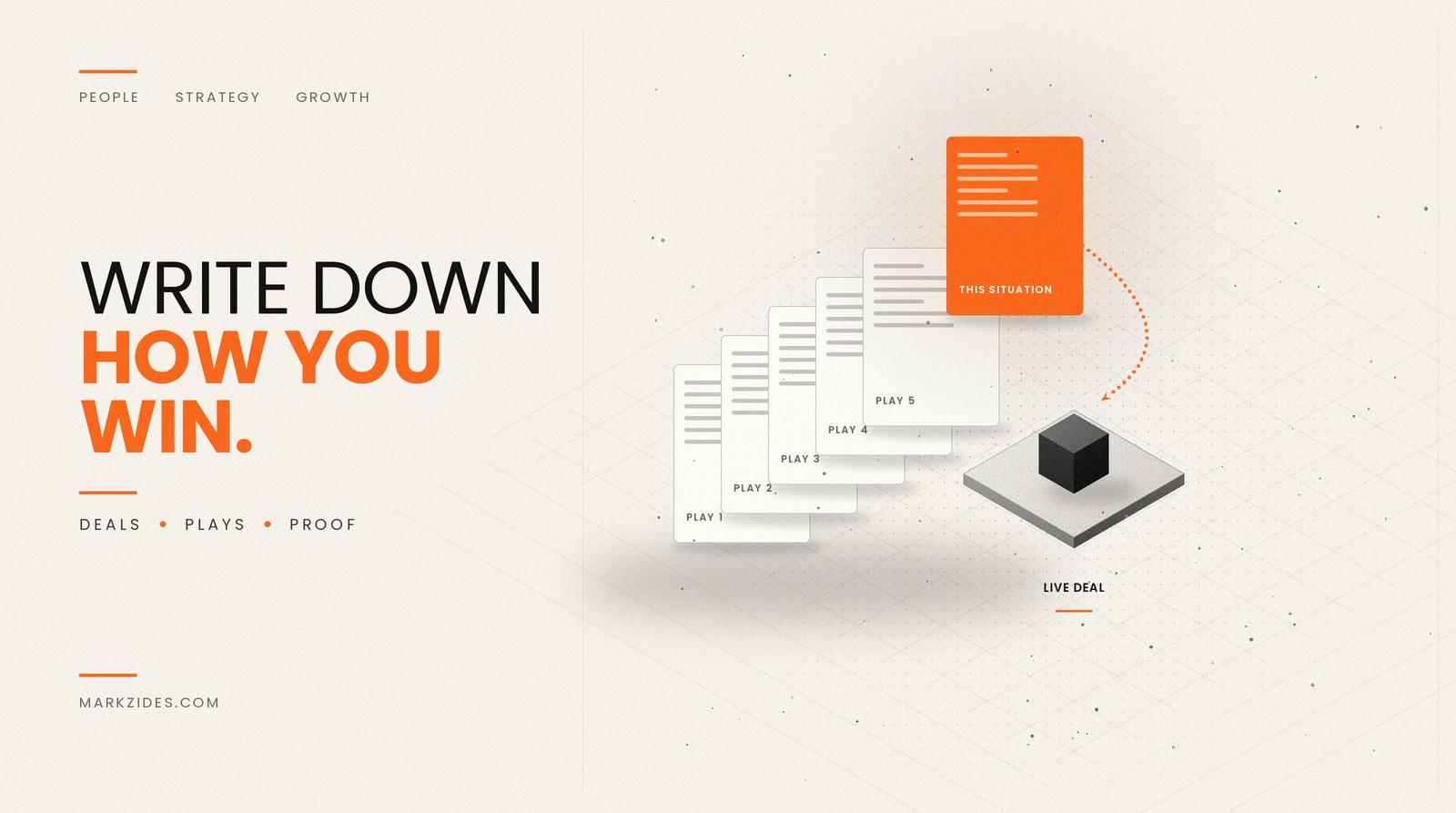
The founder closes deals nobody else in the company can close. Ask how, and the answer is a shrug: you read the room, you know when to push, you know which story to tell. New sellers watch, nod, and then lose the same deals in the same places. The knowledge is real, but it lives in one head, and it leaves the building every evening. Most attempts to write a sales playbook end as a long document of good intentions that nobody opens after the first week. There is a better way to build one.
How to Write a Sales Playbook in Seven Steps
The steps take about a month for a company with a handful of sellers. The founder or the best seller supplies most of the content, and someone else, usually the sales leader, does the writing.
1. Pull the Last Ten Deals Won and the Last Ten Lost
Start from what actually happened. For each of the twenty deals, write a short note: who the buyer was, what problem they had, what made them act now, who else was involved, what nearly lost the deal, and why it was finally won or lost. Ask the seller who ran it, and where you can, ask the buyer too. Lost deals matter as much as wins, because they show where the company keeps losing.
Do this: Put the twenty deals in one spreadsheet, one row each, before you write a word of the playbook.
2. Name the Situations That Keep Coming Back
Read the twenty notes side by side and group them by situation, not by product or industry. Three to five situations usually cover most deals: the buyer already has a supplier, procurement is pushing on price, the deal went quiet after a good demo, the lead came through a referral. A situation is something a seller can recognize in the moment, which is what makes it useful.
Do this: Give each situation a short name your sellers would actually say out loud.
3. Write One Play per Situation, on One Page
A play is the response to a situation. It says when it applies, who it is for, what to say, what to send, which next step to ask for, and how you know it worked. Use the buyer's own words where you can, taken from the deal notes. Keep each play to one page, so a seller can read it in the parking lot before a meeting.
Do this: Write the first play yourself, then ask your best seller to write the second using it as a model.
4. Add Your Qualifying Questions and Meeting Standard
Every play rests on the same base: the questions that tell you whether a deal is real, and what counts as a qualified meeting. Write down the five or six questions your best seller always asks in a first conversation, the ones that uncover the real problem, the person who decides and the timing. Consultative selling is mostly these questions, asked well and followed up properly.
Do this: List the questions in the order they are usually asked, with the answer that would make you walk away.
5. Add the Proof Your Sellers May Use
Buyers believe evidence more than claims. Collect the proof that settled doubts in the deals you won: customer stories with results, references who have agreed to take calls, before-and-after figures, the answer to the question that always comes up. Mark which proof fits which play. Remove anything you would not want a buyer to check.
Do this: For each play, name the one piece of proof that does the most work, and make sure every seller can find it in under a minute.
6. Test It on Live Deals for Thirty Days
A playbook is a set of guesses until sellers use it. For thirty days, ask every seller to name which play they are running on each open deal, and review what happened in the weekly pipeline review. Some plays will work as written. Some will need new words. One will probably turn out to describe a situation that hardly ever happens.
Do this: Add a column for the play to every open deal in your CRM, and fill it in during the review.
7. Review It Every Quarter
Markets change, buyers change, and a play that worked last year can stop working. Once a quarter, look at which plays sellers used, which deals they won with them, and which situations came up that the playbook does not cover. Rewrite or retire plays that stopped working, and add one for any new situation that came up three times or more.
Do this: Put an owner's name and a last-reviewed date at the top of every play.
What Is a Sales Playbook?
A sales playbook is a short written guide to what your sellers should do in the situations they meet most, based on how your company's deals are actually won. It turns one person's judgment into something a new seller can learn, use on a live deal and improve.
It is different from the sales process. The steps of your sales process describe the stages every deal moves through, from first contact to signature. The playbook describes what to do inside those stages when a particular situation comes up: the buyer who already has a supplier, the procurement team pushing on price, the deal that went quiet.
Sales Playbook Template
Use this layout for every play. Each field should take a few lines at most. If a field needs more, the play is probably two plays.
| Field | What goes in it |
|---|---|
| Situation | A short name sellers will use, such as "Has a supplier already" |
| Signal | What the buyer says or does that tells you this play applies |
| Who it is for | The role you are usually talking to in this situation |
| What to say | Two or three questions or lines, in plain words, taken from deals you won |
| What to send | The one piece of proof that fits this situation best |
| Next step to ask for | The specific commitment that moves the deal forward |
| How you know it worked | What the buyer does if the play landed |
| Owner and date | Who keeps the play current, and when it was last reviewed |
A complete playbook is three to five of these pages, plus one page of qualifying questions and the meeting standard, and a short list of where the proof is kept.
Sales Playbook Examples
Three plays, written for made-up companies to show what a finished page looks like. Use them as models for the form, not as scripts.
Play: The Buyer Already Has a Supplier
An IT managed services firm with $8 million in revenue. Signal: the buyer says, "We already have someone for that." Say: "Most of our clients had someone too. What would have to happen for you to look at alternatives?" Then ask when their current contract renews. Send: a one-page plan showing how a switch happens without downtime. Next step: a thirty-minute review of their current service against the gaps they named, set before the renewal date. It worked if: they share the renewal date and agree to the review.
Play: Procurement Pushes on Price
An industrial parts distributor with $15 million in revenue. Signal: a buyer asks you to match a competitor's price line by line. Say: "Which of these items would stop your line if they arrived late?" Then ask what a stock-out costs them. Send: your delivery and fill-rate record for similar customers. Next step: agree pricing on committed volume for the critical items, rather than a discount on every line. It worked if: the conversation moves from unit price to total cost.
Play: The Deal Went Quiet After the Demo
A software company with $4 million in revenue. Signal: a strong demo, then no reply for ten days. Say: a short email that names the problem the buyer described, in their words, and asks one yes-or-no question about whether it is still a priority this quarter. Send: a one-page plan with the steps and dates to a decision. Next step: a call that includes the person who signs. It worked if: the plan comes back with dates, or the buyer says no and you can close the deal out. Both are better than waiting, and the same idea runs through every method for shortening the sales cycle.
What to Leave Out of a Sales Playbook
A playbook gets used when it is short. Leave out the company history, the full product specifications, the organization chart and anything already on the website. Link to them if sellers need them. Leave out plays for situations that came up once. And leave out anything nobody in the company actually does, however good it sounds. A playbook that describes the way you would like to sell teaches new sellers to lose in new ways.
A rough limit helps: if the whole thing runs past twenty pages, sellers will stop opening it during live deals, and that is the only place it matters.
Sales Playbook vs Sales Process vs Sales Enablement
The three are related, and each needs the others.
| Sales process | Sales playbook | Sales enablement | |
|---|---|---|---|
| Answers | What stages does a deal go through? | What do I do in this situation? | How does every seller learn and keep using it? |
| Form | A list of stages with exit criteria | Three to five one-page plays | Onboarding, content, coaching and tools |
| Changes | Rarely | Every quarter | As the team grows |
The process comes first, because plays sit inside its stages. The playbook comes next. Sales enablement is how the playbook gets taught to every new hire and coached every week, so it does not end up in a shared folder nobody opens.
How to Get Your Team to Use the Sales Playbook
Sellers use a playbook when it helps them win and when their manager asks about it. Both can be arranged.
- Ask about plays in every deal review. "Which play are you running here?" is the fastest way to make the playbook part of the job.
- Use it in every call review. Coach against the play, not against a general idea of a good call.
- Build onboarding around it. A new seller's first month should be spent learning the plays and hearing them used on real calls.
- Credit the seller who improves a play. When someone finds better words that win, put their name on the update.
If the founder is still the best seller, the founder should go first: run a play exactly as written in front of the team. Nothing tells sellers more clearly that founder-led sales is becoming the company's way of selling.
Frequently Asked Questions
What should a sales playbook include?
The three to five situations your sellers meet most, one play for each, the qualifying questions and meeting standard every deal rests on, and the proof sellers may use, such as customer stories and references.
How long should a sales playbook be?
Short enough to use during a live deal. Most good playbooks run under twenty pages: one page per play, one page of qualifying questions, and a list of where the proof is kept.
Who should write the sales playbook?
The person who wins the most deals supplies the content, which is usually the founder at first. The sales leader does the writing and keeps it current, with each play given a named owner.
What is the difference between a sales playbook and a sales process?
The sales process is the set of stages every deal moves through. The playbook is what to do inside those stages when a particular situation comes up, such as a price push or a deal that has gone quiet.
How often should a sales playbook be updated?
Review the whole playbook every quarter, and change a play as soon as sellers find it no longer works. Add a new play when the same situation has come up three times or more.
Final Thought
A sales playbook is not a document about selling. It is a record of how your company actually wins, written so the next seller can do it too. Start with twenty real deals, write one page per situation, and test every page on live deals before you call it finished. That is the C in Mark's UNLOCK Method: codify what works, so the way you win stops depending on who happens to be in the room. Building that first playbook from real deals is a core part of sales consulting work with a growing team.
Ready to build a revenue engine that runs without you?
Mark works alongside founders as a player-coach — not a slide deck.
Book a 30-minute call