
What Is an Earnout? How It Works, What Actually Gets Paid, and How to Negotiate One

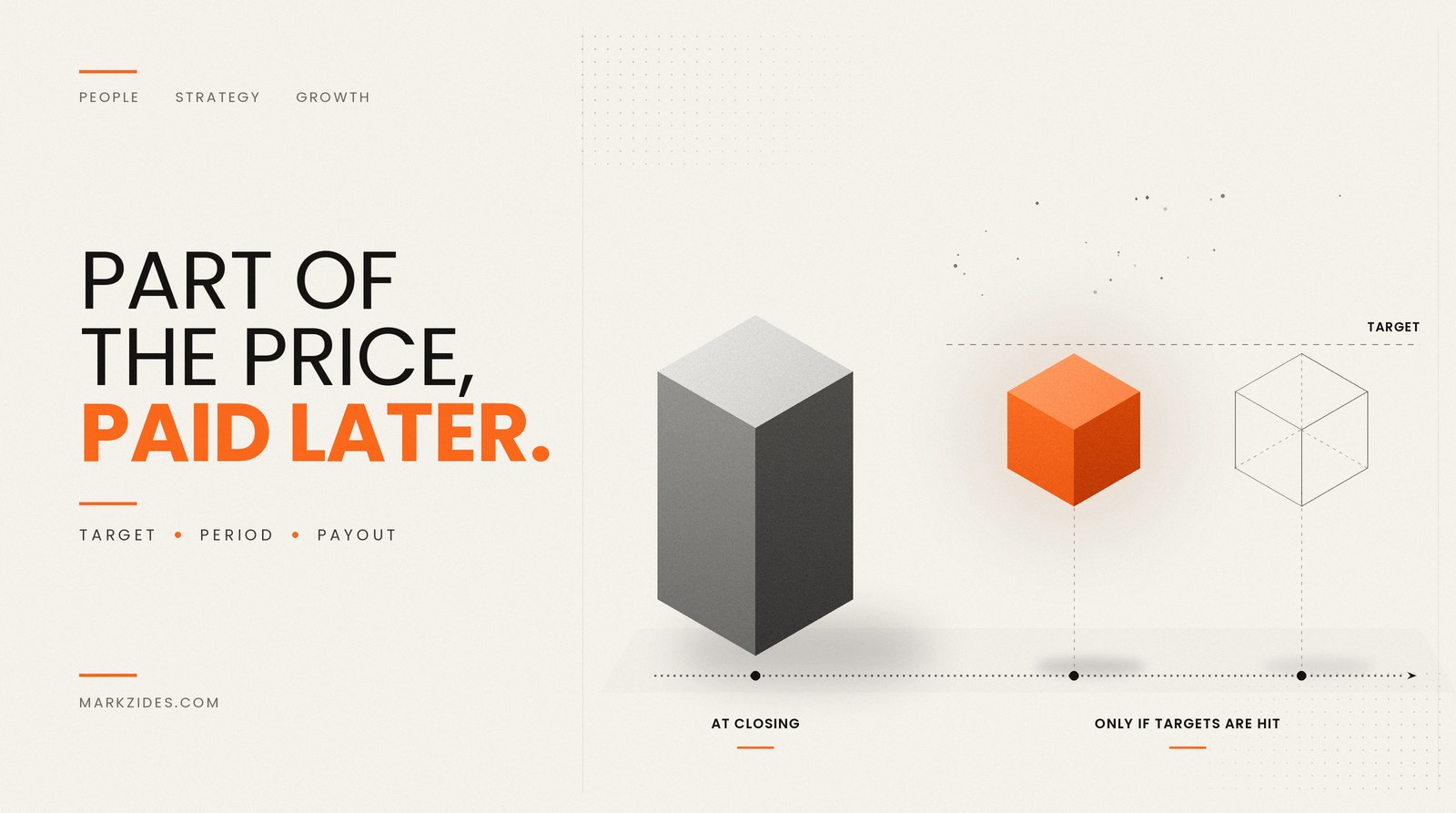
Every business sale has two prices. One is the number in the announcement, the one you tell your family about. The other is the money that actually reaches your account, and the gap between them is often an earnout. Buyers like earnouts because they cost nothing unless things go well. Sellers accept them because the headline looks better with one in it. Whether you ever see that money depends on a handful of terms that most owners skim in the final week of the deal, when everyone is tired and wants to close.
What Is an Earnout?
An earnout is the part of a business's sale price that the buyer pays after closing, and only if the business hits targets set in the purchase agreement. The rest of the price is paid when the deal completes. Accountants call it contingent consideration, and it is also written earn-out.
Earnouts exist because buyer and seller disagree about the future. The seller prices the business on the growth they can see coming. The buyer prices it on the results already in the accounts. An earnout lets both sign: the buyer pays the higher price only if the growth arrives. Buyers reach for one in three situations.
- A gap on price. The seller wants a value based on this year's plan, and the buyer will only pay for last year's results.
- A business tied to its founder. If customers and staff are loyal to the owner rather than the company, the buyer wants the owner to stay, and an earnout gives them a reason to. A business that runs without its founder needs far less of this.
- One large uncertainty. A renewal coming up with a customer that carries too much of the revenue, a product not yet launched, or a contract still being negotiated. The earnout puts the risk on the side that knows the most about it.
How an Earnout Works: A Worked Example
Every earnout comes down to six terms: how much, measured on what, over what period, against what target, paid by what formula, and counted by whose rules. Here is a simple one.
| Term | Example |
|---|---|
| Headline price | $20 million |
| Paid at closing | $16 million |
| Earnout | Up to $4 million, 20 percent of the headline price |
| Measure | Revenue of the business you sold |
| Period | The first full year after closing |
| Target | $12 million of revenue |
| Formula | Nothing below $9.6 million (80 percent of target), rising evenly to the full $4 million at $12 million |
| Cap | $4 million. Nothing extra above the target |
Now suppose revenue comes in at $11.4 million, 95 percent of the target. Under this sliding scale you receive $3 million. If the same earnout had been written as all or nothing, you would receive nothing at all, for missing by five percent.
The formula matters as much as the target. These are the shapes you will see in a draft agreement:
- All or nothing. The full amount at the target, nothing below it. Simple, and the worst shape for a seller.
- Sliding scale. Payment starts at a floor and rises with results up to a cap, as in the example.
- Tiers. Fixed payments at set steps, for example half the earnout at 90 percent of target and the rest at 100.
- Catch-up. On an earnout measured over two or more years, a shortfall in one year can be earned back if the next one runs ahead.
How Common Are Earnouts?
Common, and more so in smaller deals. In Pepperdine's 2025 Private Capital Markets Report, investment bankers said a contingent earnout was used to close 43 percent of their deals. Only seller financing, rollover equity and a lower multiple were used more often.
Data from completed deals points the same way. SRS Acquiom, which acts as paying agent and seller representative on private company sales, found an earnout in 24 percent of 2025 deals outside life sciences, against 17 percent across 2014 to 2022, in its 2026 earnout and milestone summary. In deals worth $50 million or less the figure was 30 percent, and among US private equity buyers it rose from 13 percent to 24 percent.
The two sources measure different things. The bankers were asked what it took to get their deals closed, and the deal data counts every sale. Both say the same thing to an owner selling now: expect to be offered one.
How Much of an Earnout Actually Gets Paid?
Less than most sellers expect. The same SRS Acquiom summary reports on 100 private company sales outside life sciences with an earnout, closed between 2021 and mid-2024. In 59 percent of them, sellers had received at least part of the earnout. Across all of them, sellers had received 21 percent of the most they could have earned: about one dollar in five.
When an earnout paid anything, sellers typically received about half of it. In deals with $50 million or less paid at closing, the median among those that paid anything was 43 cents on the dollar.
That changes how to read an offer. Two offers can carry similar headline prices and be worth very different amounts to you. Compare them on the cash at closing first, then value the earnout at a fraction of its face value.
| Offer A | Offer B | |
|---|---|---|
| Headline price | $20 million | $18 million |
| Cash at closing | $14 million | $17 million |
| Earnout | Up to $6 million over three years, on profit | Up to $1 million over one year, on revenue |
| If the earnout pays one dollar in five | $15.2 million | $17.2 million |
This is an illustration, not a forecast. Offer A's earnout could pay in full. But Offer B puts $3 million more in your account on the day you sign, and asks you to prove far less afterwards.
Why Earnouts Fail to Pay
After closing, the buyer runs the business you are being measured on. Most earnout disputes start with one of these:
- Costs moved onto your numbers. The buyer's overheads, management fees or integration costs are charged to the business, and profit falls.
- Revenue moved off them. Customers move onto the buyer's contracts, your product is bundled with theirs, or your sales team is told to sell the buyer's products first.
- The accounting changes. New rules for when revenue counts or what counts as a cost move the result, with no change in the business.
- Investment is withheld. The hires, the marketing budget or the product launch your forecast assumed never happen.
- You lose the authority to deliver. You stay on as an employee, but cannot hire, set prices or spend without approval.
- The business disappears into a bigger one. It is merged or reorganized until the thing being measured no longer exists on its own.
None of this needs bad faith. A buyer is entitled to run its own company, and its priorities after closing are rarely the ones in your forecast. That is why the protections have to be written into the purchase agreement. What is not written down is very hard to enforce later.
How to Negotiate an Earnout
Agree the cash at closing first, then negotiate the earnout as if you may never see it. These are the terms that decide whether you do.
- Keep it small. The more of the price that sits in the earnout, the more risk you carry for a business you no longer control. If the cash at closing is a price you would accept on its own, the earnout is upside. If it is not, keep negotiating the cash.
- Pick a measure you can see and drive. Revenue or gross profit is much harder to move with cost allocations than EBITDA or net profit. If the buyer insists on profit, list in the agreement which costs may be charged against it and which may not.
- Keep the period short. One to two years. The longer it runs, the more the buyer's plans, rather than the business you built, decide the result.
- Ask for a sliding scale and a catch-up. Payment should start well below the target and rise with results, and a shortfall in one year should be recoverable in the next.
- Write the accounting down. The measure should be calculated with the same accounting policies as the financial statements the buyer relied on, with a worked example attached to the agreement.
- Agree how the business will be run. For the length of the earnout: separate books, its own sales team and budget, no moving customers or revenue elsewhere, and no price changes without your agreement. Buyers will push back. For a short period, the ask is reasonable.
- Get the numbers every month. The right to monthly results and to inspect the books, so a shortfall shows up in month four, not at the end.
- Agree what makes it due early. If the buyer sells or merges the business, breaks the operating terms or ends your role without cause, the full earnout should become payable at once.
- Agree how disputes end. An independent accountant decides any disagreement over the numbers within a set time, rather than a lawsuit that outlasts the earnout.
- Check the tax before you sign. Whether an earnout is taxed as part of the sale price or as pay for your work depends largely on whether it is tied to your staying employed. Have your accountant model it.
A buyer that will agree to none of these is telling you how it expects the earnout to end.
Earnout vs Seller Financing, Rollover and Holdback
An earnout is one of several ways a buyer pays part of the price after closing. What separates them is what the later payment depends on.
| Term | What it is | Is the money certain? | What it depends on |
|---|---|---|---|
| Earnout | Part of the price, paid if the business hits targets | No | The business's results after the sale |
| Deferred payment | A fixed part of the price, paid on set dates | Yes, if the buyer can pay | The buyer's ability to pay |
| Seller financing | You lend the buyer part of the price, repaid with interest | Yes, if the buyer can pay | The buyer's ability to pay. Usually ranks behind the buyer's bank |
| Rollover equity | You keep a stake in the company alongside the buyer | No | What the company sells for next time |
| Holdback or escrow | Part of the price held back to cover claims | Mostly. Released unless a claim is made | Problems found after the sale |
Only the earnout depends on how the business performs under its new owner. That is what makes it the hardest of the five to count on, and the one most worth negotiating.
Should You Accept an Earnout?
Accept one when most of these are true:
- The cash at closing is a price you would take on its own.
- The target is one you are confident of, on numbers you will still influence.
- You will stay to run the business, with the authority to hire, set prices and spend.
- The period is two years or less, and the formula pays something for coming close.
Push back, or walk away, when the earnout is most of the price, the measure is profit after the buyer's costs, you will not be running the business, or the buyer will not put the protections in writing.
Frequently Asked Questions
How long does an earnout last?
Most run one to three years after closing, paid once a year or at the end of the period. Shorter is better for the seller, because the longer the earnout runs, the more the buyer's decisions, rather than the business you built, decide the result.
What percentage of the purchase price is an earnout?
There is no standard share. It depends on how far apart buyer and seller are on price. The larger the share in the earnout, the more risk the seller carries, so judge the offer on the cash at closing and treat the earnout as upside.
Are earnouts taxed as capital gains?
Often, but not always. In the United States, an earnout treated as part of the sale price is usually taxed as a capital gain and can be reported as it is received. If it is tied to your staying employed, it may be taxed as ordinary income instead. Have your accountant review it before you sign.
What happens to an earnout if the buyer sells the company?
It depends on the agreement. Without an acceleration clause, the obligation stays, but the business it measures can be merged or reorganized until the target is hard to reach or even to measure. Ask for the full earnout to become due if the business is sold or merged during the period.
Is an earnout a good idea for the seller?
It can be, when the cash at closing is a fair price on its own and the earnout pays for growth you are confident of and will still control. It is a poor deal when it carries most of the price or depends on profit after the buyer's costs.
Final Thought
An earnout is a promise to pay for a future you will no longer control. Treat the cash at closing as the price and the earnout as a bonus, and negotiate its terms as if you will have to prove every dollar, because you will. The stronger defence starts years before the sale. A company that does not depend on its founder or a few large customers gives a buyer less reason to hold back part of the price. Building that independence is the K of the UNLOCK Method: keep scaling beyond the founder. If a sale is two or three years away, exit planning is where that work starts.
Ready to build a revenue engine that runs without you?
Mark works alongside founders as a player-coach — not a slide deck.
Book a 30-minute call