
Customer Concentration Risk: How to Measure It, What Buyers Do With It, and How to Reduce It

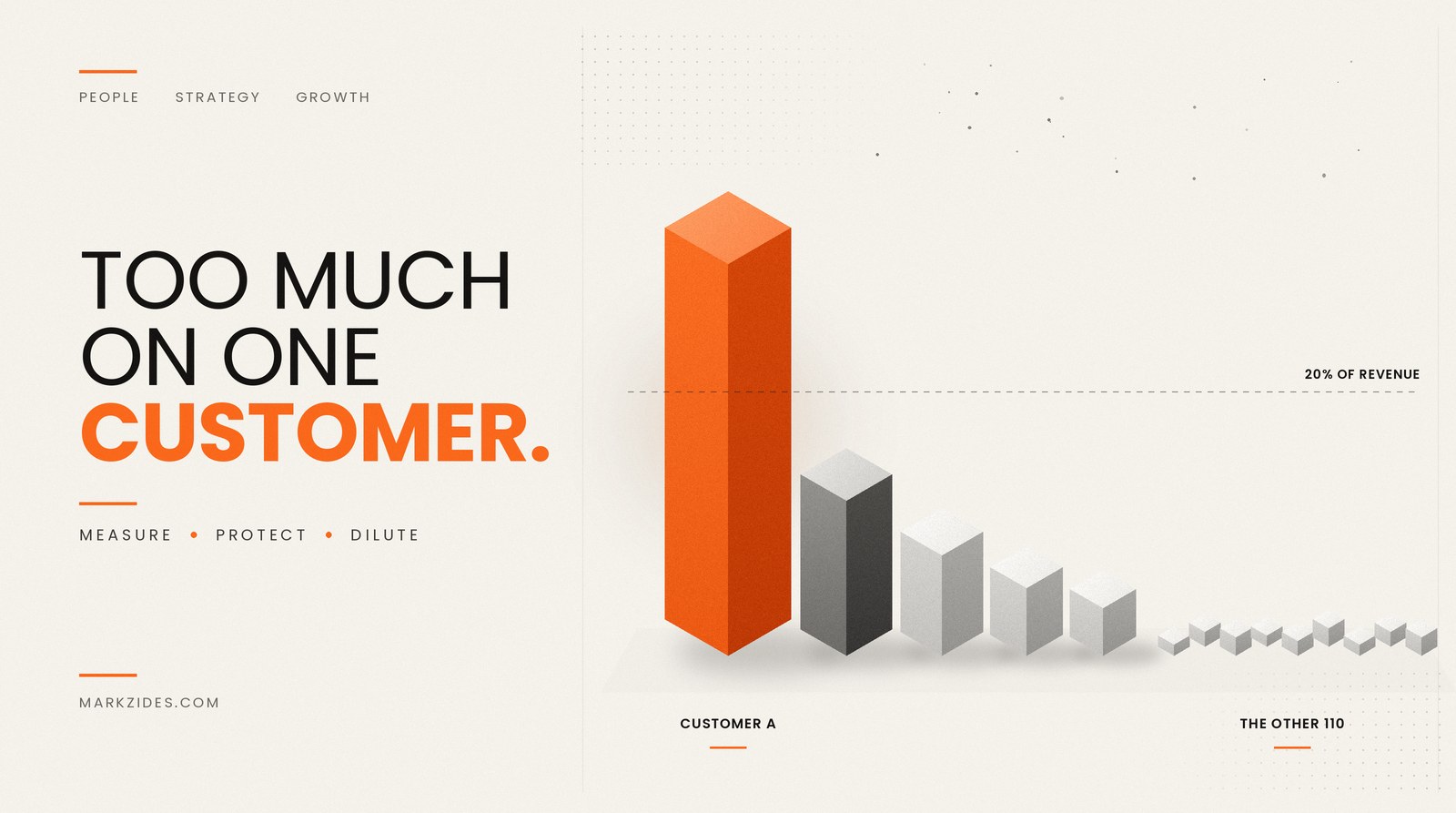
Landing a customer big enough to carry the business feels like the moment the company made it. Payroll is covered, the forecast looks easy, and the account team knows every name on the other side. Then something changes that you do not control. A new buyer joins them, a budget gets cut, or a rival offers a lower price, and the account that carries the business is suddenly up for discussion. Customer concentration risk rarely shows up in a good year. It shows up when the customer, a lender or a buyer for your company starts asking questions.
What Is Customer Concentration Risk?
Customer concentration risk is the risk that a company depends on so few customers for its revenue that losing one, or giving in to one, would change the business. It is usually measured as the share of annual revenue that comes from the largest customer and from the top five.
The risk comes in two forms, and the second one is the one owners forget.
- Loss. The customer leaves, cuts its spending or goes under, and the revenue goes with it. The costs you built to serve it stay.
- Leverage. The customer knows how much you need it. It asks for a lower price, longer payment terms or free extras, and you agree, because the alternative is worse. Concentration costs you margin long before it costs you revenue.
In professional services the same thing is called client concentration. The measure and the fixes are the same.
How to Calculate Customer Concentration
Take revenue by customer for the last twelve months, rank the customers from largest to smallest, and divide each one's revenue by the total. Two figures matter most.
- Largest customer share = largest customer's revenue ÷ total revenue
- Top five share = revenue from the five largest customers ÷ total revenue
Count customers as a buyer would. Two subsidiaries of the same parent company are one customer. So are several sites that sign one contract.
Here is a worked example for a company with $12 million in revenue over the last twelve months.
| Customer | Revenue | Share | Running total |
|---|---|---|---|
| Customer A | $3.0M | 25% | 25% |
| Customer B | $1.4M | 12% | 37% |
| Customer C | $1.0M | 8% | 45% |
| Customer D | $0.6M | 5% | 50% |
| Customer E | $0.5M | 4% | 54% |
| The other 110 customers | $5.5M | 46% | 100% |
The largest customer is 25 percent and the top five are 54 percent. Both are high. A buyer looking at this company will spend more time on Customer A than on anything else in the business.
The concentrations hiding behind the top five
The top five share is where most calculations stop. A careful buyer keeps going, because a business can look spread out and still hang on one thread.
- Relationships. If the founder personally holds most of the large accounts, the business is concentrated in one person. This is the most common reason a company that still sells through its founder is worth less than its numbers suggest.
- Renewal dates. Forty customers who all renew in the same quarter are a single bad quarter waiting to happen.
- Industry. Many customers in one sector can all cut spending at the same time.
- Channel. If one distributor or channel partner brings in most of your customers, you depend on that partner, however many end customers you have.
- Pipeline. If one customer is 20 percent of revenue but 40 percent of the deals you expect to close this year, the risk is growing, not shrinking.
How Much Customer Concentration Is Too Much?
As a rule of thumb, one customer above 10 percent of revenue gets noticed, and one above 20 percent changes the terms of a sale or a loan. There is no legal limit for a private company. The bands below are the ones buyers and lenders commonly work to, and they shift by industry and size of deal.
| Largest customer | Top five | How it reads | What tends to happen |
|---|---|---|---|
| Under 10% | Under 25% | Low | Rarely raised |
| 10 to 20% | 25 to 50% | Moderate | Buyers ask for the contract, the history and who owns the relationship |
| 20 to 30% | Over 50% | High | Priced into the offer, or into how much of the price is paid later |
| Over 30% | Over 70% | Severe | Some buyers walk away. The rest want much of the price tied to keeping the customer |
The 10 percent line has an official source. Under US accounting rules (ASC 280), a public company must disclose when any single customer accounts for 10 percent or more of its revenue. Buyers and investors read those disclosures, so they carry the same habit into private deals.
Two things move the bands. A contract helps: a large customer on a multi-year agreement with a long notice period is a smaller risk than the same customer buying order by order. And one customer is not always one buyer. If your largest account is twelve divisions that each choose you and pay you separately, losing all twelve at once is unlikely, and a good buyer will see that. Some industries, such as government contracting and suppliers to a handful of large manufacturers, live with high concentration as normal and are priced against each other on that basis.
How Customer Concentration Affects Valuation
Customer concentration lowers what a buyer will pay, and changes how they pay it. Buyers value a company on the profit they expect to keep after they own it. Every point of revenue that one decision outside your control could remove is a point they discount, or protect themselves against.
Private equity firms say so directly. In Pepperdine's 2025 Private Capital Markets Report, the firms surveyed rated customer concentration 4.04 out of 5 for importance when judging a company's risk, close behind the strength of the management team at 4.21.
The discount rarely arrives as a single number. It shows up in the terms:
- A lower multiple on the profit, because the profit is less certain.
- More of the price paid later, through an earnout tied to keeping the customer, or a sum held back for a year or two.
- A call with the customer during due diligence, and sometimes a condition that the customer agrees to the sale.
- A close read of the contract, looking for a clause that lets the customer leave if the company changes hands.
Lenders react the same way. Banks that lend against receivables often cap how much of the borrowing base can come from one customer, so a concentrated business can borrow less against the same invoices. That is why customer concentration matters as much when a private equity firm is the buyer as when it is a competitor, and why it belongs at the top of any list of problems to fix before selling your business.
How to Reduce Customer Concentration Risk
Work on two tracks at once. Make the large customer harder to lose, and grow the rest of the business faster than it. The goal is not to shrink your best customer. It is to make it a smaller share of a bigger company.
Make the big customer harder to lose
- Put the relationship on paper. Move from purchase orders to a contract with a term, a notice period and renewal dates you know. If you plan to sell, check for clauses that let the customer leave on a change of ownership, and renegotiate them while there is no deal on the table.
- Widen the relationship. Build relationships at several levels on both sides: your account lead, a senior executive, and the people who use your product day to day. If the founder is the only link, the customer is tied to the founder, not to the company.
- Become harder to replace. Sell into more of their divisions, connect your work to their processes, and show them, in a review every quarter, the results they would lose by switching.
- Decide your walk-away point. Know the price and terms below which you would rather lose the account. A customer that senses you have no limit will keep testing it. If prices need to move, raise them with notice and a reason rather than waiting for the customer to set them.
Grow the rest faster
- Pick the next five. Name five to ten accounts that could each become a top customer, and give each the plan, the senior attention and the targets the largest one gets.
- Add a segment or a channel. A second industry, a second region, or a partner that reaches customers your team does not. Each is a separate source of revenue that does not move with the first.
- Set a ceiling and track it. Agree a limit, for example no customer above 15 percent of revenue, and report the largest customer share and the top five share every month alongside revenue.
Concentration does not fall in a quarter. Growing the rest of a company enough to dilute one large customer takes two or three years, which is why it belongs in an exit plan from the start, not in the six months before a sale.
What Buyers Ask About Your Largest Customers
Have these ready before the first buyer asks. A seller who can answer them at once looks like a seller in control of the risk.
| The buyer asks | Have ready |
|---|---|
| How has each large customer's revenue moved? | Revenue by customer for three years, with the reasons for any big change |
| What stops them leaving? | The contracts, with term, notice period, renewal dates and any change of ownership clause |
| Who holds the relationship? | A map of the contacts on both sides, showing it does not depend on one person |
| Are they profitable? | Gross margin by customer, including discounts and the cost to serve them |
| Is the customer itself healthy? | What you know about their plans, budget and buyers, and their payment record with you |
| What happens if they leave? | A plan: which costs would go, and how fast the rest of the business is growing |
The last answer matters most. A buyer can accept a large customer. What they will not accept is an owner who has never thought about losing it.
Frequently Asked Questions
What is a good customer concentration ratio?
For most companies, a largest customer below 10 percent of revenue and a top five below 25 percent is comfortable. Buyers rarely raise concentration at those levels. Between 10 and 20 percent for one customer, expect questions. Above 20 percent, expect it to affect the price or the terms of a sale.
Is 20 percent customer concentration high?
Yes, for a single customer. One customer at 20 percent of revenue is the point where most buyers start to price the risk, through a lower multiple, an earnout tied to keeping the customer, or both. A contract with a long term and notice period softens it.
Do companies have to disclose customer concentration?
Public companies in the United States do. Under the accounting standard ASC 280, they must disclose when a single customer accounts for 10 percent or more of revenue. Private companies have no such rule, but buyers, investors and lenders will ask for the same figures.
Can you sell a business with high customer concentration?
Yes, but usually for less, or with more of the price paid later and tied to keeping the customer. Some buyers will walk away. A signed multi-year contract, relationships beyond the founder and a growing rest of the business all narrow the gap.
How does customer concentration affect a business loan?
Lenders treat it as a risk to repayment. Banks that lend against receivables often cap how much of the borrowing base can come from one customer, so you can borrow less against the same invoices, and loan terms may be stricter.
Final Thought
A large customer is a strength until it becomes the thing a buyer, a lender or the customer itself can use against you. The fix is not to sell less to them. It is to know exactly how much of the company rests on them, put that relationship on firmer ground, and grow everything else faster. Finding that dependence before someone else does is the U of the UNLOCK Method: uncover the real constraints. If a sale is two or three years away, exit planning is where that work starts.
Ready to build a revenue engine that runs without you?
Mark works alongside founders as a player-coach — not a slide deck.
Book a 30-minute call