
Management Buyout: How to Sell Your Business to Your Managers

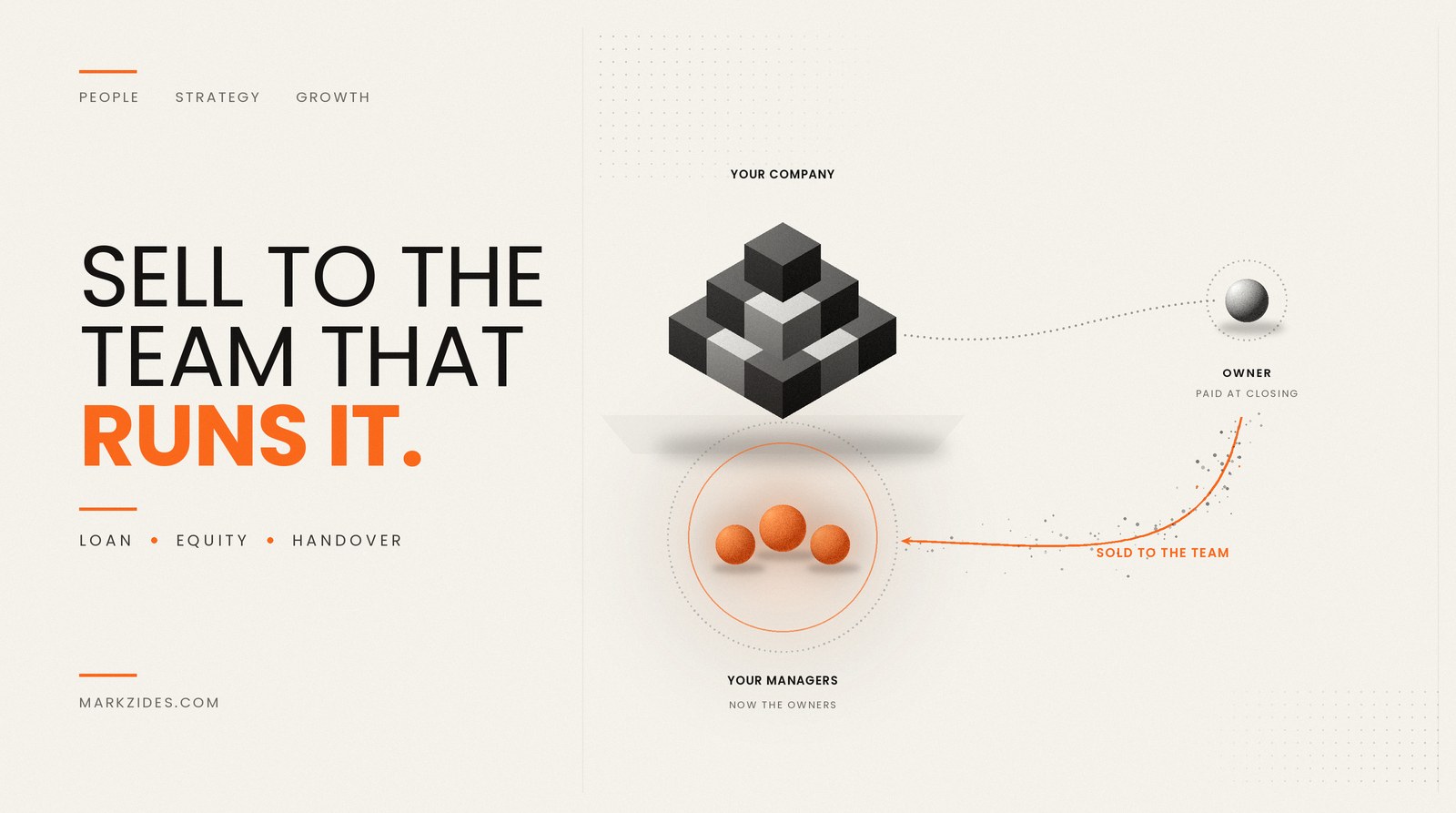
The best buyer for your company may already sit down the hall. Your operations lead knows every customer by name. Your finance manager knows where the margin hides. They would keep your people, protect your name and run the place much as you would. There is one problem: they do not have the money, and you do not want to wait a decade to be paid. A management buyout is how owners and their teams close that gap, and whether it works is settled long before anyone talks price, by lending rules most owners never read.
What Is a Management Buyout?
A management buyout (MBO) is the sale of a company to the people who already manage it. The managers borrow most of the price against the company's own cash flow, add some of their own money, and usually ask the owner to take part of the price later, as a loan.
It is one of the seven ways an owner can leave a company, and the one that changes the business least. The buyers know the customers, the systems and the problems, so there is less to discover and less to explain. What they lack is capital. That one fact shapes the rest of the deal: the price, the timing, how much you receive at closing and how long your money stays in the company.
A management buyout is not a sale to the whole workforce. An employee stock ownership plan (ESOP) buys shares for a trust that holds them for all employees, with its own tax rules and its own appraisal. It needs a separate plan and is left out here.
Management Buyout vs Management Buy-In vs Leveraged Buyout
The three differ in who buys and what they already know, and that difference changes how a lender treats them.
| Deal | Who buys | What they know | How it is paid for |
|---|---|---|---|
| Management buyout (MBO) | Your current managers | Everything, from the inside | Bank loan, their own cash, a seller note, sometimes an investor |
| Management buy-in (MBI) | An outside manager or team who will run it | Only what their checks turn up | The same mix, usually with an investor; lenders ask more of outsiders |
| Leveraged buyout (LBO) | An investment firm | What its checks turn up; it keeps or hires the managers | Mostly debt secured on the company, plus the firm's fund |
The lines blur. Most management buyouts are also leveraged buyouts, because the loan sits on the company being bought. Under SBA rules, an outsider who takes control counts as an initial acquisition, where the 10 percent equity cannot be reduced, so a buy-in costs the buyer more cash up front.
How a Management Buyout Works
A management buyout works by turning the company's future profit into a price paid to you today. Four parties sit at the table:
- The managers. They buy the shares or the assets, often through a new company, and they sign for the loan alongside the business.
- The lender. It lends against the company's cash flow, not the managers' savings, so its rules set the ceiling on the price.
- You, the seller. You take most of the price at closing and, in most deals, lend the rest back as a seller note.
- Sometimes an investor. When the loan and the team's cash fall short, an investor buys a stake for the difference.
At closing, the loan and the managers' cash pay you, and the company takes on the debt. After closing, the company repays the bank from its profit, typically over up to ten years, and repays your note on whatever terms you agreed.
The point for an owner is that the company pays for itself. Every loan payment comes out of the profit you built, which is why the lender's reading of that profit decides the deal, and why a buyout that stretches the company too far hurts the managers first and your note second.
How to Finance a Management Buyout
A management buyout is financed from four sources, usually layered in this order:
- A bank loan. In the US this is often an SBA 7(a) loan, which can cover most of the price.
- The managers' own cash. It shows the lender the buyers have something to lose.
- A seller note. You lend part of the price back and are repaid over time.
- An investor. Cash for a share of the company, when the first three do not reach the price.
Bank lending is the backbone of small company sales. In BizBuySell's third-quarter 2026 survey, 78 percent of buyers said they expect to use SBA financing to complete an acquisition, and seller financing is increasingly bridging the gap. Seller money is normal at larger sizes too: investment bankers in Pepperdine's 2025 Private Capital Markets Report said seller financing was used to close 54 percent of their deals.
Two other tools close a gap. An earnout makes part of the price tied to future results, though a lender will look hard at any payment that competes with its loan. And when the gap is too wide for a note, an investment firm backs the managers: it supplies most of the equity, often takes control, and the managers own a smaller share with room to earn more.
The 2026 SBA Rules for Management Buyouts
New SBA rules took effect on October 1, 2026, in SOP 50 10 8.1, issued with Information Notice 5000-880695. They decide how much your managers can borrow and what you must accept to make it work.
| Rule | What it says | What it means for you |
|---|---|---|
| Who counts as an owner buyout | Buyers who have worked actively in the business for the last 24 consecutive months. A buyer with less time is treated as an outside acquisition. | Start the clock early. A manager hired 18 months ago cannot use these terms yet. |
| Equity | 10 percent of the purchase price. For owner buyouts, the lender may reduce or waive it if the company has enough cash and working capital and no negative net worth. | Your managers may need far less of their own money than an outside buyer would. |
| Seller note as equity | Counts only on full standby, with no principal or interest paid for the term of the loan, and for no more than half the required equity. | If your note fills the equity, you wait up to ten years for it. |
| Debt service coverage | Cash flow must cover the loan payments at least 1.25 times. | This is the ceiling on the price. |
| Valuation | An independent valuation by an accredited appraiser on every change of ownership. Total debt cannot exceed it. | The bank will not lend past the appraised value, whatever price you agree. |
| Loan size and term | Up to $5 million on a standard 7(a) loan, repaid over no more than 10 years. | Above roughly $1 million of cash flow, the cap binds and other money is needed. |
| Whether you can stay | In an outside acquisition, the seller leaves and may consult for up to 24 months. In a partial sale, an original owner stays and guarantees the loan. | Decide early whether you sell all of it or keep a stake. |
These rules cover SBA-guaranteed loans. A conventional bank loan follows the bank's own policy, and a buyout above the $5 million cap usually needs an investor or a larger seller note.
Management Buyout Example: The Numbers
Here is the arithmetic on an illustrative company. It earns $800,000 a year in EBITDA, its profit before interest, tax, depreciation and amortization, and you agree a price of $4.0 million, five times that profit. The two managers buying it have both worked there for more than 24 months.
- Bank loan: $3.6 million, 90 percent of the price.
- Managers' cash: $200,000.
- Your seller note, on full standby: $200,000. Together with the managers' cash it makes the $400,000 of equity, and it is the most a note can supply: half.
Now the lender's check. Over 10 years at an assumed 10 percent rate, the $3.6 million loan costs about $571,000 a year. Coverage is $800,000 ÷ $571,000 = 1.40, above the 1.25 floor. At exactly 1.25, the same profit would carry a loan of about $4.0 million, so with the equity the highest price it supports is near $4.5 million, if the valuation agrees.
The same rules lend very different sums at other levels of profit:
| Yearly cash flow | Most the bank lends at 1.25 coverage | Highest price with 10 percent equity |
|---|---|---|
| $500,000 | About $2.5 million | About $2.8 million |
| $800,000 | About $4.0 million | About $4.5 million |
| $1,000,000 | $5.0 million, the cap | About $5.6 million |
| $1,500,000 | $5.0 million, the cap | About $5.6 million, unless an investor or a larger note fills the rest |
All figures are illustrative, at an assumed 10 percent rate over 10 years. Lenders measure cash flow more strictly than EBITDA, after the salaries the new leaders will draw and the spending needed to keep the business running, so the real figure is usually lower. Treat these as ceilings and ask a lender to run your own numbers.
Is Your Management Team Ready to Buy?
Your team is ready when they already run the company and can carry a loan. Run these five tests 12 to 24 months before a sale:
- They already make the decisions. Hiring, pricing and the budget run through them. If you still approve every large quote, the real buyer is still you.
- One leader, with the others behind them. A buyout needs one person who will be chief executive, and a group that agrees who it is before money is discussed.
- They can find their share of the equity. Even if the lender cuts the 10 percent, a team with nothing of its own at stake is a weak buyer. Ask early what each could put in.
- They will sign the loan personally. Lenders ask the buyers to stand behind it. Some strong managers will not put their home behind a loan, and that is better learned now.
- Your largest customers deal with them, not you. If your top accounts still call you, the lender and the managers both carry a risk neither can price.
Together these tests describe a company that already runs without you, owned by you and led by them. If two of the five fail, fix them before you talk price. A buyout agreed with an unready team leaves the risk with you after closing, while your note is still owed.
How to Do a Management Buyout in 6 Steps
A management buyout starts 12 to 24 months before closing. These are the six steps, in order.
1. Test the Team 12 to 24 Months Out
Run the five tests above and act on what fails. Give the likely leader a profit and loss to run, put them in front of your largest customers, and make sure each buyer will pass the 24-month employment test by the time a lender sees the file.
Do this: name the leader in private and agree a date by which they will run the company without you for a month.
2. Get an Independent Valuation
The SBA requires one from an accredited appraiser, and total debt cannot exceed it, so it anchors the whole deal. Order it before you discuss a price with your managers, so the number comes from neither side.
Do this: commission the valuation yourself, and share it with the team only once you have read it.
3. Build the Financing
Work backward from the lender's coverage test to the most the company can borrow, then decide how the rest is paid: the managers' cash, your note, an earnout or an investor. Talk to two or three lenders who make change of ownership loans.
Do this: write the sources of money on one page, with how much each puts in and when you are paid.
4. Manage the Conflict of Interest
Your managers are negotiating against you while they run your company and hold its information. They know which quarter will be weak and which customer is wobbling. Keep the roles apart: you need your own adviser and lawyer, and they need theirs.
Do this: agree in writing that the business keeps running as normal during the sale, with the same targets and reporting.
5. Complete Diligence and the Documents
The lender and any investor will run the same diligence any buyer runs, even though the buyers know the business. Expect a purchase agreement, the loan documents, a standby agreement if your note counts as equity, and non-compete terms.
Do this: read the standby agreement line by line before you sign it, since it decides when you are paid.
6. Hand Over
Set out what you do after closing. If you sell everything, you leave, though under SBA rules an outside buyer may hire you as a consultant for up to 24 months. If you keep a stake, you stay as an owner and guarantee the loan.
Do this: write a handover plan with dates for every customer, supplier and banking relationship you still hold.
Pros and Cons of a Management Buyout for the Owner
A management buyout trades some price and some certainty for control over who carries the company on.
| What you gain | What you give up |
|---|---|
| Your people, customers and name stay with a team you chose | Usually a lower price than an open sale would bring |
| Buyers who already know the business, so diligence is quicker and less disruptive | Part of the price waits, sometimes ten years behind the bank |
| A confidential sale, with no auction and no competitor reading your numbers | Your unpaid money depends on how well the managers run the company |
| Control over timing and structure, with people you trust | Negotiating with your own employees strains the relationship |
| Room for a gradual handover if you keep a stake | If the team is not ready, there may be no deal at all |
Common Management Buyout Mistakes
The costly mistakes in a buyout are about terms and timing, and the owner controls both. These are the ones to avoid:
- Agreeing a price before running the lender's numbers. A figure the coverage test cannot support has to be cut later, after everyone has counted on it.
- Signing a seller note without reading the standby terms. On full standby, you receive nothing until the bank is repaid.
- Starting too late. A manager short of 24 months in the business moves the deal into stricter rules.
- Using one adviser for both sides. Your managers' interests and yours diverge the moment a price is named.
- Selling to a team that has never run the company without you. The weakness shows up after closing, while your note is still owed.
Frequently Asked Questions
How does a management buyout work?
The managers agree a price with the owner, then fund it with a bank loan, some of their own cash and usually a seller note. The company repays the loan from its profit over up to ten years. The lender's coverage test and an independent valuation set how much can be borrowed, which effectively caps the price.
Can employees buy a business with no money?
Rarely with none, but with very little. Under SBA rules for owner buyouts, a lender may reduce or waive the 10 percent equity when the company has enough cash and working capital. A seller note on full standby can also count for half of it. Lenders still prefer buyers with something of their own at stake.
What is the difference between an MBO and an MBI?
In a management buyout, the company's existing managers buy it. In a management buy-in, an outside manager or team buys it and takes over running it. Insiders know the business and are easier to finance. An outsider who takes control falls under stricter SBA rules, where the 10 percent equity cannot be reduced.
Can an SBA loan fund a management buyout?
Yes. An SBA 7(a) loan of up to $5 million can fund a change of ownership, repaid over up to ten years. Buyers employed in the business for the last 24 consecutive months qualify as an owner buyout. The company's cash flow must cover the payments 1.25 times, and an independent valuation is required.
Is a management buyout cheaper than selling to an outside buyer?
Usually, yes. Managers can pay only what the company's cash flow lets them borrow, while an outside buyer may pay more for growth or savings they can add. It can cost less to complete, because there is no search for a buyer. The trade is a lower price for more control over who takes over.
Final Thought
A management buyout pays the owner who built a team, not just a business. The price depends on what the managers can borrow, and what they can borrow depends on whether the company already runs through them. Both are decided by how you organized the company years before the sale. That is the O of the UNLOCK Method: organize for growth. Mark has three exits behind him. His exit planning work tests the team, sets the valuation and builds the financing early enough for your managers to buy on terms that pay you.
Ready to build a revenue engine that runs without you?
Mark works alongside founders as a player-coach — not a slide deck.
Book a 30-minute call