
Business Exit Strategy: 7 Options, What They Pay and How to Choose

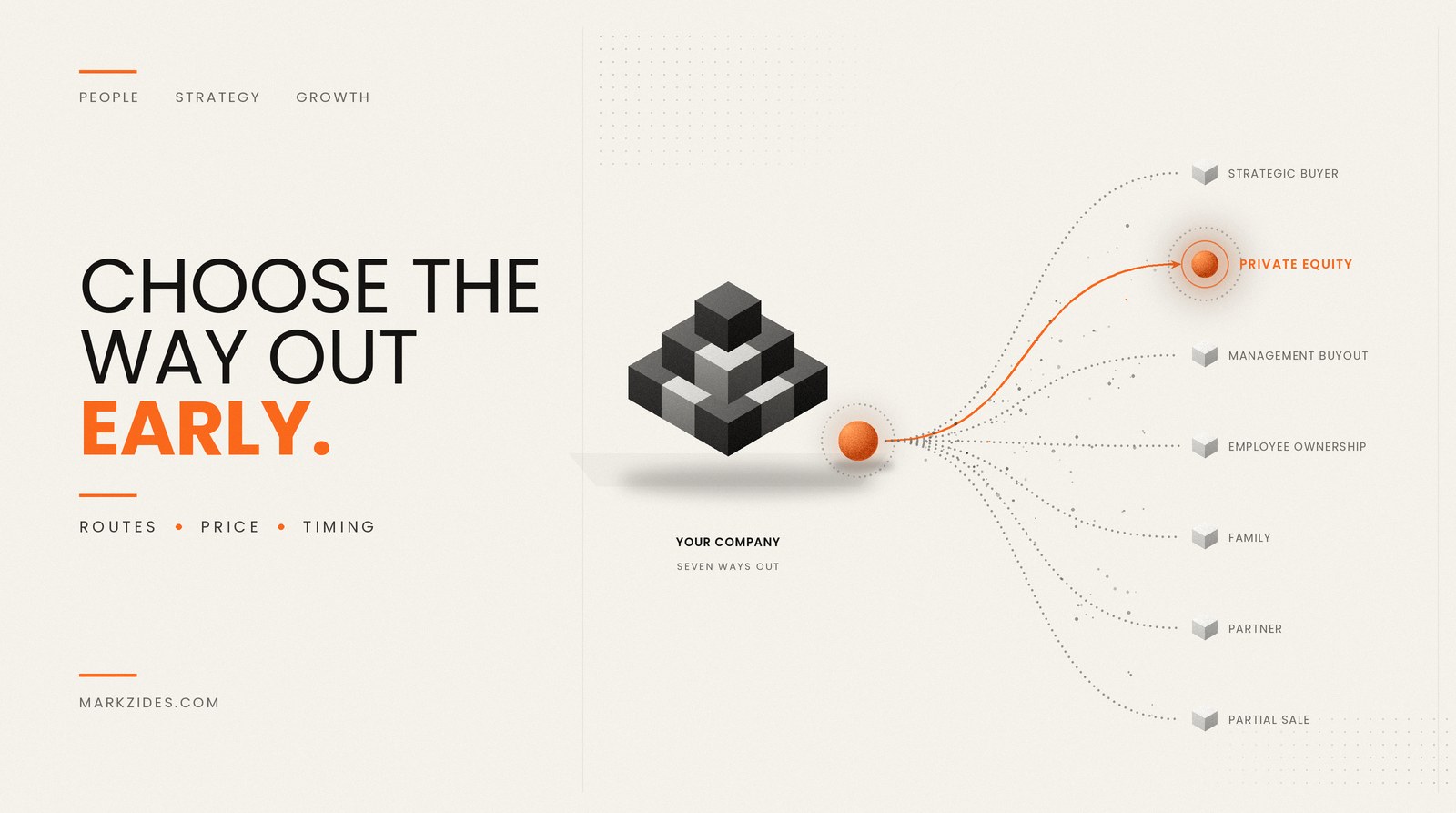
Most owners can name the number they want for their company. Far fewer can say who would pay it, how the money would reach them, or what they would do the Monday after. That gap is where good companies lose value. An owner decides to sell when they are tired, takes the first serious offer, and learns at closing that a large part of the price is a promise. The owners who avoid this settle those questions years before anyone calls. They treat a business exit strategy as part of running the company, not as its last chapter.
What Is a Business Exit Strategy?
A business exit strategy is your plan for leaving the company you own: who takes it over, how much you are paid, when the money reaches you and what part you play afterwards. It is set years before a sale, because most of what decides the price takes years to change.
An exit strategy is not the same thing as a sale. The sale is one event at the end. The strategy chooses the route first, then shapes the company so that route pays. Two owners with the same profit can walk away with very different sums: one picked the likely buyer early and prepared for that buyer, the other sold to whoever called first.
Exit planning is the work of carrying it out: the valuation, the handover of your own job and the fixes a buyer would otherwise discount.
The 7 Business Exit Strategies
There are seven types of exit strategies that fit an owner-run company. They differ less in the headline price than in how that price is paid and who carries the business on after you.
| Route | Who pays | Price | Cash at closing | Your role after | Needs first |
|---|---|---|---|---|---|
| Strategic buyer | A competitor, supplier or customer | Often the highest | Most of it | A short handover | Something the buyer cannot build |
| Private equity | An investment firm | Strong once profit is large | Most, with part rolled over | Often stay to run it | Profit that can grow, and a team |
| Management buyout | Your own managers | Usually below market | Part, the rest over years | Their lender | Managers who can run it and borrow |
| Employee ownership (ESOP) | A trust for your employees | Appraised fair market value | Part, the rest over years | Often stay for the transition | Profit to carry the loan |
| Family succession | A child or relative | Whatever you agree | Little | Adviser, or owner of the rest | A successor who wants it |
| Sale to a partner | Your co-owner | Set by your buy-sell agreement | Often paid in installments | Out | A written agreement, funded |
| Partial sale | An investor buying a stake | A share of full value | For the part sold | Still in charge | Profit large enough to attract one |
1. Sell to a Strategic Buyer
A strategic buyer is a company already in or near your market: a competitor, a supplier, a customer or a larger firm moving into your line of work. They can pay the most because they count savings and sales you could never reach alone, such as your customers on their products or one office instead of two. That premium is not automatic. They pay it when you have something they cannot build quickly: a customer base, a licence, a location or a team. Expect most of the price at closing, with part held back against claims and sometimes part paid later and only if targets are met. Your job usually ends after a handover, and your company's name may not last.
Below about $1 million in price, the outside buyer is often an individual buying a job rather than a company. They lean on bank loans: 78 percent of the buyers BizBuySell surveyed in the third quarter of 2026 expect to use an SBA loan, and seller financing is increasingly filling the gap when the loan falls short.
2. Sell to Private Equity
A private equity firm buys your company with its investors' money and borrowed money, plans to grow it, and sells it again some years later. Most of what these firms buy is bolted onto something they already own: in PitchBook's count for the third quarter of 2025, add-ons were 74.1 percent of US buyouts. If your company is bought as an add-on to a company the firm already owns, you are priced as a part of the plan. If it becomes the platform the firm builds on, you are usually asked to keep running it and to roll part of the price into the new company, which pays a second time when the firm sells.
The terms of a sale to a private equity firm turn on the cash at closing, the debt the firm puts on the company, how much you roll over and what role you are offered. One of Mark's three exits was into a nine-figure private equity roll-up, so Mark has read those terms from the seller's chair.
3. Management Buyout
In a management buyout, the people who already run the company buy it from you. They know the business, so the checks are lighter and customers barely notice. The catch is money. Managers rarely have the price, so they borrow what a bank will lend against the company's cash flow, and you lend the rest as a seller note repaid from future profit. That makes you a creditor of a company you no longer control, and if it struggles, your payments are the first to slow. A buyout works when the managers already make the big decisions, the company carries little debt and you can wait for part of your money.
4. Employee Ownership Through an ESOP
An employee stock ownership plan, or ESOP, is a trust that buys your shares on behalf of your employees. The company usually borrows to fund the purchase and repays the loan from its profits over several years. You are paid fair market value, set by an independent appraiser, so an ESOP will not match a strategic buyer's premium. What it offers instead: your team keeps the company, you can sell in stages, and US tax rules give the seller and the company advantages that your tax adviser should price for you. The NCEO counts 6,411 US companies with an ESOP, 5,993 of them private. It needs a payroll and steady profit large enough to carry the loan.
5. Family Succession
Passing the company to a child or relative keeps your name on the door, but it is the route most likely to blur price, control and family. Children rarely have the money to pay full value, so the transfer is often part gift and part sale over many years, which needs estate and tax advice. The harder question is the successor, not the price. Do they want it, and could they run it if you were not in the building? Answer with evidence: give them a real part of the company to run for two or three years and judge the results. Agree in writing what happens for relatives who are not in the business, and when you step out of the decisions.
6. Sell to a Partner
If you own the company with partners, the simplest exit is often to them. A buy-sell agreement sets the terms in advance: what triggers a sale, such as retirement, death, disability or a dispute, how the price is set and how it is paid. The usual gap is funding. A formula price means little if the remaining partners cannot pay it, so agreements are often backed by insurance for death and disability and by installments for retirement. Check yours today: when was the valuation formula last updated, and would it produce a price you would accept?
7. Partial Sale or Recapitalization
A partial sale lets you take money out without leaving. An investor, often a private equity firm, buys a minority or majority stake. You keep running the company and keep the rest of the shares. Done well, it pays twice: once now, and again on the rest when the company is sold later at a larger size. It also brings a partner who will want board seats, monthly reporting and a say in big decisions, so it suits an owner who wants help to grow, not one who wants to be left alone. Ask how and when the investor plans to sell, because their timetable becomes yours.
Two routes are left off on purpose. Closing the company returns the least, because buyers pay for the equipment and stock, not the profit they produced, so it fits only when nobody would buy the company whole. A stock market listing suits a handful of very large companies and does not let an owner leave quickly.
How to Choose an Exit Strategy
Four questions narrow the exit strategy options to two or three. Answer them in order, because each one rules routes out.
- How much do you need at closing? Work back from what you need, after tax, fees, debt and any part paid later. If you need most of the price on the day, your routes are a strategic buyer or private equity. If you can wait for part of it, a management buyout, an ESOP and a family sale open up.
- Could someone inside run it without you? A management buyout, an ESOP and family succession all need a successor already in the building. If there is nobody, you are choosing an outside buyer, or two years of building the team first.
- Do you want to stay involved? A partial sale or a private equity platform keeps you in the company and pays you again later. A strategic sale or a sale to your partner gets you out.
- How large are the earnings? Size decides who will look at all. Small companies sell mostly to individuals and to companies in the same market. Investment firms look for profit large enough to carry the debt they will put on it.
Under all four sits one test: how much the company still depends on you. When BizBuySell published its Q3 2026 report, its president Bob House said in the release that buyers were "gravitating toward businesses with reliable cash flow, clean financials, limited owner dependence, and a clear path to financing."
Do this: write your answers to the four questions on one page before you speak to any buyer or adviser.
What Each Exit Strategy Pays
The route decides who can pay. The size of the company and how far it depends on you decide how much. In GF Data's records of 5,669 private equity deals from 2003 to September 2025, the average price rose from 5.9 times EBITDA for companies valued at $10 million to $25 million, to 9.7 times for those valued at $250 million to $500 million.
Smaller companies trade lower again. BizBuySell's Q3 2026 Insight Report counted 2,132 small businesses sold in the quarter at a median price of $350,000. Those that sold for more than $1 million averaged 3.73 times cash flow, and those below $1 million averaged 2.30 times.
Owner dependence works the same way inside a single company. Take an illustrative company with $3 million of EBITDA. At 5.9 times, it is worth about $17.7 million. If a buyer believes a third of that profit leaves with the owner, they price $2 million of EBITDA, and the same multiple gives $11.8 million. Nothing about the route changed. Only the buyer's view of what happens when you leave.
The internal routes usually pay less than the market. Managers and family borrow against the same profit the company needs to run, so the price is set by what they can finance. How the money arrives matters as much as the multiple. Investment bankers in Pepperdine's 2025 Private Capital Markets Report said seller financing was used to close 54 percent of their deals and rollover equity 50 percent. Compare offers on the cash at closing first, then on what is promised later.
How to Build an Exit Plan in 5 Steps
An exit plan turns the strategy into dates and work. Start two to three years before you want to leave.
1. Set the Number, the Date and Your Role After
Write down the cash you need after tax, fees and debt, the year you want to be out of the daily work, and what you want to do the week after you leave. These three answers pick the route more reliably than any valuation.
Do this: ask a tax adviser what the number means before tax, since that is the figure a buyer will negotiate.
2. Get a Valuation
An independent valuation tells you whether the number is realistic today and how far the company is from it. Ask the valuer what they would discount and why. That list is your work plan.
3. Take Yourself Out of the Daily Work
Every route except closing needs someone who can run the company without you. Building a company that runs without you means handing over decisions first, then the selling, then the relationships with the largest customers. A buyer will want a year or more of evidence that it already works this way.
4. Fix What Buyers Discount
The usual list is short. A buyer discounts a company where one customer is too large a share of revenue, where revenue has to be won again every year, where the books need the owner to explain them, and where key contracts end when you leave. Each takes a year or more to change.
5. Pick the Route and Keep a Second One Open
Choose the route your answers point to, and keep one more alive until signing: a private equity process with a management buyout behind it, or a strategic sale with a partial sale as the fallback. A second route is what lets you refuse a bad term. Once the route is clear, the sale itself took a median of 8 to 9 months from listing to closing among the brokers in Pepperdine's survey.
Exit Strategy Example: A One-Page Plan
This is an illustrative plan for a services company with $3 million of EBITDA. The figures only show the format.
| Item | Illustrative plan |
|---|---|
| The number | $12 million after tax, fees and debt |
| The date | Out of the daily work by the end of 2028, sold by mid-2029 |
| Role after | Two years on the board, no operating role |
| First route | Sale to private equity as a platform |
| Second route | Management buyout led by the operations director and the finance lead |
| What a buyer would discount | The top customer is 28 percent of revenue, and the owner closes every deal over $100,000 |
| Work this year | Hire a sales leader and move the top customer to an account team |
| Work next year | Grow the second-largest customer group and close the monthly accounts in ten days |
Do this: fill in the same eight rows for your company and review them every quarter.
Common Exit Strategy Mistakes
Most failed exits fail on timing and preparation, not on the route. The Exit Planning Institute says only 20 to 30 percent of businesses that go to market actually sell.
- Planning only once you are worn out. An exit decided in the depths of founder burnout takes the first offer and accepts terms a rested owner would refuse.
- One route and no fallback. A buyer who knows you have nowhere else to go will price that in, usually late in the deal.
- Judging offers on the headline price. Two offers with the same number can pay very different amounts at closing.
- An untested successor. Family and management routes fail when nobody checked whether the successor could run the company without you.
- Telling people at the wrong time. Too early, staff and customers get nervous. Too late, the managers you need feel bypassed. Tell your leadership team when the route is chosen, and everyone else when the deal is signed.
Frequently Asked Questions
What are the 5 exit strategies?
Most lists name five: a sale to an outside buyer, a management buyout, employee ownership through an ESOP, family succession and closing the business. Owner-run companies have two more worth weighing: a sale to a partner under a buy-sell agreement, and a partial sale that takes money out while you keep running the company.
What is the best exit strategy for a small business?
For most small businesses, a sale to an outside buyer pays the most at closing, and that buyer is often an individual using a bank loan. If a manager or relative could run the company, a buyout keeps it going but usually pays over years. The best route is the one that fits your number, your date and your successor.
When should you start planning an exit?
Start two to three years before you want to leave. That is how long it takes to hand over the daily work, reduce reliance on your largest customers and show a buyer a clean record. Starting earlier costs nothing, because the same work makes the company easier to run while you still own it.
How long does it take to exit a business?
The sale itself took a median of 8 to 9 months from listing to closing among the brokers in Pepperdine's 2025 survey. The preparation before it usually takes longer, often two years or more. Payments can also continue after closing, through a seller note, an earnout or a second sale of the shares you rolled over.
What is an exit strategy in a business plan?
In a business plan, the exit strategy section tells investors how they will get their money back, usually through a sale to a larger company or to private equity within a set number of years. Keep it short and specific: the likely buyers, the rough timing and the results that would make the company attractive to them.
Final Thought
Owners rarely regret the route they chose. They regret choosing it late, when the business still ran through them and the first offer looked like the only one. The routes that pay best and the routes that keep the company going share one condition: a company that keeps growing after you step back. That is the K of the UNLOCK Method: keep scaling beyond the founder. Mark has three exits behind him, one of them a nine-figure private equity roll-up. His exit planning work starts twelve to twenty-four months before a sale and fixes what a buyer would otherwise discount.
Ready to build a revenue engine that runs without you?
Mark works alongside founders as a player-coach — not a slide deck.
Book a 30-minute call