
Private Equity Roll-Ups: How They Work and What They Mean for Owners

The letter usually comes from a company you have never heard of. It says it is building a national leader in your industry and would like to talk about a partnership. Within a year, two of your competitors have new owners, and your best manager has taken a call from a recruiter for a regional group. That is a private equity roll-up arriving in your market. Almost everything written about roll-ups is written for the investors who run them. This is written for the owner on the other side of the table, who has one sale to get right.
What Is a Private Equity Roll-Up?
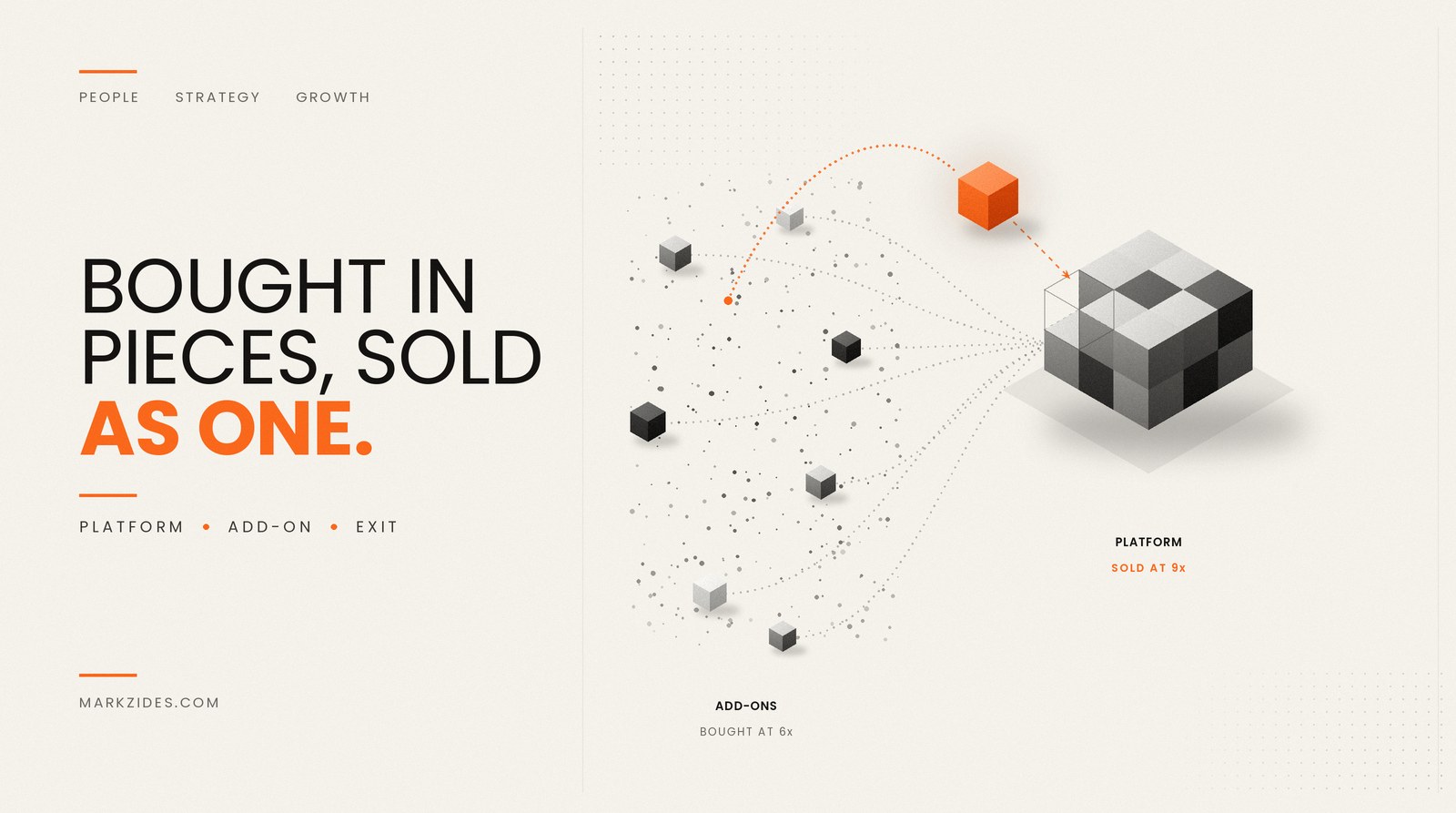
A private equity roll-up is a strategy in which a private equity firm buys one established company in a fragmented industry, then buys smaller companies in the same industry and merges them into it. The aim is to sell the larger group a few years later at a higher multiple of earnings than the firm paid for the parts.
It is also called buy-and-build, a consolidation play or a rollup. Bain & Company defines buy-and-build as a platform company making at least four add-on acquisitions. In its 2024 study of the strategy, close to half of all add-on deals were at least the fourth purchase by the same platform, up from 21 percent in 2003. Owners in a consolidating industry are rarely dealing with a one-off buyer. They are dealing with a buying program.
These are the words you will hear in the first meeting:
| Term | What it means for you |
|---|---|
| Platform | The first, larger company the firm buys. The others are joined to it, and its leaders usually run the group. |
| Add-on | A smaller company bought and merged into the platform. |
| Sponsor | The private equity firm that owns the platform and funds the purchases. |
| Multiple | The price as a multiple of yearly earnings, usually EBITDA. |
| Rollover equity | Part of your price taken as shares in the platform instead of cash. |
| Holding period | How long the firm plans to own the platform before it sells the group. |
Roll-up vs bolt-on vs tuck-in
A roll-up is the whole strategy. A bolt-on and a tuck-in are single purchases inside it. A bolt-on usually keeps its name, team and customers and runs as a unit of the platform. A tuck-in is absorbed completely, so its name, systems and often its office disappear. Ask which one the buyer has in mind, because it tells you how much of what you built will survive.
How a Roll-Up Strategy Makes Money
A roll-up makes money three ways: buying small companies at lower multiples than the combined company sells for, cutting the costs the companies no longer need to carry separately, and growing faster once they are together. The first is the one every owner should understand, because it is paid for out of the seller's price.
1. Multiple arbitrage
Buyers pay more for each dollar of earnings in a larger company. A bigger business has more customers, more managers and more ways to grow, so it looks less risky. In GF Data's records of 5,669 private equity deals from 2003 to 2025, companies sold for $10 million to $25 million went for 5.9 times EBITDA on average. Companies sold for $250 million to $500 million went for 9.7 times.
A roll-up turns that gap into profit. The example below uses multiples in line with those averages.
| Step | EBITDA | Multiple | Value |
|---|---|---|---|
| The firm buys a platform | $10M | 8x | $80M |
| It buys five add-ons at $2M EBITDA each | $10M | 6x | $60M |
| Total paid | $20M | 7x on average | $140M |
| It sells the combined company | $20M | 9x | $180M |
The firm makes $40 million before it has grown anything, and before debt, fees and the cost of joining the companies. The five owners sold $10 million of EBITDA for $60 million. Inside the combined company, the same earnings were valued at $90 million. That difference is why the buyer called, and it is the room you have to negotiate.
2. Shared costs
Six companies do not need six finance teams, six payroll systems, six insurance policies and six sets of supplier contracts. The roll-up runs one back office and buys at the scale of the group. Every dollar saved is added to EBITDA, which is then sold at the higher multiple.
3. Faster growth
A larger company can bid for contracts none of the parts could win alone, sell each company's services to the others' customers, and hire managers a small firm could not afford. This is what separates good roll-ups from weak ones. In Bain's review of 44 buy-and-build deals made between 2010 and 2019, those that relied on multiple arbitrage alone returned 1.4 times the money invested on average. Those with a real plan for faster growth or better margins returned 2.2 times.
Which Industries Get Rolled Up
Private equity rolls up industries made of many small, owner-run companies, where no firm has a large share of the market and demand is steady. The usual targets share most of these traits:
- Fragmented. Hundreds or thousands of similar companies, most of them run by their founders.
- Recurring demand. Customers buy again every year, through contracts, maintenance or plain need.
- Local delivery. The work is done near the customer, so no national leader has taken the market.
- Owners nearing retirement. Many founders with no successor, which means a steady supply of sellers.
- A back office that can be shared. Billing, scheduling, purchasing and hiring work the same way from one company to the next.
That is why the same industries come up again and again: heating, air conditioning, plumbing and electrical contractors; dental, veterinary and physical therapy practices; accounting firms and financial advisers; insurance agencies; IT managed service providers; landscaping, pest control and other home services; and testing, inspection and specialist business services. A newer kind of roll-up buys service firms, accounting practices among them, and plans to raise margins with AI software as well as a shared back office. The arithmetic is the same.
Roll-ups are now the main way private equity buys companies. Add-ons made up 74.1 percent of all US private equity buyouts in the third quarter of 2025, according to PitchBook's US PE Breakdown, against a five-year average of 72 percent. Ten years earlier the share was under 60 percent.
Signs a roll-up has reached your market
- Letters or calls about a "partnership" from a company you do not recognize, owned by a fund.
- Competitors that keep their names but add "part of" a group you have never heard of.
- A competitor bidding on work it was too small for last year.
- Your managers getting calls from recruiters for a new regional group.
- Suppliers offering better volume terms to a group you are not part of.
Platform or Add-On: What Each Owner Gets
Whether your company is bought as the platform or as an add-on decides almost everything about the deal: the multiple, your role afterwards, how much rollover equity you are offered and how much of your company survives. Platforms are usually the larger, better-run companies in the group, with a management team that can absorb others. Add-ons are usually smaller and more dependent on their owner.
| Platform | Add-on | |
|---|---|---|
| Price | The higher multiple, because the firm is buying the base it will build on | Lower, often close to what a company your size would get on its own |
| Your role | You may stay as chief executive, or a new one may be brought in above you | You report to the platform's leaders for an agreed transition period |
| Rollover equity | Often a large share of your price, in the company the whole plan depends on | Usually smaller, and in the platform's shares rather than your own company's |
| Your company afterwards | Becomes the buyer, and adds finance, integration and acquisition staff | Joined to the platform, and its name, systems, prices and benefits may change |
| What you are paid for | Leadership, systems and room to grow | Customers, staff, locations and earnings |
Add-on owners are rarely paid all in cash. An offer often mixes cash at closing, rollover equity in the platform, an earnout paid only if targets are met, and sometimes a seller note, which is a loan from you to the buyer repaid over a few years. Only the cash is certain, so judge the offer by what it pays at closing, then by what each other part depends on.
Most owner-run companies are bought as add-ons, and that can be a good outcome. It does mean the price is set mostly by your earnings and the buyer's need, not by your plans, so the work that raises the price has to happen before the first call.
If your company is among the largest and best run in a fragmented market, you may have a third option: become the platform. A firm looking for a base pays more for a company with a leadership team that runs the business without its founder, monthly numbers it can trust, and the systems to absorb other companies. Those take years to build.
How to Sell Your Company Into a Roll-Up
Sell into a roll-up the way the buyer buys: knowing what your company is worth to them, not only what it is worth alone. You still recast your earnings, line up your numbers and compare offers on what you keep, as you would when selling your business to private equity. What changes is who sets the price and why.
1. Work out what you are worth inside their company
Multiply your EBITDA by what the combined company is likely to sell for, not only by what a company your size usually gets. Using the averages above, $2 million of EBITDA might fetch about 6 times on its own, or $12 million. Inside a group that sells at 9 times, it carries $18 million of value. You will not get all of that gap, but you can ask for a share of it through the price, the rollover or both. The buyer will still mark you down for the things any buyer does, from revenue that depends on a few large customers to an owner who holds every key relationship.
2. Find out where the fund is in its plan
Ask which firm owns the platform, when it bought it and how many add-ons it has made. A platform in its first year has a long plan ahead and pays for companies that fit it. A platform four or five years in is nearing its own sale and may need a few more add-ons to finish its story, which can mean a better price and a shorter wait on your rollover. Ask about debt as well. In 2024 Bain estimated that a typical platform bought a few years earlier on variable-rate debt was paying about twice what its investors had expected financing to cost in 2020.
3. Price the rollover as an investment
Rollover equity is the part of your price paid in platform shares. It is the source of the second bite of the apple, and in a roll-up it can be the larger bite, because your shares are sold at the combined company's multiple. It is also a stake in a company that carries debt, run by people you do not control, sold on the fund's timetable. Value it as you would any investment you could not sell for five years.
4. Talk to more than one consolidator
When one fund is rolling up an industry, others usually are too. A buyer that knows it is the only one at the table pays the small-company price. A buyer that knows a rival platform wants your locations, your customers or your team has to pay for the gap. They only need to know someone else is interested.
5. Agree the integration before you sign
Ask what happens in the first year to your name, your staff, their pay and benefits, your prices, your systems and your role. Anything that matters to you goes into the purchase agreement or your employment agreement. Promises made over dinner are not contracts, and the people who made them may not be there in two years.
6. Talk to owners who already sold to them
Ask the platform for the names of three owners it has bought, including one who has left. Ask them what changed in the first year, whether the earnout was paid in full, and whether they would sell to the same buyer again. A platform that will not give you names has already answered the question.
What Happens After a Roll-Up Buys Your Company
The back office changes first. Most roll-ups move finance, payroll, benefits, insurance and purchasing onto the platform's systems in the first months, because those savings are part of what they paid for. The slower changes follow:
- Monthly reporting. Your numbers go to the platform's finance team every month, in their format, against a budget you may not have set.
- Prices and terms. Price lists, payment terms and contracts are brought in line with the group, which can mean price rises your customers notice.
- Your name. Some roll-ups keep local brands for years because customers trust them. Others rebrand within a year.
- Your people. Pay and benefits move onto group plans. Some staff gain from working for a bigger company, and some of your best people leave.
- Your role. You go from making every decision to running a branch or a region inside someone else's plan. For many founders this is the hardest change.
When Roll-Ups Go Wrong
Roll-ups fail when the companies are bought but never really joined, when the debt grows faster than the earnings, or when the only plan was to buy small and sell big. For an owner who took rollover equity, each of these shows up as a second bite that is smaller, later or gone.
- Integration never happens. The group runs six companies on six systems, and the savings in the plan never arrive.
- Too much debt. Add-ons are often bought with borrowed money. When rates rise, more of each year's cash goes to the lenders and less to growth.
- Arbitrage alone. Buying small and selling big works only if buyers still pay more for size when the fund sells. If they do not, a roll-up with no growth plan has little left to sell.
- The people leave. In a service business, customers often follow the people they know. A roll-up that loses the managers it bought has bought very little.
Questions to Ask a Roll-Up Buyer
Ask these before you agree a price.
| Question | Why it matters |
|---|---|
| How many companies have you bought, and how many of their owners are still with you? | Shows how the platform treats sellers after the deal. |
| When did the fund buy the platform, and when does it plan to sell? | Decides how long your rollover is locked up. |
| How much debt does the platform carry, as a multiple of EBITDA? | Lenders are paid before shareholders, and that includes you. |
| What multiple do you expect the combined company to sell for? | Tells you what your earnings are worth inside the group. |
| What happens to my name, staff, pay and systems in the first year? | The answer belongs in the agreement, not only in a meeting. |
| What will my role be, who will I report to, and for how long? | Decides whether you are running a business or a branch. |
| What class of shares is my rollover, and what happens to it if I leave? | Under some agreements, leaving early costs you part of its value. |
| Can I speak to three owners you have bought, including one who left? | The most honest check you can run. |
Sell to a Roll-Up, Become One, or Compete With One
An owner whose industry is being rolled up has four real choices.
| Choice | When it fits |
|---|---|
| Sell as an add-on | You want to sell within a few years, you have no successor, and the price and rollover reflect your value inside the group. |
| Become the platform | You are among the larger, better-run companies in your market, with a team that runs without you and numbers a fund can trust. |
| Sell elsewhere | A buyer outside the roll-up, or your own managers, would pay more or keep more of what you built. |
| Stay and compete | You serve a niche the group cannot serve well, your customers value a local owner, and your team will not be poached. |
The weakest position is making no choice, because the roll-up keeps moving. Each company it buys makes the group bigger, cheaper to run and better placed to win your customers. Selling elsewhere is a real option, and a well-run sale process with several kinds of buyer is often what gets a roll-up to raise its price.
Frequently Asked Questions
What is a roll-up in private equity?
A roll-up is a strategy in which a private equity firm buys one company in a fragmented industry as a platform, then buys smaller competitors and merges them into it. The aim is to sell the larger combined company a few years later at a higher multiple of earnings than the firm paid for the parts.
What is an example of a roll-up strategy?
A firm buys a regional heating and air conditioning contractor with $10 million of EBITDA, then buys five smaller contractors in nearby cities with $2 million each. It joins their back offices, sells each company's services to the others' customers, and a few years later sells the six as one larger business.
What industries are good for roll-ups?
Industries made of many small, owner-run companies with steady demand and no dominant leader. Common examples are heating, plumbing and electrical contractors, dental and veterinary practices, accounting and financial advice, insurance agencies, IT managed services, home services, and testing and inspection.
What is the difference between a platform and an add-on?
The platform is the first, larger company a private equity firm buys in a roll-up, and its leaders usually run the combined group. Add-ons are the smaller companies bought afterwards and merged into it. Platforms usually sell for higher multiples and are offered more rollover equity than add-ons.
Is selling to a roll-up a good idea?
It can be, if the price reflects what your earnings are worth inside the combined company and the rollover terms are clear. It suits owners who want to sell within a few years and have no successor. It suits less well owners who want to keep control of their name, people and prices.
Final Thought
A roll-up buys companies like yours because they are worth more together than apart. That is not a reason to refuse the offer or to accept it. It is a reason to know your number before the first meeting: what your company earns, what it would be worth inside theirs, and what you need from the deal besides the cash. That is the L of the UNLOCK Method, leverage the right opportunities, and a roll-up is the right one only on the right terms. Mark has been on the selling side of three exits, one of them a nine-figure private equity rollup. If a buyer has already called, or you expect one to, his exit planning work starts with what that buyer will mark you down for, well before the bankers arrive.
Ready to build a revenue engine that runs without you?
Mark works alongside founders as a player-coach — not a slide deck.
Book a 30-minute call