
Product Positioning: How to Make Buyers See the Difference

Your product works. Customers who buy it stay, and some recommend you to others. But new prospects take the first call, say it sounds interesting, then go quiet or choose the option they already knew. Your salespeople explain it three different ways. Your website reads like every rival's with the logo swapped. So you rewrite the homepage again, and still nothing changes. The trouble usually sits a level below the words, in choices nobody made on purpose, and better copy cannot reach it. Product positioning is where those choices get made.
What Is Product Positioning?
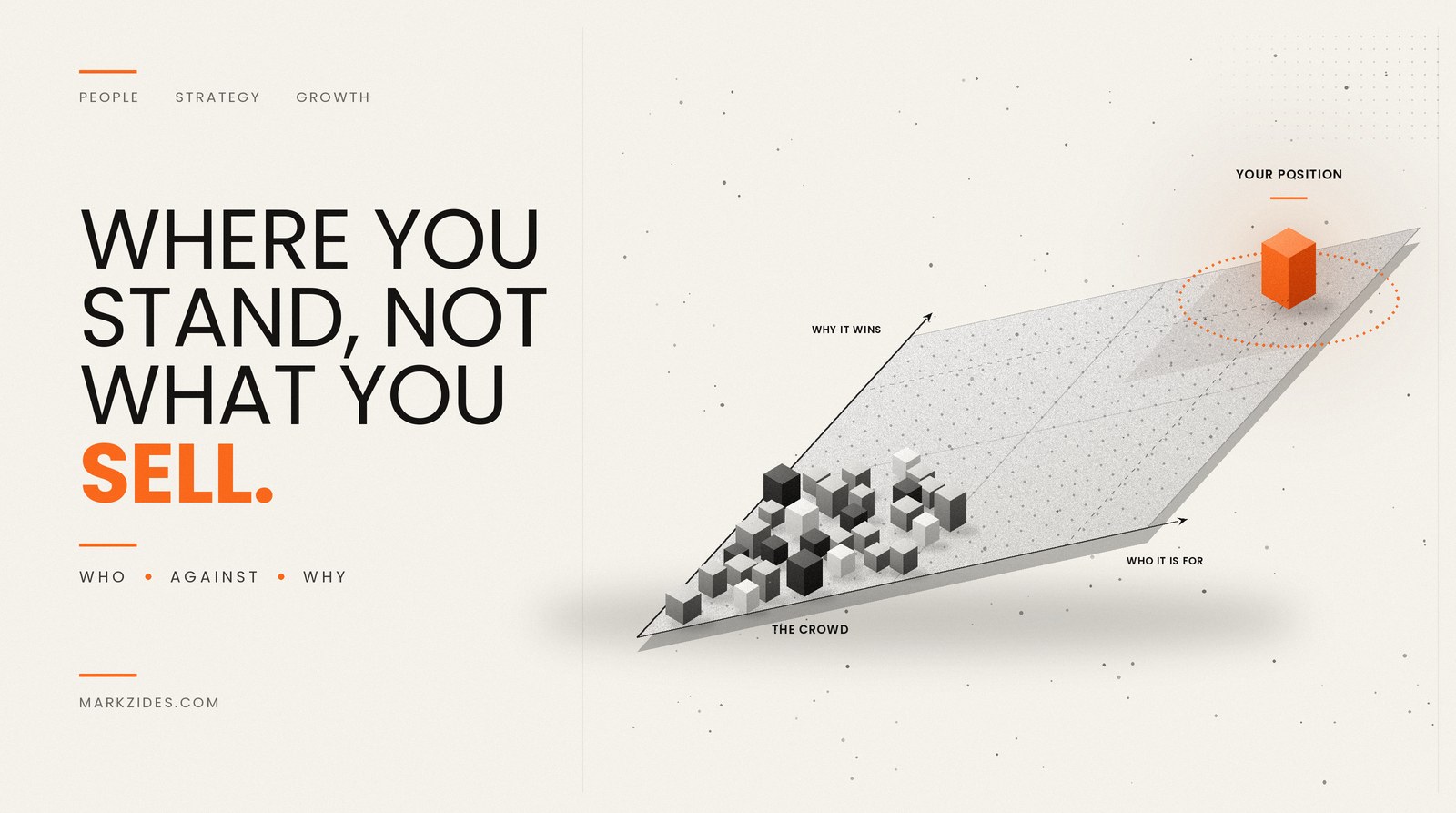
Product positioning is the choice of where a product sits in a buyer's mind: who it is for, what it is compared with, and why it wins that comparison. It is a decision, not a slogan. The tagline, the homepage and the sales deck are written from it afterwards.
A complete position settles five things:
- Who it is for: the customers who care most about what you do best.
- What they would do instead: the real alternatives, including doing nothing.
- What only you do: the strengths the alternatives cannot match.
- What that is worth: the value, in terms the buyer can count.
- The frame: the category the buyer files you under, which sets who you are compared with and what price feels fair.
Leave any one of them open and the buyer fills it in, usually by comparing you with the cheapest option they know.
Is Positioning Your Problem?
Positioning is the likely problem when a good product loses for reasons nobody can name. Five signs point to it:
- Prospects say it sounds interesting, then go quiet.
- Price comes up in the first meeting, before anyone has discussed value.
- More deals are lost to doing nothing than to a competitor.
- Each salesperson describes the product differently, and so does the founder.
- Put a rival's logo on your homepage and nobody would notice.
Each sign has the same root. The buyer cannot see why you are different, so they fall back on price or on staying put. That is the normal state of business buying. When Google and CEB surveyed 3,000 business buyers in 2013, they found that even where buyers saw a difference between suppliers, only 14 percent were willing to pay more for it.
A weak position is one of the quiet reasons a company stops growing while its product is fine. More marketing will not fix it: a bigger campaign on an unclear position only spreads the confusion further.
How to Position Your Product in 6 Steps
The steps run in order, because each one feeds the next. Most teams start at the last step, the statement, which is why so much positioning reads like everyone else's.
1. List What Buyers Would Do Instead
Start with the alternatives, not the product. A buyer who does not choose you still does something: buys from a rival, hires someone, builds it in a spreadsheet, stretches the people they have, or does nothing and lives with the problem. That list is your real competition, and doing nothing is often its biggest entry.
The best source is your last ten deals, won and lost. Ask the buyers, or the salespeople who ran them, what else was on the table and what they would have done without you.
Do this: Write the alternatives down, with the number of recent deals that went to each.
2. Find What Only You Do
Set your strengths against that list, one alternative at a time. A strength counts only if the alternatives cannot match it and you can prove it: a guarantee, a speed, a specialist skill, a track record in one industry. Features every rival also lists do not count, however good they are.
Most companies find two or three real strengths, and that is enough. A long list usually means the test was too generous.
Do this: Make three columns, the strength, the alternative it beats and the proof, then strike out any line a rival could also write.
3. Turn Each Strength Into Value the Buyer Can Count
A strength is what you do. Value is what it changes for the buyer: hours saved, money kept, risk removed, revenue added. Ask "which means?" after each strength until you reach something the buyer could put in a budget. "A two-hour response" becomes "no lost billable hours in tax season".
Value has a personal side too. The same study found business buyers were almost 50 percent more likely to buy when they saw personal value in the purchase, such as confidence in their choice or a lift to their career. The person signing wants to look right. A difference the buyer can count, and defend to their boss, is one they will pay a higher price for.
Do this: Next to each strength, write the value in the buyer's terms, with a number wherever you have one.
4. Name the Customers Who Care Most
Some customers value your strengths far more than others. They buy faster, argue less about price and stay longer. Find them in your own records: rank your customers by margin, by how quickly the first sale closed and by how long they have stayed, then look at the top ten. What they share, whether an industry, a size or a moment that made them buy, is who the product is for.
That group becomes the target. Positioning for everyone means competing with everyone, usually on price. Narrowing feels risky, but it is the same call a sound go-to-market strategy makes about who to sell to first, and nothing stops you selling to customers outside the group.
Do this: List your best ten customers and circle the traits that at least six of them share.
5. Choose the Frame You Compete In
The frame is the category the buyer files you under. It decides who you are compared with and what price feels fair. There are three choices:
- An existing category, such as managed IT services. Easy to understand, but crowded, and the buyer compares you on price.
- A narrow slice of one, such as IT for accounting firms. Still easy to understand, with far fewer rivals in it.
- A new category of your own. It can work, but teaching a market a new idea takes years and money that few companies of $5M to $20M have.
The narrow slice is usually right at that size: specific enough to stand out, familiar enough that nobody needs it explained.
Do this: Pick the narrowest frame your target customers already use when they describe the problem.
6. Write It Down and Test It for 30 Days
Only now write the position, using the formula in the next section. Then test it where buyers react: open every first sales call and every outreach email with it for 30 days. A survey tells you what people say. A sales call shows you what they do, and a first conversation built around the buyer's problem is the best place to hear it.
Watch three things: whether prospects repeat the idea back in their own words, whether more first meetings lead to a second, and whether price comes up later than it used to. If one fails, go back to the step that feeds it. Prospects who do not care point to step four. Prospects who compare you on price point to step two or step five.
Do this: Before you start, write down the three measures and where each stands today.
Product Positioning Statement: Formula and Examples
A positioning statement is the position written as one sentence for your own team, not for customers. It keeps sales, marketing and the website saying the same thing. The formula:
For [the customers who care most] who [have this problem], [your product] is the [frame] that [delivers the value only you deliver], unlike [what they would do instead], because [your proof].
The three examples below are illustrations for companies of typical sizes, not real firms:
- A $6M IT services firm: For accounting firms of 50 to 200 staff who cannot afford downtime in tax season, we are the IT partner for accounting firms that guarantees a two-hour fix during filing months, unlike general IT providers that treat every client alike, because our engineers support the main accounting software every day.
- A $15M maker of industrial sensors: For maintenance managers at food plants who lose money every hour a line stands still, we are the sensor supplier for washdown lines that ships rated parts from stock within 48 hours, unlike catalogue distributors with six-week lead times, because we hold the full range and test every unit before it leaves.
- A $3M software company: For finance teams at dental groups with five or more practices who close each month by hand, ours is the reporting tool for multi-site dental groups that puts every practice's numbers in one view on the first working day, unlike general accounting software that needs a consultant to set up, because it connects to the common practice systems out of the box.
Each one names a customer narrow enough to picture, an alternative the buyer really considers, and proof a salesperson can show.
Product Positioning Map
A positioning map plots you and the alternatives against the two things your target customers care about most. It shows at a glance where the crowd is and where the open space is.
Choose the axes from step three, not from your feature list: the two kinds of value the target customer weighs most. Place the alternatives honestly, using what buyers told you in step one. An open corner is only worth taking if the customers from step four actually want what sits there.
Before and After: One Position Rewritten
Here is the IT services firm from the examples, before and after the six steps. The service did not change. What changed is who it is for, what it is compared with and why it wins.
| Before | After | |
|---|---|---|
| Who it is for | Businesses of all sizes | Accounting firms with 50 to 200 staff |
| Compared with | Other IT companies | A general IT provider, or one in-house IT person stretched thin in tax season |
| What only we do | Round-the-clock support, cloud, cyber security | A two-hour fix guarantee in filing months, from engineers who know the accounting software |
| Value | Peace of mind | No lost billable hours in the busiest weeks of the year |
| Frame | Managed IT services | IT for accounting firms |
| Homepage headline | Your trusted technology partner | IT that stays up in tax season |
The before column is true and says nothing. Every line could belong to any IT firm, so the buyer compares on price. The after column gives up most of the market on paper, and gives the part it keeps a clear reason to choose.
Product Positioning vs Brand Positioning, Value Proposition and Messaging
The four terms are often used as if they meant the same thing. They do not, and mixing them up is how a company ends up rewriting its tagline when the real problem is who it sells to.
| Term | What it answers | Who reads it | How often it changes |
|---|---|---|---|
| Product positioning | Who this product is for, what it is compared with and why it wins | Your own team | When the market or the product shifts |
| Brand positioning | What the whole company stands for, across every product | The market | Rarely |
| Value proposition | What a buyer gets and why it is worth the price | The buyer | By segment or offer |
| Messaging | The words on the website, in decks and on calls | The buyer | Often, as you test what works |
Positioning comes first. The value proposition and the messaging are written from it, and the brand sits above all of a company's products. A company with one product often has one position and one brand, which is why the terms blur.
Five Product Positioning Mistakes
- Positioning for everyone. The wider the target, the more rivals in the comparison, and the more the buyer leans on price.
- Positioning against the wrong rival. The company you watch most is often not the one the buyer considers. Doing nothing usually is.
- Leading with features. Buyers do not compare feature lists for long. They compare what changes for them.
- Positioning by committee. A position everyone agrees to is usually the one nobody objects to. One person should own it, normally the founder, often working with a part-time marketing leader.
- Changing it every quarter. A position takes time to register with a market. Change it when the market or the product changes, not when one campaign disappoints.
Frequently Asked Questions
What is product positioning in simple terms?
It is the decision about who a product is for, what it is compared with and why it wins that comparison. A good position makes the right buyer think "this is for companies like mine, and it beats what I would do otherwise". The website copy and the sales pitch are written from it.
What are the main types of product positioning?
Positions are usually built on one of five things: a benefit the buyer values, a comparison with a named alternative, price and quality, a specific use or customer, or a category of your own. Most companies of $5M to $20M do best with a specific customer or use, because it is the easiest to prove.
What is the difference between positioning and differentiation?
Differentiation is what makes you different. Positioning chooses which of those differences matter, to whom, and against which alternative. A company can have many differences and still be badly positioned if none of them matter to the customers it targets.
How often should a company revisit its positioning?
Review it once a year, and change it only when something real has moved: a new kind of customer, a new rival, a changed product or a shifted market. Changing it more often stops it registering with buyers and confuses your own team.
Who should own positioning in a small company?
The founder or chief executive, because deciding who the company sells to is a strategy decision. Sales and marketing should help build it from customer evidence, and a marketing leader usually turns it into words, but the final call should sit with one person.
Final Thought
Product positioning is not a wording exercise. It is a decision about which customers to win and which comparison to win, made before anyone writes a headline. Get it right and the right buyers can finally see why the product is for them, which is when deals move faster and price stops leading the conversation. That is the L in Mark's UNLOCK Method: leverage the right opportunities, by aiming the company at the customers it is best placed to win. Mark is a six-time founder with three exits, and finding that position is where demand generation work begins.
Ready to build a revenue engine that runs without you?
Mark works alongside founders as a player-coach — not a slide deck.
Book a 30-minute call