
Solo Founder: When Going It Alone Works and How to Do It Well

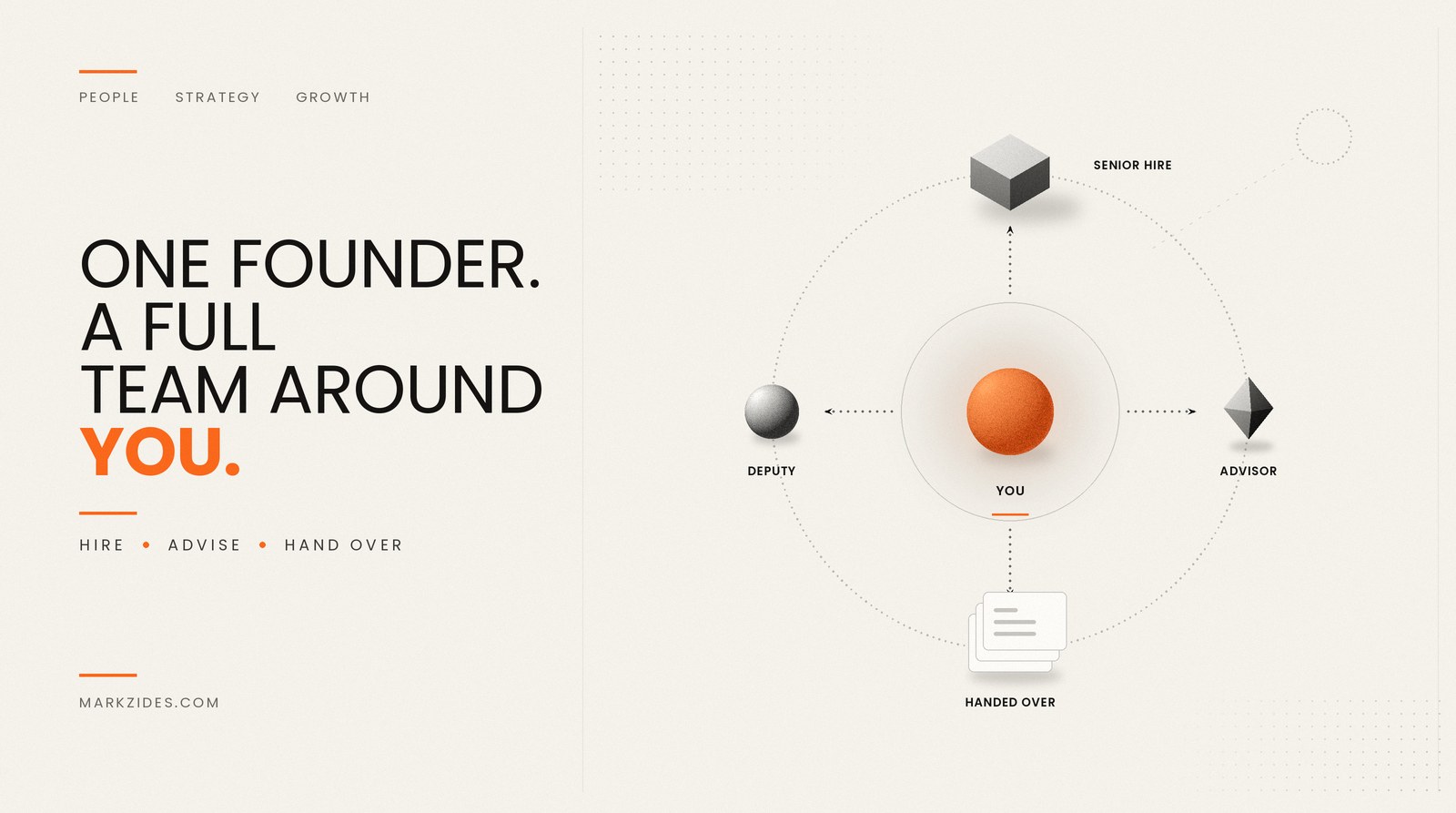
Every investor meeting, every bank form and most networking events ask the same question sooner or later: and who is your cofounder? You do not have one. Nobody checks your big decisions before you make them, nobody covers for you when you are ill, and some nights you wonder whether going alone was the mistake. It probably was not. Starting alone is rarely what sinks a company. What sinks it, slowly, is still being the only person it runs on years later, when it should need you least and depends on you most.
What Is a Solo Founder?
A solo founder is a person who starts a company alone and holds the founder's role without a partner. Being solo does not mean working alone. A solo founder can have employees, investors, advisors and a board. What they do not have is anyone else who started the company, owns a founder's share and carries the same risk.
The difference between a solo founder and a solopreneur is ambition, not headcount. A solopreneur builds a business around their own work and usually means to keep it small. A solo founder builds a company meant to grow past them, with a team that delivers the work and often a sale at the end. Many solo founders start out looking like solopreneurs. The difference shows in what they build next.
Solo Founder vs Cofounder: What the Research Says
The common advice is that you need a cofounder. The research is more mixed than that, and more useful.
| Study | What it looked at | What it found | What it means for you |
|---|---|---|---|
| Greenberg and Mollick, NYU Stern and Wharton (2018) | Ventures funded on Kickstarter from 2009 to 2015 that later became formal businesses | For-profit ventures started alone were about 2.5 times as likely to survive as those started by teams. Solo founders were 55 percent less likely than teams of three to close the business | Going alone does not, by itself, lower the odds that the company lasts |
| Howell and Hall (reported 2026) | Technology startups, using accelerator and startup database records | Solo founders with broad knowledge across functions and deep expertise in one area did as well as cofounded ventures. Teams still grew faster on average | Breadth is the condition. A narrow specialist on their own is the risky case |
| Carta Founder Ownership Report (2025) | Startups incorporated on Carta's platform | Solo founders led 35 percent of the startups incorporated in 2024, but only 17 percent of the startups founded that year that had closed a venture round by the end of it | Investors back solo founders less often, so the funding road is narrower |
Two cautions. The Kickstarter ventures were small and crowdfunded, not venture-backed, and the result reversed for nonprofits, where teams were about twice as likely to survive. And none of these studies shows that going solo causes anything. Founders who choose to go alone may differ in other ways.
Read together, they say something plain. Going solo is a workable way to start. The price is paid in funding options and in speed, and it works best for founders who can cover most of the business themselves.
When Going Solo Works, and When It Does Not
Three questions decide it, and they are worth answering before you start looking for a partner.
Can you sell and deliver the first version yourself? If you can win the first customers and do the work, or build the product, a cofounder is a choice rather than a need. If you can do neither, you need someone who can, from the first month.
Does the company need two deep skills at once? Some companies need hard technical work and complex enterprise sales from the start, and neither can wait. That is the real case for a cofounder. Most service and B2B companies need one deep skill and a lot of breadth, which a solo founder can cover and hire around.
Do you plan to raise a large round early? If so, expect more questions about the team and have answers ready. If you plan to grow from revenue or a small raise, the funding gap in the research matters much less.
If the answers point to a partner, take your time over testing someone properly before you give them a share. If they point to going solo, the rest of this article is how to do it well.
How to Build a Company as a Solo Founder
Each step below replaces something a cofounder would have given you, without giving away a cofounder's share of the company.
| What a cofounder gives | What replaces it | When to add it | What it costs you in control |
|---|---|---|---|
| A second skill | A senior hire or part-time executive for the biggest gap | Before the gap holds back sales or delivery | Shares only where the role earns them, vesting over time |
| A second opinion | An advisory group or independent director, plus a decision log | In the first year | Hearing no from someone you cannot overrule by being the boss |
| A second pair of hands | Recurring work handed over with a written brief | As soon as you have tracked a week of your time | Some say over how the work gets done |
| A second person the company runs on | Know-how written down, a second signatory on the bank, a named deputy | With the first hires | Approvals you now share |
| Someone who shares the worry | A peer group of founders at your stage | From the start | Nothing but the time |
1. Name the Gaps a Cofounder Would Have Filled
Start with a plain list. Down one side, write what the company needs done well in the next year: selling, delivering, the product, finance, hiring, operations. Next to each, give yourself an honest mark: strong, can do, or cannot do. The cannot-do lines are the gaps a cofounder would have filled. The can-do lines are where most of your week disappears.
Then add the things a cofounder gives that never show on a skills list: someone to argue with before a big decision, someone to share the load, and someone the company could run on if you were gone for a month. Those are gaps too.
Do this: Write the list on one page, no more than eight lines, and circle the two gaps that would hurt most this year.
2. Fill the Skill Gap First
Your biggest skill gap is usually the first hire that really matters. If the company cannot carry a full-time senior person yet, a part-time executive who has done the job before can cover it a few days a month and help you hire the full-time role later. Either way, hire for the gap, not for help with what you already do well.
Be careful with shares. A cofounder's stake is for someone who took a founder's risk from the start. A senior person who joins later should earn shares over time, on the same vesting terms as everyone else, and only where the role is critical to what the company will be worth.
Do this: Write the job description for your biggest gap this month, even if you will not hire for it until next quarter.
3. Get a Second Opinion on a Schedule
The thing solo founders miss most is someone who asks "are you sure?" before a big call. Friends are too kind, and staff work for you. So build it in.
Two things work. The first is a small advisory group, or an independent director who will tell you no, meeting you on fixed dates and seeing the real numbers. The second is a written decision log: before any big decision, write down what you are deciding, what you expect to happen, and what would prove you wrong. Review it every month. It will not replace a partner, but it catches the decisions made out of tiredness or pride.
Do this: Book the first advisor meeting before the end of the month, and start the log with the next decision that costs real money or is hard to undo.
4. Buy Back Your Hours
A cofounder halves the load. Without one, the only way to get hours back is to hand work over, earlier than feels comfortable. The skill is handing work over so it stays handed over: a clear result, an agreed level of authority, and check-ins that step down over time.
Start with work that moves the business but does not need your judgment. Keep what only you can do: the direction, the biggest customers, the key hires and the cash.
Do this: Track one week of your time, and hand over the first recurring job on the list within a month.
5. Make the Company Able to Run Without You
A cofounder is also insurance. If one founder is ill or away, the other keeps the company going. A solo founder has to build that insurance on purpose, and the earlier it starts, the cheaper it is.
Write down what lives only in your head: how you price, who the key contacts are at each customer, where the contracts and logins are kept. Add a second person who can sign on the bank account and approve payments. Name a deputy who runs things when you are away, and test the arrangement by taking a full week off.
Do this: List the five things that would stop if you disappeared for a month, and fix the first one this quarter.
6. Do Not Carry It Alone
Founders with a partner share the worry as well as the work. Solo founders need somewhere else to put it. A small group of founders at the same stage, meeting every month, gives you people who understand the job and have no stake in your decisions. Carrying every risk on your own is one of the reasons founders burn out, and it is one of the easier ones to fix.
Do this: Join or start a group of four to six founders at your stage, and put the first meeting in the diary.
Raising Money as a Solo Founder
Investors back fewer solo founders, and the reason is concentration risk. If one person is the company, that person leaving, falling ill or burning out ends it. You will not change that view, but you can answer it.
Show traction first. Revenue from customers who are not friends is the strongest answer to any question about the team. Show the team around you: the senior hire for your biggest gap, the advisors who meet you on a schedule, the deputy who runs things when you are away. And show a written plan for the gaps that remain, with who you will hire and when. A solo founder who has built all three looks less like a single point of failure and more like someone who builds teams.
If you plan to grow from revenue rather than outside money, most of this still applies. Banks, large customers and, one day, buyers ask the same question in different words.
What Being the Only Founder Means When You Sell
The question that matters most comes at the end. A buyer pays for a company that keeps earning after the sale. If every big customer, every key decision and all the know-how sit with the only founder, the buyer is paying for you, and you are about to leave.
Buyers handle that risk in three ways: a lower price, more of the price paid later and only if targets are hit, or a requirement that you stay on for years. That is what owner dependence does to the price, and a solo founder who has built nothing around them tends to get all three. The fix is the work in the steps above, started early enough that it has a track record by the time a buyer looks.
Frequently Asked Questions
Is it better to be a solo founder or have a cofounder?
Neither is better in general. Research on crowdfunded ventures found that solo-founded companies survived at least as well, while teams tend to grow faster and raise money more easily. Go solo if you can sell and deliver the first version yourself. Look for a cofounder if the company needs two deep skills from the start.
Can a solo founder raise venture capital?
Yes, but fewer do. Carta's 2025 report found solo founders led 35 percent of the startups incorporated on its platform in 2024, but only 17 percent of those founded that year that had closed a venture round. Traction, a strong team around you and a written plan for the gaps answer most investors' concerns.
What is the difference between a solo founder and a solopreneur?
A solopreneur builds a business around their own work and usually plans to stay small. A solo founder builds a company meant to grow beyond them, with a team that delivers the work and often a sale at the end. Many solo founders start out as solopreneurs and change course as the business grows.
How do solo founders make big decisions alone?
The good ones stop making them alone. They book fixed meetings with an advisor or independent director who sees the numbers, and keep a written decision log: what they are deciding, what they expect, and what would prove them wrong. A monthly review of the log catches the calls made out of tiredness or pride.
Can you add a cofounder later?
You can, but someone who joins after the start is really a senior hire with a founder's title. Give them shares that vest over several years, as with any key hire, and agree in writing what they own and what they decide. Test the working relationship first, just as you would with a cofounder on day one.
Final Thought
Going solo is not the mistake people assume. The mistake is a company that is still only you when it needs to be more. Founders who do it well fill each gap a partner would have filled: a senior hire for the skill, advisors for the second opinion, a team for the hours, a deputy for the days they are away. That is the O in Mark's UNLOCK Method: organize for growth, so the company is built to grow past the person who started it. Mark is a six-time founder with three exits, and building the team around a founder, in the right order, is the work of a growth advisor.
Ready to build a revenue engine that runs without you?
Mark works alongside founders as a player-coach — not a slide deck.
Book a 30-minute call