
Bootstrapping vs Venture Capital: What Each Path Costs and Pays You

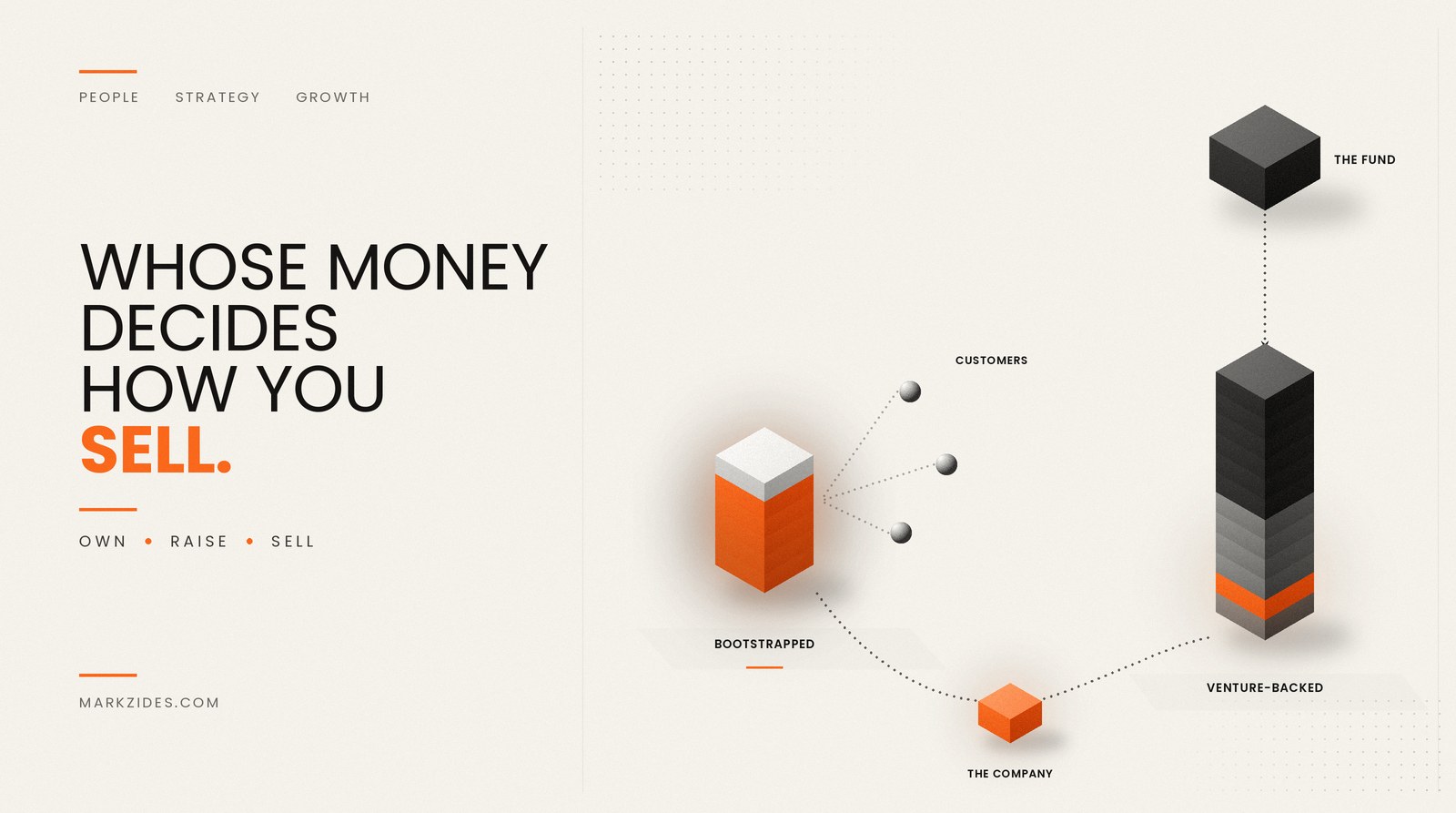
A venture fund wants in. After months of bootstrapping on your own money, the interest feels like proof that the company is real, and everyone around you treats raising as the obvious next step. Advisers ask how much you are raising, not whether. Other founders post their rounds like birth announcements. So the question in front of you seems to be how much to take, and on what terms. It is not. The money is the smaller decision. The bigger one is the kind of sale it commits you to, and who gets paid first when that day comes.
What Is the Difference Between Bootstrapping and Venture Capital?
Bootstrapping means growing a company on your own money and on what customers pay you. Self-funded means the same thing. A bootstrapped company may borrow from a bank or take a little from family, but nobody outside owns a large share or has a say in where it goes.
Venture capital means selling part of the company to a fund in exchange for money to grow faster. It is ownership, not a loan. The fund is paid when the company is sold or lists its shares, and it usually takes a board seat and rights over big decisions. Because a fund's returns come from a handful of very large wins, it only invests in companies that could become very large.
| Bootstrapping | Venture capital | |
|---|---|---|
| Where the money comes from | Your savings, customers' payments, bank loans | A fund, in exchange for shares |
| What you give up | Speed | Part of the company, and some control |
| Who decides | You | You, with investors on the board and a veto over big decisions |
| How fast you can grow | As fast as profits allow | Faster than profits allow, while the money lasts |
| How you get paid along the way | Salary, and profits you choose to take out | Salary; profits go back into growth |
| The sale it needs | Any sale that works for you | A very large sale, or a listing |
| What failure looks like | A smaller company that still pays you | Running out of money before the next round |
| Who it suits | Companies customers will pay for early | Companies that must spend for years before customers pay, in markets the biggest player wins |
How to Choose Between Bootstrapping and Venture Capital
Two questions do most of the work: how much cash the company needs before customers pay, and how large a sale its market allows. Place your company on the grid, then test the answer against the five questions under it.
1. How Much Cash Do You Need Before the First Customer Pays?
Add up what you must spend before revenue arrives: building the product, approvals, stock, the first hires. A services firm can often win its first client before it spends much at all. A company building hardware or a regulated product may need years of spending first, and savings will not cover that.
Then work it out again with revenue arriving at half the speed you hope for. Planning cash for the slow case is what keeps a bootstrapped company alive when the first sales take longer than planned.
Do this: Write down the cash you need to reach the first paying customer in the slow case, and where it will come from.
2. Does the Market Reward Whoever Gets Big First?
In some markets the biggest player takes most of the customers, because each new user makes the product more useful to the others, or because buyers rarely switch once they have chosen. There, coming second can be fatal, and speed is worth giving up a share for. In most B2B and service markets, buyers choose on fit, trust and results, and several firms can do well at once. Growing more slowly costs you little there.
Do this: Look at the three strongest firms in your market and ask whether they won by getting big first or by being good.
3. What Size of Sale Would Change Your Life?
A venture fund needs a few companies to return many times what it put in, because many of its investments will return little or nothing. So it pushes every company it backs toward a very large sale. A sale that would change your life can count as a failure to the fund. If a sale in the tens of millions would be a great outcome for you, that is a strong argument for keeping the company yours.
Do this: Write down the sale price that would let you walk away happy, and keep it next to any term sheet you are offered.
4. How Much Say Do You Want to Keep?
Taking venture money means sharing big decisions. Investors usually sit on the board, and the terms often give them a veto over selling the company, raising more money or changing the plan. Some founders welcome the help. Others find, too late, that they now answer to someone whose interests are not quite theirs.
Do this: Ask for the list of decisions an investor would have to approve before your first serious meeting, not after.
5. Can Your Customers Fund the Growth?
The best money to grow on is your customers'. If each new customer pays back what it cost to win within months, growth funds itself, and outside money can only speed it up. If customers never pay it back, outside money only makes the losses bigger. Check whether each customer pays back what it cost to win before you decide anything else.
Do this: Work out how many months a new customer takes to pay back the cost of winning them. The common guideline is under twelve.
The Numbers Behind the Choice
Venture capital gets most of the attention and very little of the action. Using the US Census Bureau's 2014 Annual Survey of Entrepreneurs, a Kauffman Foundation briefing found that only 0.6 percent of businesses with employees started with venture capital. The usual starting money was personal and family savings, bank loans and personal credit cards. More founders used a credit card, 10.3 percent, than venture money.
The survey is from 2014, but it is still the clearest count of how companies are actually funded, and it makes the point plainly: most companies are built without venture money.
For those who do raise, each round takes a share. Carta's Founder Ownership Report 2025, covering more than 45,000 startups incorporated from 2015 to 2024, found that the median founding team owns 56.2 percent of the company after a seed round, 36.1 percent at Series A and 23 percent at Series B. That is all the founders together, not each of them.
| Stage | Median share the founding team still owns | What that means at a $50 million sale, before any preference |
|---|---|---|
| Bootstrapped, no outside shareholders | All of it | $50 million |
| After a seed round | 56.2% | $28.1 million |
| At Series A | 36.1% | $18.05 million |
| At Series B | 23% | $11.5 million |
The $50 million sale is made up to show the scale; the shares are Carta's medians.
What Each Path Pays You When You Sell
A venture fund is paid when the company is sold, and it is usually paid first. Venture investors normally buy shares with a liquidation preference: before anyone else is paid, they get back what they put in, or more if the terms say so. Only what is left is shared among founders and staff. In a very large sale, the preference barely matters. In a modest one, it can take almost everything.
The figures below are made up to show the maths, using Carta's median ownership after Series B.
- A bootstrapped founder who owns the whole company and sells it for $30 million keeps $30 million, before tax and fees.
- A venture-backed founding team that owns 23 percent and sells for $100 million shares $23 million.
- A venture-backed company that raised $35 million with a simple 1x preference and sells for $40 million pays its investors $35 million first. That leaves $5 million for every other shareholder, founders and staff together.
The bootstrapped founder sold for less than a third of the price and walked away with more. A profitable company that never raised also has more buyers than many owners expect: a trade buyer in the same market, a private equity firm buying a profitable founder-owned company, or selling to the people who already run it. None of them needs the company to be huge. They need profit that will carry on after you leave.
How to Grow Without Outside Money
Bootstrapping is not doing without. It is paying for growth in a different order.
- Get paid first. Deposits, annual billing up front and milestone payments put customers' money to work before you spend your own.
- Price for margin. Low prices need volume, and volume needs cash. Raising prices without losing the customers you want is often the quickest money a bootstrapped company can find.
- Keep fixed costs low until the sale repeats. Hire when the work is there, not ahead of it, and rent before you buy.
- Borrow once revenue repeats. A bank lends against steady revenue without taking a share of the company.
- Consider a minority investor later. Some private equity and growth investors buy a minority stake in profitable companies. It lets a founder take some money off the table without signing up for a very large sale.
None of this is as fast as a large round. All of it keeps the company, and the sale, yours.
When to Raise, If You Do
If the company does need outside money, timing and terms matter more than the headline valuation.
Raise after the point where strangers buy at full price and keep paying. Before that, money mostly pays for guesses, and the share you give away is at its most expensive. Raise from strength, too. A company with many months of cash left can negotiate; a company with weeks left takes what it is offered.
And read the terms before the valuation. The preference, the board seats and the list of decisions investors must approve shape your future more than the price per share. A high valuation with heavy terms can leave you worse off at a sale than a lower one with clean terms.
Frequently Asked Questions
Is bootstrapping better than venture capital?
Neither is better in general. Bootstrapping suits companies customers will pay for early, in markets where several firms can do well. Venture capital suits companies that must spend for years before revenue, in markets where the biggest player wins most. For most B2B and service companies, growing from revenue leaves more of the eventual sale with the founder.
Can you bootstrap first and raise venture capital later?
Yes, and it often means better terms. A company with paying customers and repeat sales raises from strength, gives away a smaller share for the same money, and can walk away from a bad offer. The risk is waiting too long in a market where a funded competitor can win the customers first.
What does bootstrapped mean?
A bootstrapped company has grown on its founders' own money and its customers' payments, without selling a large share to outside investors. Self-funded means the same thing. A bootstrapped company can still borrow from a bank, because a lender takes neither ownership nor a say in how the company is run.
Do bootstrapped companies sell for less?
They often sell at lower prices, because growing from revenue is slower. But the founder usually keeps a far larger share. A founder who owns the whole company and sells for $30 million keeps more than a founding team that owns 23 percent of a company sold for $100 million. Your share of the price matters more than the price.
How many startups get venture capital?
Very few. A Kauffman Foundation briefing on the US Census Bureau's 2014 Annual Survey of Entrepreneurs found that only 0.6 percent of businesses with employees started with venture capital. Personal and family savings, bank loans and personal credit cards were all far more common sources of starting money.
Final Thought
Bootstrapping vs venture capital is not a test of ambition. It is a question of fit: the money has to suit how much cash the company needs and the sale its market allows. Take venture money for a company that does not need it, and you swap a good sale you would have owned for a great one that only some companies reach. That is the L in Mark's UNLOCK Method: leverage the right opportunities, the ones that suit the company you are actually building. Mark is a six-time founder with three exits, and helping owners choose how to fund growth with the sale already in mind is the work of a growth advisor.
Ready to build a revenue engine that runs without you?
Mark works alongside founders as a player-coach — not a slide deck.
Book a 30-minute call