
What Is a Chief Commercial Officer? The Role, What It Owns, and Whether You Need One

Sooner or later a founder hears the title chief commercial officer from an investor, a board member or a candidate, and the same doubt follows. Is this a real job, or a grander name for head of sales? The answer matters more than it sounds. Hire the wrong commercial leader and the problem holding growth back stays where it was, now with an expensive executive standing in front of it. This guide is for the person deciding: what the role owns, how it differs from the jobs it gets confused with, and how to tell whether you need one yet.
What Is a Chief Commercial Officer?
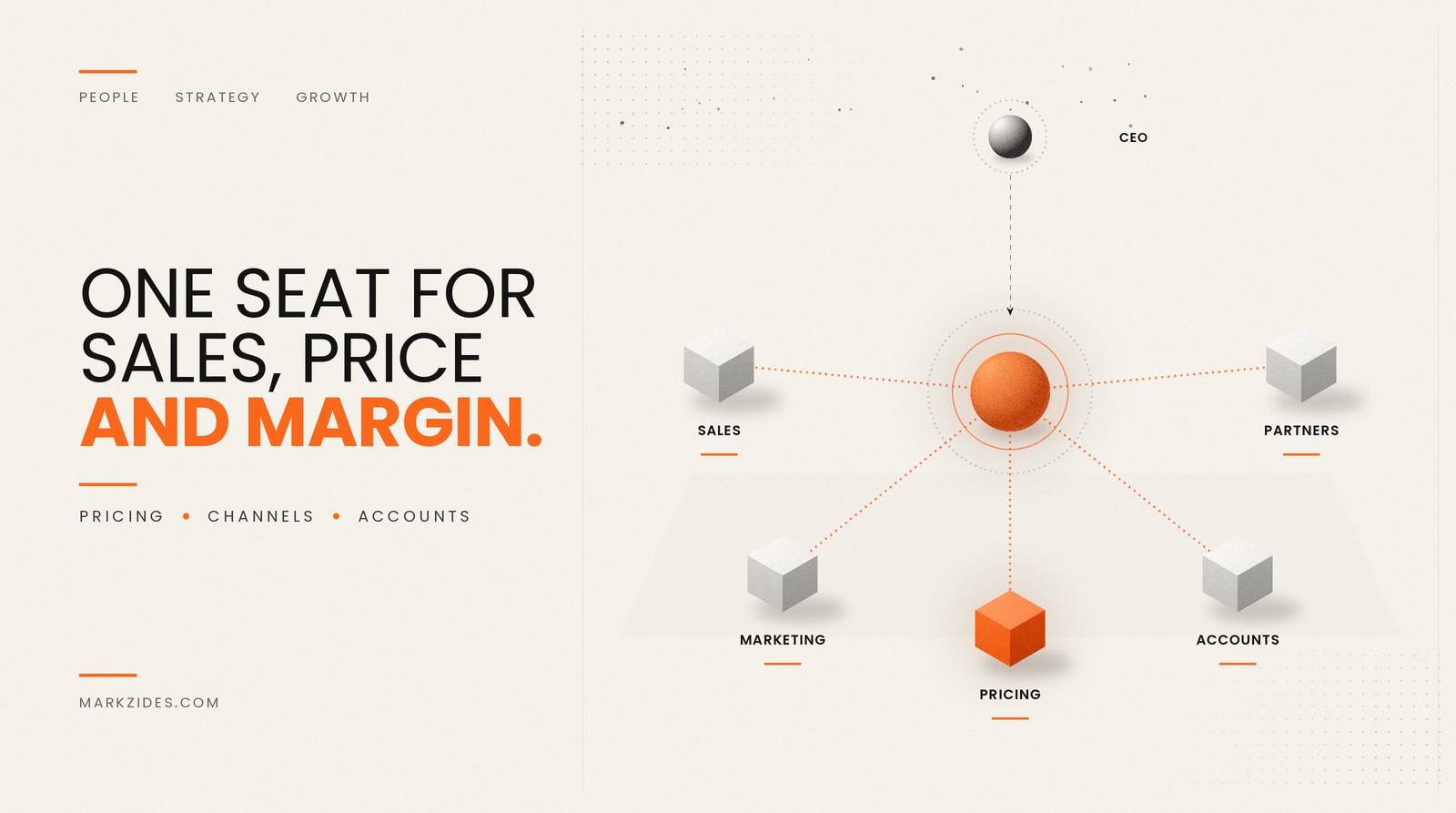
A chief commercial officer (CCO) is the executive who owns how a company earns its revenue: which customers it goes after, what it sells them, at what price and on what terms, and through which channels. The role usually brings sales, marketing, pricing, key accounts and partners under one leader who reports to the chief executive.
The word that separates it from other titles is commercial. A head of sales is judged on what gets sold. A chief commercial officer is judged on what gets sold, at what margin, to which customers, and whether that mix is one the business can live on.
The title is more common outside the United States, and in industries that sell through contracts, distributors or several regions at once: manufacturing, logistics, pharmaceuticals, airlines. In American software companies the same seat is more often called chief revenue officer. In biotech, chief business officer is used for a version of the role weighted toward partnerships and licensing deals.
What Does a Chief Commercial Officer Do?
A CCO owns six areas. In a smaller company some of them take a few hours a month. In a larger one, each has its own team.
| Area | What the CCO decides | What it looks like when nobody owns it |
|---|---|---|
| Commercial strategy | Which markets, segments and customers to pursue, and which to stop serving | Everyone chases every deal, and the pipeline is wide and shallow |
| Pricing and terms | List prices, discount limits, payment and contract terms | Each seller sets the price on the call, and margin falls as revenue grows |
| Sales | The team, territories, targets, the process and the forecast | The founder closes the big deals and the forecast is a guess |
| Marketing | Positioning, the message, and where demand comes from | Marketing reports leads, and sales says they are useless |
| Key accounts and retention | Plans for the largest customers, renewals, growth inside accounts | The biggest customer is looked after by whoever sold it, years ago |
| Channels and partners | Distributors, resellers and partners, and which customers each route serves | Partners and the direct team compete for the same customer on price |
What ties the six together is the trade-offs between them. A discount that wins one deal is a sales decision, a pricing decision and a margin decision at the same time. A new distributor in a region is a channel decision that changes what the direct team can sell there. When those calls sit with different people chasing different targets, the company argues with itself. The CCO makes them in one place.
Pricing is where the role most often pays for itself. Few companies have anyone whose job is to hold the price, so it erodes one deal at a time, and raising prices without losing customers becomes a project nobody owns. The same is true of the largest accounts: a key account plan for each of the customers the business cannot afford to lose is squarely the commercial chief's work.
Some companies add product launches and customer service to the remit. Few give the CCO operations, finance or product development, which is where the line with the chief operating officer and the chief financial officer sits.
Who Does a Chief Commercial Officer Report To?
The CCO reports to the chief executive and sits on the executive team beside the chief financial officer and the chief operating officer. Reporting to the CCO, in a company large enough to have them all: the head of sales, the head of marketing, the lead for key accounts and customer success, the head of partnerships or channels, and the people who run pricing and sales operations.
In a smaller company the chart is flatter. The CCO often has two or three direct reports, runs pricing personally, and still sells to the largest customers. That is not a flaw. A commercial chief who cannot sell is a poor fit for a company where every large deal still matters.
Chief Commercial Officer vs Chief Revenue Officer
The two roles overlap more than they differ. Both own sales and marketing, and both report to the chief executive. A chief revenue officer is judged on revenue growth and the accuracy of the forecast, and usually owns sales, marketing, customer success and revenue operations. A chief commercial officer is judged on profitable revenue, and usually adds pricing, contract terms, channels and the choice of markets.
| Chief revenue officer | Chief commercial officer | |
|---|---|---|
| Main measure | Revenue growth and forecast accuracy | Revenue and margin, and the mix of customers and channels behind them |
| Usually owns | Sales, marketing, customer success, revenue operations | The same, plus pricing, terms, channels and partners, and market choices |
| Most common in | Software and subscription businesses, mostly in the United States | Manufacturing, distribution, healthcare, travel, and companies selling in several regions |
| The question it answers | How do we grow revenue predictably? | Are we selling the right things, to the right customers, at the right price? |
In practice the title follows the industry more often than the job. A software company with one product and one sales motion will call the seat CRO. A manufacturer selling through distributors in four countries will call it CCO. If you are choosing, choose by scope. If the problem is a predictable pipeline, the role is revenue. If the problem is pricing, channels and margin, the role is commercial.
CCO vs COO, CMO, Chief Sales Officer and CEO
Each of these roles shares a border with the CCO. The table shows where each border sits.
| Role | Owns | Where the line with the CCO sits |
|---|---|---|
| Chief operating officer | Delivery: operations, supply, service, and the processes that fulfil what was sold | The CCO wins and keeps customers, the COO delivers to them. The line is the signed contract. |
| Chief marketing officer | Brand, positioning and demand | Where both exist, marketing usually reports to the CCO. The CMO shapes how the company is seen; the CCO decides what is sold and at what price. |
| Chief sales officer or VP of sales | The sales team, its targets, the process and the forecast | Sales is one of the CCO's functions. Sales hits the number; the CCO decides which number, from which customers, at what margin. |
| Chief business officer | Partnerships, licensing and large deals | Narrower and deal-led. In smaller companies it is often the same remit under another name. |
| Commercial director | The same scope, one level down | A commercial director runs the function. A CCO answers for it on the executive team. |
| Chief executive | The whole company: strategy, capital, the team and the board | The CEO sets where the company is going. The CCO owns how it earns the revenue to get there. |
The last row is the one that matters most in a founder-led company. Until there is a commercial chief, the chief executive is doing the job by default: setting prices on calls, deciding which customers to chase, refereeing sales and marketing. Handing that over is a large part of the move from founder to chief executive, and it is usually the part founders hold on to longest.
What a Chief Commercial Officer Is Measured On
A CCO is measured on profitable revenue, which takes more than one number. Pick four or five of these for the scorecard, not all seven.
| Measure | What it tells you | Warning sign |
|---|---|---|
| Revenue growth, new and existing customers apart | Where growth is coming from | All growth from new customers while existing ones shrink |
| Gross margin by customer and channel | Whether the growth is worth having | Revenue up, margin down |
| Price realization | How much of the list price you actually collect | The average discount rising quarter after quarter |
| Net revenue retention | Whether existing customers stay and buy more | Below 100 percent: the base shrinks before any new sale counts |
| Win rate and sales cycle | How well the team sells | Deals taking longer with no change in their size |
| Customer concentration | How much risk sits in the largest accounts | One customer large enough that losing it would change the year |
| Forecast accuracy | Whether the plan can be trusted | Misses in both directions, quarter after quarter |
A CCO who reports only revenue is reporting half the job. Revenue bought with discounts, or won from customers who cost more to serve than they pay, looks like growth for a year and then shows up in the margin. When deals are slowing, the fix usually starts with qualifying harder and agreeing next steps on every call, which is the sales team's work, held to account by the commercial chief.
Does Your Company Need a Chief Commercial Officer?
You need one when the commercial decisions, what to charge, which customers to chase, which channels to use, are made by too many people or by the founder alone, and the business has grown past the point where that works. You probably do not need one if you sell one product through one channel and the gap is a sales team that misses its number.
Five signs the seat is empty and it is costing you:
- Every large price goes to the founder, or nobody decides at all and each seller makes it up.
- Revenue grows and margin does not, because discounts are set deal by deal.
- You sell direct and through partners, and the two compete for the same customers.
- Sales and marketing each report good numbers, and the company still misses its plan.
- A few large customers carry the business, and nobody senior owns the relationship.
Then match the hire to the problem. A chief officer is an expensive answer to a problem a narrower role could fix.
| The problem | The hire |
|---|---|
| The sales team misses its number, and the process and coaching are weak | VP of sales |
| The pipeline is unpredictable across sales, marketing and customer success | Chief revenue officer |
| Pricing, channels, margin and the choice of markets are the problem | Chief commercial officer |
| Customers are won, but delivery breaks | Chief operating officer |
| Not enough of the right people know the company exists | Head of marketing |
If your problem sits in the first row, hire the VP of sales and interview for the number they owned, not for how well they present. A commercial chief placed over a weak sales team spends the first year doing the VP's job.
What to Look For When Hiring One
Look for someone who has owned margin, not only a quota. Many strong sales leaders have never set a price, run a channel or answered for gross margin, and the CCO role is mostly those three things.
- Has changed prices and held them, and can say what customers did and what happened to margin.
- Has run more than one route to market, or managed partners alongside a direct team.
- Has owned the largest customers personally, not only through account managers.
- Has worked at your stage. A CCO from a large company is used to a pricing team, a marketing team and an analyst for each. In a company of fifty people, they will do much of that work themselves.
Five questions that separate a commercial leader from a sales leader with a bigger title:
- Walk me through a price change you made. What did you change, how did customers react, and what happened to margin?
- Which customers, products or channels did you stop serving, and why?
- How did you set discount limits, and what happened when a seller wanted to go below them?
- Tell me about your largest account. Who owned it at each level, and what was the plan for it?
- What would you look at in your first thirty days here, and what do you expect to find?
Ask for figures in every answer. A candidate who has done the work remembers the numbers, including the ones that went wrong.
Full Time, Part Time or Interim
A full-time CCO is a senior hire, and in a company still working out its pricing and channels it can come too early: the person arrives to find there is no plan to run yet. Two other routes are common. An interim executive fills the seat full time for a fixed period, usually while you search. A part-time revenue leader works a set number of days a month, builds the commercial plan, the pricing rules and the team, and hands a working function to a full-time hire when the company is ready for one.
The part-time route suits a company that needs the decisions made before it needs a full-time executive to make them every day.
Frequently Asked Questions
What does CCO stand for?
In most companies CCO stands for chief commercial officer. The same letters are also used for chief customer officer, chief compliance officer, chief content officer and chief creative officer, so check the job description. A chief customer officer is the closest of these, but owns retention and customer experience rather than pricing and sales.
Is a chief commercial officer higher than a chief revenue officer?
Neither title is senior to the other by definition. Both report to the chief executive, and a company rarely has both. What sets the weight of the role is scope: the one that answers for pricing, channels and margin as well as sales carries the wider remit.
Is a chief commercial officer the same as a head of sales?
No. Sales is one of the functions a CCO runs. The head of sales owns the team and the number. The CCO also owns pricing, marketing, channels and the choice of which customers to pursue, and answers for margin as well as revenue.
Does a startup need a chief commercial officer?
Rarely. An early company usually has one product, one channel and a founder who still sells, so a commercial chief has little to decide that the founder is not already deciding. The role starts to earn its cost once pricing, channels and key accounts need one owner and the founder can no longer be it.
What is the difference between a CCO and a COO?
The CCO wins and keeps customers: what is sold, to whom, and at what price. The COO runs delivery: operations, service and the processes that fulfil what was sold. The line between the two roles is the signed contract.
Final Thought
Titles travel. The same job is a CCO in one industry, a CRO in another and a head of sales with a bigger business card in a third. What matters is that pricing, channels, the largest customers and the sales team answer to one person, measured on revenue the business can keep. Deciding who owns those calls, before deciding what to call the job, is the O of the UNLOCK Method: organize for growth. When the honest answer today is that the founder owns them all, a growth advisor can help decide which seat to fill first.
Ready to build a revenue engine that runs without you?
Mark works alongside founders as a player-coach — not a slide deck.
Book a 30-minute call