
Designing a B2B Demand Generation Strategy That Scales: The Executive Blueprint

Most B2B organizations don't actually have a lead generation problem; they have a systemic failure in how they engineer and capture market intent. If your marketing spend feels like a black hole and your sales team is constantly questioning lead quality, you're likely operating on gut feel rather than a structured revenue architecture. It's an exhausting cycle where CAC climbs while pipeline velocity remains stubbornly low.
You know that waiting for the "perfect" lead to fall into the CRM isn't a sustainable growth plan. You need a B2B demand generation strategy that functions as a predictable, high-performance engine rather than a series of disconnected campaigns. This executive blueprint moves you beyond erratic lead chasing toward a system-driven approach that aligns every dollar spent with a specific sales outcome.
We'll detail how to design a scalable revenue engine that accounts for the 70% of research buyers now conduct before ever contacting a vendor. We'll also examine the role of AI-powered workflows and dark social attribution in creating a shorter, more efficient sales cycle that drives long-term valuation and exit readiness.
Key Takeaways
- Identify the fatal flaws of the "Lead Gen Trap" and learn how to replace high-volume, low-intent friction with a system that prioritizes market education and sales readiness.
- Discover the framework for a scalable B2B demand generation strategy that leverages dynamic ICP signal stacking and authority-driven content to build trust at scale.
- Learn to differentiate between demand generation and demand capture to optimize your marketing spend and significantly reduce your cost-per-acquisition.
- Follow a structured 90-day roadmap to audit your revenue operations, align sales and marketing through rigorous SLAs, and build a predictable growth engine.
- Understand how fractional CRO leadership acts as the strategic architect to implement these systems, bridging the gap between high-level vision and granular execution.
Beyond the Lead Gen Trap: Why Your Revenue Engine is Stalling
Most executives view marketing as a lead faucet. You turn it on, and sales should be busy. This narrow focus is the "Lead Gen Trap," a cycle that prioritizes raw volume over actual intent and forces sales teams to waste time on prospects who have no desire to buy. A true B2B demand generation strategy isn't about collecting email addresses to hit a monthly quota. It's the strategic alignment of market education and sales readiness. It ensures that when a prospect finally raises their hand, they've already done the work to understand why your solution is the only logical choice.
The landscape has shifted fundamentally. By 2026, buyers are completing 70% to 80% of their research before they ever engage with a sales representative. If your strategy relies on gating every piece of content just to capture a name, you're fighting against the modern buyer's autonomy. You aren't creating demand; you're creating friction. Moving from tactical lead collection to systemic demand creation requires a Strategic Architect. This is an operator who can design a system where marketing builds the preference and sales executes on the intent, turning your revenue operations into a predictable engine rather than a series of lucky breaks. For those seeking this type of specialized growth agency, check out Tools N Tactics | Local SEO & Digital Marketing Solutions.
The Cost of Misalignment: Marketing vs. Sales
Siloed departments turn your pipeline into a black box. Marketing celebrates a record month of MQLs while Sales complains about a lack of real opportunities. This friction often stems from the foundational 'Demand Waterfall' model. While this model provided a necessary structure for the industry, many organizations use it to obsess over vanity metrics that don't correlate to cash. When you optimize for lead volume, you sacrifice revenue velocity. Scaling becomes impossible because your forecasting relies on gut feel rather than the hard data of intent signals and stage-to-stage conversion reality.
Demand Gen vs. Lead Gen: The Strategic Pivot
Demand generation is a long-term revenue play that builds brand authority and buyer preference, rather than a short-term grab for contact information.
Traditional lead generation focuses on capturing existing demand, which is a finite and increasingly expensive pool. Demand generation, however, creates new demand by educating the 95% of your market that isn't currently looking to buy. It replaces the "grab and pitch" mentality with a value-first architecture. This systemic approach is the bedrock of fractional CRO services, where the objective isn't just to fix a single campaign. Instead, the goal is to rebuild the entire revenue architecture to ensure every marketing dollar spent is directly traceable to sales results and long-term exit readiness.
The 3 Pillars of a Scalable B2B Demand Generation Strategy
A scalable B2B demand generation strategy is not a collection of marketing tactics. It is a Revenue Operating System. To build a system that produces predictable growth, you must move beyond the surface-level activities of posting on social media or sending cold emails. You need a structure that aligns market signals with authority-driven education and seamless sales execution. When these three pillars work in unison, you stop chasing the market and start leading it.
Building a Dynamic ICP with Signal Stacking
Traditional firmographics like company size and industry are no longer enough to drive high-velocity growth. A sophisticated operator uses signal stacking to identify accounts with high intent. This involves layering technographic data, such as what tools a prospect uses, with behavioral data and intent signals. You aren't just looking for a company that fits a profile; you're looking for a specific window of opportunity. If a company recently changed leadership or implemented a complementary technology, their readiness to buy increases significantly.
Modern B2B deals involve a buying committee of 6 to 10 stakeholders. Your strategy must shift from targeting individual leads to engaging the entire account. If you only educate the end-user but ignore the CFO's operational concerns, the deal will stall. By stacking signals across the organization, you can orchestrate a multi-threaded approach that builds consensus before the first sales call even happens. This methodology is a core component of the 9 modern demand generation strategies used by high-growth firms to dominate their categories.
Authority as a Scalable Asset
In an environment where 51% of software buyers begin their research with an AI chatbot, your content must be both human-centric and AI-discoverable. For companies looking to optimize their presence in these new search landscapes, ZeroClick.sg provides specialized AI Visibility Strategy and Brand Citation Management to ensure your authority is recognized by AI engines. Content is not a cost center; it's a scalable asset that handles the heavy lifting of the buyer journey. To convert high-level decision-makers, your thought leadership must solve specific operational pains rather than offering vague best practices. It should provide the clarity that replaces gut-feel anxiety with structured solutions.
Distribution is where authority is realized. Your ICP lives in "Dark Social" channels like private Slack communities, LinkedIn, and industry-specific hubs. You must embed your expertise where these conversations happen organically. If you find your internal team lacks the bandwidth to design this complex architecture, engaging fractional CRO services can provide the leadership needed to embed these systems into your daily operations without the overhead of a full-time hire.
The final pillar is the feedback loop between sales and marketing. Demand generation only scales if sales can capture that intent efficiently. Sales enablement ensures that every insight gathered during the demand creation phase is used to personalize the closing process. This creates a continuous cycle of improvement, where sales results inform marketing spend and marketing precision accelerates sales velocity.
Lead Gen vs. Demand Gen vs. Demand Capture: A Comparison
To build a high-performance revenue engine, you must first distinguish between three distinct functions that are often incorrectly used interchangeably. Lead generation, demand generation, and demand capture serve different roles in your growth architecture. A sophisticated B2B demand generation strategy integrates all three, but it recognizes that their impact on intent, cost-per-acquisition (CAC), and sales cycle length varies significantly. If you treat them as the same, you'll inevitably misallocate capital and stall your pipeline velocity.
- Lead Generation: Primarily tactical. It focuses on collecting contact information through gated assets. While it provides high volume, it often yields low intent, forcing sales to act as filters rather than closers. Before selecting a vendor or approach, reviewing an executive comparison of B2B lead generation services can help you avoid the most common architecture mistakes that stall pipeline velocity.
- Demand Generation: The strategic process of building brand authority and educating the market. It creates preference before a buyer is even in a purchase cycle. It requires higher upfront investment but results in significantly shorter sales cycles. For a comprehensive executive-level breakdown of what is demand generation and how it drives predictable revenue, this framework is essential reading for any growth-focused operator.
- Demand Capture: The act of harvesting existing intent. This is where SEO and PPC live. It's efficient for reaching the 5% of the market currently looking to buy, but it's also the most competitive and expensive space to occupy; for those looking to optimize their performance in this arena, RANE Digital offers strategic guidance on maximizing visibility in an AI-driven search environment.
The ultimate judge of your success across these functions is "Revenue Velocity." This metric measures how quickly prospects move through your funnel and how much revenue they generate over a specific period. By leading with demand generation, you pre-qualify buyers through education. This ensures that when they enter the demand capture phase, their win rate is higher and their time-to-close is lower. A balanced budget typically allocates 60% to demand creation and 40% to capture, ensuring you're both planting seeds and harvesting the crop simultaneously.
When to Capture vs. When to Create
Identifying "in-market" buyers using real-time intent data allows you to execute precise demand capture. However, over-investing in capture channels like Google Ads while ignoring market education is a recipe for diminishing returns. You'll eventually exhaust the small pool of active buyers and face skyrocketing costs. Demand capture is the harvest of the seeds planted by demand generation. If you don't create a steady stream of new interest through authority-driven content, your harvest will eventually fail.
This principle applies across all sectors, especially in specialized manufacturing where the ROI of heritage and sustainability must be proven to niche stakeholders; for a practical example of this in the electric vehicle space, learn more about Xion Motors.
The CRO Perspective on Funnel Metrics
From the view of a Chief Revenue Officer, success isn't measured by "Cost per Lead." That's a vanity metric that hides inefficiency. Instead, focus on "Pipeline Contribution by Channel" and "Sales Velocity." High-quality demand generation reduces the leakage between the discovery and closed-won stages because the prospect is already sold on your methodology before the first meeting. For organizations looking to scale quickly, outsourced lead generation can serve as a valuable laboratory. It allows you to test demand generation hypotheses and messaging in a controlled environment before embedding them into your permanent revenue operations; if you are looking for an agency to help execute these strategies, check out Exclusive Business Marketing.
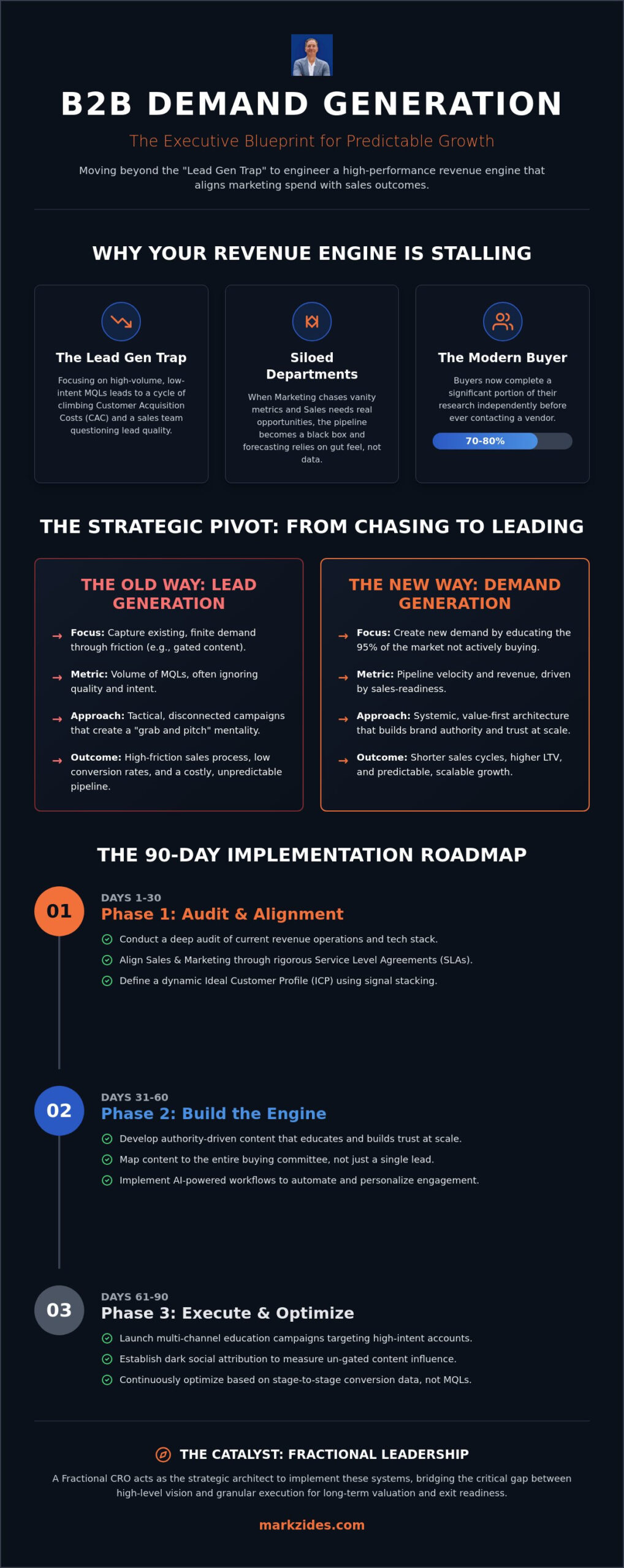
The 90-Day Demand Gen Implementation Roadmap
Strategy without execution is merely a wish. Transforming your revenue operations into a scalable B2B demand generation strategy requires a disciplined 90-day sprint. This isn't about minor tweaks; it's about building a repeatable revenue operating system that functions independently of the executive team's personal efforts. During this window, you move from a reactive posture to a proactive, system-driven engine that creates and captures intent with clinical precision.
- Phase 1 (Days 1-30): Audit & Alignment. We stop guessing. This phase is dedicated to ICP validation and establishing sales-marketing SLAs. We define exactly what constitutes a high-intent signal and who owns each millimeter of the funnel.
- Phase 2 (Days 31-60): Engine Construction. We build the content architecture and integrate intent data. This is where we design the "always-on" education layers that prime the market before sales ever enters the room.
- Phase 3 (Days 61-90): Execution & Optimization. We launch the campaigns and activate the feedback loops. Success here is measured by pipeline velocity, not just lead volume. We use real-world sales data to refine our marketing spend in real-time.
Phase 1: Setting the Foundation
Deep customer research is the bedrock of this roadmap. You must identify "unmet" pains that your competitors are ignoring. If you don't understand the operational anxiety of your CFO or the technical hurdles of your end-user, your messaging will fail to resonate. We establish a "Revenue Operating System" where the handoff from marketing to sales is triggered by an Engagement Threshold. This ensures sales only spends time on prospects who have reached a pre-defined level of authority and intent.
Scaling Beyond the Founder
Most mid-market firms are trapped in founder-led selling. The CEO's personal network is the primary source of revenue, which creates a dangerous bottleneck for growth. To scale, you must build a sales team that doesn't rely on the founder's charisma or connections. We implement sales enablement tools that mirror the demand gen narrative, ensuring the story told in marketing is the same one closed in sales. By standardizing the discovery process, you turn sales into a repeatable science. If you're ready to bridge the gap between founder-led success and a system-led future, you can audit your revenue operations here to see where your engine is stalling.
This transition requires a shift in mindset. You're no longer just selling a product; you're managing a predictable system. Every discovery call becomes a data point that informs the content architecture. Every marketing campaign becomes a test of your ICP's "unmet" pains. This alignment is what allows a business to grow sustainably, ensuring that marketing spend and sales results are always in lockstep.
Architecting Your Growth: Why Fractional Leadership is the Catalyst
Most mid-market firms possess the necessary technology stack but lack the organizational discipline to turn those tools into a cohesive B2B demand generation strategy. You don't need another software subscription; you need a builder. A Fractional CRO acts as the strategic architect who bridges the gap between high-level vision and granular execution. They don't just suggest tactics. They embed the systems and accountability frameworks required to move from erratic lead generation to a predictable revenue engine that functions with or without the founder's direct involvement.
Fractional CRO vs. Full-Time Hire
Speed is the ultimate competitive advantage in a high-stakes growth environment. A full-time executive search can often take six months and requires a significant capital commitment. In contrast, a fractional leader can deploy a functional revenue system within the 90-day window we've discussed. This speed to impact comes from "battle-tested" experience across multiple industries and growth stages. They've seen the failure points before and know how to bypass them. By aligning marketing and sales under a single, revenue-focused vision, they replace "gut-feel" anxiety with the calm of a structured methodology.
The cost-benefit analysis is clear. You gain access to elite leadership without the $300,000+ overhead of a full-time hire. This allows you to reallocate those savings into the demand generation engine itself, accelerating your path to market dominance. It's a pragmatic solution for companies that are too large for founder-led sales but not yet ready for a permanent C-suite layer.
Beyond high-level leadership, many SMEs find success by augmenting their internal capabilities with an agile external team; for instance, Herzog Neue Medien & Marketing functions as a specialized marketing department that can rapidly execute the technical and creative components of a demand generation strategy.
Preparing for the Next Level: Fundraising and Exits
A robust demand engine is the most significant driver of company valuation during fundraising or exit negotiations. When VCs or private equity firms conduct due diligence, they evaluate your "Demand Engine" to determine if your growth is sustainable. They look for a B2B demand generation strategy that is system-driven rather than dependent on lucky breaks or personal networks. If your revenue is predictable and your CAC is stable, your valuation multiple increases significantly.
Predictable revenue is the number one driver of valuation multiples. It signals to investors that you have a repeatable blueprint for success. To reach this level of operational excellence, you must audit your current pipeline for "Demand Gaps" and identify where the engine is leaking. Transitioning from a culture of intuition to a culture of data-driven accountability is the final step in architecting a business that is ready for the next level of performance. Whether you are preparing for an exit or simply aiming for sustainable growth, the architecture you build today determines the valuation you command tomorrow.
Architecting a Future of Predictable Revenue
Scaling a high-growth organization requires moving beyond the anxiety of erratic lead chasing. By implementing a system-driven B2B demand generation strategy, you replace "gut-feel" marketing with a repeatable revenue engine that aligns sales execution with market education. This transition from founder-led effort to a structured operating system creates the stability necessary for rapid expansion and long-term exit readiness.
You now have the roadmap to audit your current pipeline, build authority-driven content, and integrate the intent signals that shorten sales cycles. Whether you're preparing for a major fundraising round or optimizing for an eventual exit, the strength of your demand engine remains the primary driver of your company's valuation. A disciplined approach to revenue operations ensures that your growth is both sustainable and defensible against market shifts.
If you're ready to leverage fractional leadership for scalable growth and embed battle-tested sales execution systems, the next step is clear. Ready to build a predictable revenue engine? Explore Fractional CRO Services with Mark Zides.
The path from uncertainty to clarity starts with a single strategic decision. Your future revenue architecture is waiting to be built.
Frequently Asked Questions
What is the difference between B2B lead generation and demand generation?
Lead generation is a tactical exercise focused on capturing contact data through gated assets or direct outreach. In contrast, a B2B demand generation strategy is a strategic framework designed to create market preference and build brand authority before a prospect even enters a sales cycle. Lead gen captures existing intent; demand gen builds the pipeline of the future by educating the market.
How long does it take to see results from a demand generation strategy?
You should expect to see structural improvements in pipeline quality and sales alignment within 90 days of implementation. However, significant revenue impact typically requires six to nine months, depending on the complexity of your sales cycle. This timeline accounts for the period needed to move prospects from initial awareness through the authority-driven education layers to high-intent discovery.
Do I need a full-time CRO to build a demand generation engine?
You don't need a full-time CRO to architect this system; in fact, fractional leadership is often more efficient for mid-market firms. A fractional CRO provides the same strategic blueprint and operational discipline without the high overhead of a permanent executive hire. This allows you to embed expert-level systems while maintaining the capital flexibility required for marketing spend and sales execution.
What are the most important metrics for measuring demand generation ROI?
Focus on revenue velocity and pipeline contribution by channel rather than raw lead volume or cost-per-click. Key performance indicators must include your customer acquisition cost (CAC) relative to lifetime value and the conversion rate from discovery calls to closed-won deals. These metrics reveal the true efficiency of your B2B demand generation strategy and its direct impact on organizational valuation.
How does sales enablement fit into a demand generation strategy?
Sales enablement acts as the critical bridge that ensures the intent created by marketing is captured efficiently by your sales team. It provides the tools, narratives, and discovery frameworks that allow sales to continue the educational journey started during the demand creation phase. Without this alignment, you risk losing high-intent prospects during the transition from marketing awareness to sales discovery.
Can demand generation work for startups with limited budgets?
Demand generation is highly effective for startups because it prioritizes niche authority and operational expertise over massive advertising spend. By focusing on solving specific, unmet pains for a tightly defined ICP, you can build a predictable revenue engine without an enterprise-level budget. It's a strategy of out-thinking the competition by becoming the most trusted educator in your specific category—a concept leveraged by industry specialists like aquaticseo.com for marine-based businesses.
What is 'Dark Social' and why does it matter for B2B demand?
Dark Social refers to the untrackable channels where B2B buying decisions are influenced, such as private Slack communities, LinkedIn DMs, and peer-to-peer conversations. It matters because a significant portion of the buyer journey happens in these spaces where traditional attribution software is blind. Your strategy must produce high-value content that is worth sharing in these hidden environments; for organizations leveraging event footage to drive this engagement, See More Edits provides the professional post-production needed to capture attention and influence the hidden phase of research.
Should I outsource my lead generation while building a demand engine?
Outsourcing lead generation is a strategic move that maintains pipeline consistency while you construct your long-term demand engine. It serves as a laboratory to test messaging, ICP hypotheses, and signal-stacking techniques without diverting internal resources from building your permanent revenue architecture. This dual-track approach ensures you don't sacrifice short-term revenue for the sake of long-term scalability and exit readiness. For executives who want to deepen their understanding of what is demand generation as a scalable revenue operating system, this foundational knowledge is critical before committing to an outsourced execution model.
Ready to build a revenue engine that runs without you?
Mark works alongside founders as a player-coach — not a slide deck.
Book a 30-minute call