
Executive Coaching for Sales Leaders: Scaling Revenue Through Strategic Architecture

Most sales leaders aren't actually leading. They're simply the world's most expensive closers, trapped in a tactical vortex where every deal requires their personal intervention. If you find yourself manually rescuing forecasts and relying on gut instinct to hit your quarterly numbers, you're not an architect; you're a bottleneck. It's a common frustration for high-growth operators who know their current pace is unsustainable. You want a business that scales through systems rather than sheer force of will.
This is why executive coaching for sales leaders is no longer a luxury; it's a strategic necessity for those ready to move from "player" to "architect." You've likely realized that tactical management won't get you to the next level of valuation or operational freedom. We're going to show you how to master the strategic revenue systems required to scale your organization with confidence. We'll explore how to design a repeatable revenue operating system, replacing gut-feel anxiety with the calm of structured, predictable results. It is time to stop managing daily fires and start engineering the exit-ready leadership capabilities your organization demands.
Key Takeaways
- Transition from a tactical operator to a strategic architect by designing revenue systems that scale independently of your daily involvement.
- Discover how executive coaching for sales leaders breaks the growth ceiling by replacing inconsistent "gut-feel" management with structured operational discipline.
- Distinguish between sales training, leadership coaching, and fractional CRO services to ensure you apply the right strategic remedy for your current business stage.
- Implement a repeatable revenue operating system that aligns sales enablement with the buyer journey and identifies critical leaks in your funnel.
- Build exit-ready leadership capabilities that transform your role into a high-value asset, increasing organizational valuation and investor confidence.
Beyond Management: Why Sales Leaders Need Executive Coaching to Scale
Management is about maintenance; leadership is about architecture. For most sales leaders, the transition from a high-performing individual contributor to a manager was instinctive. However, the shift from a manager to a strategic revenue architect requires a fundamental rewiring of how you view the organization. This is where executive coaching for sales leaders becomes the critical lever for scale. It's a strategic partnership designed to help you stop reacting to the market and start engineering it.
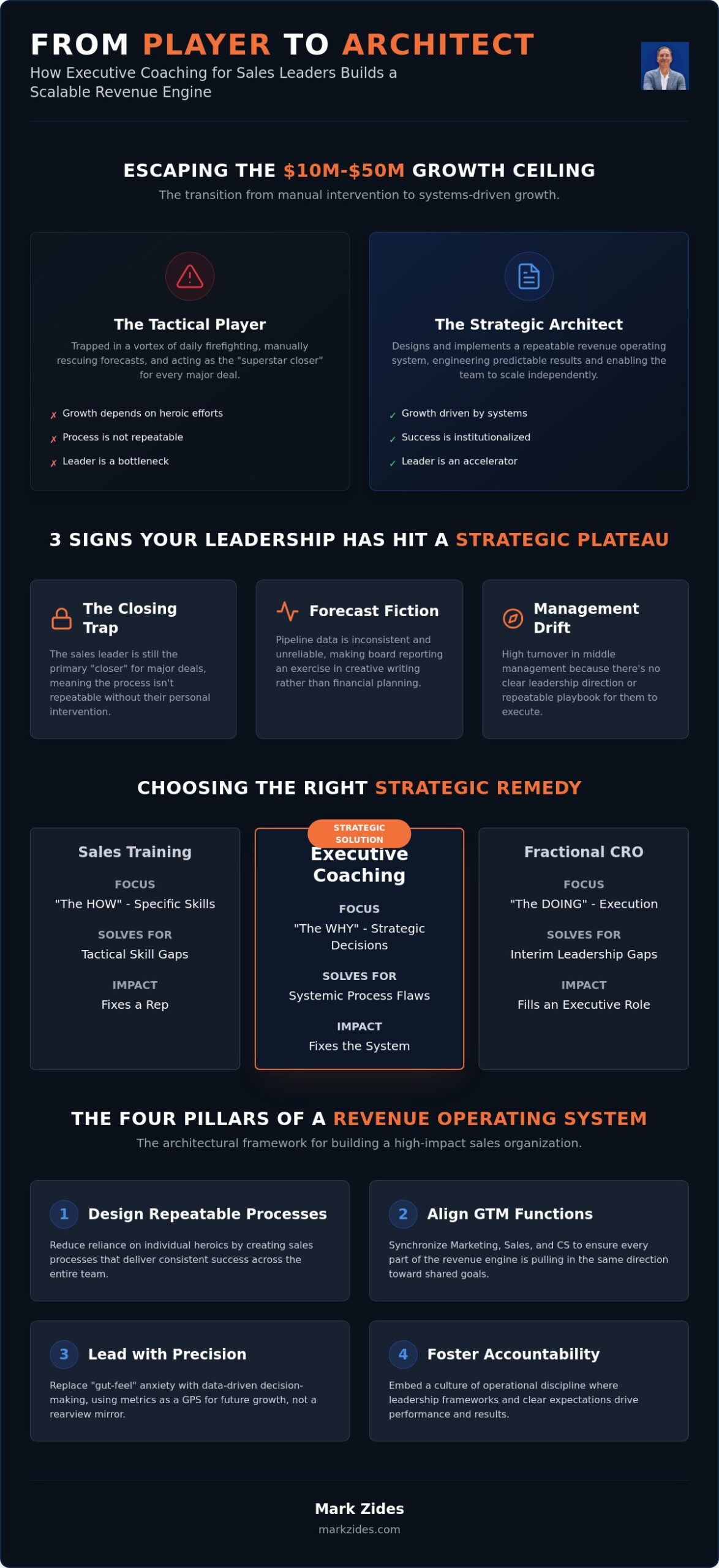
Between $10M and $50M ARR, companies often hit a "Growth Ceiling." At this stage, the tactical maneuvers that fueled early success, such as heroic individual efforts and founder-led selling, become liabilities. If your revenue growth depends on the leader being in every closing room, you haven't built a company; you've built a high-stress job. Transitioning through this phase requires moving away from the "Player-Coach" model and toward becoming a "Systems Architect" who designs repeatable, predictable revenue engines. Effective executive coaching replaces the "gut-feel" anxiety of inconsistent quarters with the calm of structured, predictable leadership frameworks.
The Critical Difference Between Sales Training and Executive Coaching
Sales training focuses on the "how" of a specific skill, such as objection handling or discovery. While valuable, training rarely solves a fundamental revenue stall. High-level executive coaching for sales leaders focuses on the "why" and the "what next" of strategic decision-making. It provides the accountability needed to stop reacting to daily fires and start embedding long-term operational discipline. Training fixes a rep; coaching fixes the system that governs those reps. If you don't address the underlying architecture, even the best-trained team will eventually fail under the weight of a broken process.
Signs Your Sales Leadership Has Hit a Strategic Plateau
Identifying a plateau before it becomes a crisis is the mark of a seasoned operator. Look for these specific architectural leaks in your organization:
- The Closing Trap: The sales leader or founder is still the primary "closer" for major deals, meaning the process isn't repeatable without them.
- Forecast Fiction: Pipeline data is inconsistent and unreliable, making board reporting an exercise in creative writing rather than financial planning.
- Management Drift: High turnover in middle management occurs because there's no clear leadership direction or repeatable playbook for them to follow.
When these signs appear, it's a clear signal that your current leadership style has reached its limit. You don't need more activity; you need better design. By embedding a repeatable revenue operating system, you move from being a bottleneck to becoming the engine of sustainable growth.
The Four Pillars of High-Impact Sales Leadership Coaching
High-impact growth is never an accident. It is the result of a deliberate architecture that supports every stage of the revenue lifecycle. While traditional management focuses on keeping the lights on, executive coaching for sales leaders equips you to build the infrastructure that powers the entire building. To move from a $10M plateau toward a $100M vision, you must master four distinct pillars of leadership that prioritize systems over luck.
Pillar 1 & 2: Building the Revenue Operating System
If your sales process relies on a few "superstar" reps to carry the quota, your business is inherently fragile. Strategic vision requires designing repeatable sales processes that reduce reliance on individual heroics and instead focus on institutionalized success. This involves aligning marketing and demand generation with specific sales execution goals; if marketing is focused on generic lead volume while sales is focused on specific account-based revenue, the resulting friction will stall your growth. A Revenue Operating System is the mechanical blueprint that synchronizes strategy, process, and technology to produce predictable, scalable growth. By embedding these systems, you ensure that every part of the revenue engine is pulling in the same direction.
Pillar 3 & 4: Leading with Precision and Accountability
Most leaders use data as a rearview mirror to explain why a quarter was missed. In a high-performance culture, data acts as a navigation tool to adjust course before the deadline arrives. This shift requires moving from "checking in" on reps to "driving outcomes" through structured, high-accountability 1:1s. You must leverage sales enablement tools to accelerate revenue velocity, ensuring your team spends less time on administration and more time on high-value activities. When data drives your decision-making, forecast accuracy moves from a "best guess" to a mathematical certainty. This level of precision is what separates a tactical manager from a strategic revenue architect.
Effective executive coaching for sales leaders bridges the gap between knowing these pillars and embedding them into the daily rhythm of your business. It provides the external perspective needed to identify where your current systems are leaking revenue and where your leadership needs to tighten. If you are ready to audit your current architecture, exploring executive coaching tailored for high-growth operators can provide the blueprint you need to scale with confidence. This is about more than just hitting next month's numbers; it is about building a legacy of operational excellence.
Comparison: Sales Training vs. Executive Coaching vs. Fractional CRO Services
Choosing the wrong intervention for a revenue stall is a costly mistake. If your sales reps are struggling to handle objections, you buy training. If your sales leader is struggling to architect a $50M revenue engine, you invest in executive coaching for sales leaders. However, if the entire revenue system is non-existent or fundamentally broken, you likely need a Fractional CRO. Understanding the distinction between these three levels of support is the difference between a minor skill bump and a total organizational transformation.
Training delivers short-term skill gains, but it rarely moves the needle on organizational valuation. Coaching and fractional leadership, by contrast, focus on long-term organizational value. While coaching refines the pilot, fractional CRO services rebuild the aircraft. One provides the strategic mindset to lead, while the other provides the hands-on execution required to embed a new operating system from the ground up. For many high-growth companies, these two services work in tandem to ensure the leader grows at the same pace as the business.
When to Choose Executive Coaching
Executive coaching is the ideal choice for high-potential leaders who possess the raw talent but lack the strategic blueprint to reach the C-suite. It's best suited for organizations that have a functional sales process but a leader who is "stuck" in tactical management. This engagement focuses on mindset shifts, strategic refinement, and the personal growth required to manage complex revenue architectures. If your leader is ready to bridge the gap to a CRO role, coaching provides the necessary accountability and vision to make that transition successful.
When a Fractional CRO is the Better Strategic Move
There are times when the leadership isn't the only problem; the system itself is the bottleneck. A Fractional CRO is required when you need an "Expert Operator" to step in and fix the revenue engine immediately. This is a critical move if you are preparing for a fundraising round or an exit where operational maturity is under the microscope. While executive coaching for sales leaders prepares the internal leader for future challenges, a Fractional CRO provides the immediate intervention needed to stabilize the ship and align demand generation with sales execution. It's about building the infrastructure today that the leader will manage tomorrow.
Ultimately, the ROI of these services is measured by the clarity they bring to your forecasting and the stability they bring to your growth. If you're relying on luck, you're gambling. If you're relying on a strategic architecture, you're scaling.
Implementing a Revenue Operating System: The Strategic Blueprint
Scaling a revenue engine isn't about working harder. It is about building a machine that produces results regardless of who is pulling the levers. If your revenue growth depends on your personal intervention in every major deal, you haven't built a scalable business; you've built a high-pressure job. Moving from a tactical operator to a strategic architect requires a methodical approach to your revenue infrastructure. Effective executive coaching for sales leaders provides the framework to transition from a deal-closer to a systems engineer who manages through architecture rather than effort.
To build a repeatable revenue operating system, follow this five-step blueprint:
- Step 1: Audit the Funnel. Identify every point where revenue is leaking. Whether it's a poor discovery process or a slow handoff from marketing, every leak is a tax on your growth.
- Step 2: Align Enablement. Your sales tools must mirror the buyer's journey. If your tech stack doesn't make it easier for the customer to buy, it is a bottleneck, not an asset.
- Step 3: Embed Accountability. Move from "checking in" to data-driven reporting. Reporting should be predictive, telling you what will happen next month, not just what happened last month.
- Step 4: Optimize Demand Gen. Ensure a consistent pipeline by focusing on quality over volume. Marketing and sales must agree on what a "Sales Ready" lead actually looks like.
- Step 5: Systematize Leadership. Refine your style so the system maintains itself. Your goal is to be the architect who monitors the gauges, not the mechanic who fixes the engine every day.
Removing the Founder from the Sales Process
Founder-led selling is the primary inhibitor of scale in 2026. If the CEO is the only person who can close a seven-figure deal, the organization is inherently fragile. You must build a "Sales Playbook" that allows others to replicate success without the founder's "magic touch." This transition requires moving from intuition to process. When you document the "why" behind every win, you turn a person-dependent business into a process-dependent asset. This is a core focus of high-level executive coaching for sales leaders who are preparing for a significant scale-up or exit. Leaders navigating this transition often benefit from CEO coaching for revenue growth that specifically addresses how to design a scalable revenue operating system independent of the founder's personal involvement. Founders who recognize themselves as the primary bottleneck will also find actionable frameworks in this entrepreneur's guide to working with a business coach for entrepreneurs to dismantle the founder's ceiling and embed operational excellence.
Aligning Demand Gen with Sales Execution
Marketing spend is an expense until it's aligned with sales execution. If marketing is driving volume while sales is starving for quality, you have a structural alignment problem. You must design a feedback loop where sales data directly informs marketing spend. Focus on quality over quantity at the top of the funnel to ensure your reps are spending their time on high-probability opportunities. When these two departments speak the same language, revenue velocity accelerates naturally.
For organizations seeking to bridge the gap between creative strategy and tangible growth, Indigo Collective Group offers the strategic leadership and hands-on execution needed to align marketing initiatives with bottom-line sales results.
If you are ready to stop guessing and start building a predictable revenue machine, partner with an expert operator who has scaled companies through these exact transitions. The difference between a plateau and a breakout is the strength of your architecture.
Accelerating Growth with Mark Zides: Peer-Level Coaching for Operators
Mark Zides functions as the Strategic Architect for revenue leaders who are tired of theoretical advice. Most coaching programs offer generic leadership platitudes; Zides offers operator-level blueprints. This is executive coaching for sales leaders delivered by someone who has sat in the CRO chair and navigated multiple successful exits. By integrating coaching with sales execution and enablement, you ensure that personal leadership growth translates directly into organizational performance. This isn't just about becoming a better manager. It is about becoming the architect of a high-growth machine.
The transition from a tactical operator to a strategic leader requires a peer who understands the high-stakes energy of a scaling business. Zides provides no-nonsense, battle-tested advice from a career spent building and exiting companies. We don't just talk about leadership; we embed the systems that make leadership effective. If your current revenue engine is person-dependent, we help you re-engineer it to be process-dependent, ensuring that your growth is both sustainable and predictable.
Preparing for Fundraising and Exit Readiness
Your sales leadership is a primary driver of company valuation. During an acquisition or fundraising round, clean data and repeatable systems are the first things VCs and acquirers scrutinize. If your revenue story relies on a few lucky quarters or the heroics of a single leader, your valuation will suffer. Mark Zides focuses on making the leader an asset during these high-stakes moments. We help you present a scalable revenue story backed by a predictable operating system, ensuring that your leadership is a reason to buy, not a reason to discount. Transitioning from intuition to a structured process is the most direct path to a higher multiple.
The 90-Day Transformation: From Gut-Feel to Forecast Accuracy
The first three months of executive coaching for sales leaders are designed to replace uncertainty with clarity. In the first 30 days, we audit the existing architecture to identify revenue leaks. By day 60, we are embedding the accountability cadences required to drive specific outcomes. By the end of 90 days, your organization transitions from a reactive fire-fighting mode to a proactive revenue culture. You stop guessing what the quarter will look like and start engineering the result with mathematical precision. This is the shift from managing a team to leading an engine.
Stop managing the vortex of tactical deals and start building the strategic systems your organization requires to scale. It's time to upgrade your leadership from operator to architect. Schedule a strategic briefing with Mark Zides today to begin your transformation.
From Operator to Architect: Securing Your Revenue Legacy
Scaling to the next level of performance requires more than just harder work; it demands a fundamental shift in your leadership architecture. You've seen how moving beyond tactical management and embedding a repeatable revenue operating system can stabilize growth and eliminate the anxiety of inconsistent forecasting. By aligning demand generation with disciplined sales execution, you transform from a world-class closer into a strategic architect who leads with precision. This shift is what separates a high-growth business from one that is simply high-stress.
Effective executive coaching for sales leaders provides the peer-level accountability needed to make this transition permanent. Through a methodology focused on exit readiness and valuation maximization, you move from being a bottleneck to becoming your organization's greatest asset. Mark Zides brings battle-tested operator experience to help you design the systems that ensure your success is predictable rather than accidental. If you're ready to stop managing daily fires and start engineering a legacy of excellence, it's time to act. Master your revenue engine with Mark Zides and secure the future of your organization today. You have the vision; we provide the blueprint to build it.
Frequently Asked Questions
What is the difference between sales management training and executive coaching?
Sales management training focuses on tactical skill acquisition for mid-level managers, while executive coaching for sales leaders addresses the strategic architecture of the entire revenue engine. Training teaches you how to manage a team; coaching teaches you how to design a repeatable system. If you need to fix a specific skill gap, buy training. If you need to scale a $50M organization, invest in a strategic partnership that refines your decision-making and operational discipline.
How long does it take to see results from executive coaching for sales leaders?
You can expect to achieve strategic clarity within the first 30 days, followed by a full organizational shift toward forecast accuracy within 90 days. The initial phase identifies revenue leaks and structural bottlenecks that provide immediate relief to the leader. By the end of a typical three-month engagement, the transition from gut-feel management to a proactive, data-driven revenue culture is usually well-established and producing measurable pipeline stability.
Can executive coaching help with founder-led sales transition?
Yes, transitioning away from founder-led selling is a primary focus of high-level coaching for growth-stage operators. We focus on building a comprehensive "Sales Playbook" that institutionalizes the founder's intuition into a repeatable process others can execute. This removes the founder as the primary bottleneck, allowing the business to scale independently of their personal involvement in every major deal. It's about turning a person-dependent business into a process-dependent asset.
How does sales leadership coaching impact company valuation?
Sales leadership coaching directly increases valuation by embedding the repeatable systems and clean data that acquirers and VCs demand during due diligence. Investors don't buy "heroic effort"; they buy predictable revenue engines. By focusing on exit readiness and operational maturity, coaching ensures your leadership is a high-value asset that supports a higher multiple. A leader who can present a scalable revenue story with mathematical certainty is far more valuable than one who relies on luck.
Is executive coaching worth the investment for a mid-sized B2B company?
It is essential for companies hitting the $10M to $50M ARR "Growth Ceiling" where tactical management starts to fail. At this stage, the complexity of the organization outpaces the leader's ability to manage through sheer force of will. Investing in a strategic architect ensures you build the infrastructure necessary to reach the next milestone without burning out your team. The ROI is found in increased forecast accuracy, reduced management turnover, and sustainable revenue velocity.
What specific sales leadership topics are covered in a coaching engagement?
Engagements typically focus on the four pillars of revenue architecture: strategic vision, systems design, talent optimization, and data-driven decision-making. We dive into granular execution details such as aligning demand generation with sales goals, designing high-accountability 1:1 cadences, and leveraging sales enablement tech stacks. The goal is to move beyond "checking in" on deals and toward driving outcomes through a structured revenue operating system.
How do I know if I need a business coach or a Fractional CRO?
You need a coach if the leader is capable but lacks the strategic blueprint to reach the C-suite; you need a Fractional CRO if the revenue engine itself is fundamentally broken and requires immediate hands-on intervention. Coaching refines the pilot, while a Fractional CRO rebuilds the aircraft. If you have a solid foundation but a "stuck" leader, coaching provides the best path. If you're missing the foundation entirely, a Fractional CRO is the better strategic move.
What happens if our current sales process is completely broken?
We start with a comprehensive audit to identify the specific "leaks" in your funnel before attempting to scale. Scaling a broken process only accelerates failure, so the priority is to fix the underlying architecture first. We'll align your sales enablement with the actual buyer journey and embed a cadence of accountability that ensures the new process sticks. Once the leaks are plugged, we focus on accelerating growth through a repeatable and predictable revenue engine.
Ready to build a revenue engine that runs without you?
Mark works alongside founders as a player-coach — not a slide deck.
Book a 30-minute call