
What is Demand Generation? The Executive Guide to Predictable Revenue

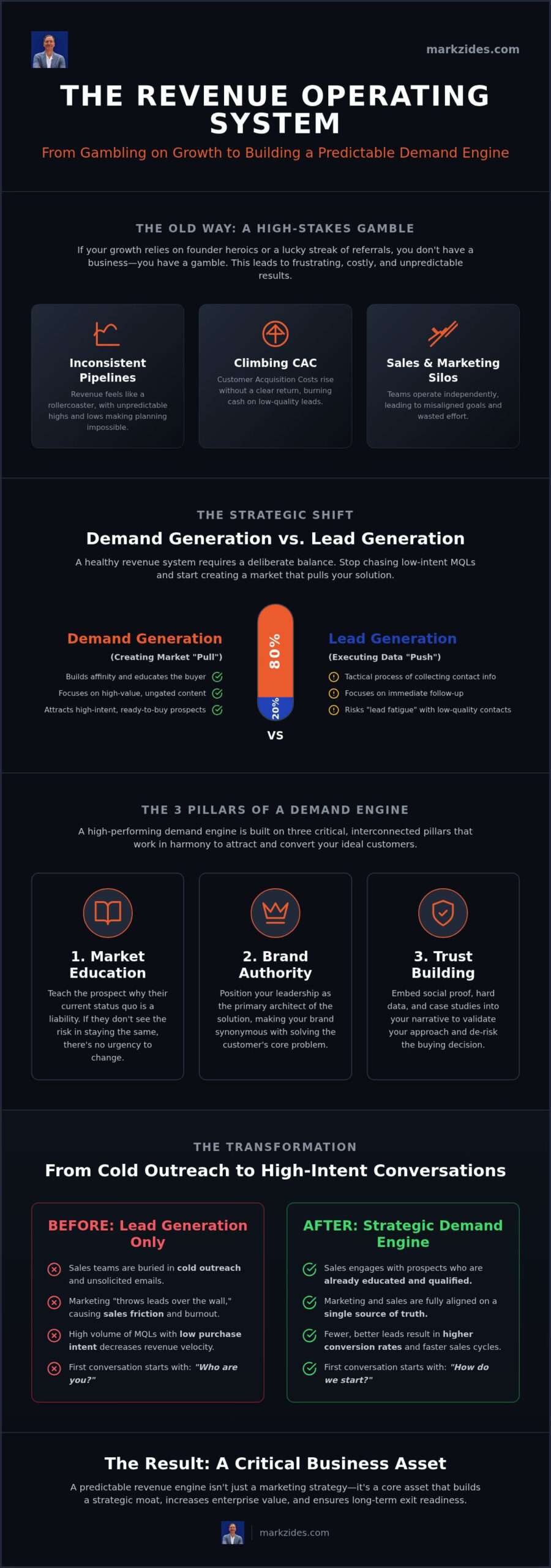
If your revenue growth depends on the heroics of a founder or a lucky streak of referrals, you don't have a business; you have a gamble. Most executives feel the weight of inconsistent pipelines and the mounting cost of low-quality leads that never close. It's frustrating to watch sales and marketing operate in silos while Customer Acquisition Costs climb without a clear return. To fix this, you must look beyond top-of-funnel noise and ask: what is demand generation in the context of a scalable, high-growth engine?
Mastering this discipline allows you to replace gut-feel marketing with a data-driven revenue operating system. This guide provides the strategic framework to align your teams and accelerate growth. We'll examine the architecture of a high-performing engine, from designing lead quality standards to embedding the systems that ensure your marketing spend finally mirrors your sales results. It's time to stop guessing and start building for scale.
Key Takeaways
- Define what is demand generation as a strategic revenue operating system designed to replace fragmented marketing tactics with a repeatable pipeline architecture.
- Differentiate between creating market "pull" and capturing "push" data to ensure your sales team focuses on high-intent, ready-to-buy prospects.
- Implement a unified Revenue Operating System that aligns marketing spend with sales results through a single source of truth.
- Transition from generic SEO-filler to SME-led content and hyper-targeted ABM plays to capture high-value enterprise accounts with precision.
- Recognize how a predictable revenue engine serves as a critical asset for increasing enterprise value and ensuring long-term exit readiness.
Defining Demand Generation: More Than Just Brand Awareness
Stop treating marketing like a slot machine. If your strategy involves throwing capital at brand awareness and hoping for a spike in sales, you're gambling with your growth. To build a sustainable, scalable business, you must understand what is demand generation in its most tactical, operational form. It isn't just about getting impressions or "brand heat." It's the strategic process of building a data-driven engine that manufactures interest and desire for your specific solution.
This system replaces the gut-feel anxiety of traditional marketing with a structured methodology for pipeline growth. It spans every touchpoint. From the moment a prospect realizes they have a pain point to the day they become a vocal advocate for your brand, demand generation is the architect of that journey. Your objective is to move prospects from being unaware of the problem to being convinced that your solution is the only logical remedy. When you define what is demand generation as a cross-functional system, you stop treating marketing as an isolated silo and start treating it as a revenue engine.
The Core Components of a Demand Engine
A functional demand engine relies on three critical pillars. First, market education is essential. You aren't just selling a product; you're teaching the prospect why their current status quo is a liability. If they don't see the risk in staying the same, they won't feel the urgency to change. Second, brand authority positions your leadership as the primary architect of the solution. Third, trust building involves embedding social proof and hard data into your narrative to validate your strategic approach. When these components work in harmony, you create a system that attracts high-intent buyers automatically.
Why Demand Generation is the Foundation of Scaling
Scaling a business is impossible if your sales team is stuck in a cycle of cold outreach. Cold calls and unsolicited emails have low conversion rates and high burnout potential. A robust demand engine reduces this friction by doing the heavy lifting of qualifying and educating the prospect before the first sales call even happens. This alignment ensures that when your sales team does engage, they're speaking to someone who already understands your value proposition and is ready to buy.
Beyond immediate revenue, this engine builds a strategic moat around your business. By establishing category leadership through consistent, high-value demand plays, you make it harder for competitors to gain a foothold. You aren't just competing on price; you're competing on the authority you've already established in the mind of the buyer. This is how you transition from founder-led sales to a predictable revenue operating system.
Demand Generation vs. Lead Generation: Clearing the Confusion
Executives often use the terms "demand generation" and "lead generation" interchangeably. This is a strategic error that leads to misallocated budgets and frustrated sales teams. To build a predictable revenue engine, you must understand that while they are related, they serve two distinct operational functions. If you are still asking what is demand generation in relation to your lead capture efforts, think of it as the difference between creating a market "pull" and executing a data "push."
Demand generation is the top-down effort to make the market want your product before they ever fill out a form. It's about building affinity and educating the buyer. Lead generation, conversely, is the tactical process of collecting contact information for immediate follow-up. A healthy revenue system requires a deliberate balance: roughly 80% demand creation to build the pipeline and 20% lead capture to harvest it. When you focus solely on lead generation, you end up with "lead fatigue," where your sales team is buried under a mountain of low-quality contacts who have no actual intent to buy.
The Lead Quality Trap
More leads do not equal more deals. In fact, a high volume of Marketing Qualified Leads (MQLs) can actually decrease your revenue velocity if those leads lack intent. Without a foundation of demand, marketing simply "throws leads over the wall" to sales. These prospects might have downloaded a whitepaper, but they don't understand your unique value proposition. Effective demand generation filters out these low-intent prospects. It ensures that by the time a buyer reaches your sales team, they are already convinced of your methodology. It moves the conversation from "Who are you?" to "How do we start?" For a deeper look at how to evaluate providers and architect a higher-quality pipeline, the B2B lead generation services comparison guide for 2026 offers a strategic framework for moving beyond tactical outreach.
Balancing Creation and Capture
Strategic demand creation relies on building authority through ungated channels. It requires a shift from hiding your best insights behind forms to leading with value. Designing this balance is a core pillar of effective fractional CRO services. By embedding these systems, you ensure your organization isn't just collecting names, but is actually accelerating revenue.
- Demand Creation: Subject-matter-led content, podcasts, and social leadership that build affinity and trust without a paywall.
- Demand Capture: High-intent triggers like gated technical webinars or direct "Contact Sales" buttons for buyers ready to move.
Aligning these two functions under a single revenue leader ensures that marketing spend finally mirrors your sales results. This shift in perspective-from capturing data to generating desire-is the only way to answer what is demand generation in a way that actually scales your bottom line. If your current system feels fragmented, exploring outsourced lead generation can help bridge the gap while you build your internal demand engine.
The Revenue Operating System: Aligning Sales and Marketing
Marketing and sales silos are the silent killers of enterprise value. If your marketing team celebrates lead volume while your sales team complains about lead quality, you have a structural failure. To build a scalable engine, you must implement a Revenue Operating System. This is the unified infrastructure that connects the pull of demand to the close of sales. It creates a single source of truth that prevents marketing from simply throwing leads over the wall to a frustrated sales department.
At this level of scale, understanding what is demand generation requires looking at the entire lifecycle of a deal. It isn't just a marketing function; it's a cross-functional discipline. Designing the hand-off points between these teams requires a Strategic Architect who can oversee the flow of data and communication. Success is no longer measured by vanity metrics like click-through rates or impressions. Instead, the focus shifts to pipeline velocity and realized revenue. If the system doesn't produce closed deals, the system is broken.
Shared Metrics: Moving Beyond Vanity
Stop obsessing over clicks. High-growth operators align their teams around Customer Acquisition Cost (CAC) and Customer Lifetime Value (LTV). If your marketing spend doesn't correlate with a healthy LTV:CAC ratio, your engine is inefficient. You must also track the "Demand Gen Cycle Length." This metric measures the duration from a prospect's first interaction with your brand to the final closed-won deal. By quantifying pipeline contribution, you gain visibility into how much revenue is marketing-sourced versus sales-sourced. This clarity allows for surgical precision in your budget allocation and resource planning.
The Role of Sales Enablement in Demand Gen
Demand generation doesn't end when a prospect fills out a form. Your sales team must be an extension of your marketing narrative. If the messaging shifts between an ad click and a discovery call, the buyer's trust evaporates immediately. Sales teams need to be equipped with the same subject-matter insights used in your demand campaigns to maintain consistency.
When you focus on designing a B2B demand generation strategy that scales, you create a roadmap that both departments can follow. This synchronization ensures every touchpoint reinforces your authority and accelerates the decision-making process. When your sales enablement is fueled by demand gen insights, your conversion rates climb because the prospect feels they are continuing a high-value conversation rather than starting a cold sales pitch. This is what is demand generation in a truly aligned organization: a seamless journey from curiosity to contract.
Strategic Channels for B2B Demand Generation in 2026
Channels are not strategies; they are the distribution pipelines for your revenue engine. If you treat them as isolated experiments, you'll never achieve the predictability required for scale. In 2026, the definition of what is demand generation has shifted toward high-trust, high-authority environments. You must move away from generic "SEO-filler" content and embrace subject-matter-expert-led journalism. Buyers are no longer looking for basic definitions. They're looking for the architectural blueprints to solve complex operational challenges.
This shift requires a multi-channel approach that prioritizes precision over volume. High-growth firms now focus on these primary drivers:
- Account-Based Marketing (ABM): Replace the "spray and pray" model with hyper-targeted plays for high-value accounts. This aligns your marketing spend directly with the sales team's most lucrative targets.
- Dark Social: Most B2B buying decisions happen in the "dark." This includes private Slack communities, professional discussion threads, and executive peer groups. Your engine must seed these environments with value that prospects can't help but share.
- Paid Media: Stop using paid ads to force-feed generic messages. Use them as an amplifier for content that's already performing organically. If a piece of SME-led content resonates, use paid channels to put it in front of a mirror audience.
The Power of Executive Presence
Your founders and CEOs are your most underutilized demand generation assets. Buyers don't want to engage with a faceless brand; they want to learn from a seasoned peer who has been in the trenches. By building a "Media Machine" that distributes this authority across leading professional networking platforms and industry-specific channels, you transition from promotional noise to value-first leadership. This executive presence acts as a force multiplier for every other channel in your stack. It builds the "pull" that defines what is demand generation in a modern, trust-based economy.
Leveraging Partnerships and Alliances
Hyperscaler relationships and strategic alliances act as massive demand multipliers. By integrating a sophisticated partnerships and alliances strategy into your engine, you tap into pre-validated audiences that already trust your partners. Co-marketing with industry peers isn't just a networking exercise; it's a tactical move to embed your solution within an existing ecosystem of trust. When your partner validates your methodology, the friction of the sales cycle drops significantly.
Designing these complex channel architectures requires more than just a marketing manager. It requires a strategic operator who understands how to align spend with results. If your current channel mix feels like a series of disconnected bets, it's time to build a cohesive system. Explore our Marketing & Demand Generation services to audit your current stack and design a high-velocity revenue engine.
Scaling the Engine: From Implementation to Exit Readiness
Building a high-performing demand generation engine is about more than hitting next month's sales targets. It's about constructing a tangible business asset. In the eyes of an investor or a potential acquirer, a company that understands what is demand generation as a structured revenue system is significantly more valuable than one relying on sporadic growth. Predictability is the ultimate currency of enterprise value. If your revenue is the result of a documented, repeatable engine rather than founder-led heroics, you've built a firm that's ready to scale or exit.
Scaling requires a shift from intuition to automation. You must move away from manual interventions and toward processes that function independently of any single individual. This transition is what separates a lifestyle business from a high-growth enterprise. Investors pay a premium for systems, not luck. Regular audits of this system ensure that the engine stays optimized, identifying where friction is slowing down your pipeline velocity and where capital is being wasted on low-performing channels. Without these checkpoints, the engine you've built will eventually stall under the weight of its own complexity.
Audit Your Current Revenue Engine
You can't scale what you haven't measured. A comprehensive audit starts by identifying the "leaks" in your current funnel. Are you losing prospects between the initial touchpoint and the discovery call? If so, your demand capture isn't aligned with your demand creation. You must also evaluate your tech stack. An over-complicated stack often hinders growth by creating data silos that prevent a single source of truth. Finally, assess your leadership. Scaling a revenue engine often requires a level of strategic oversight that internal teams may lack. This is where bringing in fractional support can bridge the gap, providing the expertise of a "Strategic Architect" without the overhead of a full-time executive hire.
Preparing for Fundraising or Acquisition
If you're preparing for a fundraising round or an acquisition, your demand generation strategy is your most powerful proof of market fit. Venture capitalists and private equity firms look for data-driven forecasting. They want to see that if they inject capital into your engine, it will produce a predictable, scalable return. A documented demand engine provides this clarity. It transforms "gut-feel" projections into a structured roadmap for growth. It proves that you've mastered what is demand generation by showing a clear link between marketing activity and realized revenue. This level of transparency is essential for maximizing your valuation during the exit process.
Ready to move from gut-feel to forecast accuracy? Connect with Mark Zides for a Strategic Consultation to begin designing your path to a predictable exit.
Build Your Revenue Architecture for Scale
Transitioning from fragmented marketing tactics to a structured engine is the only way to achieve sustainable growth. You've learned that understanding what is demand generation requires a fundamental shift from simply capturing data to actively manufacturing market desire. By aligning your sales and marketing teams under a unified operating system, you replace gut-feel anxiety with the clarity of a predictable pipeline. This architecture doesn't just drive leads; it builds a durable business asset that increases your enterprise value and ensures you're ready for a successful exit. High-stakes environments demand high-stakes discipline.
Mark Zides provides the fractional CRO leadership and battle-tested sales execution strategies needed to embed these systems into your organization. Don't leave your revenue to chance. Master Your Revenue Engine with Mark Zides and install the predictable operating system your business deserves. The path to scalable, high-velocity growth is within your reach; it's time to start building.
Frequently Asked Questions
What is the primary difference between demand generation and lead generation?
Demand generation is the strategic process of creating market desire and affinity for your solution before a prospect ever interacts with a sales rep. Lead generation is the tactical act of capturing contact information for immediate follow-up. While lead gen harvests the pipeline, demand generation builds it. A healthy system prioritizes building trust and authority over simply collecting email addresses in a database.
How long does it take to see results from a demand generation strategy?
You should expect a period of three to six months before seeing significant pipeline momentum from a new demand engine. Because this strategy relies on building trust and educating the market, the results are cumulative rather than instantaneous. If you need immediate volume, you might supplement with short-term tactics, but sustainable, predictable revenue requires the patience to install and optimize the long-term architecture.
Is demand generation only for large B2B companies?
No, demand generation is essential for any B2B organization looking to move beyond founder-led sales or inconsistent referrals. While the complexity of the tech stack may vary, the core principles of market education and brand authority apply to startups and enterprise firms alike. In fact, smaller firms often see a greater relative impact because a robust engine allows them to compete with much larger incumbents on authority.
What are the most important metrics to track in demand generation?
The most critical metrics to track are pipeline velocity, Customer Acquisition Cost (CAC) relative to Lifetime Value (LTV), and marketing-sourced revenue. You must move beyond vanity metrics like clicks or impressions. Instead, focus on the "Demand Gen Cycle Length" to understand how quickly your engine converts an unaware prospect into a closed-won deal. These data points provide the clarity needed for executive-level decision-making.
Can I outsource my demand generation engine?
Yes, you can leverage fractional CRO services or outsourced lead generation to design and support your engine. Many high-growth companies use external experts to architect the system while their internal teams focus on execution. This approach provides access to battle-tested strategies and specialized skills without the long-term overhead of a full executive hire, allowing you to scale your operations with greater precision and speed.
How does demand generation affect my company's valuation?
A documented demand generation engine significantly increases your company's valuation by proving that your revenue is predictable and scalable. Investors and acquirers pay a premium for businesses that have moved beyond "gut-feel" marketing. When you can demonstrate a clear, data-driven link between marketing spend and sales results, you reduce the perceived risk for buyers and justify a higher enterprise multiple during an exit.
What role does a Chief Revenue Officer (CRO) play in demand generation?
The Chief Revenue Officer acts as the strategic architect who aligns the silos of marketing, sales, and customer success. In the context of what is demand generation, the CRO ensures that the narrative remains consistent across the entire buyer journey. They are responsible for designing the hand-off points between teams and ensuring that the organization's tech stack and metrics are unified under a single revenue goal.
How do I know if my company is ready for a formal demand gen engine?
Your company is ready for a formal engine if you are struggling with inconsistent pipeline growth or high customer acquisition costs. If your sales team is spending too much time on "cold" prospects or if your marketing efforts feel disconnected from your sales results, you have a structural gap. Understanding what is demand generation in a formal sense allows you to replace intuition with a scalable, data-driven revenue operating system. Executives evaluating their options can also benefit from reviewing a structured guide to comparing B2B lead generation services to identify the right external partners for closing that gap. For organizations ready to take the next step, the 2026 executive checklist for top of funnel lead generation provides the operational frameworks needed to build a high-volume, high-quality pipeline that functions independently of founder involvement.
Ready to build a revenue engine that runs without you?
Mark works alongside founders as a player-coach — not a slide deck.
Book a 30-minute call