
B2B Lead Generation: Executive Comparison Guide 2026

High lead volume is often the primary driver of revenue stagnation. If your CRM is overflowing with contacts but your sales team is still struggling to book meetings with actual decision-makers, you don't have a lead problem; you have an architecture problem. Evaluating B2B lead generation services requires more than a simple vendor checklist; it necessitates a strategic shift from tactical outreach to a scalable revenue operating system. You likely know the frustration of inconsistent quality from past vendors and the exhaustion of relying on founder-led selling to keep the business moving.
It's a common cycle where disconnected sales and marketing engines produce noise rather than predictable growth. This guide provides the strategic framework to compare providers and align your pipeline with a long-term revenue architecture. You'll discover how to transition from tactical outreach to a sophisticated demand generation engine that delivers sales-ready appointments and prepares your organization for eventual exit readiness.
Key Takeaways
- Shift from gut-feel prospecting to a structured revenue architecture that treats lead generation as a core strategic function rather than a tactical silo.
- Analyze the 2026 cost-to-value ratio of internal SDR teams compared to the immediate speed-to-market offered by specialized B2B lead generation services.
- Master the distinction between capturing existing demand and creating new demand to ensure your pipeline doesn't hit an artificial growth ceiling.
- Identify agency red flags by auditing data sourcing methods and intent signals to protect your brand reputation from low-quality outreach.
- Embed your top-of-funnel activities into a 90-Day Revenue Operating System to align every appointment with long-term exit readiness and scalable growth.
Navigating the B2B Lead Generation Landscape in 2026
Modern B2B lead generation is no longer a volume game played by dialers in a basement. It's a high-precision engineering project. If you're still relying on "gut-feel" prospecting, you're essentially gambling with your burn rate. In 2026, the most successful organizations treat B2B lead generation services as a specialized revenue-driving function that integrates directly into a wider growth architecture. This transition from manual, scattergun outreach to AI-Powered Lead Generation and Sales System Implementation is the difference between stagnation and scale. It's about designing a system that identifies signals before they become obvious to the rest of the market.
The primary metric for 2026 isn't just "leads generated." It's Revenue Velocity. This framework measures how quickly high-intent prospects move from the first touch to a closed-won deal. By embedding advanced analytics and real-time intent signals into your top-of-funnel strategy, you ensure that every dollar spent on outreach is optimized for speed and conversion. If your pipeline is clogged with "maybe" leads, your velocity drops and your customer acquisition cost spikes. Precision is the only remedy for an inefficient funnel.
The Shift from Quantity to Sales-Ready Quality
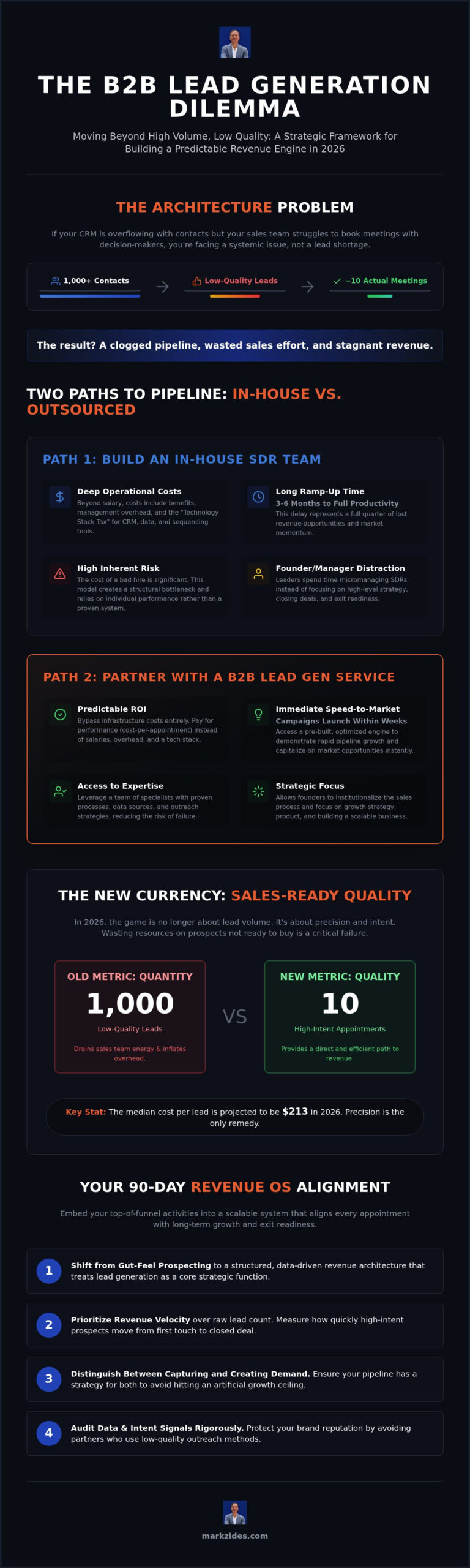
The math is simple but often ignored. Processing 1,000 low-quality leads drains your sales team's energy and inflates your overhead. In contrast, securing 10 high-intent appointments with decision-makers who are actively in-market provides a direct path to revenue. This requires a sophisticated approach to lead generation that prioritizes intent data over basic firmographics. We've moved beyond the stale MQL versus SQL debate. The goal now is identifying "Revenue-Ready Opportunities" where the buyer's behavior indicates an immediate need. With the median cost per lead rising to $213 in 2026, you can't afford to waste resources on prospects who aren't ready to buy.
Why Founders Must Step Back from Direct Prospecting
Founder-led selling is a necessary catalyst in the early days, but it's a structural bottleneck for any company aiming to surpass $10M ARR. You can't scale a business on one person's intuition and personal network. Professionalized B2B lead generation services allow you to institutionalize the sales process. This creates a repeatable system that functions independently of the founder's schedule. It replaces individual charisma with operational discipline, ensuring that your pipeline remains full even when you aren't the one making the calls. By shifting the burden of prospecting to an expert operator, you free yourself to focus on high-level strategy and exit readiness.
In-House vs. Outsourced B2B Lead Generation Services
Building an internal sales development representative (SDR) team is often a vanity project that masks deep operational costs. Beyond base salary and commissions, you must account for the Technology Stack Tax. A modern prospecting engine requires a sophisticated suite of tools for intent data, email sequencing, and CRM management. These costs accumulate quickly and require constant maintenance. When you partner with professional B2B lead generation services, you bypass this infrastructure cost entirely. You aren't just buying leads; you're accessing a pre-built, optimized environment designed for high-velocity output.
Speed-to-market is another critical differentiator. Hiring and training an internal team usually takes three to six months before they reach full productivity. In a high-growth environment, that's a quarter of lost revenue. Outsourced partners can often launch campaigns within weeks. This agility is vital during fundraising rounds where you need to demonstrate rapid pipeline growth to investors. It allows you to scale up or down based on capital availability without the HR friction of layoffs or rapid hiring cycles.
The ROI of Outsourcing Your Pipeline
To calculate true ROI, you must compare the cost-per-appointment against the fully loaded cost of an internal employee. This includes benefits, overhead, and management time. The New Rules of B2B Lead Generation suggest that data-driven precision now outweighs raw activity volume. Outsourcing reduces the risk of a bad hire. It allows you to pivot your strategy without the friction of restructuring a department. Sales leaders who spend their days micromanaging SDRs are effectively neglecting their primary duty of closing high-value deals. This represents a massive opportunity cost that stunts organizational growth.
Hybrid Models: The Best of Both Worlds?
You don't always have to choose one or the other. Many scaling companies use external partners to augment an existing internal team. This hybrid approach works well for market testing or top-of-funnel experimentation where you want to validate a new vertical without distracting your core staff. The key is ensuring data continuity between your external partner and your internal CRM. If you want to professionalize your entire approach, exploring Fractional CRO services can provide the necessary discipline and repeatable systems that internal teams often lack. This enables B2B lead generation services to function as a scalable extension of your sales engine, providing the top-of-funnel volume while your internal account executives focus on closing. It creates a seamless transition that protects your brand reputation while accelerating your path to market dominance.
Lead Generation vs. Demand Generation: Which Strategy Drives Revenue?
Confusing lead generation with demand generation is a strategic error that leads to inevitable revenue plateaus. Traditional B2B lead generation services focus on capturing existing demand. They identify the small percentage of prospects who are already actively looking for a solution. While this is essential for immediate pipeline health, it eventually hits a ceiling. If you aren't actively creating new demand by educating your market and building brand authority, you're competing in an increasingly expensive and crowded space where everyone is chasing the same 3% of active buyers.
A Strategic Architect views these two functions as complementary components of a single revenue system. Lead generation harvests the crop, but demand generation prepares the soil. For a deeper dive into these mechanics, consult our guide on What is Demand Generation? The Executive Guide to Predictable Revenue. Balancing these ensures you aren't just reacting to the market. You're actively shaping it to your advantage.
Designing a Scalable Demand Strategy
Scaling requires a shift from hunting individual leads to farming a broad ecosystem of prospects. This involves building a B2B demand generation strategy that leverages thought leadership and executive branding. When your leadership team is perceived as a primary source of industry insight, cold outreach becomes warm. Prospects who have consumed your content are already halfway through the buying journey before they ever speak to a sales rep. This approach transforms your B2B lead generation services from a cold-calling exercise into a sophisticated engagement engine that builds long-term equity.
The Marketing and Sales Alignment Gap
Lead generation often fails because marketing and sales operate in silos. If marketing is focused on volume and sales is focused on quality, the result is friction and wasted capital. You need a unified Revenue Engine where every lead follows a pre-defined sales path based on intent and fit. This is where the role of a Fractional CRO becomes indispensable. By providing operational excellence and strategic oversight, they bridge the gap between these departments. Investing in marketing and sales alignment consulting ensures that every lead generated is actually revenue-ready. It replaces the internal blame game with a structured, accountable system designed for sustainable growth and exit readiness.
Key Criteria for Evaluating B2B Lead Generation Partners
Selecting a partner for B2B lead generation services is a high-stakes decision that either professionalizes your pipeline or degrades your brand reputation. Many agencies operate on a "churn and burn" model, prioritizing raw volume over the strategic fit of the appointments they book. If an agency promises a fixed lead count before auditing your Ideal Customer Profile (ICP), they are selling you a commodity, not a strategy. You must vet for partners who utilize real-time intent signals rather than stale, scraped databases. In 2026, the difference between a qualified lead and a waste of time lies in the signal-layered qualification process that identifies buyers already showing in-market behavior.
Your evaluation should also extend to their technology stack. Ask whether they use AI for deep personalization or simply to accelerate mass-blasting. A sophisticated partner uses automation to research prospects and route leads in seconds, not to spam thousands of uninterested contacts. Furthermore, assess their sales enablement capabilities. A lead is a liability if your team cannot close it. The best partners don't just book meetings; they provide the context, intelligence, and handoff discipline required to move that prospect through your entire revenue operating system. To ensure your pipeline entry point is engineered for scale, review the top of funnel lead generation executive checklist for 2026 before finalizing any partner evaluation.
The 'Operator' vs. The 'Agency' Mentality
You need a partner who functions as a strategic extension of your leadership team. An "Agency" focuses on fulfilling a contract, while an "Operator" focuses on your bottom line. This distinction is critical when targeting high-value accounts or navigating complex "Hyperscaler" relationships. Vetting for industry-specific expertise ensures your outreach sounds like a peer-to-peer conversation rather than a generic sales pitch. Demand transparency in reporting that goes beyond vanity metrics. You should have real-time visibility into Revenue Velocity and the health of the conversion funnel at every stage.
Vetting for Exit Readiness
Repeatable revenue is the most valuable asset you can present to a potential acquirer or VC. A professionalized lead generation partner increases your company's valuation by proving that your growth isn't dependent on founder intuition or luck. They provide the clean, audit-ready data that demonstrates a predictable path to future earnings. If you want to transition from tactical outreach to a system that builds long-term equity, you must align your top-of-funnel activities with a broader strategic vision. To ensure your lead generation efforts are fully integrated with your growth goals, consider how Fractional CRO services can provide the oversight needed to build a truly scalable sales engine.
Beyond the Lead: Aligning Lead Gen with Your Revenue Operating System
Stop treating a booked meeting as the final objective. If your B2B lead generation services end at the appointment, you're leaving significant revenue on the table. A truly scalable business treats lead generation as the top-of-funnel component of a comprehensive 90-Day Revenue Operating System. It is the fuel. The engine, however, is the system that processes that fuel into closed deals. This requires a decisive shift from tactical outreach to integrated revenue architecture. You must align your entry point with your exit goals.
This is where Fractional CRO services become essential. An expert operator doesn't just monitor how many leads enter the pipeline; they optimize the entire funnel for maximum velocity. They ensure that Sales Execution & Enablement is in place so your account executives have the tools, training, and discipline to convert those high-intent appointments into signed contracts. Without this alignment, high lead volume simply exposes the cracks in your sales process. It accelerates your burn rate without accelerating your growth.
Building the Blueprint for Growth
A Fractional CRO designs the structural architecture that B2B lead generation services inhabit. They embed the accountability necessary to ensure that every lead is followed up with surgical precision. This isn't just about sales activity. It's about connecting lead generation with broader strategic functions. For example, the link between partnerships and lead generation efficiency is often overlooked. When your outreach is supported by a robust network, your credibility soars and your sales cycle shrinks. It replaces cold friction with warm momentum.
Preparing for the Next Level: Fundraising and Scale
Investors don't buy leads; they buy predictable revenue. By professionalizing your top-of-funnel data, you can build a credible 24-month revenue forecast that stands up to the scrutiny of VCs or potential acquirers. Implementing a sophisticated partnerships and alliances strategy allows you to lower your customer acquisition cost while increasing lead quality. This moves your organization from a state of gut-feel anxiety to the calm of structured, repeatable systems. It's the difference between a company that struggles to grow and one that is engineered for scale.
Real growth demands the mindset of an Expert Operator. It is time to stop gambling on disconnected tactics and start building a sustainable revenue engine. Move from gut-feel to forecast accuracy by conducting a strategic revenue audit today.
Architecting Your Path to Predictable Scale
High-growth technology firms don't scale on luck. They scale on repeatable, institutionalized systems. If you've realized that founder-led selling and disconnected marketing engines are preventing you from reaching your next milestone, it's time to professionalize your architecture. We've explored the necessity of moving beyond vanity metrics to focus on Revenue Velocity and the critical distinction between capturing and creating demand. Selecting the right B2B lead generation services is the first step toward building a pipeline that actually converts into sustainable revenue.
The true differentiator is how those leads are processed through a 90-Day Revenue Operating System. Mark Zides specializes in helping B2B SaaS organizations embed the discipline and accountability required for rapid progress. By providing Fractional CRO oversight for all lead gen engines, he ensures that your sales engine is not just active, but exit-ready. It's time to replace gut-feel anxiety with the clarity of a battle-tested blueprint designed for your specific growth stage.
Stop guessing and start scaling with a Strategic Revenue Audit from Mark Zides.
Your path to a predictable, scalable future starts with a single, disciplined step toward operational excellence.
Frequently Asked Questions
What are B2B lead generation services and how do they work?
B2B lead generation services are specialized engines that identify, engage, and qualify high-intent prospects on your behalf. They work by integrating advanced intent data with multi-channel outreach to deliver a consistent flow of sales-ready opportunities into your CRM. This process replaces manual, "gut-feel" prospecting with a structured system designed to target decision-makers at the exact moment they are in-market for a solution.
How much do B2B lead generation services cost in 2026?
Costs in 2026 are typically structured around monthly retainers, pay-per-lead, or hybrid performance models. While specific fees depend on your industry and target account complexity, most professional partners align their pricing with the value of the pipeline they generate. You should evaluate cost in the context of Revenue Velocity rather than just looking at the initial line item on your balance sheet.
Is it better to hire a lead gen agency or an in-house SDR?
Outsourcing is often the more strategic choice for companies prioritizing speed and operational discipline. Hiring an in-house SDR requires significant capital for training, management, and the associated technology stack. An agency provides an immediate, scalable solution that reduces the risk of bad hires and allows your internal team to focus exclusively on closing high-value deals.
What is the difference between a lead and a qualified appointment?
A lead is simply a point of contact, whereas a qualified appointment is a verified meeting with a decision-maker who meets your Ideal Customer Profile. The goal of professionalized B2B lead generation services is to move beyond vanity metrics like lead counts. They focus on delivering revenue-ready opportunities that have a high probability of progressing through your sales funnel.
How do I measure the ROI of my lead generation partner?
ROI should be measured by tracking the conversion rate from appointment to closed-won revenue and the overall shortening of your sales cycle. While cost-per-lead is a common metric, the true measure of success is the quality of the pipeline and its contribution to your company's valuation. A successful partnership builds a repeatable asset that enhances your long-term exit readiness.
Can lead generation services help with founder-led sales transition?
Yes, these services are essential for removing the founder-led bottleneck that often stunts growth at the $10M ARR mark. By institutionalizing the prospecting phase, you replace individual charisma with a repeatable sales process. This transition allows founders to step back from direct outreach and focus on building the organizational architecture required for sustainable scale.
What role does a Fractional CRO play in lead generation?
A Fractional CRO acts as the strategic architect who ensures lead generation is integrated into a wider revenue operating system. They bridge the gap between marketing and sales, ensuring that lead gen isn't an isolated tactic. Their oversight ensures that your sales execution and enablement processes are optimized to convert the volume generated at the top of the funnel.
How long does it take to see results from a lead generation service?
You'll typically see initial outreach activity within the first month. However, building a predictable, high-velocity engine usually takes a full 90-day cycle. This period allows for the refinement of messaging, the validation of intent data signals, and the establishment of a consistent rhythm that moves prospects from initial awareness to a sales-ready state.
Ready to build a revenue engine that runs without you?
Mark works alongside founders as a player-coach — not a slide deck.
Book a 30-minute call