
Fractional CRO Services: The Strategic Blueprint for Scaling Revenue in 2026

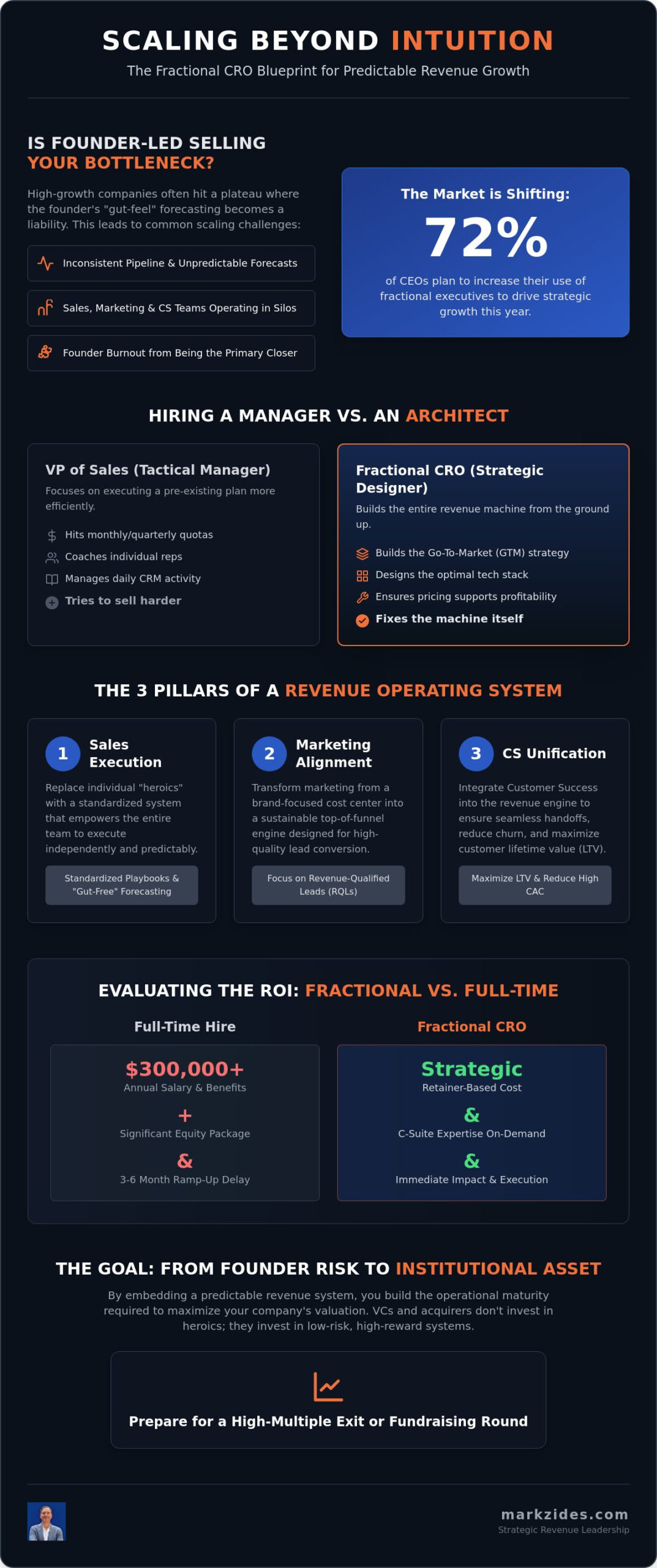
What if the primary obstacle to your next $10M isn't your product, but the fact that your revenue growth still depends entirely on your personal intuition? It's a common trap for high-growth leaders. You've built a successful company on grit and "gut-feel" forecasting, yet you now face an inconsistent pipeline and teams operating in silos. With 72% of CEOs planning to increase their use of fractional executives this year, it's clear that the shift toward expert fractional CRO services is no longer a temporary fix; it's a strategic requirement for scaling. You need a system that works when you aren't in the room.
We understand the anxiety of founder burnout and the pressure of preparing for a major exit or fundraising round. You deserve the clarity of a structured, predictable revenue engine. This guide will teach you how to replace founder-led intuition with a repeatable revenue operating system through expert fractional leadership. We'll outline the exact blueprint to align your go-to-market strategy, ensure forecast accuracy, and build the operational maturity required to maximize your company's valuation in 2026.
Key Takeaways
- Shift from founder-led intuition to a repeatable revenue operating system that scales without your constant oversight.
- Discover how fractional CRO services integrate sales, marketing, and customer success into one unified, high-velocity engine.
- Implement a 90-day strategic blueprint designed to identify funnel leaks and embed standardized sales playbooks for immediate impact.
- Prepare for exit or fundraising by building a predictable revenue model that replaces founder-led risk with institutional stability.
- Compare the ROI of fractional leadership against full-time hires, focusing on rapid execution and the elimination of executive ramp-up delays.
What Are Fractional CRO Services? Moving Beyond Founder-Led Selling
A fractional Chief Revenue Officer is a high-level executive who provides strategic leadership on a retainer basis. Unlike a consultant who merely offers advice, a fractional CRO acts as an embedded operator. They own the revenue outcome. By leveraging established Chief Revenue Officer (CRO) principles, they bridge the gap between initial product-market fit and institutional scale. This model allows mid-market companies to access C-suite expertise without the immediate commitment of a $300,000 salary and equity package.
The core mission of fractional CRO services is the total unification of sales, marketing, and customer success. In many high-growth organizations, these teams operate in silos. Marketing generates leads that sales cannot close; sales closes deals that customer success cannot support. A fractional leader fixes this by installing a single revenue engine where every department is measured by the same North Star metrics. They move the organization from "gut-feel" intuition to a data-driven, repeatable system.
Most founders scale to their first $5M or $10M through sheer force of will. This founder-led selling is essential early on, but it becomes a liability as you approach Series B. If the founder remains the primary closer, the business cannot scale. It becomes a bottleneck. Transitioning to a system-led model is the only way to ensure predictable forecasting and long-term sustainability. If your growth depends on your personal involvement in every deal, you don't have a scalable company; you have a high-stakes job. For SaaS organizations facing this exact inflection point, understanding how a fractional CRO for SaaS scales beyond founder-led sales is the critical next step toward building an institutional revenue engine.
The Difference Between a Fractional CRO and a VP of Sales
It's a common mistake to hire a VP of Sales when you actually need a revenue architect. A VP of Sales is a tactical manager. They focus on hitting the monthly quota, coaching reps, and managing the daily CRM activity. A Fractional CRO is a strategic designer. They build the Go-To-Market (GTM) strategy, select the tech stack, and ensure the pricing model supports profitability. If your sales process is fundamentally broken, a VP will just try to sell harder. A CRO will fix the machine itself.
When Your Business Needs a Fractional Revenue Leader
Recognizing the need for external leadership is a sign of operational maturity. You should consider fractional CRO services if you face these specific challenges:
- Stagnating growth despite having a high-quality product and a capable team.
- High Customer Acquisition Costs (CAC) that are outstripping your Lifetime Value (LTV).
- Marketing and sales teams that are misaligned on lead quality and follow-up.
- The urgent need to prepare for a significant capital raise or an acquisition exit.
As your revenue engine scales, your physical infrastructure must keep pace. For organizations expanding their footprint, utilizing verified commercial listings from propzee.in ensures that your real estate decisions are as data-driven and secure as your sales strategy.
The 3 Pillars of Strategic Revenue Leadership
Scaling a business past the $10M mark requires more than just hiring more headcount. It requires a deliberate architecture. While a VP of Sales might focus on the next deal, fractional CRO services focus on the next level of organizational maturity. This transition is built upon three foundational pillars that transform a fragile, founder-dependent startup into a resilient, institutional asset. When these pillars are aligned, the business stops reacting to the market and starts commanding it.
The strength of these pillars directly dictates your company's valuation. Acquirers and VCs don't pay high multiples for luck or "hero" sales reps. They pay for systems that produce predictable results. By embedding these structures now, you ensure that your revenue engine is seen as a low-risk, high-reward investment during future fundraising or exit negotiations.
Sales Execution: Building the Repeatable Pipeline
If your sales team relies on individual heroics to hit their numbers, your pipeline is at risk. Strategic leadership replaces these heroics with playbooks. By building a repeatable sales process, you remove the founder from the daily grind and empower the team to execute independently. This "Revenue Operating System" standardizes everything from lead qualification to closing techniques. It ensures that every new hire can reach full productivity in weeks rather than months, providing the consistency required for accurate, "gut-free" forecasting.
Marketing Alignment: Demand Gen That Actually Converts
Marketing must be more than a cost center for brand awareness. It must function as a sustainable top-of-funnel engine designed for conversion. We shift the focus from vanity metrics to revenue-qualified leads (RQLs). This pillar involves designing a demand generation strategy that scales in lockstep with your sales capacity. In many cases, integrating outsourced lead generation—whether through a general agency or a niche expert focused on full arch implant marketing—is the most efficient way to bridge the gap while your internal engine matures. This ensures your sales team remains focused on high-value closing activities while the top-of-funnel stays consistently full.
Partnerships & Alliances: Unlocking Indirect Revenue
The third pillar involves moving beyond direct sales to leverage partnerships and alliances. By aligning with hyperscalers and strategic channel partners, you unlock indirect revenue streams that scale with significantly less overhead. This creates a diversified revenue mix that is highly attractive to investors. If you want to see how these pillars can be tailored to your specific growth stage, you might consider an executive coaching engagement to sharpen your leadership team's focus on these strategic drivers.
Evaluating the ROI: Fractional CRO vs. Full-Time Hire
Hiring a full-time Chief Revenue Officer is often viewed as a milestone of success, yet for many mid-market firms, it is a premature financial burden. A traditional C-suite search takes four to six months to complete and carries a heavy price tag including a $300,000+ base salary, aggressive equity grants, and significant benefits packages. If the hire doesn't work out, the "divorce" cost can be catastrophic. Fractional CRO services offer a superior alternative by providing the same strategic depth at a fraction of the total compensation cost, effectively de-risking your leadership layer during critical growth phases. For a detailed breakdown of how these two models stack up, see our comprehensive analysis of the fractional CRO vs full time CRO ROI and execution comparison.
Speed to value is the most critical metric in a high-growth environment. While a full-time executive typically requires six to nine months to reach full productivity, a fractional operator delivers a measurable impact within 30 to 45 days. They don't need to spend months "learning the culture"; they arrive with a battle-tested blueprint ready for immediate deployment. This agility allows you to scale the engagement up as revenue grows or pivot the strategy without the friction of a long-term employment contract.
Cost Comparison and Budget Allocation
The math of fractional leadership is simple but transformative. By opting for a fractional model, you avoid the $50,000+ recruiting fees and the long-term liability of a heavy executive payroll. These "saved" funds can be immediately reallocated into high-impact areas like demand generation tools, sales enablement content, or additional lead generation capacity. Because you bypass the heavy costs of equity and executive search fees while accelerating the sales cycle, the ROI for fractional CRO services often exceeds 3x within the first twelve months.
The Executive Coaching Benefit
A fractional CRO doesn't just build systems; they build people. They act as a high-level mentor for your existing VP of Sales, coaching them to eventually step into the full-time CRO role as the company matures. This provides a clear professional development path for your internal talent while ensuring the founder receives the strategic guidance necessary to stop playing "lead salesperson." If you are looking to sharpen your own executive presence, consider CEO Coaching for Revenue Growth to align your leadership style with your new revenue operating system. This dual focus on system architecture and leadership development ensures that the growth you achieve is both sustainable and institutional.
The 90-Day Revenue Operating System: From Audit to Acceleration
Luck is not a strategy. While many organizations wait months for a full-time hire to "get their bearings," fractional CRO services operate on a compressed, high-impact timeline. A 90-day sprint replaces chaos with a structured Revenue Operating System, moving the company from founder-led hustle to institutional scale. This isn't a period of observation; it's a period of aggressive construction. The objective is to install a repeatable machine that produces predictable results long after the initial engagement ends.
The transition from "gut-feel" decisions to data-driven execution happens in three distinct phases. By Day 90, the organization has moved from identifying leaks to launching new revenue channels. This methodical progression ensures that every strategic move is backed by hard data rather than optimistic projections. SaaS companies in particular benefit from this structured approach; you can explore the full methodology in our guide on deploying a fractional CRO for SaaS to install a 90-day revenue operating system. If you are ready to stop guessing and start scaling, you can partner with an expert to deliver fractional CRO services and begin your transformation today.
The Revenue Audit: Identifying Your Growth Levers
The first 30 days are dedicated to the Revenue Audit. This is a deep-dive analysis of your current conversion rates, specifically focusing on the transition from Marketing Qualified Lead (MQL) to Sales Qualified Lead (SQL) and finally to Closed-Won. We evaluate the existing sales tech stack to identify redundant tools or integration gaps that are slowing down your reps. Simultaneously, we review your current partnership and alliance strategies to see where indirect revenue is being left on the table. This audit identifies the specific growth levers that will provide the highest ROI in the shortest amount of time.
Embedding the System: Ensuring Long-Term Scalability
In the second phase (Days 31-60), we focus on system embedding. This involves creating a comprehensive GTM Blueprint for the next 12 to 24 months. We standardize sales playbooks, refine CRM hygiene, and train the team on a new revenue operating rhythm. This is where we replace individual heroics with a repeatable process. By setting up a dashboard for real-time forecast accuracy, we provide the leadership team with the visibility required to make informed strategic decisions. The goal is to ensure that the sales process is so well-defined that it can scale independently of the founder's daily involvement.
The final phase (Days 61-90) is about acceleration. With the foundation set, we launch new demand generation channels and formalize partnership programs. This is where the fractional CRO services model proves its value by shifting from fixing the past to building the future. By the end of this sprint, the business has a clear, data-backed path to its next revenue milestone, fully equipped with the playbooks and systems necessary to maintain momentum.
Maximizing Valuation: Exit Readiness and Fundraising with a Fractional CRO
Revenue is the ultimate scoreboard, but for sophisticated investors, how you generate that revenue matters more than the total number. If your growth depends on the founder's personal network or individual heroics, acquirers view your business as a high-risk asset. They aren't looking to buy a job; they're looking to buy a machine. Utilizing fractional CRO services allows you to de-risk your organization by shifting from unpredictable, founder-led selling to institutional revenue systems. This transition is often the difference between a standard industry multiple and a premium valuation.
During the due diligence process, a fractional CRO acts as your strategic advocate. They provide the clean, segmented data that VCs demand, showing exactly where your revenue comes from and how much it costs to acquire. By demonstrating operational excellence before you hit the market, you signal to buyers that the business is ready for immediate, post-acquisition scale. This proactive approach eliminates the "red flags" that often stall or kill deals during the final stages of negotiation.
Fundraising Readiness: Prepping for Your Next Round
Investors in 2026 are increasingly focused on capital efficiency. To win your next round, you must develop a Growth Narrative backed by granular revenue data. This means showing scalable unit economics where your LTV-to-CAC ratio is both healthy and improving. A fractional leader helps you optimize your revenue model to prove that additional capital will be used to accelerate a proven system rather than to find one. If you are preparing to pitch, our Fundraising Readiness Consulting can help you refine your metrics and narrative for maximum impact.
Exit Strategy: Positioning for Acquisition
Maximizing your exit requires more than just a high growth rate. You must ensure the revenue engine runs flawlessly without the founder's involvement. This involves cleaning up sales contracts, standardizing partnership agreements, and ensuring all intellectual property related to the sales process is documented and transferable. When you replace a hero-based culture with a CRO-led system, you significantly increase your EBITDA multiples by proving that the business success is systemic and sustainable. By the time you reach the closing table, your fractional CRO services engagement will have paid for itself many times over through a significantly higher final sale price.
Transitioning from Founder-Led Hustle to Institutional Scale
Grit alone cannot bridge the gap to your next revenue milestone. To scale effectively, you must replace founder-led intuition with a repeatable Revenue Operating System that functions independently of your daily involvement. We've outlined how the three pillars of strategic leadership and a disciplined 90-day sprint can transform your organization from a fragile startup into a resilient, high-value asset. Choosing fractional CRO services is the ultimate de-risking strategy for mid-market firms aiming for professional excellence.
Our battle-tested "Expert Operator" methodology is specifically designed to drive SaaS exit readiness and institutional stability. We don't just offer advice; we embed the systems and provide integrated outsourced lead generation support necessary to accelerate your growth. If you are ready to stop relying on "gut-feel" forecasting and start building a predictable engine, now is the time to act. Schedule a Strategic Revenue Audit with Mark Zides today to secure your company's future. You have built the foundation; let's construct the machine that takes you to the next level.
Frequently Asked Questions
What is the typical cost of fractional CRO services?
The cost of hiring a fractional leader is significantly lower than the total compensation package of a full-time C-suite executive. You avoid the heavy burden of equity grants, performance bonuses, and executive benefits. Most engagements operate on a monthly retainer basis, allowing you to reallocate the capital saved into high-impact growth areas like demand generation and sales tools. This model provides a high-level strategic architect at a price point that fits mid-market budgets.
How many hours a week does a fractional CRO work?
A fractional CRO typically dedicates 10 to 20 hours per week to your business, depending on the complexity of your systems. The focus is on high-leverage strategic activities rather than administrative tasks. This model provides enough bandwidth to lead the team and design the revenue architecture without the unnecessary overhead of a full-time executive presence. It's about the impact of the hours, not the quantity of the time spent.
Can a fractional CRO help with hiring a full-time sales team?
Absolutely. A key responsibility of the CRO is to build a high-performing sales organization that can function without the founder's constant oversight. They design the ideal candidate profiles, lead the interview process, and establish the compensation structures required to attract top-tier talent. This ensures that your full-time team is built upon a foundation of operational excellence from day one, reducing the risk of expensive hiring mistakes.
Does a fractional CRO manage my marketing department too?
Yes, the primary mandate of fractional CRO services is to unify the entire revenue engine. This includes managing marketing and demand generation to ensure they're perfectly aligned with sales execution. By overseeing both departments, the CRO eliminates the common friction between lead quality and sales follow-up. They create a seamless flow from initial interest to closed-won, ensuring that every marketing dollar spent contributes directly to the bottom line.
How long is a typical fractional CRO engagement?
A standard engagement usually lasts between 6 and 18 months. This timeframe allows the CRO to complete the initial 90-day audit, embed the new revenue operating system, and stabilize the team. Once the machine is running predictably and a full-time successor is trained or the existing VP of Sales is coached into the role, the fractional leader transitions out. They leave behind a scalable and institutionalized engine that no longer requires their daily intervention.
What is the difference between a fractional CRO and a sales consultant?
A sales consultant typically provides a report or a set of recommendations and then leaves the execution to you. In contrast, fractional CRO services provide an embedded operator who takes ownership of the revenue outcome. They don't just tell you what's broken; they design the fix, embed the system, and manage the team to ensure the results are achieved. They're a peer in the C-suite, not a distant advisor.
How does a fractional CRO improve company valuation before an exit?
Investors assign higher multiples to businesses with predictable, system-led revenue models. A fractional CRO improves valuation by removing the "founder-led risk" that often scares away acquirers. By installing a repeatable sales process and a data-driven forecasting system, they transform your revenue from an unpredictable art into a reliable, institutional science. This operational maturity signals to buyers that the business is a low-risk, high-growth asset ready for acquisition.
Ready to build a revenue engine that runs without you?
Mark works alongside founders as a player-coach — not a slide deck.
Book a 30-minute call