
Fractional CRO vs Full Time CRO: The ROI and Execution Comparison for 2026

Your next executive hire will either be the catalyst for your exit or the anchor that sinks your burn rate. Many founders believe that a massive full-time salary is the price of admission for predictable growth, but they're often buying a driver for a car that doesn't have an engine yet. When weighing a fractional CRO vs full time CRO, the decision isn't just about the budget. It's about whether you need a tactical architect to embed a repeatable revenue operating system or a manager to maintain the status quo.
You've likely felt the frustration of stagnating sales and the exhaustion of being the bottleneck in every deal. It's a high-stakes gamble that keeps you up at night. This comparison will help you discover whether a fractional or full-time revenue leader is the right strategic move to scale your sales engine without the overhead of a misaligned executive hire. We'll examine the ROI, execution speed, and the specific milestones that dictate which path leads to a scalable sales and marketing engine in 2026.
Key Takeaways
- Break the founder-led sales bottleneck by transitioning from gut-feel tactics to a structured, repeatable revenue operating system.
- Analyze the ROI of a fractional CRO vs full time CRO to determine if your stage of growth requires a builder of systems or a manager of people.
- Accelerate execution speed by deploying a battle-tested operator who can deliver strategic alignment in weeks rather than months.
- Identify the five organizational red flags that signal a need for high-level revenue leadership without the risk of a $400k executive hiring mistake.
- Prepare for fundraising or a successful exit by embedding a scalable sales and marketing engine directly into your company's DNA.
The Revenue Leadership Gap: Why the Traditional CRO Model is Failing Startups
Growth is a liability if it isn't predictable. Most founders wait until they are drowning in operational friction to hire a revenue leader, but they often fall into the "Founder-Led Sales" trap. This is the stage where the CEO's charisma and deep product knowledge are the only things closing deals. It doesn't scale. It creates a strategic bottleneck that prevents true organizational maturity because the sales process lives in the founder's head rather than in a repeatable system. When you're stuck in this cycle, the debate between a fractional CRO vs full time CRO becomes the most critical decision on your roadmap.
The High Cost of a Full-Time Hiring Mistake
The financial toll of a misaligned executive hire is staggering. In 2026, the average base salary for a full-time Chief Revenue Officer (CRO) is approximately $230,000, but that's just the starting point. When you factor in benefits, payroll taxes, and overhead, the total cost of a full-time employee is typically 28 to 35% higher than the base salary. Add in headhunter fees and equity grants, and a single hiring failure becomes a $400,000 catastrophe.
The most dangerous element isn't the cash burn; it's the "6-month realization cycle." It usually takes half a year to realize a new hire isn't the right fit for your specific stage of growth. During those 180 days, your revenue engine stalls. You lose market momentum and competitive ground that you can't buy back with a second round of funding. If you hire for management when you actually need strategic architecture, you're paying a premium for a leader who is managing a broken engine rather than building a new one.
Moving from Founder-Led to System-Led Growth
Scaling requires a fundamental shift from intuition to architecture. A "Great Salesperson" knows how to close a prospect, but a "Revenue Architect" knows how to build the machine that closes ten thousand prospects. Many startups make the mistake of hiring a VP of Sales too early. They get a leader who knows how to manage headcount, but they lack the strategic framework to align marketing, sales, and customer success into a single revenue operating system.
If you're evaluating a fractional CRO vs full time CRO, you must identify the primary friction point in your business. Are you missing a manager, or are you missing a blueprint? Most startups in the $3M to $10M range don't need a full-time executive to sit in meetings all day. They need an expert operator to install the plumbing. Consider these red flags that indicate your current model is failing:
- Your pipeline relies on individual heroics and "gut-feel" rather than data-driven stages.
- Sales and marketing operate in silos with conflicting KPIs and zero lead-to-revenue visibility.
- You're hiring more sales reps to fix a conversion problem that is actually a positioning issue.
- The CEO is still the only person who can close a Tier 1 account.
Filling this leadership gap isn't about adding another body to the org chart. It's about embedding a repeatable system into your company's DNA so that growth becomes an inevitable outcome of your operations rather than a lucky break. For product-led businesses in particular, understanding how a fractional CRO for SaaS can move your organization beyond founder-led sales is a critical step toward building that sustainable foundation.
Defining the Fractional CRO: Strategic Architecture vs. Daily Management
A Fractional CRO is a battle-tested operator providing executive leadership on a retainer basis. They aren't consultants who hand over a slide deck and disappear. They're architects who design, embed, and accelerate the revenue systems your business lacks. When comparing a fractional CRO vs full time CRO, the distinction lies in the output. A full-time hire often spends 80% of their time on daily management and internal politics. A fractional leader applies the 80/20 Rule of Revenue. They dedicate 20% of the traditional work week to driving 80% of the strategic impact, focusing exclusively on high-leverage activities like Go-To-Market (GTM) strategy, RevOps, and sales enablement.
One of the most common mistakes founders make is hiring a person before they have a system. Hiring a full-time executive to "figure it out" is an expensive way to conduct an experiment. A fractional leader arrives with a proven blueprint. They don't need six months to understand your market; they need six weeks to audit your plumbing and start fixing the leaks. This "part-time" engagement doesn't signal a lack of commitment. It represents a commitment to efficiency. You're paying for their years of experience and their ability to execute with precision, not for their presence in every Monday morning stand-up.
The Fractional CRO as a Strategic Architect
The primary role of a fractional leader is to build the strategic architecture that a full-time CRO will eventually inherit. This involves designing repeatable sales processes and marketing funnels that function without founder intervention. They optimize your technology stack by aligning CRM data, lead generation tools, and reporting frameworks into a single source of truth. Most engagements center on a 90-Day Revenue Operating System. This framework moves your organization from the chaos of "gut-feel" projections to the clarity of forecast accuracy. If you want to see how this architecture transforms a scaling business, you can explore the Fractional CRO Services: The Strategic Blueprint for Scaling Revenue in 2026.
When Fractional is the Superior Strategic Move
Timing is everything in the fractional CRO vs full time CRO debate. For companies bridging the gap between Series A and Series B fundraising rounds, a fractional leader provides the executive "polish" and operational discipline required by sophisticated investors. They're also the superior choice for specialized projects, such as launching a new product line or entering an international market where you need a specific playbook rather than a permanent department head.
Choosing this model allows you to maintain an aggressive growth trajectory while keeping your executive burn rate low. It's about buying the results, not the overhead. If you're ready to stop guessing and start scaling, it might be time to partner with an expert operator who has been in the trenches and knows how to win.
Fractional CRO vs. Full-Time CRO: The ROI and Execution Comparison
ROI isn't just about the salary line item. It's about time-to-value. When you analyze a fractional CRO vs full time CRO, you're comparing a permanent overhead commitment to a surgical strategic intervention. High-growth companies often over-hire for the stage they're currently in. This results in bloated executive burn rates and unnecessary equity dilution that haunts the cap table for years. By 2027, Gartner projects that more than 30% of midsize enterprises will have at least one fractional executive on retainer. They aren't doing it to save pennies; they're doing it to accelerate growth without the friction of a traditional hire.
The Cost-Benefit Analysis for 2026
Total compensation for a full-time executive often reaches 1.3x their base salary when you include payroll taxes, health insurance, and 401k matching. For a leader at the $230,000 level, your actual burn is closer to $300,000 before you even issue a single share of equity. A fractional leader operates on a fixed monthly retainer, typically ranging between $10,000 and $20,000. This model allows you to scale your leadership spend up or down based on your actual revenue performance.
Perhaps most importantly, it preserves founder ownership. Hiring a fractional leader for a 12-month build-out phase saves significant equity that would otherwise be permanently committed to a full-time hire who may or may not be the right fit for your next stage. You're buying the same level of expertise while keeping your cap table clean for future fundraising rounds.
Execution: Deep Integration vs. Strategic Oversight
The "Daily Management" myth suggests that you need a leader in the office forty hours a week to manage a small team. It's an inefficient use of capital. If you have a five-person sales team, they don't need constant oversight; they need a repeatable system. A fractional leader delivers this by establishing accountability frameworks and KPIs that matter to your board. They move fast. While a traditional search takes four months to hire and another three to onboard, a fractional operator can be embedded and delivering results within weeks.
The debate between a fractional CRO vs full time CRO often ignores the value of objectivity. Fractional leaders bring an external peer's perspective. They aren't worried about internal office politics or protecting their job; they're focused on what works. They also provide immediate access to a network of external partnerships and hyperscaler connections that would take a new full-time hire years to cultivate. They build the machine, hire their own full-time successor once the system is proven, and then exit, leaving you with a scalable revenue engine.
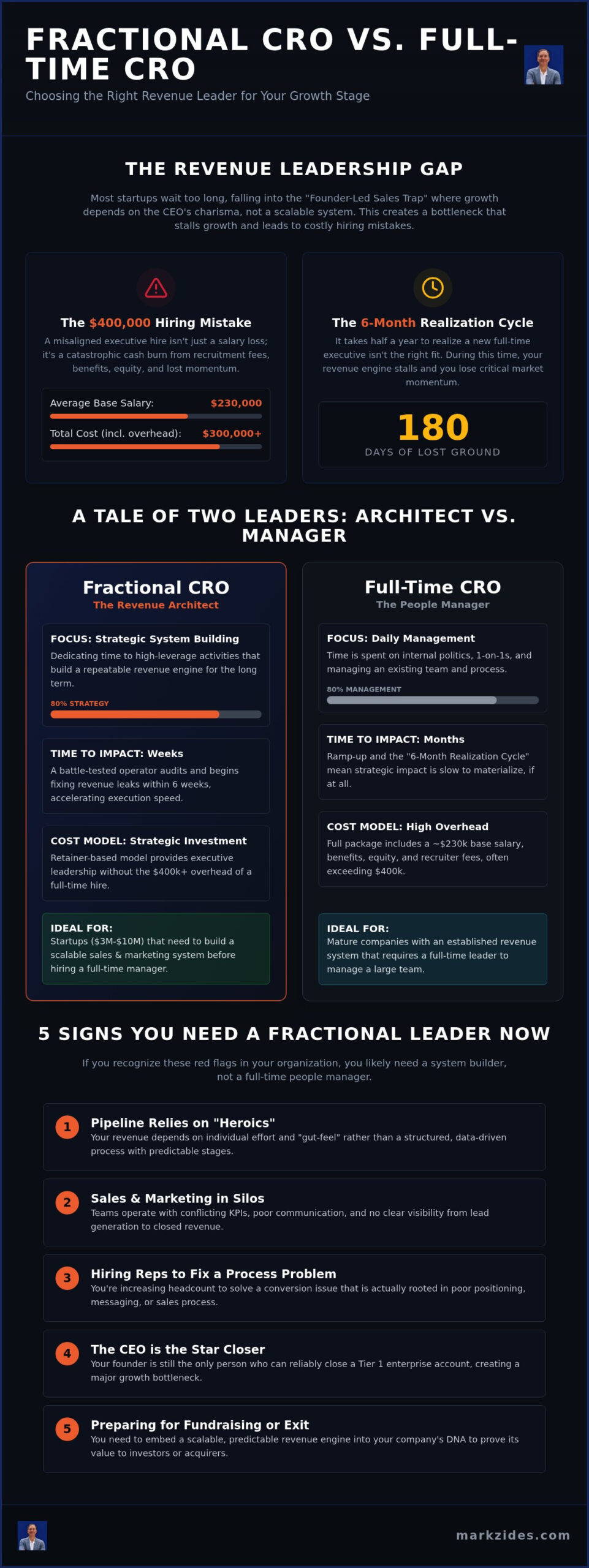
Decision Framework: 5 Signs Your Business Needs a Fractional Leader Right Now
Growth isn't a byproduct of effort; it's a result of architecture. If your sales team is busy but revenue remains flat, you don't have a productivity problem. You have a system problem. Deciding between a fractional CRO vs full time CRO requires an honest assessment of your current operational maturity. You don't hire a driver for a car that doesn't have an engine yet. If you are experiencing any of the following five signals, the "Expert Operator" model is your most logical next step.
- Activity without Achievement: Your sales team is hitting their call and email quotas, but the needle isn't moving on closed-won deals.
- The Founder Bottleneck: You, the CEO, are still the primary person closing every major deal. If you step away, the pipeline freezes.
- Departmental Silos: Marketing and Sales are operating as two different companies. They don't share data, KPIs, or a unified view of the customer journey.
- The Horizon Event: You're 12 to 18 months away from a major fundraising round or a strategic exit.
- Systemic Void: You have people and tools, but you lack a repeatable Revenue Operating System that produces predictable results.
Assessing Your Current Revenue Maturity
A full-time executive hire is a management move. A fractional hire is a construction move. Before you commit to a $400,000 annual package, conduct a Revenue Maturity Audit. Ask if your current GTM strategy has a "Missing Link" that a manager can't fix. Often, the issue is a fragmented RevOps tech stack that provides zero visibility into lead-to-revenue conversion. A fractional leader identifies these gaps and aligns your CRM, lead gen, and reporting tools for scalability before you bring on a permanent department head. Understanding where the Chief Revenue Officer fits within your business functions is a critical prerequisite to making that permanent hire with confidence.
Exit Readiness and Fundraising Preparation
Institutionalizing revenue is the fastest way to increase your company's valuation. VCs and private equity firms don't just buy your product; they buy the predictability of your growth. If your revenue is still "founder-led," it's considered a high-risk asset. A Fractional CRO prepares your organization for the scrutiny of a data room by cleaning revenue metrics and proving that the sales engine runs independently of the CEO.
They also play a vital role in navigating hyperscaler partnerships and alliances that can accelerate your market reach before a sale. By the time you reach the negotiating table, your revenue isn't a guess; it's a documented, repeatable system. Secure your exit readiness by engaging a Fractional CRO who builds for valuation.
Scaling with Precision: The Mark Zides Fractional Advantage
Advice is cheap; execution is everything. Most consultants deliver a deck of recommendations and leave you to figure out the implementation. That isn't how high-growth engines are built. The Mark Zides methodology is rooted in an "Operator" mindset, focusing on the actual construction of the systems that drive revenue. When you evaluate a fractional CRO vs full time CRO, the advantage of a fractional operator like Mark Zides is the immediate injection of battle-tested discipline. You aren't just hiring a strategist; you're partnering with an architect who has been in the trenches and knows how to remove the founder-led bottleneck once and for all.
This approach moves your organization from "gut-feel" anxiety to the clarity of structured, predictable systems. It's a transition from hoping for a good quarter to knowing exactly how your pipeline will perform. By embedding a Revenue Operating System directly into your company's DNA, you create a foundation that is sustainable, scalable, and ready for the scrutiny of institutional investors.
The 90-Day Revenue Transformation
Precision scaling requires a methodical path forward. The 90-day framework is designed to deliver rapid progress without the friction of a traditional executive onboarding cycle. It follows a logical progression of building and fixing:
- Month 1: Audit and Alignment: We identify the leaks in your funnel and align your sales and marketing KPIs. We stop the bleeding and establish a single source of truth for your data.
- Month 2: System Architecture: We build the repeatable pipeline. This involves designing the playbooks, optimizing the tech stack, and embedding the accountability frameworks that drive results.
- Month 3: Execution and Enablement: We empower your team to win. We move from design to action, ensuring your sales force has the tools and training to execute the new blueprint with confidence.
This transformation is often complemented by executive coaching for founders. As the systems evolve, the leadership must evolve with them. Mark provides the blueprint for founders to step back from the daily closing loop while maintaining the "magic" that built the company in the first place.
Building Your Future Sales Force
A successful fractional engagement doesn't just fix the present; it prepares you for the future. One of the most valuable aspects of the Mark Zides approach is the assistance in hiring and training your permanent full-time sales leaders. Because the system is already built and the KPIs are established, you can hire with total clarity. You're no longer looking for a "savior" to fix your revenue; you're looking for a manager to run a machine that already works. This eliminates the $400,000 hiring mistake and ensures your organization is built for a long-term, high-valuation exit.
Scale your revenue with a Fractional CRO who acts as an Operator, not just an Advisor.
Architecting Your Path to Scale
The choice between a fractional CRO vs full time CRO is ultimately a choice between building a system or managing a department. For high-growth startups, the priority must be the architecture of a repeatable revenue engine. By shifting from gut-feel tactics to a proven Revenue Operating System, you remove the founder-led bottleneck and prepare your organization for institutional scrutiny. Whether you're navigating hyperscaler partnerships or driving toward exit readiness, the objective is to maximize valuation through operational excellence and predictable performance.
You've seen the risks of the $400,000 hiring mistake. You know the signs of a stalled engine. Now's the time to replace uncertainty with a structured blueprint for success. It's about moving from a collection of activities to a coordinated machine that delivers results month after month. Stop guessing and start scaling. Book a consultation with Mark Zides to see if a Fractional CRO is your missing link.
Your sales engine is ready for its next level of performance. Let's build the machine that makes your growth inevitable.
Frequently Asked Questions
How many hours a week does a fractional CRO usually work?
A fractional CRO typically commits between 10 and 25 hours per week to your organization. This schedule is designed to focus exclusively on high-leverage strategic tasks like Go-To-Market architecture and RevOps alignment. By stripping away the administrative overhead of a traditional 40-hour role, they deliver the same strategic impact as a full-time executive at a significantly lower burn rate.
Is a fractional CRO the same as a sales consultant?
No, the primary difference lies in execution. A sales consultant is an advisor who provides a roadmap and leaves the implementation to the founder. A fractional CRO is an expert operator who takes executive ownership of your revenue engine. They don't just tell you what to fix; they embed the systems, manage the teams, and stay accountable for the results.
Will a fractional CRO manage my existing sales team?
Yes, providing leadership and accountability for your existing team is a fundamental part of the engagement. They install the frameworks your reps need to move from "gut-feel" selling to a repeatable process. This includes conducting pipeline reviews, setting meaningful KPIs, and removing the CEO from the daily management loop so you can focus on broader company vision.
Can a fractional CRO help with Series A or Series B fundraising?
Absolutely, they are vital for institutionalizing your revenue before you meet with investors. VCs look for predictable, system-led growth rather than founder-led heroics. A fractional leader helps clean your revenue metrics, prepares the data room, and proves that your sales engine is a scalable asset. This level of operational discipline often leads to higher valuations during the fundraising process.
How long does a typical fractional CRO engagement last?
Most engagements last between six and eighteen months depending on your specific growth milestones. The objective is usually to build the revenue operating system and stabilize the pipeline. Once the machine is running predictably and the team has scaled to a certain size, the fractional leader often helps transition the role to a permanent full-time successor.
What is the average ROI of hiring a fractional CRO vs. a full-time one?
The ROI is driven by both cost savings and speed to value. When comparing a fractional CRO vs full time CRO, the fractional model is often 40% to 60% less expensive because it eliminates benefits, equity dilution, and heavy bonuses. More importantly, a specialist in fractional executive leadership philadelphia can be embedded and delivering a strategic blueprint within weeks, whereas a traditional executive search often takes six months to yield results.
Does a fractional CRO provide their own lead generation tools?
They don't typically provide software licenses, but they audit and optimize your current tech stack to ensure you aren't wasting capital. They specialize in aligning CRM, lead generation, and reporting tools into a single source of truth. If your pipeline is empty, they can also design and oversee outsourced lead generation strategies to ensure your sales team has a steady flow of qualified opportunities.
What happens when my company outgrows a fractional leader?
Outgrowing the fractional model is a primary goal of the engagement. When your revenue reaches a point where daily, full-time oversight is necessary, the fractional CRO manages the transition. They help you write the job description, vet candidates, and onboard your new full-time leader. This ensures the systems they built continue to function without interruption as you move to the next stage of maturity.
Ready to build a revenue engine that runs without you?
Mark works alongside founders as a player-coach — not a slide deck.
Book a 30-minute call