
Fractional CRO for SaaS: Scaling Beyond Founder-Led Sales in 2026

Most founders believe that hiring three more AEs will solve their revenue plateau, but adding more weight to a fractured foundation only accelerates the collapse. You've likely spent the last few quarters white-knuckling through unpredictable pipelines while acting as the primary closer for every major deal. This is where a fractional CRO for SaaS becomes the strategic architect your organization needs to move beyond founder-led heroics. It's an exhausting bottleneck that prevents you from working on the business, often resulting in high churn and poor alignment between your marketing and sales teams.
Transitioning to this leadership model allows you to build a repeatable, forecastable sales process that operates without your constant intervention. You'll discover how to embed a structured GTM architecture that aligns your departments and prepares your business for a successful Series B or a high-multiple acquisition. This article outlines the exact steps to install a 90-day revenue operating system, ensuring your company is positioned to capture the record-breaking private equity dry powder currently flooding the 2026 market.
Key Takeaways
- Understand why a fractional CRO for SaaS is an embedded operator responsible for the entire revenue lifecycle, providing accountability that standard consultants lack.
- Transition from a linear sales funnel to a circular revenue engine where team alignment and customer retention serve as your primary growth levers.
- Evaluate the ROI of fractional leadership to secure executive-level strategy and execution at a fraction of the cost of a full-time C-suite hire.
- Follow a 90-day blueprint to audit your tech stack, fix pricing models, and eliminate the founder-led sales bottleneck for good.
- Build the predictable revenue systems that maximize valuation and ensure your business is positioned for a successful 2026 acquisition or Series B.
What is a Fractional CRO for SaaS and Why Does it Matter?
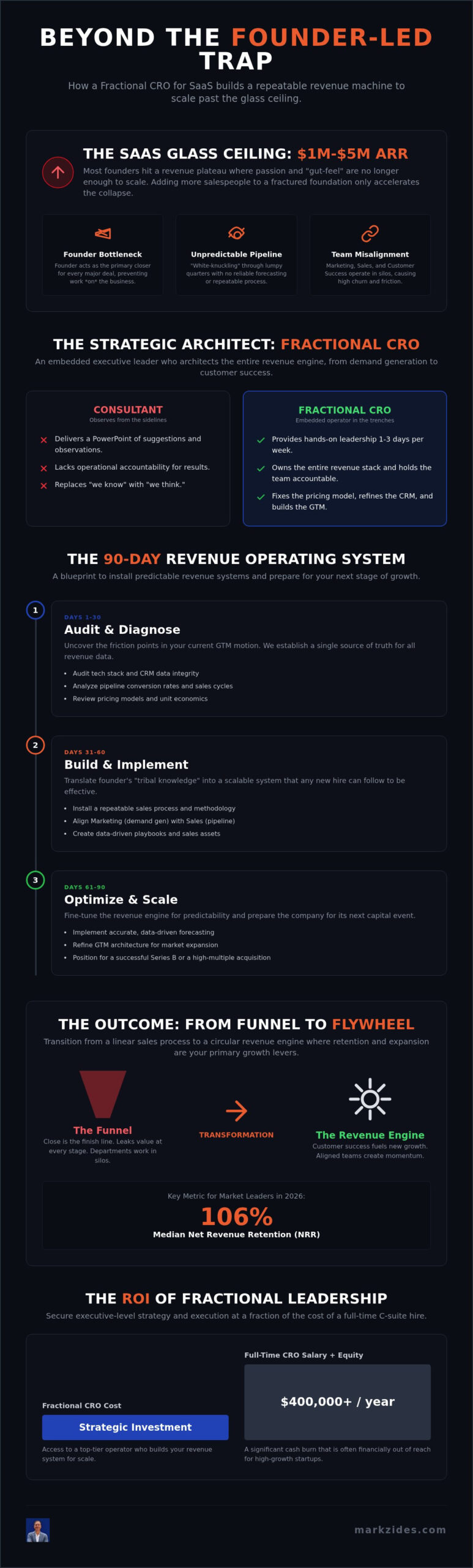
Scaling a SaaS company is less about hiring more people and more about designing a system that works while you sleep. A fractional CRO for SaaS is an embedded executive leader who takes full ownership of the "find, win, and keep" lifecycle. They don't just manage a sales team; they architect the entire revenue engine, from demand generation to customer success. This role is built for the high-growth environment where a full-time, $400,000-a-year executive is financially out of reach, but the need for strategic leadership is non-negotiable.
Unlike a consultant who observes from the sidelines and offers suggestions, a fractional CRO has operational accountability. They lead your team 1 to 3 days per week, managing the CRM, setting quotas, and refining the tech stack. If you are trying to understand the broader category of this high-impact role, it helps to look at What is a Fractional Executive? and how they differ from interim hires. In the SaaS world, this means a leader who can align Product-Led Growth (PLG) and Sales-Led Growth (SLG) motions into a single, cohesive strategy. Their primary objective is simple: transition your business from founder-led heroics to a repeatable revenue machine.
The 'Founder-Led' Trap
Most SaaS startups hit a glass ceiling between $1M and $5M ARR. The reason is simple: the founder is the primary salesperson. While your passion and deep product knowledge can close the first few dozen customers, that "gut-feel" approach doesn't scale. When you are the only one who can navigate a complex enterprise deal, you become the ultimate bottleneck. This creates a culture of "heroics" rather than "systems." A fractional CRO builds the bridge to the next level of scale by documenting your tribal knowledge and embedding it into a scalable sales process that any AE can follow.
Fractional CRO vs. Traditional Business Consultant
The distinction between a consultant and a fractional operator is a matter of execution. Consultants provide a PowerPoint presentation; fractional CROs provide leadership. They don't just tell you that your pricing is wrong or your churn is high. They get into the trenches to fix the pricing model and redesign the onboarding flow. This "operator" mindset is critical for SaaS companies that need to fix the plumbing while simultaneously steering the ship toward an exit. They own the revenue stack and hold the team accountable to the data, replacing "we think" with "we know."
In the 2026 market, where 68% of technology leaders are consolidating vendors, your revenue architecture must be lean and integrated. A fractional CRO ensures that your marketing, sales, and customer success teams aren't just working in the same building, but are finally speaking the same language.
The SaaS Revenue Architecture: Beyond the Sales Funnel
SaaS growth is not a linear progression from lead to close. It is a circular engine where retention and expansion are the primary fuel sources. If your current model treats the sales close as the finish line, you're leaving significant valuation on the table. A fractional CRO for SaaS designs a system where marketing, sales, and customer success operate from a single source of truth. This alignment is your most powerful growth lever. When these departments share one data set, you eliminate the friction that causes high churn and lumpy quarters.
Building a scalable sales pipeline requires more than just a higher volume of calls. It demands an architecture that can withstand market pressure and shifts in buyer behavior. Research on SaaS Go-to-Market Strategy highlights that strategic decision-making in sales team structure is what separates market leaders from also-rans. By shifting the focus from a traditional funnel to a revenue flywheel, you ensure that every dollar spent on acquisition contributes to long-term net revenue retention (NRR). In 2026, where the median NRR for successful SaaS companies sits at 106%, expansion is no longer optional; it is the core deliverable.
Marketing and Demand Generation Alignment
Stop measuring your marketing team by the number of leads they generate. In the current SaaS environment, "leads" is a vanity metric. You need a demand generation engine that delivers qualified pipeline. A fractional CRO for SaaS enforces unified definitions between teams. This ensures that every marketing campaign is designed to attract high-LTV customers rather than just filling the CRM with noise. If marketing spend isn't directly tied to revenue outcomes, the system is broken. We fix this by embedding accountability into the demand gen process, ensuring every dollar invested has a clear path to a signed contract.
Partnerships and Alliances Strategy
Growth doesn't always come from adding headcount. Often, the most efficient way to scale is through partnerships and alliances. By leveraging hyperscalers like AWS, Azure, or Google Cloud (GCP), you can expand your market reach without the overhead of a massive internal sales team. A VP of Sales is typically too focused on the monthly quota to manage these long-term relationships effectively. A CRO is better suited for this because they view partnerships as a strategic revenue stream. They design formal programs that drive indirect revenue, creating a force multiplier for your existing sales efforts.
If your revenue engine feels like a collection of disconnected parts, it's time to rebuild your GTM architecture with a veteran operator who understands the mechanics of scale.
Fractional CRO vs. Full-Time CRO vs. VP of Sales
Hiring the wrong leader at the wrong time is the fastest way to burn through your Series A runway. Most founders confuse a VP of Sales with a Chief Revenue Officer, leading to expensive misalignments and high executive turnover. While a VP of Sales focuses on the tactical execution of closing deals, a CRO focuses on the strategic architecture of the entire revenue engine. Understanding this distinction is critical for any founder looking to scale without wasting capital. To gain deeper clarity on where a Chief Revenue Officer fits in business functions and how their reporting lines drive accountability across every revenue-generating team, it's worth reviewing the full 2026 executive framework.
The financial reality of 2026 is stark. A full-time C-suite executive in the US carries an average base salary of $225,000 to $230,000, with total employer costs often exceeding $320,000 before bonuses or equity. In the SaaS sector, OTE often hits the $350,000 to $500,000 range. Choosing a fractional CRO vs full time CRO allows you to capture 80% of the strategic impact for roughly 40% of the cost. This model is part of The New Wave Of Fractional Leaders who prioritize capital efficiency and operational velocity over headcount vanity. For companies in the "Goldilocks" zone between Seed and Series B, this approach preserves runway while accelerating growth.
The VP of Sales Misconception
A VP of Sales is a tactical leader. They are exceptional at recruiting AEs, coaching reps, and dragging enterprise deals across the finish line. However, they aren't necessarily systems architects. If your GTM strategy is broken, hiring a high-priced closer won't fix it; it will only highlight the cracks in your foundation. Choosing a fractional CRO instead of VP of sales provides the strategic architecture first, ensuring that when you do hire a full-time VP, they step into a system built for success. They focus on the "why" and "what next" of the entire revenue lifecycle, not just the monthly quota.
Cost and ROI Analysis for 2026
The cost of "no-action" or a bad hire often exceeds the executive's salary in lost momentum and market share. When you hire a full-time CRO too early, you risk high executive turnover because these leaders are often forced to spend their time fixing basic operational "plumbing" rather than driving high-level strategy. This misalignment leads to burnout. A fractional model allows you to embed an expert operator who fixes the plumbing and aligns the tech stack on a part-time basis. This preserves your equity and cash while ensuring your revenue engine is ready for the next level of institutional investment.
The 90-Day Revenue Operating System: A Blueprint for SaaS Scale
A fractional CRO for SaaS doesn't arrive with a list of suggestions; they arrive with a blueprint. To move from unpredictable growth to exit readiness, you must install a Revenue Operating System that replaces founder intuition with data-driven precision. This 90-day sprint is designed to stabilize the foundation, align the teams, and accelerate the engine. By the end of this period, your revenue performance should be a predictable output of a structured system, not a series of lucky breaks. The shift from gut-feel to forecast accuracy is the hallmark of a business ready for institutional investment.
- Days 1-30: The Revenue Audit. We diagnose the structural bottlenecks in your funnel and tech stack. This is the diagnostic phase where we identify why deals stall and where data is leaking.
- Days 31-60: Embedding the System. We fix the pricing model and enforce the marketing-sales handshake. This phase ensures that every team is working toward the same North Star metric with unified definitions.
- Days 61-90: Acceleration. We build the outbound engine and activate partnership motions with hyperscalers like AWS or Azure. This is about increasing velocity without increasing chaos.
Phase 1: Diagnostic and Data Integrity
If your CRM data is junk, your forecast is junk. Most SaaS companies have a leaky customer journey because their data foundation is fractured. We begin by auditing the CRM to ensure every stage of the funnel is tracked with precision. We also interview your customers to refine positioning. If your messaging doesn't resonate with high-LTV buyers, your sales team is fighting an uphill battle. We identify the specific points where prospects drop off and implement immediate remedies to plug those leaks. This ensures that every dollar you spend on demand generation is actually contributing to the bottom line.
Phase 2: Sales Execution and Enablement
The ultimate goal of this system is to remove the founder from the day-to-day sales calls. To achieve this, we equip your team with a repeatable sales process and the enablement tools required to close larger ACV deals. We move beyond feature selling to value selling, implementing the training necessary for your AEs to handle complex enterprise negotiations. When the process is documented and the team is enabled, growth becomes a forecastable reality rather than a gut-feel hope. If you're ready to stop being the primary closer and start being the CEO, it's time to install your revenue operating system today.
Exit Readiness: Positioning Your SaaS for Fundraising or Acquisition
Acquirers and venture capitalists don't just buy a product; they buy a predictable revenue engine. In the high-stakes environment of 2026, where private equity firms are sitting on $3.7 trillion in undeployed capital, the competition for high-quality SaaS assets is fierce. However, this capital is selective. Investors are looking for businesses that have moved beyond founder-led heroics into a state of operational excellence. A fractional CRO for SaaS ensures that your revenue narrative is backed by bulletproof data, making your organization an irresistible target for acquisition or a Series B lead.
The market has reached a point of bifurcation. While the median private SaaS company trades at approximately 4.5x Annual Recurring Revenue (ARR), those with strong retention and repeatable systems command multiples of 6x to 8x. This "valuation gap" is closed through the strategic architecture provided by an expert operator. During due diligence, your revenue data must be audit-ready. If you can't explain your cohort churn or your customer acquisition cost (CAC) payback periods with precision, you risk deal friction or significant valuation haircuts. The CRO's role is to lead this process, ensuring that every metric presented to a potential buyer is verified and defensible.
Maximizing Valuation through RevOps
Efficiency is the primary metric for 2026. We focus on optimizing your LTV/CAC ratios to demonstrate that your growth isn't just fast, but sustainable. This involves cleaning up revenue contracts and ensuring your "Revenue Operating System" provides a single source of truth. A diversified revenue stream is also critical. By showing a healthy mix of direct sales and indirect revenue from hyperscaler partnerships like AWS or Azure, you prove that your business can thrive in multiple market conditions. This level of preparation signals to investors that the ship is stable and ready for a massive infusion of capital.
The Path Forward with Mark Zides
Mark Zides approaches every engagement as a Strategic Architect. His "Expert Operator" methodology isn't about applying temporary patches; it's about embedding the discipline and accountability required for long-term value. As your business matures, Mark develops a clear transition plan to hand the reins to a permanent internal successor. This ensures that the systems installed during the fractional tenure continue to produce results long after the initial engagement ends. You aren't just hiring a part-time leader; you are installing a blueprint for inevitable success. If you're ready to move from unpredictable quarters to exit readiness, it's time to scale your SaaS revenue with a fractional CRO and capture the valuation your hard work deserves.
Architecting Your Path to Predictable Scale
Scaling a SaaS organization in 2026 requires moving beyond the heroics of founder-led sales and embedding a system that functions independently of your daily intervention. We've explored how a circular revenue engine, driven by alignment between marketing and sales, creates the stability necessary for high-multiple exits. By installing a 90-day revenue operating system, you replace gut-feel anxiety with the clarity of structured, forecastable growth. Engaging a fractional CRO for SaaS is the most capital-efficient way to bridge the gap between Seed and Series B while preserving your runway for future expansion.
Mark Zides is a battle-tested operator who specializes in SaaS GTM strategy and partnership alliances. He brings a no-nonsense approach to fixing your operational foundation and ensuring your business is audit-ready for its next major milestone. Mark's focus on operational excellence and exit readiness provides the blueprint you need to maximize your valuation. If you're ready to stop managing chaos and start leading a scalable revenue machine, Book a Revenue Strategy Session with Mark Zides today. The transition from uncertainty to clarity is within reach. It's time to build the foundation your vision deserves.
Frequently Asked Questions
What exactly does a fractional CRO do for a SaaS company?
A fractional CRO for SaaS designs and manages the entire revenue lifecycle, covering demand generation, sales execution, and customer expansion. They are not consultants; they are embedded operators who take accountability for the CRM, tech stack, and team performance. Their job is to replace founder heroics with a repeatable revenue operating system that aligns marketing and sales into a single, cohesive engine.
How many hours per week does a fractional CRO typically work?
Engagement typically spans 1 to 3 days per week, depending on your organization's maturity and growth objectives. This structure allows you to secure executive-level strategy and operational leadership without the $320,000 annual cost of a full-time C-suite hire. They work as an integrated member of your leadership team, participating in Slack, executive meetings, and board briefings to drive rapid progress.
Can a fractional CRO help with my Series B fundraising?
Yes, they are essential for ensuring your revenue data is audit-ready and defensible during institutional due diligence. They focus on optimizing key metrics like LTV/CAC and Net Revenue Retention (NRR) to demonstrate a predictable engine to VCs. By proving that your growth is the result of a structured system rather than luck, they significantly increase your valuation and fundraising success.
What is the difference between a fractional CRO and a fractional CMO?
While a fractional CMO focuses primarily on brand positioning and top-of-funnel demand generation, a fractional CRO owns the entire "find, win, and keep" lifecycle. The CRO ensures that marketing spend translates into closed contracts and long-term customer expansion. They act as the strategic architect who prevents silos, ensuring that marketing, sales, and customer success all share the same data and objectives.
Do I still need a VP of Sales if I hire a fractional CRO?
It depends on your team's size and tactical needs. A VP of Sales is a tactical manager focused on daily rep coaching and recruitment, while a CRO is a strategic architect focused on the revenue system. In many cases, a fractional CRO instead of VP of sales builds the foundation and sales process first, eventually helping you hire and onboard the right full-time VP of Sales to execute the plan.
How long does a typical fractional CRO engagement last?
Most engagements last between 6 and 18 months, providing sufficient time to install and stabilize a new revenue operating system. This window allows the leader to audit the tech stack, fix the pricing model, and activate new partnership motions. The goal is often to build the engine to a point where the business can transition smoothly to a permanent, full-time executive successor.
What are the common signs that my SaaS needs a fractional CRO?
The most common signs include a founder who is still the primary closer, unpredictable "lumpy" revenue quarters, and high churn rates. You likely need fractional leadership if your marketing and sales teams aren't speaking the same language or if you can't forecast the next 90 days with accuracy. These symptoms indicate an architectural failure that more headcount alone cannot fix.
Is a fractional CRO worth it for a seed-stage startup?
It is worth it once you've achieved initial product-market fit and are ready to scale beyond founder-led sales. Hiring an expert operator at the seed stage prevents you from building on a fractured foundation. It ensures that your first few Account Executives step into a documented, repeatable sales process, which preserves your runway and accelerates your timeline to a successful Series A.
Ready to build a revenue engine that runs without you?
Mark works alongside founders as a player-coach — not a slide deck.
Book a 30-minute call