
Where Does a Chief Revenue Officer Fit in Business Functions? A 2026 Executive Guide

Your current organizational chart is likely the primary bottleneck preventing your next stage of growth. When sales, marketing, and customer success operate as isolated silos, you end up with fragmented data, soaring acquisition costs, and a go-to-market strategy that lacks cohesion. Identifying exactly where does chief revenue officer fit in business functions is no longer a theoretical exercise for HR; it's a strategic necessity for any leader who demands predictable, scalable results. You've likely felt the frustration of gut-feel forecasting and the friction that occurs when departments chase conflicting KPIs.
It's time to replace that operational anxiety with a structured, high-performance system. This 2026 executive guide provides the blueprint for positioning the CRO as the central architect of your revenue engine. We'll define the specific reporting lines that drive accountability and outline a framework for aligning every revenue-generating function into a single, unified lifecycle. You'll gain absolute clarity on how the CRO role differs from the CMO or CSO, ensuring every leader in your C-suite has a clear mandate to accelerate growth without stepping on toes.
Key Takeaways
- Move beyond the "super-sales" myth and understand how a CRO architecturally unifies marketing, sales, and success into a single revenue engine.
- Gain clarity on exactly where does chief revenue officer fit in business functions by establishing direct reporting lines to the CEO and aligning departmental VPs under a unified command.
- Navigate the C-suite overlap by distinguishing the CRO's holistic lifecycle ownership from the tactical specializations of the CMO and CSO.
- Map revenue functions across the entire customer journey to eliminate data silos and accelerate the transition from initial acquisition to long-term retention.
- Evaluate the strategic advantages of fractional CRO leadership to build repeatable systems and exit readiness without the overhead of a full-time executive hire.
Defining the Chief Revenue Officer: More Than a 'Super-Sales' Role
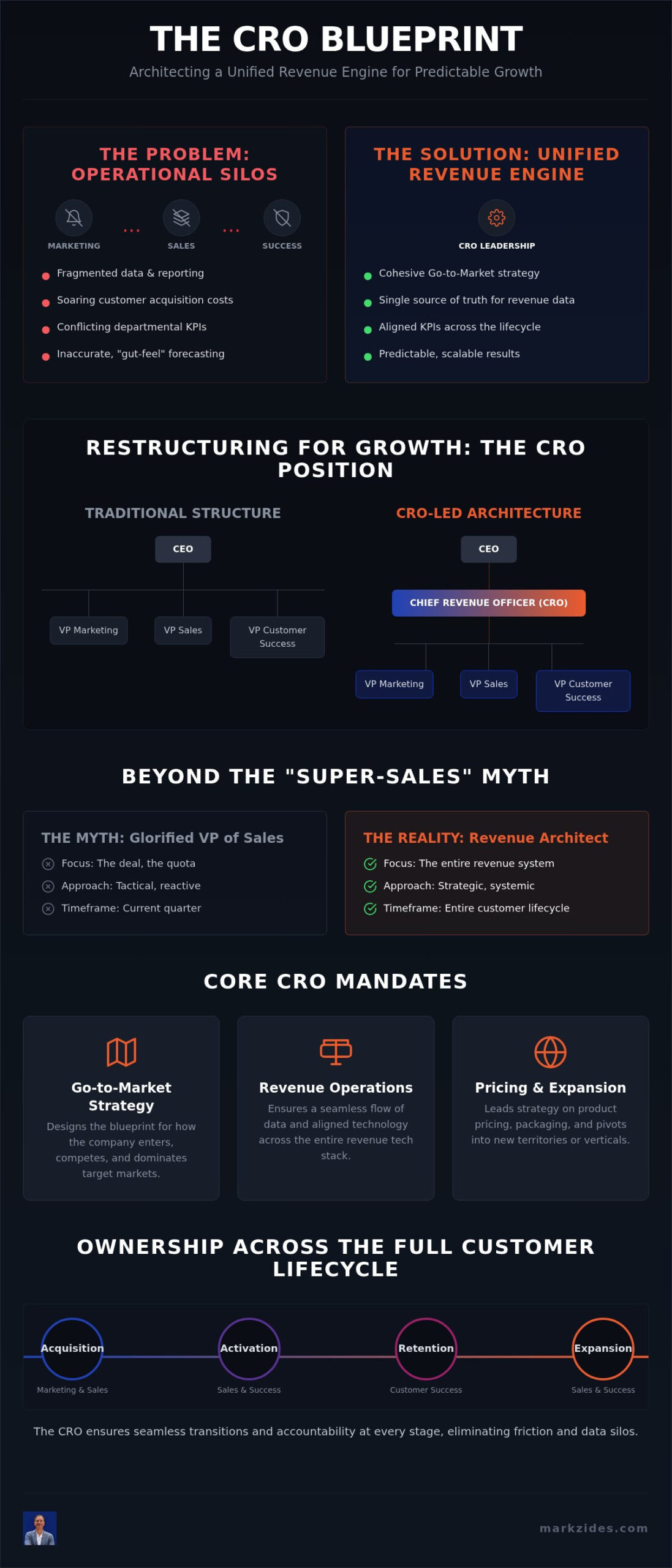
Many executive teams make the fatal mistake of viewing the CRO as a glorified VP of Sales with a more expensive title. This perspective is a relic of a fragmented past. A Chief Revenue Officer (CRO) is not a high-level closer brought in to rescue struggling deals; they are the executive leader responsible for every revenue-generating process across the entire customer lifecycle. Understanding where does chief revenue officer fit in business functions requires a shift in perspective from departmental silos to a unified revenue engine. While a sales leader focuses on the transaction, a CRO focuses on the system that makes the transaction repeatable and the growth predictable.
In 2026, the Chief Revenue Officer is the strategic architect of the enterprise's revenue operating system, responsible for designing and maintaining the end-to-end machinery that converts market opportunity into sustainable capital. This "Revenue Engine" concept is the primary framework for the role's existence. It treats marketing, sales, and customer success not as separate kingdoms, but as interconnected components of a single mechanical process. If one part of the engine fails, the entire machine loses momentum. The CRO ensures that every gear, from initial brand awareness to long-term retention, is synchronized for maximum output.
The Shift from Sales Management to Revenue Architecture
Traditional sales management is inherently tactical; it focuses on the deal, the quota, and the current quarter. Revenue architecture is a different discipline entirely. It focuses on the process over the individual win. Modern CROs manage the "Leaky Bucket" by placing as much strategic weight on retention and expansion as they do on new customer acquisition. They move the organization away from intuition-based growth and "gut-feel" forecasting. Instead, they embed rigorous data-driven scaling models that provide the CEO and board with absolute clarity on future performance. This transition from sales management to architecture is what allows a business to move beyond founder-led selling and into a phase of professional, repeatable execution.
Core Responsibilities in the 2026 Business Landscape
The CRO's mandate extends into the very foundation of the business model. Their core responsibilities include:
- Go-to-Market (GTM) Strategy Design: They don't just execute the plan; they design the blueprint for how the company enters and dominates markets.
- Revenue Operations (RevOps) Oversight: The CRO ensures the tech stack is aligned so that data flows seamlessly between departments without friction or loss of integrity.
- Pricing and Market Expansion: They lead the strategy on how to price products for maximum value and when to pivot into new territories or verticals.
By centralizing these functions, the CRO removes the friction that typically exists between marketing's lead generation and sales' execution. They ensure that the promises made during the acquisition phase are actually delivered during the success phase, protecting the company's valuation and long-term health.
The Organizational Fit: Where the CRO Sits on the Chart
Placing a Chief Revenue Officer correctly within your organizational structure is the difference between a high-performance engine and a collection of grinding gears. To be effective, the CRO must report directly to the CEO. Any other reporting line, such as placing the role under a CFO or COO, risks subordinating growth to cost-cutting or operational logistics. As The CEO's New Secret Weapon, the CRO acts as the primary architect of the company's valuation, ensuring that every strategic move is measured against its ability to generate sustainable capital.
When you analyze where does chief revenue officer fit in business functions, the most significant change occurs in the layer immediately below them. In a modern revenue architecture, the VP of Sales, the VP of Marketing, and the VP of Customer Success all report directly to the CRO. This unified umbrella eliminates the traditional friction between departments. If marketing is generating leads that sales can't close, or if sales is closing deals that customer success can't retain, the CRO has the authority to diagnose the system failure and implement a remedy immediately. They serve as a peer to the COO and CFO, completing a "Power Triangle" that balances operations, finance, and growth.
This structure is particularly vital for companies moving away from founder-led selling. For many CEOs, the sales process is a heavy weight they've carried since day one. By embedding a CRO into the C-suite, the founder can finally step back from the "closer" role and focus on vision and capital. It's a transition from a business that relies on individual heroics to one that relies on a repeatable, scalable system.
Vertical vs. Horizontal Alignment
A CRO provides two distinct types of alignment. Vertically, they manage the hierarchy, ensuring that the boots-on-the-ground teams in sales and marketing are executing the GTM strategy with precision. Horizontally, they act as the bridge to Product and Finance. They ensure the product roadmap aligns with what the market is willing to pay for and that the revenue model satisfies the financial requirements for exit readiness. Siloed departments fail because they optimize for their own KPIs; a unified revenue function succeeds because it optimizes for the entire lifecycle.
The CRO in Early-Stage vs. Enterprise Organizations
The role shifts as the organization matures. In a startup or scaleup, the CRO is often a "player-coach," personally building the first repeatable revenue blueprint. In a global enterprise, the focus moves toward portfolio management and aligning disparate regional markets. For mid-market firms that need this level of expertise but aren't ready for a multi-million dollar executive hire, fractional CRO services provide a strategic way to build the system without the enterprise-level overhead. If you are struggling to bridge the gap between your current sales team and your growth targets, a fractional leader can often embed the necessary discipline more quickly than a full-time search.
CRO vs. CMO vs. CSO: Navigating the Overlap
Efficiency dies in the "gray zones" between departments. In many organizations, the friction between marketing and sales is treated as an inevitable cost of doing business. Marketing claims the leads are high quality; sales claims they are unusable. This finger-pointing stops when you understand where does chief revenue officer fit in business functions. While the Chief Marketing Officer (CMO) focuses on brand awareness and top-of-funnel demand, and the Chief Sales Officer (CSO) focuses on quota attainment and territory management, the CRO is the connective tissue. They are the bridge that ensures marketing's leads become sales' closed deals and customer success's retained revenue.
The CRO resolves the age-old "Marketing vs. Sales" conflict by establishing a single source of truth for data. Instead of departments chasing isolated KPIs that don't move the needle, the CRO aligns every team toward the same North Star: profitable revenue growth. They don't just manage people; they manage the conversion velocity between stages. By embedding a unified revenue architecture, the CRO ensures that the hand-off points between teams are seamless. For a deeper dive into how this role manages the entire lifecycle, The Agile Brand Guide to the CRO provides a comprehensive breakdown of these operational intersections.
The CRO/CFO Partnership: Revenue vs. Profitability
A critical, yet often overlooked, relationship is the one between the CRO and the CFO. While the CFO manages the balance sheet and mitigates risk, the CRO manages the growth engine. This alignment is vital for fundraising and exit readiness. If the CRO is driving aggressive growth at the expense of sustainable unit economics, the CFO will eventually have to pull the emergency brake. Together, they balance the Customer Acquisition Cost (CAC) against the Lifetime Value (LTV) to ensure the business isn't just growing fast, but growing healthily. This partnership transforms revenue from a "gut-feel" projection into a predictable, bankable asset.
Defining Ownership Across the Funnel
To eliminate operational overlap, the CRO must define clear ownership at every stage of the customer journey. This isn't about micro-management; it's about clear accountability:
- Top of Funnel: The CMO leads demand generation, but the CRO monitors lead quality to ensure marketing spend aligns with sales capacity.
- Middle and Bottom of Funnel: The CSO leads the closing process, while the CRO ensures the conversion velocity remains high and the sales tech stack is optimized.
- Post-Sale: The VP of Customer Success leads retention efforts, but the CRO ensures that expansion revenue and upsell opportunities are baked into the long-term strategy.
By defining these boundaries, the CRO allows specialists to focus on their core strengths while maintaining a bird's-eye view of the entire revenue lifecycle.
Mapping CRO Functions Across the Customer Lifecycle
The functional map of a CRO covers the entire "Customer-to-Cash" journey. In legacy organizations, departments often care only about their specific slice of the pie. Sales cares about the close. Marketing cares about the lead. Success cares about the support ticket. This fragmentation is precisely where does chief revenue officer fit in business functions as a unifying force. They architect a continuous loop where acquisition, retention, and expansion are treated as a single, interdependent process. By centralizing these levers, the CRO ensures that the momentum generated in one stage isn't lost in the next.
Retention is often the most neglected revenue driver in high-growth environments. A CRO redefines customer success from a reactive support function into a proactive revenue generator. By aligning success teams with specific expansion targets, they transform a "Leaky Bucket" into a compounding asset. They use data to identify which customers are prime for upsells and cross-sells; this ensures the sales cycle for existing accounts is even more efficient than for new ones. This level of optimization increases the Average Contract Value (ACV) while simultaneously lowering the overall cost of growth.
Sales Execution and Enablement
Scaling a business requires moving beyond the individual heroics of a few top performers. A CRO embeds sales execution and enablement systems that equip every team member with the tools to close predictably. They build repeatable pipelines that don't crumble when a superstar leaves or when the founder steps away from the deal desk. If you're struggling with founder-led sales, implementing a fractional CRO for SaaS can provide the specialized execution strategies needed to professionalize your sales engine and move toward a data-driven model.
Partnerships and Alliances as Revenue Multipliers
Indirect revenue is the secret weapon of the modern revenue architect. The CRO designs formal partnership programs and alliances with hyperscalers to expand market reach without a linear increase in headcount. These relationships act as revenue multipliers; they allow the business to tap into established ecosystems and accelerate trust with new buyers. By managing these alliances as part of the core revenue map, the CRO ensures that indirect channels are as disciplined and measurable as direct sales. This strategic alignment turns partnerships into a predictable pillar of the GTM strategy.
If your revenue lifecycle feels fragmented, it's time to build a more resilient system. Design your revenue blueprint with a fractional CRO to align your functions and accelerate growth.
Implementing the CRO Function: Full-Time vs. Fractional
Hiring a full-time executive is one of the most expensive and risky decisions a CEO can make. In the current market, the average total compensation for a Chief Revenue Officer in the United States often reaches $416,766 when bonuses and cash incentives are included. For a scaling mid-market company, committing to this level of salary and equity before a repeatable system is actually in place is a dangerous gamble. If the hire fails, you haven't just lost capital; you've lost six to twelve months of market momentum. Understanding where does chief revenue officer fit in business functions allows you to see that the value lies in the architectural blueprint, not necessarily in a permanent seat at the table from day one.
This is why high-growth organizations are increasingly turning to fractional leadership. A strategic CRO engagement focuses on building a "90-day Revenue Operating System." This isn't a period of observation; it is a period of aggressive construction. The objective is to audit the existing tech stack, align the sales and marketing workflows, and embed a data-driven forecasting model that removes the "gut-feel" anxiety from the executive suite. By the end of this period, the organization isn't just performing better; it's prepared for its next major milestone, whether that is a Series B funding round or a strategic exit. A CRO ensures your revenue is seen as a predictable asset, which directly maximizes your company's valuation.
Signs Your Business is Ready for Revenue Leadership
You don't need a CRO when you're still searching for product-market fit. You need one when you've found it but can't scale the machinery. Look for these specific indicators:
- Founder-Led Fatigue: The CEO is still the primary closer on every major deal, creating a massive operational bottleneck.
- Departmental Dissonance: Sales and marketing are speaking different languages and chasing conflicting KPIs.
- The Leaky Bucket: New customer acquisition is strong, but high churn rates are negating your gains and suppressing your LTV/CAC ratio.
If these indicators resonate, understanding when to hire a fractional CRO can help you identify the precise operational triggers that signal your business is ready for a structural revenue transformation.
The ROI of Fractional Execution
The primary advantage of the fractional model is the speed to impact. While a full-time executive search can take months, a fractional leader can begin embedding systems within weeks. Many founders instinctively reach for a VP of Sales hire when growth stalls, but choosing a fractional CRO instead of VP of Sales addresses the systemic gaps in your revenue architecture rather than simply adding more sales pressure to a broken foundation. When comparing the fractional CRO vs full time CRO investment, the ROI becomes clear through the lens of risk mitigation and capital efficiency. You gain the expertise of a battle-tested operator who has built these systems before, without the long-term burden of a massive compensation package. This allows you to stabilize your revenue engine first, ensuring that when you do eventually hire a full-time leader, they are stepping into a system designed for success. Position the CRO as the strategic architect for your next phase of growth; stop guessing and start building a predictable path to the next level.
Architecting Your Predictable Path to Scale
Identifying exactly where does chief revenue officer fit in business functions is the first step toward professionalizing your GTM strategy. You now have the blueprint to move beyond fragmented silos and the limitations of founder-led selling. By centralizing marketing, sales, and customer success under a single strategic architect, you transform growth from a series of lucky breaks into a repeatable, bankable system. This structural shift is what separates companies that stagnate from those that scale with precision toward a successful exit or a major funding milestone.
If you're ready to replace gut-feel anxiety with forecast accuracy, it's time to implement a battle-tested revenue engine. Stop guessing at your pipeline and start building with a partner who understands the mechanics of rapid B2B growth. Scale your revenue engine with Mark Zides' Fractional CRO Services to deploy a predictable revenue system designed for 2026 and beyond. You have the vision to lead; now you have the operational framework to make your success inevitable.
Frequently Asked Questions
Who does a Chief Revenue Officer report to?
A Chief Revenue Officer must report directly to the CEO. This reporting line is essential to maintain growth as a primary strategic objective rather than a secondary function of finance or operations. When analyzing where does chief revenue officer fit in business functions, it's clear they must sit as a peer to the COO and CFO. This position ensures that the company's valuation remains a top priority at the highest level of leadership.
What is the difference between a VP of Sales and a CRO?
While a VP of Sales focuses on hitting quarterly quotas and managing individual deal execution, a CRO is responsible for the entire revenue architecture. The VP of Sales is a tactical leader who manages the sales team. The CRO is a strategic architect who designs the system connecting marketing, sales, and retention. They focus on the long-term health of the revenue lifecycle rather than just the immediate transaction.
Does every company need a Chief Revenue Officer?
Not every company requires a CRO from day one. Early-stage startups often function perfectly well with a founder-led sales model or a single VP of Sales. However, once a business reaches the scaling phase and experiences friction between marketing and sales, a CRO becomes necessary. You need this role when your growth depends on a repeatable system rather than individual heroics or gut-feel decisions.
Can a CRO replace a Chief Marketing Officer?
A CRO does not replace the specialized function of a Chief Marketing Officer. Instead, the CRO provides a unified framework where the CMO can focus on brand and demand generation while remaining aligned with sales targets. The CMO manages the "what" and "how" of the brand, while the CRO ensures those activities directly contribute to the bottom line and customer lifetime value.
What are the primary KPIs for a Chief Revenue Officer?
The primary KPIs for a CRO focus on the efficiency and sustainability of the growth engine. These typically include Net Revenue Retention (NRR), Customer Acquisition Cost (CAC) efficiency, and the LTV/CAC ratio. They also monitor revenue velocity and forecast accuracy to ensure the business is predictable. Unlike a sales leader who only tracks bookings, the CRO tracks the health of the entire customer lifecycle.
How does a CRO help with fundraising or an exit?
A CRO maximizes valuation by transforming revenue from an unpredictable variable into a structured, repeatable asset. Investors and buyers look for forecast accuracy and a battle-tested blueprint for growth. By embedding disciplined systems and reducing reliance on founder-led sales, the CRO proves to potential acquirers that the company can continue to scale profitably after a transition. This structural maturity significantly reduces investment risk.
When is the right time to hire a fractional CRO?
You should consider a fractional CRO when your business has achieved product-market fit but lacks the internal systems to scale predictably. This is often the ideal choice for mid-market firms that need executive-level revenue architecture but aren't ready for the high overhead of a full-time hire. A fractional leader can embed the necessary systems and alignment in weeks, providing a faster ROI than a traditional executive search.
What business functions report to a CRO?
In a modern organizational chart, the VP of Sales, VP of Marketing, and VP of Customer Success all report to the CRO. This is exactly where does chief revenue officer fit in business functions as the central orchestrator of the customer journey. By centralizing these departments, the CRO eliminates data silos and ensures that every function is working toward a unified go-to-market strategy rather than isolated departmental goals.
Ready to build a revenue engine that runs without you?
Mark works alongside founders as a player-coach — not a slide deck.
Book a 30-minute call