
CEO Coaching for Revenue Growth: Building a Scalable Revenue Operating System

Revenue growth isn't a sales skill; it's an operational architecture that you must design rather than just manage. If you're still the primary closer for every major deal, your business isn't a scalable asset; it's a high-stakes job that depends entirely on your personal stamina. You've likely felt the anxiety of unreliable sales forecasts and the frustration of marketing spend that never seems to align with the bottom line. It's a common inflection point where gut-feel leadership hits a hard ceiling.
Strategic CEO coaching for revenue growth provides the blueprint to break through this plateau. You'll learn how to stop reacting to the daily chaos and start embedding the systems that drive predictable, repeatable results. This article explores the transition from founder-led sales to a structured revenue operating system. We'll detail the methodology needed to shift your role from lead operator to strategic architect, ensuring your company is built for both accelerated performance and a high-valuation exit.
Key Takeaways
- Shift from intuition to data by building a Revenue Operating System that aligns sales, marketing, and demand generation under one strategic framework.
- Utilize CEO coaching for revenue growth to evolve from the primary closer into a strategic architect capable of scaling the business without personal intervention.
- Evaluate the ROI of executive coaching versus fractional CRO services to identify the most efficient path for your specific stage of growth and operational needs.
- Document a repeatable sales execution playbook to eliminate the "gut-feel" trap and ensure consistent performance across your entire organization.
- Maximize your company's exit valuation by establishing founder-independent revenue streams that prove the business is a scalable, standalone asset.
Beyond Mentorship: Why Traditional CEO Coaching Fails to Move the Revenue Needle
Traditional mentorship often focuses on the high-level philosophy of leadership. It's helpful for personal growth, but it rarely fixes a stagnant P&L. Most business and executive coaching programs prioritize soft skills like emotional intelligence or team communication. While these are necessary for a healthy culture, they don't solve the technical friction in your sales pipeline. CEO coaching for revenue growth is a strategic partnership that moves beyond advice and into operational architecture. It targets the underlying mechanics of how your company generates money.
Many founders fall into the "Gut-Feel Trap." They rely on intuition to guide their sales strategy because that's what worked in the early days. However, intuition is not a scalable system. When you reach the mid-market or prepare for a Series B, your "gut" becomes a liability. You need data-driven systems that provide predictable outcomes. General business coaching often fails here because it lacks the technical depth to address specific sales execution issues. For leaders seeking a more formal structure, Robin Lohmann offers strategic advisory and management consultation to help bridge the gap between founder intuition and professional corporate management.
The Difference Between a Business Coach and a Revenue Architect
A standard coach asks questions to help you discover your own path. A revenue architect provides the specific framework for your sales and marketing alignment. We don't just talk about "doing better"; we focus on Revenue Velocity. This metric tracks how quickly prospects move from lead to closed-won. If your velocity is low, no amount of leadership training will fix the bottom line. You need to embed repeatable systems that accelerate the buyer journey. This is the difference between advice-based coaching and operator-led growth.
Symptoms of a Broken Revenue Leadership Model
The most obvious sign of a broken model is founder-led selling. If you're still the primary closer for every major deal, your business is not a scalable asset. It's a high-stress job that depends entirely on your personal output. Other symptoms include:
- Inconsistent Lead Quality: You're spending heavily on marketing, but the sales team complains that the leads are "trash."
- Forecast Inaccuracy: Your end-of-quarter numbers are consistently 20% to 30% off from your initial predictions.
- Sales Silos: Your marketing and sales teams operate as separate entities with different goals.
These issues stem from a lack of alignment. Without a structured revenue operating system, your growth will always be erratic. Strategic CEO coaching for revenue growth helps you transition from the lead salesperson to the architect of a predictable revenue engine. You stop reacting to the latest sales fire and start building the infrastructure that prevents them. For founders ready to make this shift, the entrepreneur's guide to working with a business coach for entrepreneurs provides a detailed framework for embedding operational excellence and dismantling the founder's ceiling.
The Architect's Blueprint: Designing Your Revenue Operating System
A Revenue Operating System (ROS) is the mechanical heart of a scaling company. It's the blueprint that ensures your sales execution isn't dependent on a single superstar or your own personal involvement in every pitch. Through CEO coaching for revenue growth, you transition from managing people to managing the system itself. This shift requires embedding accountability through clear KPIs and data-driven reporting that provides real-time visibility into your revenue velocity. If you can't see where the friction exists in your pipeline, you can't fix it.
For established industrial entrepreneurs, implementing this type of system often requires specialized guidance; Co-Advisor provides business growth advisory specifically for the Australian manufacturing sector to help leaders transition from managing people to managing systems.
Effective sales execution isn't about working harder; it's about building a framework where sales, marketing, and demand generation align under one strategic umbrella. Most organizations suffer from "departmental drift," where marketing chases clicks while sales begs for qualified leads. An ROS eliminates this friction by creating a shared language and shared objectives. It turns your growth strategy into a repeatable engine that produces predictable results month after month, regardless of market volatility.
This strategic alignment also benefits from a cohesive brand presence and professional identity; The CEO Creative provides resources to help you formalize your business, including a step-by-step guide on securing a DUNS number to build corporate credit.
Building a Repeatable Sales Process
Standardizing your funnel is the first step toward removing yourself as the bottleneck. You must document every stage of the buyer journey, from the initial touchpoint to the final contract signature. This level of precision allows you to implement sales tools that provide visibility and accelerate momentum. By building a repeatable sales process, you empower your team to close deals without needing you to jump on a "last-minute call" to save the day. It shifts the burden of performance from your shoulders to the operational architecture you've designed.
Demand Generation and Marketing Alignment
Designing demand generation engines requires a tight feedback loop between your marketing efforts and your sales results. You don't need more leads; you need more qualified opportunities that fit your ideal customer profile. This alignment ensures that your marketing spend isn't wasted on vanity metrics. In some cases, using outsourced lead generation can help maintain pipeline consistency while you focus on internal alignment. If your marketing doesn't feed your sales team high-quality prospects, your ROS is broken at the source.
Establishing this level of operational discipline is often the hardest hurdle for a founder to clear alone. If you're ready to stop guessing and start scaling, exploring a fractional CRO or coaching partnership can provide the external perspective needed to identify and bridge these operational gaps.
Evaluating the ROI: CEO Coaching, Fractional CRO, or Strategic Consulting?
Choosing the right growth partner depends entirely on the specific friction points in your organization. Strategic CEO coaching for revenue growth is designed for the leader who needs to evolve from a "doer" into a "designer." It provides the strategic clarity required to oversee a complex revenue engine without getting lost in the tactical weeds. While strategic consulting often delivers a static binder of recommendations, coaching ensures you possess the skills to drive those changes yourself. It's a long-term investment in your ability to scale the company through every subsequent stage of growth.
This principle of specialized growth support applies across all sectors, including professional services; for instance, Martin Hogg (Private Practice Success) provides accredited business coaching and training specifically for counsellors and therapists looking to professionalize and scale their clinical operations.
If your organization lacks the internal bandwidth to build these systems from scratch, fractional CRO services offer a more hands-on approach. A fractional leader doesn't just give advice; they embed themselves in your workflow to build the playbooks, hire the talent, and manage the daily execution. Many high-growth companies find the highest acceleration by combining both models. This synergy allows the CEO to develop as a strategic architect while the fractional CRO manages the granular construction of the revenue operating system.
The ROI of Revenue Leadership Coaching
The financial impact of specialized coaching is measurable and significant. Organizations that invest in robust coaching programs report an average ROI of 600%. For a mid-market company, moving from a stagnant 10% growth rate to a 22.8% CAGR can represent millions in added enterprise value. This isn't just about closing more deals; it's about reducing your customer acquisition cost (CAC) through better sales and marketing alignment. When your leadership team is aligned, you also see a marked improvement in talent retention, as high-performing sales professionals stay where they have clear systems and predictable support.
Determining Your Current Business Needs
To choose the right path, you must perform a honest diagnostic of your current state. Ask yourself: Is the bottleneck my leadership, my process, or my team? If you have a strong team but no repeatable process, you need an architect. If you have a process but the team is underperforming, you need enablement. If you are the one holding everything back because you won't let go of the sales process, you need CEO coaching for revenue growth.
The cost of inaction is often higher than the investment in professional guidance. Every month you operate with an unreliable forecast or a leaky sales funnel, you're losing revenue that can never be recovered. Assessing your "Exit Readiness" now ensures that when the time comes to sell, you aren't penalized for having a leadership structure that is entirely dependent on your personal involvement. This preparation also extends to back-office compliance; if you are looking to streamline operations and reduce risk, you can explore Fiduciary Administration and Compliance Fees to see how 3(16) services can simplify your plan management.
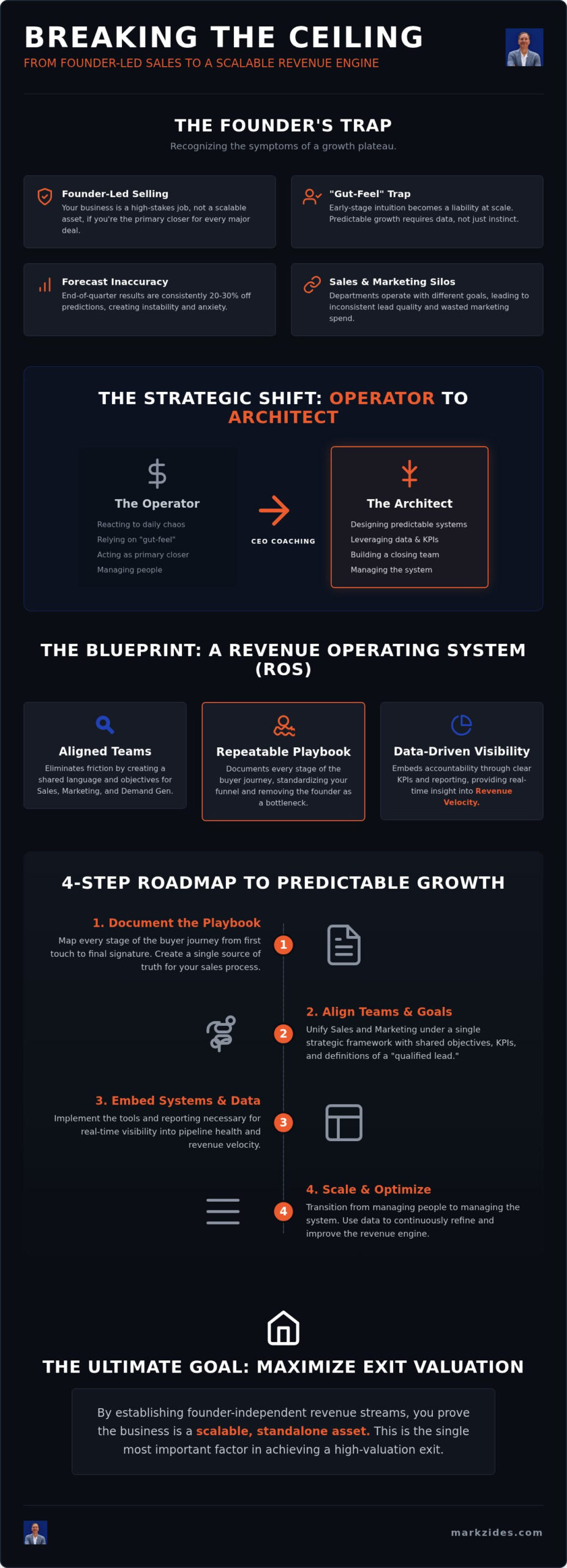
A 4-Step Roadmap to Transitioning from Founder-Led Sales to Predictable Growth
Revenue growth isn't a happy accident; it's the result of a deliberate, phased construction project. Transitioning away from founder-led sales requires more than just hiring a few account executives. It demands a total reconfiguration of your role and your operational infrastructure. Through CEO coaching for revenue growth, we implement a four-step framework designed to move you from the front lines of every deal to the strategic oversight of a self-sustaining engine.
Step 1 & 2: Audit and Design
You can't fix what you haven't measured with precision. The process begins with a clinical revenue audit. We evaluate your current sales, marketing, and partnership health to identify the "leaky buckets" in your demand generation strategy. Often, these leaks occur at the handoff between marketing and sales, where high-intent prospects are lost due to a lack of follow-up protocols. Once we've identified the friction points, we design a 90-day roadmap for revenue optimization.
This phase focuses on creating a repeatable playbook. If you don't have a documented process, you don't have a business; you have a collection of habits. We establish data-driven decision-making protocols that dictate exactly how leads are qualified, nurtured, and closed. This level of standardization ensures that every member of your team operates with the same high level of precision that you once provided personally.
Step 3 & 4: Execution and Scale
Execution is where most founders fail because they can't stop tinkering with individual deals. Step three involves embedding the system by training your team and removing the CEO from daily tactical management. We empower your sales leaders through specialized coaching, teaching them how to manage the system rather than just the people. Your new primary metric of success is Revenue Velocity. We monitor how quickly capital moves through your funnel, identifying and removing bottlenecks in real time.
Finally, we focus on accelerating growth through a partnerships and alliances strategy. Scaling solely through direct sales is expensive and slow. By leveraging hyperscaler partnerships, such as those with AWS or Azure, you can drive significant indirect revenue and expand your market reach. This shift allows you to focus on high-level architecture while the system handles the volume. If you're ready to stop being the bottleneck and start being the architect, it's time to partner with an expert operator who can build this engine with you.
Scaling to Exit: How Strategic Coaching Prepares Your Business for Maximum Valuation
Buyers don't acquire a business because of the CEO; they acquire it because of the systems the CEO built. If your personal involvement is required to close every major deal, your company is a liability, not an asset. CEO coaching for revenue growth focuses on transforming your organization from a hero-led startup into a strategic-architect-led enterprise. This shift is the single most important factor in maximizing your exit valuation. When you can prove that revenue is founder-independent, you move from a standard industry multiple to a premium one, a reality often emphasized by M&A advisory firms like Bravo Kilo Advisors.
Preparing for fundraising or an exit requires more than just high top-line revenue. It requires clean, auditable RevOps data and a strong financial foundation; organizations like Koval Investments help founders optimize their credit profiles and secure 0% interest funding to maintain momentum during these transitions. During due diligence, sophisticated buyers look for consistency in your sales velocity and surgical accuracy in your forecasts. If your data is messy, it signals operational chaos. Strategic coaching ensures your revenue operating system is built on a foundation of transparency. This makes the due diligence process a validation of your success rather than an interrogation of your operational failures.
Maximizing Valuation Before the Exit
Identifying and fixing operational inefficiencies is the fastest way to drive up your EBITDA. Organizations with robust coaching programs often see 21% higher revenue growth per employee, a metric that signals high operational efficiency to potential acquirers. We focus on shifting your business toward predictable, recurring revenue models that buyers value most. A strong management team that can survive the transition is equally critical. If the business can't run without you for ninety days, it isn't ready for a high-valuation sale. We build the leadership layers that ensure long-term stability, and for companies pursuing global growth, Encor Group offers the expertise required to manage cross-border mergers and acquisitions for a seamless market entry.
The Final Leap: From Operator to Visionary
Successful exits require a mental shift that many founders struggle to make alone. To support this internal evolution, Salarah K Starre offers subconscious reprogramming that helps leaders release the need for tactical control and embrace a new identity. You must evolve from the operator who knows every detail to the visionary who designs the future. Specialized CEO coaching for revenue growth facilitates this transition by helping you let go of tactical deal management. We ensure your revenue engine is sustained by robust partnerships and alliances, creating a diverse pipeline that doesn't rely on a single channel. This level of maturity proves to buyers that the company is a scalable, standalone machine.
The journey from founder-led chaos to a predictable revenue engine is complex, but you don't have to navigate it without a blueprint. If you are ready to build a business that is truly scalable and exit-ready, it's time to move beyond intuition. Schedule a strategy session with Mark Zides to begin designing your revenue operating system today.
Architecting Your Path to Predictable Scale
Predictable revenue growth is never the result of luck or individual heroics. It's the outcome of a robust operational architecture that you must design and oversee. By transitioning from a founder-led sales model to a structured revenue operating system, you eliminate the anxiety of unreliable forecasts and marketing misalignment. This evolution prepares your company for the highest possible valuation by proving that your revenue engine is sustainable, repeatable, and entirely independent of your daily intervention; to explore specialized corporate finance and M&A solutions, find out more from Pinnacle Global Advisory.
Strategic CEO coaching for revenue growth provides the battle-tested blueprint you need to navigate this high-stakes transition. Whether you're preparing for a major fundraising round or a strategic exit, the focus remains on building a system that delivers results with clinical precision. Mark Zides brings specialized expertise in exit readiness and SaaS scale, ensuring your organization is built for speed and stability. It's time to stop reacting to the market and start engineering your success.
Scale your revenue with a Strategic Architect; Book a session with Mark Zides
The ceiling you're hitting today is simply a sign that your current systems have reached their limit. Building the next level of performance starts with a single strategic decision. You've built the foundation; now it's time to finish the masterpiece.
Frequently Asked Questions
What is the difference between business coaching and CEO coaching for revenue growth?
Traditional business coaching often focuses on leadership soft skills and general mindset shifts. CEO coaching for revenue growth is a technical, operational partnership designed to build the systems that drive top-line results. It moves beyond high-level advice to address the specific mechanics of sales execution, demand generation, and marketing alignment. You aren't just learning how to lead; you're learning how to architect a predictable revenue engine.
How long does it take to see results from revenue-focused executive coaching?
Initial operational clarity typically emerges within the first 30 to 90 days of an engagement. While long-term cultural shifts take more time, fixing immediate friction points in the sales funnel can yield measurable improvements in revenue velocity almost immediately. The goal is to establish a 90-day roadmap that delivers quick wins while embedding the foundational systems required for sustainable, multi-year growth.
Can CEO coaching help if I'm still the only person closing deals?
This is exactly where strategic coaching is most effective. We specialize in removing the founder from the sales process by documenting your intuition into a repeatable playbook. If you are the bottleneck, your business cannot scale. Coaching provides the framework to hire, train, and empower a sales team that closes deals with the same precision you currently provide personally.
What metrics should I track to measure the success of a revenue coach?
You should measure success through Revenue Velocity, Customer Acquisition Cost (CAC) reduction, and forecast accuracy. A successful coach helps you move from gut-feel predictions to data-driven reporting. If your forecast accuracy improves and your sales cycle shortens, the coaching is working. We also monitor the percentage of revenue generated without direct CEO involvement as a primary indicator of operational scale.
Is CEO coaching only for large corporations, or is it for startups too?
Strategic coaching is vital for both, but it's particularly critical for Series A and B startups hitting a growth ceiling. Startups often have a viable product but lack the operational architecture to scale. Large corporations use coaching to realign disjointed departments. If your company is ready to transition from a hero-led culture to a systems-driven organization, you're at the right stage for professional guidance. Understanding how to select and leverage the right business coach for entrepreneurs focused on operational excellence can help you identify the precise support model your organization needs at this stage.
For founders looking to bridge these gaps, you can explore Coaching programs by Jani Havunen, which offer high-impact business development advisory to ensure your organization is built for speed and stability.
How does coaching help with exit readiness and company valuation?
Buyers pay a significant premium for founder-independent revenue streams. Coaching helps you optimize your P&L and clean up your RevOps data before you enter due diligence. By building a management team and a repeatable sales engine that survives your departure, you significantly increase your EBITDA multiple. It turns your business into a turnkey asset rather than a high-stress job that depends on you. B2C founders looking to achieve this transition can find tailored support through Founder Freedom.
Will a revenue coach help me hire a VP of Sales or a CRO?
A revenue coach often acts as a strategic advisor during the hiring process to ensure you select an operator who fits your new system. We help define the role requirements and interview candidates for technical competency and cultural alignment. Hiring the wrong leader is a million-dollar mistake; for those in the fintech and digital banking sectors, you can learn more about Mark Loucas Ltd and their specialized executive search services. We provide the external perspective needed to identify a builder who can execute your revenue blueprint effectively. A key part of this process is ensuring your new sales leader understands how building rapport as a strategic system accelerates trust and shortens sales cycles across the entire team.
What is the expected ROI of hiring a coach for revenue leadership?
Organizations with robust coaching programs report an average ROI of 600%. The financial impact is seen through accelerated CAGR and improved operational efficiency. For many clients, the return is calculated by the increase in enterprise value at exit. When you move from a stagnant growth rate to 20% or higher, the compounding effect on your valuation far outweighs the cost of the engagement.
Ready to build a revenue engine that runs without you?
Mark works alongside founders as a player-coach — not a slide deck.
Book a 30-minute call