
Mastering Indirect Revenue Channel Development: The 2026 Strategic Reference

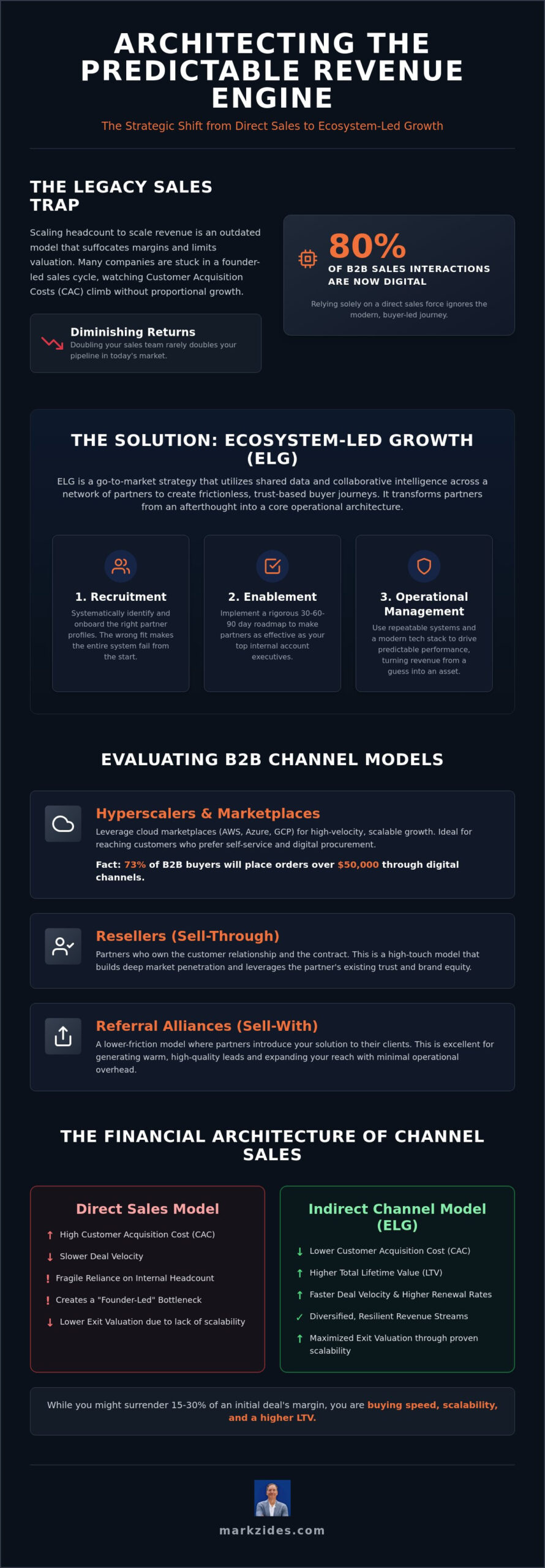
Scaling your headcount to scale your revenue is a legacy trap that suffocates margins and caps your company's valuation. While 80% of B2B sales interactions are now digital, many leaders still rely on a bloated direct sales force to drive growth. If you're stuck in the founder-led sales cycle or watching your customer acquisition costs climb, you don't need more reps; you need a sophisticated B2B channel sales strategy. It's time to stop treating partners as an afterthought and start treating them as an operational architecture.
You've likely felt the anxiety of unpredictable partner performance or the frustration of "gut-feel" forecasting. It's exhausting to build a business that relies entirely on your own team's manual effort. This strategic reference provides the blueprint to architect a high-velocity partner ecosystem that functions as a predictable revenue engine. We'll show you how to lower CAC through ecosystem-led growth and diversify your revenue streams to ensure your business is ready for a high-valuation exit. We'll detail the precise methodology for designing, embedding, and accelerating an indirect revenue system that operates with surgical precision in the 2026 market.
Key Takeaways
- Transition from linear direct sales to Ecosystem-Led Growth (ELG) by designing a systematic architecture for third-party sales.
- Master the nuances of a modern B2B channel sales strategy by aligning with Hyperscalers and selecting the right mix of reseller and referral models.
- Build an operational infrastructure where repeatable systems and a modern tech stack drive performance, reducing reliance on individual talent.
- Accelerate partner ROI with a rigorous 30-60-90 day enablement roadmap that mirrors the effectiveness of your top internal account executives.
- Maximize your exit valuation by proving scalable product-market fit through diversified, high-velocity indirect revenue streams.
Defining Indirect Revenue Channel Development in a Saturated Market
Indirect revenue channel development isn't a simple list of partners or a collection of logos on a slide. It's the systematic architecture of third-party ecosystems designed to move your product through established Marketing Channels. In the 2026 market, the "lone wolf" direct sales model is failing. A robust B2B channel sales strategy replaces the fragile reliance on internal headcount with a resilient network of partners. It shifts the burden of trust from your unknown brand to the entities your customers already rely on for strategic advice.
Building this engine requires a shift from intuition to operations. Success rests on three non-negotiable pillars: recruitment, enablement, and operational management. If you recruit the wrong profiles, your system is DOA. If you fail to enable them, they become dead weight. Without disciplined operational management, your revenue remains a "gut-feel" variable rather than a predictable asset. You aren't just selling a product; you're embedding a revenue system into another organization's workflow.
Why Direct Sales Hit a Ceiling
Doubling your SDR team rarely doubles your pipeline in 2026. The math simply doesn't work when CAC is rising and top-tier AE talent is increasingly scarce. Many organizations remain stuck in the "Founder-Led Sales Trap," where the CEO is the only person capable of closing high-value deals. This creates a bottleneck that prevents scaling and significantly lowers your company's valuation during an exit. If you want to break this cycle, you need a system that functions independently of your personal involvement. Engaging fractional CRO services provides the architectural expertise to build these systems without the risk of an expensive, permanent hire. It's about designing a blueprint that makes revenue repeatable and predictable.
The Shift to Ecosystem-Led Growth (ELG)
Traditional channel models were often transactional and one-way. ELG is different. It leverages trust networks to accelerate deal velocity by aligning with resellers, referral partners, and integration alliances. You're no longer just asking for a lead; you're integrating your value proposition into a larger solution. Ecosystem-Led Growth is a go-to-market strategy that utilizes shared data and collaborative intelligence across a network of partners to create frictionless, trust-based buyer journeys. This move from simple lead-passing to deep, data-driven alignment ensures your B2B channel sales strategy remains relevant in a market where 80% of sales interactions are now digital and buyer-led.
Evaluating Channel Models: Hyperscalers, Resellers, and Referral Alliances
Selecting the right partner model is a high-stakes architectural decision. It's the difference between a self-sustaining revenue engine and a resource-draining management burden. In 2026, a sophisticated B2B channel sales strategy must move beyond traditional "one-size-fits-all" agreements. You must align your model with how your customers actually buy. This requires a tiered approach that balances high-touch reseller relationships with high-velocity cloud marketplaces and low-friction referral networks. The objective is clear: maximize market coverage while maintaining operational efficiency.
Leaders often hesitate to launch indirect channels due to "margin cannibalization" fears. This is a narrow view that ignores the broader financial reality. While you may surrender 15% to 30% of the initial deal, channel-sourced leads typically exhibit a significantly higher Total Lifetime Value (LTV). They close faster, renew at higher rates, and carry lower support costs because the partner provides the first line of defense. When you factor in that 73% of B2B buyers are now willing to place orders exceeding $50,000 through self-service and digital channels, the argument for marketplace-led growth becomes undeniable. You aren't losing margin; you're buying speed and scalability.
To navigate this, you must define your framework across three distinct motions:
- Sell-To: The partner is the end-user. This is rare in SaaS but common in infrastructure.
- Sell-Through: The partner acts as the storefront, owning the paper and the primary customer relationship.
- Sell-With: A collaborative co-sell motion where your team and the partner's team align to solve a complex customer challenge. This is the hallmark of modern Ecosystem-Led Growth.
Hyperscaler Alliances vs. Traditional Resellers
The rise of Hyperscalers like AWS, Microsoft Azure, and Google Cloud has fundamentally changed the game. These marketplaces allow customers to use pre-approved cloud "commits" to purchase your software, effectively bypassing months of procurement friction. Listing a transactable product requires rigorous technical alignment and operational readiness, but the payoff is massive. Unlike traditional Value-Added Resellers (VARs) who might wait for you to bring them a lead, Hyperscaler alliances allow you to tap into a global sales force that is incentivized to burn down their customers' cloud budgets. If you are struggling to navigate these complex ecosystems, a focused partnerships and alliances strategy can help you architect the right entry point.
Referral and Affiliate Networks for B2B
Not every partner needs to be a certified reseller. For industry consultants, boutique agencies, and niche influencers, a low-friction referral program is often superior. These partners have the trust of the C-suite but don't want the overhead of managing a sales cycle. In 2026, success in this model depends on 100% attribution accuracy. You must deploy automated tracking mechanisms and Partner Relationship Management (PRM) tools that ensure every referral is logged and compensated instantly. This creates a "set-and-forget" lead source that fuels your direct team without increasing your headcount.
Architecting the Operational Infrastructure for Channel Scalability
Scaling a partner ecosystem isn't about hiring a "rockstar" channel manager; it's about building a machine. If your processes rely on individual heroics, they aren't scalable. An elite B2B channel sales strategy requires an operator's discipline. You must design systems that remove friction and automate accountability before you ever think about recruitment. Without a robust foundation, your partners will disengage the moment they encounter administrative friction. Systems beat talent every time when you're moving from ten partners to a thousand.
Your tech stack functions as the central nervous system of your ecosystem. It allows you to transition from "gut-feel" management to rigorous, data-driven decision making. By tracking engagement metrics, deal velocity, and win rates by partner type, you can implement tiered programs that reward actual performance rather than potential. This infrastructure quality is inextricably linked to strategic demand generation and marketing alignment. If your back-end systems aren't synced with your marketing engine, your partners won't have the high-quality collateral or lead-gen support they need to execute effectively in the field.
The Role of Partner Relationship Management (PRM)
A PRM platform is the definitive "Source of Truth" for all indirect revenue activities. It's not just a portal; it's where the partnership is operationalized. To maintain a high-velocity engine, your PRM must handle several critical functions:
- Deal Registration: This is your primary tool for preventing channel conflict. It ensures the first partner to register a lead is protected from internal sales teams or other partners.
- Lead Distribution: Automated routing ensures that inbound leads are handed to the partners best equipped to close them based on tier, geography, or technical expertise.
- Automated Co-branding: You must empower partners to generate professional, on-brand marketing materials in seconds without manual intervention from your team.
Automated registration workflows are non-negotiable. They provide the transparency needed to maintain trust. If a partner suspects their hard-won deal might be snatched away by an internal rep, they'll stop bringing you opportunities immediately. Trust is built through code and clear rules of engagement, not just handshakes.
Designing Incentive Structures That Drive Loyalty
Standard commissions are the baseline, but they aren't a strategy. To drive specific behaviors, you need more sophisticated financial levers. Market Development Funds (MDF) and Sales Performance Incentive Funds (SPIFFs) allow you to direct partner energy toward new product launches or strategic market segments. You should also implement the "First-Dollar" principle. By providing an immediate, significant reward for a partner's first closed deal within their initial 30 days, you create early momentum and prove the partnership is profitable. Don't overlook non-monetary incentives. Access to executive briefings or early product roadmaps can be far more valuable to a top-tier partner than a marginal commission increase.
High-Velocity Partner Enablement: Moving from Recruitment to ROI
Recruiting a partner is a vanity metric; revenue is the only metric that matters. To bridge the gap between a signed agreement and a closed deal, you must treat your partners with the same rigor as your internal sales team. Enablement is the process of making a third-party agent as effective as your best internal account executive. If your B2B channel sales strategy ends at the signature, your ecosystem will stagnate. You need to build a "Partner Center of Excellence" that provides the training, resources, and technical support required to turn a new recruit into a high-velocity revenue engine. This is the only way to escape the founder-led sales trap and build a business that scales independently of your personal effort.
Move away from passive training sessions that partners forget the moment they log off. Instead, implement a rigorous certification program. This ensures brand quality control and forces partners to demonstrate proficiency before they represent your product in the market. A structured 30-60-90 day onboarding roadmap is essential for setting expectations and driving early wins. If you're looking for a detailed framework on how to build a channel partner program with the right PRM platforms to support it, that resource provides the step-by-step methodology to operationalize each phase:
- Days 1-30: Technical setup, portal access, and foundational product knowledge.
- Days 31-60: Sales methodology alignment, battlecard mastery, and the first co-sell activity.
- Days 61-90: Independent lead generation and final certification for the "Gold" or "Premier" tier.
Training and Sales Assets for Indirect Teams
Partners are busy; they'll sell the product that's easiest to move. Provide "Sales-in-a-Box" kits that include pre-written email sequences, white-label demos, and competitive battlecards. Your documentation must be "partner-first," meaning it focuses on how to sell and implement the solution rather than just how the features work. Maintain mindshare through regular "Office Hours" and webinars that provide real-time updates on product roadmaps. Since 83% of B2B buyers prefer to conduct their own research, your partners need high-quality digital assets that facilitate a self-service buying experience; for an example of this in the technical hardware space, learn more about QuenchSea and their 2026 comparison guide.
Co-Marketing and Demand Generation with Partners
Demand generation is a shared responsibility. Successful co-marketing goes beyond slapping two logos on a PDF. Focus on joint webinars and co-authored whitepapers that address specific industry pain points. Measure these efforts through a shared dashboard to ensure both parties see the ROI. This collaborative approach doesn't just drive leads; it aligns your partner efforts with your broader exit readiness consulting goals. A diversified, high-performing channel proves to potential acquirers that your growth is built on a scalable system rather than just a few key employees. If you're ready to architect a partner engine that produces predictable results, explore our Sales Execution & Enablement frameworks to accelerate your progress.
Optimizing Indirect Channels to Maximize Exit Valuation
Acquirers don't just buy your current revenue. They buy the repeatability and resilience of your systems. A diversified B2B channel sales strategy proves to venture capital and private equity firms that your product-market fit isn't dependent on a single charismatic founder or a localized sales team. When 80% of B2B sales interactions occur through digital and indirect channels, a professionalized partner ecosystem becomes a primary driver of your company's multiple. It demonstrates that your growth is architected, not accidental.
Before entering a due diligence process, you must audit your channel health to ensure it stands up to intense scrutiny. Use this checklist to evaluate your readiness:
- Partner Concentration: Ensure no single partner accounts for more than 20% of your indirect revenue.
- Contractual Hygiene: Verify that all partner agreements are standardized, up-to-date, and transferable.
- Data Transparency: Confirm that your PRM provides clear historical data on deal velocity and win rates.
- Margin Health: Demonstrate that your contribution margin remains strong after partner payouts.
Measuring Indirect Channel ROI and Health
To maximize valuation, you must move beyond surface-level metrics. Your "North Star" should be Partner Attainment, which measures the percentage of your ecosystem that's actually hitting quota. High attainment indicates a healthy, scalable system; low attainment suggests your enablement is failing. You must also monitor Channel Velocity to see if partner deals close faster than direct ones. Pruning "Zombie Partners" is equally critical. These are entities that signed an agreement but haven't produced revenue in six months. They drain your management resources and dilute your performance data. By focusing on Partner Lifetime Value (PLTV), you can prioritize the relationships that offer the highest long-term strategic yield.
Leveraging Fractional Leadership to Scale Partnerships
Hiring a full-time Channel Chief for a mid-market firm is often a premature, high-burn mistake. A Fractional CRO provides the "Strategic Architect" framework required to professionalize your B2B channel sales strategy without the immediate C-suite overhead. This leader embeds the discipline, accountability, and repeatable systems that acquirers demand. They guide you through the transition from founder-led sales to a system-driven engine. Once the infrastructure is stable and generating predictable returns, you'll have the data-backed confidence to hire your first dedicated Channel Account Manager (CAM). This phased approach ensures your growth is sustainable and your organization is primed for a high-valuation exit.
Architecting Your Path to a High-Valuation Exit
The shift toward ecosystem-led growth isn't a luxury; it's a strategic imperative for leaders who want to break the founder-led sales trap. By designing a robust B2B channel sales strategy, you're building a resilient revenue engine that operates with surgical precision. Success in 2026 requires moving beyond simple recruitment to focus on high-velocity enablement and sophisticated operational infrastructure. You've seen how Hyperscaler alliances and automated PRM systems provide the transparency and speed needed to scale without increasing direct headcount.
Mark Zides brings fractional CRO expertise and specialized Partnerships & Alliances Strategy frameworks to help you professionalize your revenue systems. Our operator-led approach ensures that every pillar of your ecosystem is aligned for maximum performance and exit readiness. Don't leave your growth to chance when you can architect it for success. Ready to architect a scalable partnership ecosystem? Consult with Mark Zides today. The future of your organization depends on the systems you build today. Let's get to work.
Frequently Asked Questions
What is the difference between direct and indirect revenue?
Direct revenue is generated by your internal sales force through outbound and inbound efforts. You own the entire customer relationship and the sales process. Indirect revenue is sourced through third-party partners like resellers, affiliates, or cloud marketplaces. While direct sales offer higher control, indirect models provide superior scalability by leveraging external trust networks and established customer bases to drive growth without increasing your headcount.
How much margin should I give to channel partners in SaaS in 2026?
Standard SaaS margins in 2026 typically range from 15% to 30% depending on the partner's level of involvement. Referral partners usually receive 10% to 15% for a warm handoff. Full-service resellers who handle implementation and support command the higher end of the spectrum. You're paying for their customer access and technical expertise, which significantly lowers your internal customer acquisition costs.
How do I prevent channel conflict between my direct team and partners?
Establish clear, written rules of engagement and enforce an automated deal registration system. If a partner registers a lead first, the internal team must stand down or move to a co-sell motion. Neutralizing compensation for internal reps ensures they aren't financially penalized for a partner-led deal. This alignment turns potential friction into a collaborative B2B channel sales strategy that benefits all stakeholders.
What is a Partner Relationship Management (PRM) platform and do I need one?
A PRM is a centralized digital portal that automates partner onboarding, deal registration, and collateral distribution. If you have more than five active partners, you need one. It acts as the operational "source of truth" that prevents administrative chaos. Without it, your partner experience will suffer, and high-quality agents will migrate to competitors who offer better, more structured systems.
Can a startup launch an indirect channel too early?
Yes. Launching a channel before achieving stable product-market fit is a common mistake. Partners are force multipliers; they amplify what already works. If your internal team can't sell the product predictably, a third party won't be able to either. Focus on perfecting your internal sales playbook and demonstrating repeatable success before attempting to export that methodology to an external ecosystem.
How does indirect revenue impact my company valuation before an exit?
Acquirers value diversified revenue streams because they indicate a lower-risk business model. A robust B2B channel sales strategy proves that your growth is built on a repeatable system rather than individual heroics or founder-led sales. High-velocity indirect channels demonstrate that your product can scale across different markets and geographies without a linear, expensive increase in your direct headcount.
What are the best industries for indirect revenue channel development?
SaaS, cybersecurity, and cloud infrastructure remain the dominant sectors for indirect growth. These industries benefit from complex "sell-with" motions where partners add value through integration, implementation, and consulting. Any sector where the end-user relies on a trusted advisor or a specialized consultant for technical decisions is an ideal candidate for building a sophisticated and scalable partner ecosystem.
Ready to build a revenue engine that runs without you?
Mark works alongside founders as a player-coach — not a slide deck.
Book a 30-minute call