
How to Build a Channel Partner Program: Strategy, Steps, and Top PRM Platforms

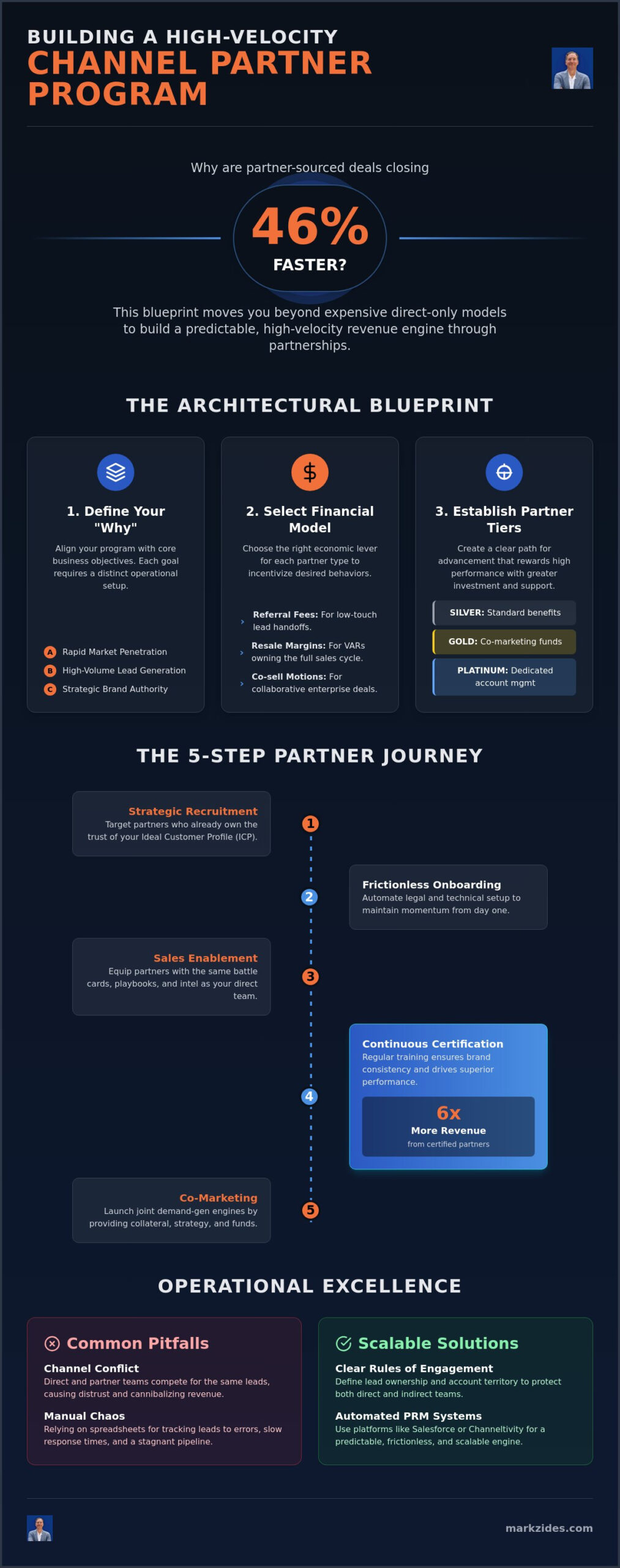
Why are partner-sourced deals closing 46% faster than direct sales while your own indirect pipeline remains stagnant? You likely recognize that scaling through a direct-only model is an increasingly expensive gamble. The friction of high customer acquisition costs and the anxiety of potential channel conflict often prevent leaders from embedding a truly scalable ecosystem into their revenue operations. It is a common frustration; you want the reach of hyperscalers and VARs but lack the structured systems to manage them without manual chaos.
This guide details exactly how to build a channel partner program that functions as a predictable, high-velocity revenue engine. You will learn to move beyond gut-feel alliances and design a repeatable framework for indirect growth. We will analyze the strategic alignment required for success, the tactical steps to deploy your program, and the top PRM platforms, including Salesforce and Channeltivity, that provide the automation necessary to scale your reach in a $4 trillion global channel market. By the end, you'll have the blueprint to turn partnerships into a core component of your exit readiness strategy.
Key Takeaways
- Define your architectural "why" to align partner tiers with specific strategic outcomes like market penetration or brand authority.
- Master how to build a channel partner program that scales by targeting partners who already possess your ideal customer profile.
- Replace manual spreadsheets with automated PRM systems to ensure your indirect revenue engine remains predictable and frictionless.
- Protect your direct sales team and ensure long-term growth by embedding clear Rules of Engagement and behavioral-based incentive structures.
- Leverage fractional leadership to design and embed your partnership strategy, avoiding the high cost of premature full-time hires.
Defining the Architecture: Strategic Alignment and Partner Tiers
Revenue growth is a construction project. If you don't start with a structural blueprint, the entire system will eventually collapse under its own weight. Understanding how to build a channel partner program begins with defining the "Why" behind your indirect motion. Are you architecting for rapid market penetration, high-volume lead generation, or strategic brand authority through hyperscaler associations? Each objective requires a distinct operational setup. You must identify your Ideal Partner Profile (IPP) by interrogating your existing customer data; look for the firms that already own the trust of your best clients. This is not about intuition. It's about aligning your expansion with established market realities.
The financial mechanics of your program must be equally precise. You have three primary levers to pull:
- Referral Fees: Best for low-touch lead generation where the partner hands off the prospect to your direct team.
- Resale Margins: Ideal for Value-Added Resellers (VARs) who take full ownership of the sales cycle and provide local support.
- Co-sell Motions: A collaborative approach where both parties work the deal, common in complex enterprise environments.
Once the model is set, establish a tiered structure. Using a Silver, Gold, and Platinum framework creates a clear path for partner advancement. It ensures that your highest-performing allies receive the most significant investment, from co-marketing funds to dedicated account management. This hierarchy transforms a loose collection of affiliates into a disciplined, incentivized sales force.
Aligning Channel Strategy with Revenue Operations
Partnerships often fail because they exist in a vacuum. To avoid this, you must embed your channel strategy directly into your 2026 strategic planning process. A common pain point is channel conflict, where partners and direct teams fight over the same lead. You can solve this by establishing clear "Rules of Engagement" that define who owns which accounts. Set rigorous KPIs that distinguish between partner-sourced revenue and partner-influenced revenue. This clarity prevents the cannibalization of direct sales and ensures that every dollar of indirect growth is incremental rather than redundant.
Choosing Your Partner Motion: Resellers vs. Alliances
The 2026 B2B landscape favors specialization. Value-Added Resellers and Managed Service Providers (MSPs) remain the backbone for hardware and infrastructure, but strategic alliances with Technology Partners (ISVs) are becoming essential for horizontal SaaS. We are also seeing a massive surge in the Referral Partner model. These are industry influencers and consultants who don't want to manage a contract but hold immense sway over the buyer's decision. By diversifying your partner motions, you create multiple entry points into your target market, ensuring your revenue engine is both resilient and versatile. If your current approach relies on reactive networking rather than a structured framework, reviewing a dedicated partnerships and alliances strategy blueprint can help you shift from accidental referrals to an engineered alliance system.
Designing the Partner Journey: From Recruitment to Enablement
Recruitment without a structured journey is a recipe for overhead. If you want to understand how to build a channel partner program that actually produces, you must move beyond the handshake and into a rigorous operational flow. A partner's experience with your brand should be as polished and predictable as your internal sales process. This journey is a multi-step construction project designed to turn a new sign-on into a high-performing revenue source as quickly as possible.
- Strategic Recruitment: Target partners who already own the trust of your ideal customer profile. Don't cast a wide net; look for firms whose existing service offerings complement your product.
- Frictionless Onboarding: Automate the legal and technical setup. If a partner has to wait weeks for portal access or contract signatures, you've already lost their momentum.
- Sales Enablement: Your partners need the same battle cards, playbooks, and competitive intel as your direct team. If they can't articulate your value proposition, they won't close deals.
- Continuous Certification: Research shows that partners who complete certification programs earn 6 times more revenue than those who don't. Regular training ensures brand consistency across the channel.
- Co-marketing: Launch joint demand generation engines. Provide the collateral and the strategy, then let your partners execute within their specific territories.
Building a Repeatable Partner Enablement Playbook
Your internal sales tools are rarely ready for external use. You must adapt your methodology into a "Partner-in-a-Box" marketing kit that includes white-labeled decks, email sequences, and case studies. This reduces the cognitive load on the partner and ensures they represent your brand accurately. Enablement Velocity is the time from signing to first deal. By focusing on this metric, you can identify where your process is stalling and refine your Partnerships & Alliances Strategy to accelerate growth.
The Hyperscaler Advantage: AWS, Azure, and Google Cloud
In 2026, integrating with cloud marketplaces is no longer optional for B2B scale. Integrating your program with AWS, Azure, or Google Cloud Marketplace allows you to tap into pre-approved budgets and accelerate procurement. You should leverage Multiparty Offers (MPO) for complex deals, allowing multiple partners to collaborate on a single transaction. To move beyond a passive marketplace listing and build a high-velocity B2B partnership program development strategy with AWS, Azure, and GCP co-selling, you need to speak the language of the hyperscaler's field sales team. This ecosystem-led growth is a core pillar of Mastering Indirect Revenue Channel Development: The 2026 Strategic Reference. Deals with a partner overlay have a 3.6 times higher win rate than direct deals, making marketplace integration a critical step in your scaling efforts.
Top Partner Relationship Management (PRM) Platforms for Channel Sales in 2026
The spreadsheet is the silent killer of scale. While manual tracking might suffice for your first three partners, it becomes a structural liability as you expand. Managing deal registration, commission structures, and enablement materials across a growing network requires a centralized operating system. In 2026, 62% of firms with over $25 million in annual recurring revenue have transitioned to dedicated PRM software to eliminate the friction of manual administration. Learning how to build a channel partner program that is truly scalable requires selecting a platform that acts as a force multiplier for your revenue operations.
Your selection criteria must prioritize bi-directional CRM integration, automated lead distribution, and a high-engagement user experience. The 2026 market is led by several key players, each serving different organizational complexities:
- Impartner: Currently holding an 18% market share, Impartner is the enterprise heavyweight. It is designed for complex ecosystems that require deep customization and sophisticated analytics to manage thousands of global partners.
- Magentrix: This platform is the preferred choice for mid-market flexibility. It excels at providing highly customizable partner and customer portals that integrate seamlessly with existing business processes without requiring an army of developers.
- Allbound: With a 14% market share, Allbound focuses on simplicity and "Enablement Velocity." It prioritizes the partner experience, ensuring that your allies can find the collateral and training they need in seconds rather than minutes.
Essential PRM Features for High-Growth Companies
Operational excellence depends on three core features. First, deal registration and pipeline protection are non-negotiable to prevent channel conflict. Second, automated lead distribution ensures that high-intent prospects are routed to the right partners instantly. Finally, integrated Learning Management Systems (LMS) are vital; modern PRM-linked LMS platforms see 99% user engagement compared to just 11% for legacy systems, directly correlating to higher partner performance.
Integrating PRM with Your Existing RevOps Stack
A PRM must not exist as a data silo. You need a bi-directional sync with Salesforce or HubSpot to ensure your direct and indirect teams are working from a single source of truth. This integration allows you to track attribution accurately, moving your strategy from gut-feel guesses to data-driven decision making. Automating a 50+ partner network via PRM typically eliminates 30+ hours of manual administrative work per week, allowing your leadership to focus on strategic alignment instead of data entry.
Operational Excellence: Solving for Channel Conflict and Incentives
Conflict is inevitable; chaos is optional. When you scale an indirect revenue stream, your direct sales team and your channel partners will eventually target the same accounts. If you haven't established clear Rules of Engagement (RoE), this friction will destroy trust and stall your pipeline. Learning how to build a channel partner program that thrives in a hybrid environment requires architecting a system where everyone knows their lane. You need ironclad protocols for lead ownership and a dedicated deal registration desk to resolve disputes before they reach executive leadership.
Success also depends on regular Partner Business Reviews (PBRs). These aren't just casual check-ins. They are strategic sessions designed to align on quarterly revenue targets and identify blockers in the sales cycle. By treating partners as an extension of your own team, you ensure that your indirect engine remains a predictable component of your growth strategy. Deals with a partner overlay already show a 53% higher win rate compared to direct-only deals, provided the operational foundation is solid.
Managing Channel Conflict in a Hybrid Sales Model
Lead ownership must be defined by a "first-look" period. If a partner registers a lead, they should have exclusive rights to that account for a set timeframe. To truly eliminate friction, implement Neutral Compensation. This ensures your direct reps are paid their full commission even if a partner-led deal closes in their territory. This alignment removes the incentive for direct reps to compete with partners, turning potential adversaries into collaborators. If your current partnership model is creating more friction than revenue, it's time to refine your Partnerships & Alliances Strategy to ensure long-term scalability.
Incentive Programs Beyond Basic Commissions
Volume-based commissions are a baseline, not a strategy. To drive specific behaviors, you must deploy more sophisticated levers. Market Development Funds (MDF) should be allocated based on projected ROI for joint marketing activities. Use SPIFFs (Sales Performance Incentive Funds) to motivate individual partner reps during specific sales sprints. Finally, don't underestimate non-monetary rewards. Providing executive access, advisory board seats, or early product beta access often builds deeper loyalty than a marginal increase in resale points. These incentives ensure that your partners are invested in your long-term success, not just the next transaction. To move from hope-based referrals to a fully engineered alliance system, explore the 2026 partnerships and alliances strategy blueprint for a structured methodology on designing and accelerating your indirect revenue architecture.
Scaling Your Indirect Revenue Engine with Fractional Leadership
Execution without architecture is expensive. Many founders rush to hire a full-time Channel Manager before they truly understand how to build a channel partner program that integrates with their core revenue operations. This premature hiring often results in a high-salary executive sitting on top of a non-existent system, struggling to find traction without a strategic blueprint. The transition from founder-led alliances to a repeatable, managed channel requires a level of senior orchestration that most early-stage companies aren't yet ready to support on a permanent basis. A Fractional CRO acts as the strategic architect, designing the framework before you commit to heavy permanent headcount.
The goal is to move from "gut-feel" networking to a structured revenue system. This involves codifying your IPP, establishing the RoE discussed earlier, and ensuring your PRM data flows seamlessly into your CRM. By embedding these systems early, you reduce the reliance on individual heroics and build an asset that is both scalable and predictable. This disciplined approach ensures that when you do eventually hire a full-time leader, they are stepping into a machine that is already primed for high-velocity growth.
The ROI of Fractional Revenue Operations
Hiring a seasoned revenue executive on a full-time basis in 2026 can be a significant financial burden for a scaling firm. Fractional leadership provides access to the same level of expertise at a fraction of the cost, focusing entirely on high-impact strategic guidance. This model is particularly effective for companies looking to implement a Fractional CRO Services: The Strategic Blueprint for Scaling Revenue in 2026. This leadership style accelerates the deployment of a 90-day Revenue Operating System, allowing you to build, test, and refine your partner motion with professional precision in a single quarter.
Preparing for Exit: The Value of a Diversified Revenue Stream
Venture capitalists and potential acquirers view a healthy, partner-led revenue mix as a massive de-risking factor. If your revenue is 100% direct-sales dependent, your business is perceived as more fragile. A mature partner program demonstrates that your product has market pull and that you've built a repeatable engine for expansion through hyperscalers and VARs. To ensure you are exit-ready, your partner contracts and data must be organized, transparent, and legally sound. If you are ready to move from stagnant growth to a predictable, partner-led future, it's time to Scale your revenue with Mark Zides and architect your next level of performance.
Architecting Your Indirect Revenue Engine
Building a channel is a construction project. It requires more than just high-level networking; it demands a structural blueprint. You've learned that success depends on aligning partner tiers with revenue goals, automating the journey with the right PRM, and establishing ironclad Rules of Engagement. Understanding how to build a channel partner program is the first step toward reducing your reliance on founder-led sales and creating a diversified, exit-ready revenue mix. When you move from manual chaos to a structured operating system, you transform your growth from a gamble into a predictable outcome.
If you're ready to replace gut-feel anxiety with a repeatable sales system, you need a battle-tested operator in your corner. Mark Zides provides the Fractional CRO expertise and proven hyperscaler partnership strategies required to embed a high-velocity engine into your organization. Stop managing by intuition and start scaling with precision. Ready to build a scalable indirect revenue engine? Schedule a consultation with Mark Zides.
The path to the next level of performance is clear. It's time to build.
Frequently Asked Questions
What is a channel partner program?
A channel partner program is a strategic revenue system where a business leverages third party organizations to sell, manage, or promote its products. It functions as a force multiplier, allowing a company to expand its market reach and scale indirect revenue without the immediate overhead of a massive direct sales force.
How much does it cost to build a channel partner program?
The cost varies based on the complexity of your ecosystem and the speed at which you intend to scale. You should budget for three primary areas: Partner Relationship Management (PRM) technology, the creation of dedicated enablement collateral, and the strategic leadership required to manage the network. Investing in a structured blueprint early prevents the high cost of manual administrative friction and failed full time hires.
What is the difference between a reseller and a referral partner?
Resellers take full ownership of the sales transaction and often provide additional value through implementation, support, or managed services. Referral partners simply identify and qualify leads, handing the prospect off to your internal sales team in exchange for a set fee or commission once the deal closes.
How do I prevent channel conflict between my sales team and partners?
You prevent conflict by establishing ironclad Rules of Engagement (RoE) and implementing Neutral Compensation for your direct reps. When your internal team is paid the same commission regardless of whether a deal is direct or partner led, they view the channel as an ally rather than a competitor for their quota.
When should a startup hire a dedicated channel manager?
A startup should wait to hire a full time manager until the partnership strategy has been architected and the first five to ten partners are actively producing revenue. It's often more effective to use fractional leadership during the build phase to ensure the system is repeatable before committing to a permanent executive salary.
What are the most important KPIs for a new partner program?
Prioritize partner sourced pipeline, deal registration conversion rates, and Enablement Velocity. While revenue is the ultimate goal, these leading indicators tell you if your recruitment strategy is targeting the right profiles and if your onboarding process is actually preparing partners to win.
Do I need a PRM platform to start a partner program?
You don't need a PRM for your first few partners, but you'll need one the moment you move toward scale. Managing more than five partners through manual spreadsheets creates data silos and operational friction that will eventually stall your growth and frustrate your allies.
How do I recruit my first 10 channel partners?
Identify firms that already hold the trust of your ideal customer profile and whose current services are complemented by your product. Focus your pitch on how your solution increases their deal size or improves their client retention. Success in how to build a channel partner program depends on proving a clear, repeatable path to profitability for your partners.
Ready to build a revenue engine that runs without you?
Mark works alongside founders as a player-coach — not a slide deck.
Book a 30-minute call