
Engineering Growth: The 2026 Partnerships and Alliances Strategy Blueprint

Most partnership programs are nothing more than a digital graveyard of logos, serving as a vanity metric rather than a revenue driver. If your current partnerships and alliances strategy consists of reactive networking and "hope-based" referrals, you're likely watching your customer acquisition costs climb while your direct sales pipeline remains stagnant. You know that the "Big Three" hyperscalers command over 60% of the market, yet you lack the internal framework to turn these giants into predictable growth engines.
It's frustrating to leave enterprise valuation on the table because your indirect revenue is an accident rather than an architecture. This article provides the blueprint to shift from accidental networking to an engineered alliance system. You'll learn how to embed your offerings into hyperscaler ecosystems to multiply your market reach and secure the valuation multiples required for a successful exit. We'll break down the methodology for designing, aligning, and accelerating a partnership model that functions with the precision of a high-performance engine.
Key Takeaways
- Transform your alliance network from a static collection of logos into a high-performance revenue engine.
- Design a formal partnerships and alliances strategy that prioritizes non-equity strategic alliances to drive scalable SaaS growth.
- Master the hyperscaler playbook to leverage the market dominance of AWS, Azure, and Google Cloud for rapid expansion.
- Replace "gut-feel" projections with repeatable systems by embedding alliance data directly into your sales enablement motion.
- Multiply your enterprise valuation by building an ecosystem-led business that de-risks the path to a strategic exit.
Beyond the Handshake: Defining a Modern Partnerships and Alliances Strategy
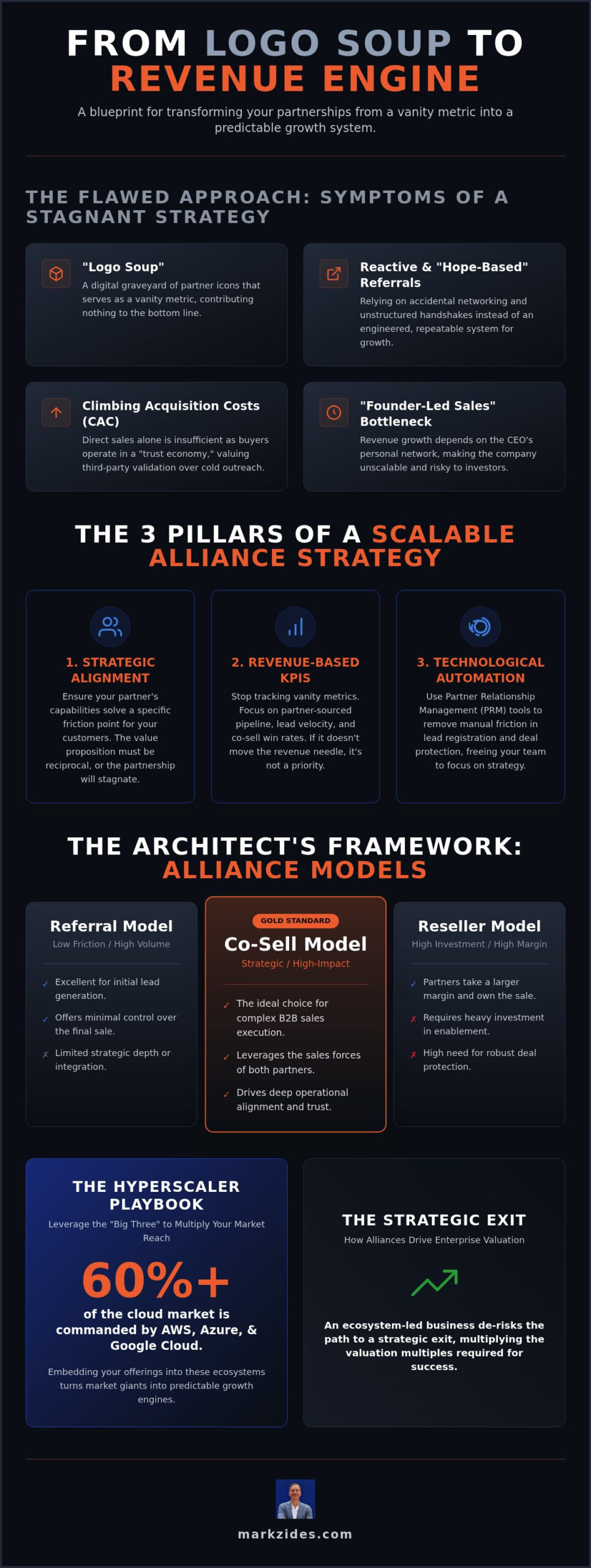
Stop treating your partner program like a social club. In the high-stakes business environment of 2026, a partnerships and alliances strategy must function as a precision-tooled revenue engine. Most organizations suffer from "Logo Soup," a vanity-driven collection of partner icons that look impressive on a website but contribute nothing to the bottom line. Real operators know that a handshake is not a strategy. True growth requires a formal framework for indirect revenue generation that is as disciplined and measurable as your direct sales motion.
Moving from tactical networking to a "Strategic Architect" approach means viewing every strategic alliance as a modular component of your broader Revenue Operating System. If you don't design these relationships with the same rigour as your product architecture, they will fail to scale. This evolution requires embedding an "Alliance Lifecycle" into your operations, ensuring that every partner moves through a structured process of recruitment, enablement, and predictable co-selling.
The 2026 Shift: Why Direct Sales Alone Is No Longer Sufficient
Rising customer acquisition costs (CAC) are the silent killer of SaaS margins. With global cloud infrastructure spending reaching $129 billion in the first quarter of 2026, the marketplace is more crowded than ever. Buyers no longer trust cold outreach or generic marketing; they operate in a "trust economy" where third-party validation from existing vendors is the primary currency. Alliances bridge this trust gap instantly.
Relying solely on direct sales also creates a dangerous "Founder-led Sales" bottleneck. If your revenue growth depends on the CEO's personal network, your company is unscalable and risky to investors. An engineered alliance strategy decentralizes this growth, allowing you to leverage the sales forces of your partners to penetrate new markets without doubling your internal headcount. Understanding what is demand generation as a discipline is equally critical here, since a predictable pipeline requires more than partnerships alone — it demands a systematic approach to creating and capturing market demand.
Key Components of a Scalable Alliance Strategy
Success isn't found in the quantity of partners, but in the depth of operational alignment. To build a system that drives predictable results, you must focus on three core pillars:
- Strategic Alignment: Your partner's capabilities must solve a specific friction point for your customers. If the value proposition isn't reciprocal, the partnership will stagnate.
- Revenue-Based KPIs: Stop tracking "meetings held" or "portal logins." Focus on partner-sourced pipeline, lead velocity, and co-sell win rates. If it doesn't move the revenue needle, it isn't a priority.
- Technological Automation: Use Partner Relationship Management (PRM) tools to remove manual friction. Automation should handle lead registration and deal protection, allowing your team to focus on strategy rather than spreadsheets.
This level of precision transforms partnerships from a "gut-feel" experiment into a repeatable system for market dominance.
The Architect's Framework: Categorizing Alliances for Maximum Leverage
You can't build a skyscraper on a residential foundation. To manage alliances strategically, you must first categorize your partners based on their operational depth and revenue potential. This classification is foundational to a partnerships and alliances strategy that multiplies enterprise valuation. For most high-growth SaaS organizations, the non-equity strategic alliance is the primary driver. It offers the agility of a partnership without the legal complexity of a merger, allowing you to plug directly into existing market demand while maintaining your autonomy.
The architect doesn't just sign agreements; they engineer them. By defining clear tiers, you move away from the "Logo Soup" of the past and toward a disciplined system where every relationship has a specific functional purpose. If you don't categorize your alliances correctly, you'll waste resources on low-impact relationships while neglecting the heavy hitters that could actually scale your revenue engine.
Referral vs. Reseller vs. Co-Sell Models
Think of these as the three distinct gears of your indirect sales motion. Referral models are low friction and high volume; they're excellent for lead generation but offer minimal control over the final sale. Resellers represent the opposite end of the spectrum, taking a larger margin but requiring heavy investment in enablement and deal protection. In 2026, the co-sell model is the gold standard for complex B2B sales execution. It allows your team to sell alongside a partner, leveraging their established trust with the customer while you maintain control over the product experience. If your current channel mix feels unbalanced, auditing your hyperscaler partnership strategy can help you identify where to deploy co-selling for maximum leverage.
Equity Alliances and Joint Ventures: When to Commit
Formal equity alliances are a high-stakes move that requires deep operational alignment. These are best reserved for entering emerging markets or pooling industry-specific data to create defensive AI moats. However, you must identify the triggers for a formal joint venture carefully. Merging operations without a full acquisition introduces cap table complexity that can complicate future fundraising rounds. Before you commit, evaluate how the JV affects your exit readiness. A poorly structured equity alliance can devalue your company by creating "poison pills" in your governance documents that scare off potential acquirers.
Selection depends on your current maturity. Early-stage firms should prioritize co-selling to gain market traction without the heavy lift of reseller enablement. Mature enterprises should look toward equity alliances only when the strategic advantage of shared resources outweighs the loss of operational agility. Every choice in your partnerships and alliances strategy should be a deliberate step toward a more predictable, scalable revenue engine.
The Hyperscaler Playbook: Scaling Through Ecosystem Dominance
Hyperscalers are no longer just infrastructure providers; they are the ultimate channel partners for the modern enterprise. In a market where Amazon Web Services (AWS), Microsoft Azure, and Google Cloud account for over 60% of global cloud infrastructure, your partnerships and alliances strategy must prioritize these ecosystems to survive. These giants, along with platform leaders like Salesforce, provide the massive scale and distribution networks that direct sales teams simply cannot replicate. If you're building a SaaS company in 2026, a hyperscaler partnership strategy is not an optional add-on; it's a mandatory requirement for market entry.
The primary advantage of these alliances lies in the "Marketplace effect." Cloud infrastructure spending reached $129 billion in the first quarter of 2026 alone, a 35% increase from the previous year. Much of this capital is tied up in "Cloud Commits," where enterprises pre-pay for cloud consumption. When your software is available on a hyperscaler marketplace, customers can use these pre-committed funds to purchase your product. This eliminates the friction of traditional procurement cycles, accelerates deal velocity, and positions your solution as a budget-neutral line item for the buyer.
Navigating the Hyperscaler Hierarchy
Success within these ecosystems requires moving beyond a "Registered" status to reach "Preferred" or "Elite" tiers. This transition isn't about time served; it's about engineering your technical documentation and sales collateral to be "Partner-Ready." Hyperscaler Account Executives (AEs) only promote solutions that are easy to understand and even easier to deploy. Research into critical success factors in strategic alliances proves that operational readiness is the most significant predictor of partnership longevity. Hyperscaler Co-sell is the alignment of partner incentives with your sales motion. Without this alignment, your listing will simply gather dust in a crowded marketplace.
Incentivizing the Partner Sales Force
You must understand the motivation of the partner AE to win their attention. These individuals are primarily compensated based on cloud consumption credits. If your software drives more data storage or compute power on their platform, you become their most valuable asset. Developing "Better Together" stories is essential; you must clearly articulate how your solution solves a specific customer pain point while simultaneously helping the partner AE hit their quota.
Aligning your B2B channel sales strategy with these compensation models creates a symbiotic relationship. When you make the partner AE the hero of the deal, they become an extension of your own sales force. This level of integration transforms your partnerships and alliances strategy from a passive listing into a high-velocity revenue engine that scales without the need for proportional increases in your internal headcount. For a comprehensive breakdown of how to activate this motion across AWS, Azure, and GCP, the 2026 guide to B2B partnership program development with hyperscaler co-selling provides the tactical playbook for turning a marketplace listing into attributed revenue.
Executing the Indirect Revenue Engine: From Blueprint to Pipeline
Execution is where most ambitious growth plans go to die. A partnerships and alliances strategy that exists only on a slide deck is a liability; it consumes resources without generating returns. To turn your blueprint into a high-velocity pipeline, you must embed your alliance motion directly into your sales enablement framework. This requires a shift from "gut-feel" networking to a disciplined, five-step operational cycle: objective alignment, partner recruitment, technical enablement, co-sell execution, and performance optimization. When these steps are synchronized, your indirect revenue becomes a predictable line item rather than a quarterly surprise.
Precision in channel sales depends entirely on forecast accuracy. If you can't track partner-sourced leads with the same granularity as your direct pipeline, you don't have a system; you have a series of accidents. Modern operators rely on robust Partner Relationship Management (PRM) platforms to serve as the "operating system" for their alliances. These tools provide the transparency needed to protect deals, manage lead distribution, and ensure that every partner is contributing to your 2026 growth targets. For a deeper dive into the technical stack required for this level of scale, review our guide on how to build a channel partner program.
Enablement: Equipping Partners to Win
Enablement isn't a one-time event; it's a continuous process of removing friction. Your Partner Portal should be a dynamic resource center that drives action, not a graveyard of outdated PDFs and broken links. Successful firms implement tiered certification programs that ensure quality control in the field, protecting your brand reputation while empowering partners to close deals independently. By automating lead distribution and deal registration through your PRM, you eliminate the manual bottlenecks that typically slow down co-sell motions. If a partner has to wait three days for a deal approval, they'll simply take their next lead to a competitor who moves faster.
Governance and Conflict Management
Channel conflict is the fastest way to demotivate both your internal sales team and your external partners. You must establish clear "Rules of Engagement" (ROE) that define how direct and indirect teams interact in the same territory. Governance is the guardrail that prevents alliance fatigue. Without a structured cadence for quarterly business reviews (QBRs), top-tier partners will lose interest and focus on other vendors. These reviews should focus on revenue-based KPIs and pipeline velocity rather than high-level "vision" statements. If you're ready to move from reactive networking to an engineered system, consider a professional partnerships and alliances strategy audit to identify your biggest execution gaps.
The Strategic Exit: How Alliances Drive Enterprise Valuation
Valuation is the ultimate scorecard for any executive leadership team. While direct sales provide immediate feedback, an ecosystem-led revenue model provides the long-term stability that acquirers are willing to pay a premium for. A robust partnerships and alliances strategy transforms your business from a standalone tool into an integrated platform. This shift significantly de-risks the organization for potential buyers. If your revenue is diversified across multiple channel partners, you're no longer vulnerable to a single point of failure in your direct sales force. Acquirers aren't just buying your current revenue; they're buying the predictability of your future growth.
Ecosystem-led companies often command higher multiples because they've proven "Market Fit" at scale without the massive headcount growth typically required by direct-only models. If you can drive 30% or more of your revenue through indirect channels, you've demonstrated that your product is valuable enough for third parties to stake their own reputations on it. This efficiency is a massive green flag during fundraising or acquisition talks. Leveraging fractional CRO services is the most efficient way to build this architectural foundation pre-exit, allowing you to embed executive-level expertise into your revenue engine without the long-term overhead of a full-time hire.
Alliances as a Moat: Defensibility in the Acquisition Process
Acquirers crave stickiness. When your software is deeply embedded into a hyperscaler's infrastructure, you aren't just a vendor; you're part of the customer's core architecture. This creates a defensive moat that's difficult for competitors to breach. During the due diligence process, partner-sourced data provides a transparent audit trail of predictable revenue that "gut-feel" projections can't match. To maximize your exit price, you must begin auditing your partner contracts at least 18 months in advance. This ensures all agreements are transferable and optimized for a change in control, which is a critical component of a comprehensive exit readiness strategy.
The Role of the Chief of Strategy and Partnerships
Maintaining alliance momentum requires a dedicated leadership role focused on operational excellence. Founders often excel at the initial handshake, but they rarely have the discipline to manage the granular details of a maturing alliance system. As you scale, you must transition partnership management to an "Operator" who can maintain the rhythm of QBRs and deal registration. Hiring a fractional leader to design the initial blueprint provides a high ROI; they bring a battle-tested methodology that prevents the "Logo Soup" stagnation common in mid-market firms. By treating your partnerships and alliances strategy as a core financial asset, you ensure your company is positioned for a high-multiple exit in the 2026 market.
Scaling the Architecture of Success
Success in 2026 isn't built on handshakes; it's built on systems. You've seen how a high-performance partnerships and alliances strategy can transform your organization from a direct-sales bottleneck into a scalable ecosystem leader. By engineering your partnership tiers, mastering the hyperscaler playbook, and embedding alliances into your core sales motion, you don't just drive predictable revenue. You build a defensible moat that multiplies your enterprise valuation and secures your path to a strategic exit.
Don't leave your growth to chance or "gut-feel" networking. I'm a seasoned operator focused on designing 90-day revenue operating systems that align channel development with exit readiness. Whether you're navigating the hyperscaler hierarchy or preparing for a high-multiple acquisition, you need a blueprint that delivers results. Build your engineered revenue engine with Mark Zides' fractional CRO services. The architecture of your future success is within reach. It's time to build.
Frequently Asked Questions
What is the difference between a partnership and a strategic alliance?
Strategic alliances are formal, objective-driven frameworks focused on deep operational integration and long-term value creation. While a standard partnership might be a simple referral agreement or a one-off marketing event, a strategic alliance involves shared resources and synchronized sales motions. In a modern partnerships and alliances strategy, the focus is on building a repeatable revenue system rather than just trading logos on a website.
How long does it take to see revenue from a new alliance strategy?
Expect a 6 to 9-month window before seeing significant indirect revenue streams. The first 90 days are usually dedicated to engineering the framework, technical enablement, and aligning sales incentives. By month six, co-selling motions typically begin to produce a measurable pipeline. This timeline can be accelerated if you're leveraging existing hyperscaler marketplaces where procurement friction is already minimized through pre-committed cloud spend.
What are the most common reasons strategic alliances fail?
Misalignment of core objectives and a lack of operational discipline are the primary killers of alliances. Many programs fail because they lack a "Strategic Architect" to manage the partnership lifecycle, resulting in "Logo Soup" with no measurable revenue outcome. If you don't define clear, revenue-based KPIs and establish a regular QBR cadence, the partnership will inevitably stagnate as internal priorities shift and interest wanes.
Do I need a PRM platform to start a partnership program?
You don't need a PRM for your first two partners, but you absolutely need one to scale beyond that. Managing deal registration and lead distribution through spreadsheets is a recipe for chaos and channel conflict. A PRM acts as the operating system for your partnerships and alliances strategy, providing the transparency and automation required to protect deals and maintain partner trust as your ecosystem grows.
How do I prevent channel conflict between my partners and direct sales team?
Establish clear Rules of Engagement (ROE) before launching any co-sell motion. These rules must define account ownership and lead protection protocols for both direct and indirect teams to ensure everyone stays in their lane. If you align compensation so that direct reps are incentivized to co-sell rather than compete, you eliminate the friction that typically destroys channel programs. Governance is the guardrail that keeps both teams focused on the customer.
What is a hyperscaler partnership and why does it matter for SaaS?
A hyperscaler partnership involves aligning your software with cloud giants like AWS, Microsoft Azure, or Google Cloud. These alliances matter because they provide access to "Cloud Commit" funds, allowing enterprises to buy your product using pre-allocated infrastructure budgets. This significantly reduces procurement cycles and helps you scale within the ecosystems that currently command over 60% of the global cloud market as of early 2026.
Can a fractional CRO help build a partnerships and alliances strategy?
Yes, a fractional CRO provides the executive-level "Operator" experience needed to build a revenue-first alliance framework from the ground up. They specialize in moving from founder-led sales to repeatable systems, ensuring your partnership motion is integrated into your broader sales enablement strategy. This is often the most efficient way to design a professional blueprint without the high overhead of a full-time executive hire during a growth phase.
How do strategic alliances impact a company valuation during an exit?
Robust alliances significantly multiply enterprise valuation by proving market fit at scale with high capital efficiency. Acquirers pay a premium for "Ecosystem-Led" companies because indirect revenue streams are more predictable and de-risk the business for the buyer. Diversified revenue through strong channel partners demonstrates that your growth isn't dependent on a single internal team, making your company a much more attractive and defensible target for a strategic exit. Building this foundation alongside a clear understanding of what is demand generation as a scalable revenue discipline ensures that both your direct and indirect channels are firing in unison toward a high-multiple outcome.
Ready to build a revenue engine that runs without you?
Mark works alongside founders as a player-coach — not a slide deck.
Book a 30-minute call