
Quality of Earnings Report: What Buyers Check Before They Pay

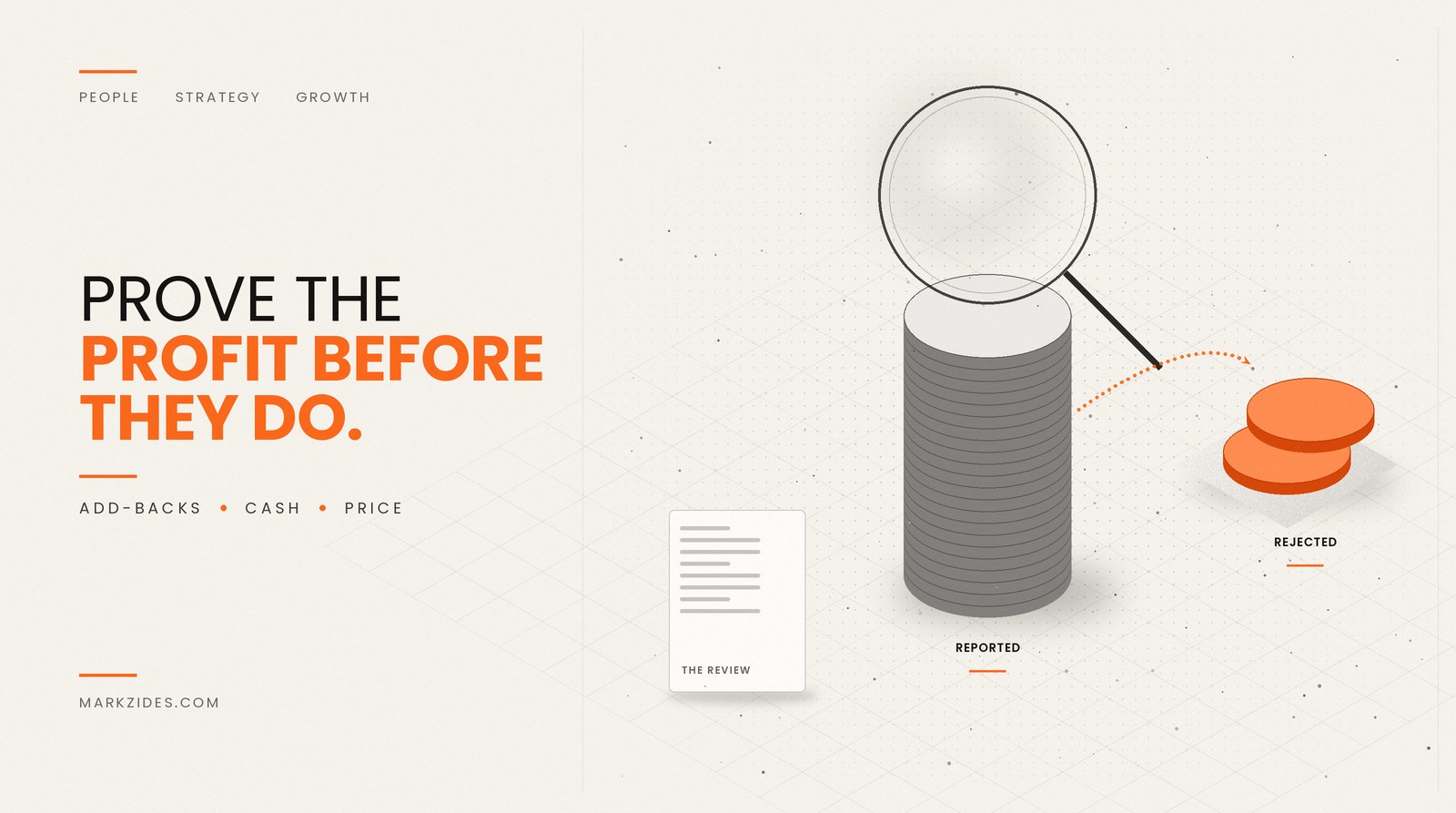
The owner agrees a price, and it feels like the finish line. The buyer's offer was a multiple of last year's profit, and the profit was the owner's own number, the one in every board pack. Six weeks later the buyer's accountants send a report. Some of the costs the owner treated as one-off seem to happen every year. A salary looks too low for the job. A large invoice landed in the wrong month. But the profit figure is now lower, and the price is a multiple of it. The quality of earnings review is where that happens.
What Is a Quality of Earnings Report?
A quality of earnings report is a review, done by an accounting firm during or before the sale of a business, that tests whether the profit the price is based on is real, will repeat under a new owner, and turns into cash. It starts from the accounts, then adjusts them: taking out true one-off costs, putting back costs the owner has not been paying, and correcting anything booked in the wrong period. The result is an adjusted profit figure, usually EBITDA, that the buyer will rely on.
| Audit | Quality of earnings report | |
|---|---|---|
| Question it answers | Do the accounts follow the accounting rules? | Is the profit real, and will it repeat for a new owner? |
| Who asks for it | Lenders, shareholders, regulators | A buyer, or a seller preparing for one |
| What it looks at | The past year's statements | Two or three years, month by month, plus the current year |
| What it produces | An opinion on the statements | An adjusted profit figure and a list of findings |
Where it sits in a sale matters. A buyer usually commissions one after the letter of intent is signed and before the final agreement, which means the headline price is already agreed and the review is where it is tested. That timing is why it matters so much in the sequence of selling a business: the price you announced to your family is not yet the price you will be paid.
What a Quality of Earnings Report Checks
Firms organise the work differently, but nearly every report tests the same six things.
1. Add-Backs and Adjusted Profit
Add-backs are costs you say a new owner would not have: a one-off legal bill, a relative on the payroll, your personal car. Each one raises the profit the price is based on, so each one is tested. The firm asks for the invoice, the payroll record or the contract, and asks whether the cost truly will not happen again. Recasting earnings this way is standard, and the paper behind each line is what decides whether it survives, as owners selling to a private equity firm find early.
2. Revenue by Customer, and How Much Repeats
The firm breaks revenue down by customer, by product and by month. It looks for how much comes from contracts or repeat orders, how much depends on a few large accounts, and whether any large one-off project inflated the year. Heavy reliance on a handful of customers is one of the first things a buyer prices, which is why customer concentration risk often shows up here as a lower multiple or a demand for part of the price to be paid later.
3. Cash Against the Books
Often called a proof of cash, this matches the money that actually moved through the bank to the revenue and costs in the accounts, month by month. Gaps are usually innocent: timing, a personal transfer, a refund booked twice. But each one has to be explained, and profit that never became cash is treated with suspicion.
4. Working Capital and the Peg
Working capital is the money tied up in running the business: what customers owe you plus stock, less what you owe suppliers. The buyer expects a normal level of it to be left in the business at closing, agreed as a target called the peg. The review sets what normal looks like from your monthly history. If you deliver less than the peg at closing, the price falls by the difference.
5. Debt-Like Items
Some obligations are not loans but will cost the new owner cash. Customer deposits for work not yet done. Bonuses earned but unpaid. Tax owed from earlier years. Old supplier bills. Repairs that have been put off. Each is usually taken off the price, like debt, and owners are often surprised by how many there are.
6. The True Cost of Running the Business
If you pay yourself less than it would cost to hire someone to do your job, the firm adds the difference back as a cost. The same goes for a spouse who keeps the books unpaid, or a role you do that nobody is paid for. A business that depends on unpaid owner time is less profitable than it looks, which is part of why a business that runs without its owner is worth more.
How a Quality of Earnings Review Moves the Price: A Worked Example
An illustrative company agrees a sale at six times adjusted profit. The six times multiple is an assumption for the arithmetic; what real deals pay depends on size, sector and growth, and the exit routes open to an owner each price differently. The seller's adjusted profit is $3.0 million, so the agreed price is $18.0 million.
The review finds four problems:
- A $150,000 add-back for a relative's salary has no record showing the work stopped. Rejected.
- A $100,000 marketing cost called one-off turns out to happen every year. Rejected.
- The owner pays themself $120,000 less than a general manager would cost. Added as a cost.
- $30,000 of revenue was booked before the work was done. Moved to the next year.
Adjusted profit falls to $2.6 million. At six times, the price falls from $18.0 million to $15.6 million: $2.4 million off, from findings that add up to $400,000 of profit. That is the arithmetic every owner should run before going to market. Sometimes the buyer does not cut the price outright and instead offers to pay part of it later if targets are met, which is how an earnout often enters a deal at this stage.
Sell-Side vs Buy-Side Quality of Earnings
A buy-side report is commissioned and paid for by the buyer, and it protects the buyer. A sell-side report is commissioned and paid for by the owner before going to market, so the problems are found while there is still time to fix them or explain them.
| Sell-side | Buy-side | |
|---|---|---|
| Who pays | The owner | The buyer |
| When | Before going to market | After the letter of intent |
| Who it protects | The owner, by finding problems first | The buyer, by testing the price |
| What it changes | Fewer surprises, a firmer price, a faster review | The final price and terms |
A sell-side report does not replace the buyer's own review. Most buyers still commission theirs. But a review that has already been done, by a firm the buyer respects, usually goes faster and finds less. It pays most when the business is large enough to attract professional buyers or the books are complex. Costs vary widely between firms, so ask two or three for a fixed fee against the same scope.
How to Prepare for a Quality of Earnings Review in Seven Steps
Most of this work belongs to your own accountant. Your job is to start early enough and to make the decisions only you can make.
- Keep monthly accrual books for three years. Revenue and costs booked in the month they were earned or incurred, not when cash moved. Cash-basis books are the most common reason a review runs long.
- Match the bank to the books every month. Reconcile every account, monthly, and keep the record. This is the proof of cash done in advance.
- Put paper behind every add-back. For each adjustment you plan to claim, file the invoice, payroll record or contract, and a note on why it will not recur. Drop any you cannot prove.
- Build a revenue file by customer. Revenue by customer by month for three years, with contract terms and renewal dates. Know your concentration before the buyer tells you.
- Clean up owner costs. Take personal expenses off the company and pay yourself, and anyone in the family who works there, at market rate for at least a year before the sale.
- Track working capital by month. Two years of monthly working capital lets you argue for a fair peg, rather than accept one set from a single good month.
- Name one person to answer questions within a day. Slow answers make reviews run long and make buyers nervous. Decide in advance who answers and how fast.
| Step | Who does it | Start before going to market |
|---|---|---|
| Monthly accrual books | Your accountant | 12 months or more |
| Bank matched to books | Bookkeeper | 12 months |
| Paper for add-backs | You and your accountant | 9 months |
| Revenue file by customer | Finance, with sales | 9 months |
| Owner costs cleaned up | You | 12 months |
| Working capital by month | Your accountant | 6 months |
| One person answering | Your finance lead | From the letter of intent |
None of this is tax or legal advice, and your own accountant and lawyer should set the details. What an owner can do is start the clock early. Getting the business ready for a buyer's review, a year before anyone asks, is most of what good exit planning is for.
What Usually Lowers the Price
- Add-backs with no invoice, contract or payroll record behind them.
- "One-off" costs that appear in two or three years running.
- An owner, or family, paid below what the job would cost to fill.
- Revenue booked before the work was done, or a large project that will not repeat.
- Working capital below its normal level at closing.
- Customer deposits, unpaid bonuses and old taxes treated as debt.
- Too much revenue from too few customers.
Frequently Asked Questions
What is the difference between an audit and a quality of earnings report?
An audit checks that the accounts follow the accounting rules. A quality of earnings report asks a different question: whether the profit is real, will repeat for a new owner and turns into cash. A company can pass an audit and still see its profit cut in a review.
How long does a quality of earnings review take?
Usually several weeks once the firm has your files, and longer for a complex business. Slow answers from the seller's side are the most common reason a review runs long, so name one person to respond within a day.
Who pays for a quality of earnings report?
The buyer pays for its own review. An owner who wants one done before going to market pays for a sell-side report, which finds problems while there is still time to fix them or explain them.
Is a sell-side quality of earnings report worth it?
It usually pays when the company is large enough to draw professional buyers or the books are complex. For a small, simple business, clean monthly books and proof for every adjustment may be enough.
What is a working capital peg?
The normal level of working capital the buyer expects to find in the business at closing, agreed in the deal. If you deliver more than the peg, the price usually rises by the difference; if less, it falls.
Final Thought
The price you agree is a multiple of a profit figure nobody outside the company has checked yet. The quality of earnings review is where it gets checked, and every dollar that fails costs you the multiple. Find the problems first: books kept monthly, cash matched, every adjustment proven, and an owner paid like the person who will replace them. That is the K in Mark's UNLOCK Method: keep scaling beyond the founder, so the business a buyer examines stands on its own numbers. Getting a company ready for that examination is a core part of exit planning work.
Ready to build a revenue engine that runs without you?
Mark works alongside founders as a player-coach — not a slide deck.
Book a 30-minute call