
The Entrepreneur’s Guide to Business Coaching: Scaling Through Operational Excellence in 2026

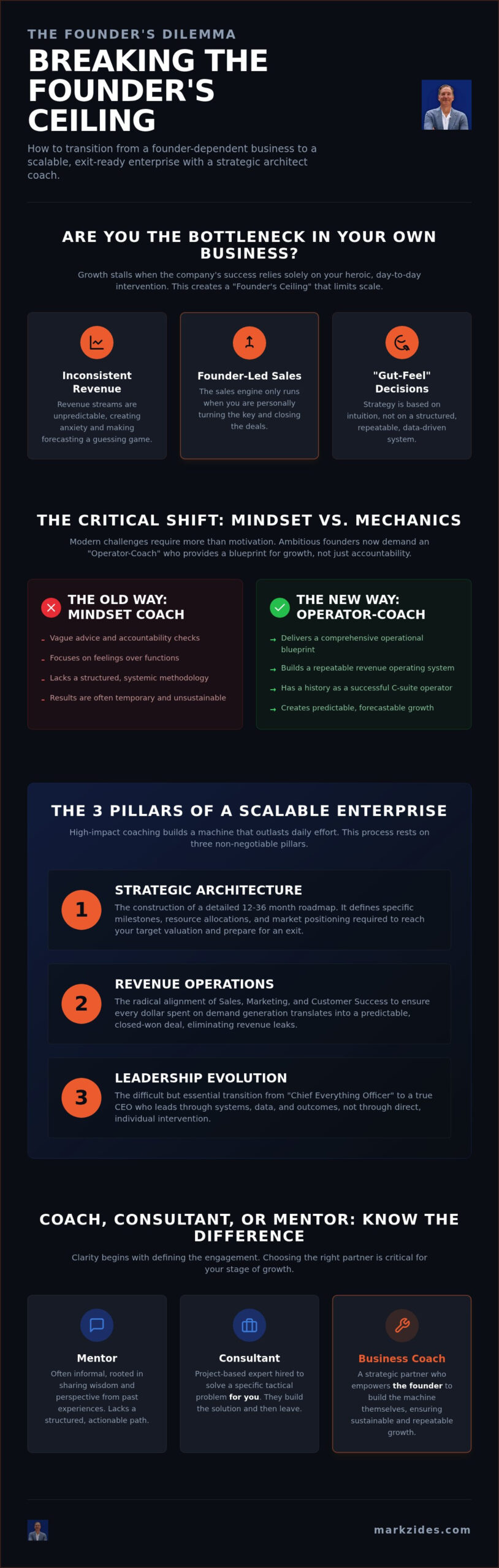
Your business isn't stalling because you lack vision; it's hitting a ceiling because you've become its primary bottleneck. It's a common trap where every growth milestone depends on your personal, heroic intervention. You likely feel the weight of inconsistent revenue and the anxiety of a sales engine that only runs when you're the one turning the key. Engaging the right business coach for entrepreneurs is the only way to trade that "gut-feel" chaos for the calm of a structured, predictable system.
This guide provides the blueprint to identify and leverage a coach who acts as a strategic architect rather than just a mindset mentor. You'll learn how to vet experts who can help you dismantle the founder's ceiling and embed a scalable revenue operating system into your organization. We'll walk through the methodology of building a company that functions independently of your daily presence, ensuring you're fully prepared for fundraising or a lucrative exit. This isn't about working harder. It's about designing a machine that performs with precision while you focus on the horizon.
Key Takeaways
- Shift from mindset-focused advice to a strategic architecture that aligns your vision with a 12-36 month operational roadmap.
- Discover how to vet a business coach for entrepreneurs by auditing their history as a successful operator and evaluating their systemic methodology.
- Replace "gut-feel" decision-making with a repeatable revenue operating system that ensures predictable, forecastable growth.
- Identify the critical differences between traditional consulting and high-impact coaching to empower yourself as a builder rather than a bystander.
- Prepare your organization for fundraising or exit by embedding the operational excellence required for a business to run without founder intervention.
What is a Business Coach for Entrepreneurs in 2026?
A business coach for entrepreneurs is no longer a luxury for the uncertain; they are a strategic architect for the ambitious. In 2026, the role has evolved from providing simple "accountability checks" to delivering comprehensive operational blueprints. This partner provides a disciplined, external perspective that identifies structural weaknesses you are too close to see. They don't just ask how you feel about your progress. They analyze your revenue operating system, stress-test your lead generation, and ensure your team is aligned with a 36 month roadmap. If your business relies on your daily "heroic" intervention to survive, you haven't built a company; you've built a high-stress job.
The global coaching market has reached approximately $5.34 billion, with over 122,974 practitioners worldwide according to the ICF 2025 Global Coaching Study. This 54% increase in practitioners since 2019 has created a critical divide. Generalist coaching is dying because founders no longer have time for vague mindset shifts. The rise of the specialist "Operator-Coach" reflects a demand for mentors who have actually sat in the C-suite. These experts help you dismantle the "Founder's Ceiling," which is the exact point where your personal talent and intuition become the primary bottlenecks preventing further scale.
The Difference Between Mentorship, Coaching, and Consulting
Clarity begins with defining the engagement. Mentorship is often informal and rooted in shared wisdom from past experiences. It's valuable for perspective but lacks a structured path. Consulting is project-based; you hire a consultant to solve a specific tactical problem, such as a software implementation. They build the solution for you and then leave. A business coach for entrepreneurs focuses on empowering the founder to build the machine themselves. They provide the frameworks and decision-making rigor that turn a visionary into a disciplined CEO, ensuring the growth is sustainable and repeatable.
Why Founders Need an 'Operator-Coach' to Scale
Mindset-only coaching often fails because it ignores the mechanics of revenue. An operator-coach identifies "revenue leaks" in your sales funnel and marketing engine that "gut-feel" management misses. They move your organization from hero-led growth, where success depends on a few star players, to system-led growth. By embedding a revenue operating system, they replace chaos with predictable, forecastable results. This transition is essential for any founder eyeing an eventual exit or a major fundraising round, as investors buy systems, not individual effort.
The 3 Pillars of High-Impact Entrepreneurial Coaching
High-stakes scaling requires more than just "hustle" or a positive mindset; it requires rigid structural integrity. When you engage a business coach for entrepreneurs, the objective isn't to talk about your feelings, but to build a machine that outlasts your daily effort. This process rests on three non-negotiable pillars that transform a chaotic startup into a mature, scalable enterprise. Without these pillars, growth is accidental and usually unsustainable.
- Pillar 1: Strategic Architecture. This is the construction of a detailed roadmap for the next 12 to 36 months. It defines the specific milestones, resource allocations, and market positioning required to reach your target valuation.
- Pillar 2: Revenue Operations. This involves the radical alignment of sales, marketing, and customer success. It ensures that every dollar spent on demand generation translates into a predictable, closed-won deal.
- Pillar 3: Leadership Evolution. This is the difficult transition from "Chief Everything Officer" to a true CEO. You must learn to manage through systems and outcomes rather than tasks and individual interventions.
The Revenue Operating System is the core deliverable of high-impact coaching, serving as the codified framework that converts market opportunity into predictable profit without requiring the founder's direct labor.
Strategic Architecture and Exit Readiness
A sophisticated coach prepares your business for valuation and acquisition long before you're ready to sell. Investors and venture capitalists look for "red flags" that signal high risk, such as extreme founder-dependency or a lack of repeatable processes. If you are the primary salesperson or the sole keeper of client relationships, your business valuation will suffer. By aligning your current actions with long-term capital raise goals, you build a company that's "exit-ready" at any moment. This structural discipline is why 87% of organizations report a positive ROI from coaching according to the International Coaching Federation.
Operationalizing the Revenue Engine
Scaling requires you to implement sales execution frameworks that don't require you to close every deal personally. You must bridge the gap between demand generation and sales enablement to ensure your team has the tools to win. High-impact coaching focuses on measuring what matters, moving your focus from vanity metrics like "social reach" to forecast accuracy and pipeline velocity. If you're ready to stop guessing and start growing, you might benefit from a strategic architecture approach that treats revenue as a predictable science. This shift from hero-led growth to system-led growth is the only way to achieve true operational excellence in 2026.
Mindset vs. Operational Coaching: Which Do You Need?
Mindset coaching is often sold as a panacea for every entrepreneurial struggle, yet it rarely fixes a broken sales funnel. While affirmations might improve your outlook, they won't repair a fragmented lead generation system or an inconsistent closing process. A high-impact business coach for entrepreneurs understands that sustainable growth requires more than just a "shift in perspective." It requires the installation of rigid, repeatable systems. If your revenue is plateauing despite your best efforts, the problem isn't your motivation; it's your architecture.
Most founders fall into the "Gut-Feel" Trap. This is the reliance on intuition and personal heroics that successfully carries a business to its first few million in revenue. However, this same intuition becomes a liability when trying to scale past the $5M to $10M mark. At this stage, the complexity of the organization outpaces your ability to manage by feel. You need data-driven frameworks and operational discipline. Transitioning to CEO coaching for revenue growth is the only way to link your daily activities to tangible EBITDA improvements and long-term enterprise value.
Consider the case of a B2B firm with a stalled pipeline. A traditional coach might focus on the founder's "limiting beliefs" about sales. An operational coach, however, audits the lead scoring criteria, fixes the broken hand-off between marketing and sales, and embeds a standardized discovery framework. By treating the pipeline as an engineering problem rather than a psychological one, the business achieves predictable growth that doesn't depend on the founder's mood or energy levels.
The ROI of Operational Coaching
Operational coaching delivers a measurable return by eliminating the high cost of founder-led selling. When you act as your company's primary closer, the opportunity cost is staggering; you're trading high-value strategic planning for tactical tasks that a system should handle. Predictable revenue systems do more than just increase monthly cash flow. They significantly increase business valuation multiples. Buyers pay a premium for "turnkey" operations where the revenue engine is codified and the founder is optional.
When Mindset Still Matters
Mindset isn't irrelevant, but it must serve the system. The most common psychological hurdle for scaling founders is the fear of delegation. You must develop the discipline to follow a repeatable system even when your "gut" tells you to intervene. Moving from a scarcity mindset to a scale mindset means trusting the process over your own individual brilliance. A business coach for entrepreneurs helps you navigate this transition, ensuring you have the mental fortitude to let go of the "hero" role so your organization can finally breathe.
How to Vet a Business Coach: A 5-Step Checklist
Selecting a business coach for entrepreneurs is a high-stakes decision that dictates your company's trajectory for the next 36 months. You aren't looking for a cheerleader; you're looking for a partner with the scars to prove they've been in the trenches. The market is saturated with "certified" mentors who have never managed a significant P&L or navigated a genuine market downturn. To avoid wasting capital, you must apply a rigorous vetting process that prioritizes operational results over theoretical knowledge.
This is why many founders turn to Marshall Solutions Group, a veteran-owned firm that helps founder-led companies improve leadership and operational performance through disciplined management consulting.
- Step 1: Audit Their 'Operator' History. Did they build and scale actual companies, or did they only build a coaching practice? You need a coach who has navigated real-world volatility and understands the friction of scaling a team.
- Step 2: Evaluate Their Methodology. Is their approach a repeatable system or just "gut-feel" advice? A professional coach provides a clear blueprint for scaling that remains consistent regardless of the founder's mood.
- Step 3: Check for Revenue Alignment. A qualified business coach for entrepreneurs must understand the technical nuances of sales enablement and demand generation. If they can't diagnose a broken pipeline, they can't help you scale.
- Step 4: Request 'Proof of Scale.' Ask for specific examples of how they helped a firm move from one revenue tier to the next. Moving from $2M to $10M requires a completely different playbook than moving from $10M to $50M.
- Step 5: Test for Strategic Fit. A great coach challenges your assumptions rather than simply validating them. If they don't push back on your "gut-feel" decisions with data-backed logic, they aren't providing value.
If you're ready to move beyond theory and implement a proven growth framework, explore how Mark Zides applies these operator-first principles to drive measurable revenue.
Red Flags to Avoid in Your Search
The "Certification Trap" is the most common pitfall for founders. While credentials from organizations like the ICF provide a baseline of ethics, they don't guarantee the ability to fix a failing sales engine. Avoid one-size-fits-all programs that don't account for your specific market dynamics or competitive landscape. If a coach cannot explain exactly how they measure their own ROI through EBITDA improvements or revenue growth, they're a consultant in disguise, not a strategic architect.
The 'Strategic Architect' Interview Questions
Direct questions reveal the depth of a coach's experience. Ask: "How would you help me remove myself from the sales process in the next 6 months?" This tests their ability to build systems over heroics. Follow up by asking what specific revenue operating systems they've implemented in similar-sized firms. Finally, ask how they align marketing spend with sales execution. Their answer should focus on conversion and forecast accuracy rather than vanity metrics like "brand awareness." A coach who also understands the science of building rapport as a repeatable system rather than a soft skill will be far better equipped to help your team shorten sales cycles and close high-stakes deals.
Scaling with a Strategic Architect: The Mark Zides Approach
Scaling a high-growth company is ultimately an engineering problem. While many mentors focus on the psychological hurdles of leadership, Mark Zides operates as a Strategic Architect. This approach treats your organization as a construction project where structural integrity is paramount. By functioning as a business coach for entrepreneurs who prioritizes operational excellence, Mark bridges the critical gap between executive coaching for sales leaders and the tactical execution of fractional leadership. He doesn't just offer advice; he embeds the blueprints necessary to support a heavy revenue load.
The core deliverable of this partnership is the Revenue Operating System. This is a codified framework that replaces individual heroics with repeatable processes. It provides the clarity you need to stop managing by crisis and start leading by objective. When your sales, marketing, and customer success teams are aligned through a single architectural vision, the result is total predictability. Don't hire a coach simply to feel better about your progress. Hire an architect to build a better business that can stand independently of your daily intervention.
From Founder-Led to System-Driven
The transition from founder-led sales to a system-driven engine is the most dangerous phase of scaling. Mark's methodology specifically targets the B2B sales and marketing engine to ensure your growth is sustainable. This involves building a robust demand generation engine that feeds the sales pipeline with high-intent leads. By moving from "Gut-Feel" to "Forecast Accuracy," you gain the ability to make data-backed investments in your team and technology. This shift ensures that every dollar spent on marketing is directly linked to a measurable outcome in the sales cycle.
Taking the Next Step
High-growth entrepreneurs need more than just a sounding board; they need a blueprint for the next level of performance. If you find yourself acting as the primary closer or the sole problem-solver in your organization, you've hit the founder's ceiling. The first step toward dismantling that ceiling is a comprehensive strategic audit of your current revenue operations. This audit identifies the tactical friction points and structural weaknesses that are currently siphoning off your profits. It's time to stop guessing and start building with precision. Scale your revenue with Mark Zides and transform your business into a high-performance machine ready for exit or expansion.
Architect Your Exit: The Path to Predictable Scale
The era of relying on "gut-feel" to drive growth is over. To dismantle the founder's ceiling, you must transition from a hero-led organization to a system-driven machine. Engaging a business coach for entrepreneurs who understands the mechanics of sales execution and revenue operations is the catalyst for this change. By prioritizing strategic architecture over vague mindset shifts, you build a business that is not only scalable but also ready for fundraising or a lucrative exit.
Mark Zides provides the fractional CRO expertise and executive coaching required to bridge the gap between high-level ambition and granular operational excellence. His focus on Revenue Operating Systems ensures that your growth is predictable, forecastable, and sustainable. If you're ready to replace uncertainty with structural clarity, it's time to act. It's the difference between a business that owns you and a business you truly own.
Scale your business with a Strategic Architect. Schedule a consultation with Mark Zides. Your vision deserves a foundation that can support its weight. Let's start building.
Frequently Asked Questions
What is the average cost of a business coach for entrepreneurs?
Industry data from 2026 shows experienced coaches charge $200 to $600 per hour, while C-suite specialists command over $1,000. Monthly retainers for growth-stage companies typically range between $2,000 and $15,000. These figures reflect the high-stakes nature of professional mentorship. Engaging a business coach for entrepreneurs is a strategic investment in your company's infrastructure rather than a tactical expense.
How long should I expect to work with a business coach before seeing results?
You should expect to see tactical improvements within 90 days, while systemic transformation usually requires six to twelve months. Initial wins often include improved calendar management or clarified sales roles. However, building a repeatable revenue operating system that functions without your daily intervention takes sustained effort. Long-term results are measured by the transition from founder-led heroics to predictable, scalable growth.
Is a business coach the same as a fractional CRO?
A business coach focuses on empowering the founder through frameworks, while a Fractional CRO takes direct ownership of the revenue function. While they are different roles, an operator coach often bridges this gap by providing the roadmap and the tactical expertise to execute it. This ensures that strategic advice is grounded in operational reality and leads to measurable results.
Can a business coach help me with fundraising or preparing for an exit?
Yes, a strategic coach is essential for preparing your business for valuation and acquisition. They help you identify and fix red flags that sophisticated buyers look for, such as extreme founder-dependency or fragmented sales data. By aligning your current operations with exit readiness standards, you maximize your enterprise value well before you enter a formal sales process. Structure drives valuation.
How do I know if I'm ready for a business coach or if I should just hire more staff?
If your current team is underperforming or your revenue is inconsistent, hiring more staff will likely only scale your existing chaos. You are ready for a coach when you realize that a lack of systems is your primary bottleneck. A business coach for entrepreneurs helps you build the operational blueprints that make your future hires successful. This ensures your headcount investments actually drive a return.
What is the difference between executive coaching and entrepreneur coaching?
Executive coaching typically focuses on leadership development within an established corporate structure. Entrepreneur coaching is fundamentally different because it involves building the structure itself. It addresses the unique challenges of scaling a company from the ground up. This includes designing revenue operations, sales enablement, and the psychological transition from a hands-on founder to a disciplined CEO. Both require different blueprints for success.
How much time per week will I need to commit to the coaching process?
Expect to commit one to two hours for direct sessions each week, plus additional time for implementation. High-impact coaching is not a passive activity. It requires active participation in designing and embedding new workflows. The objective is to invest time on the business now so you can reclaim significant hours from the daily grind later. Discipline is non-negotiable.
What metrics should I use to measure the success of my business coach?
Success should be measured by tangible outcomes such as revenue growth, forecast accuracy, and EBITDA improvements. You should also track the reduction in founder-led sales and the increased autonomy of your leadership team. If the coaching process doesn't lead to a more predictable and scalable organization, the engagement isn't delivering its full ROI. Focus on data over feelings.
Ready to build a revenue engine that runs without you?
Mark works alongside founders as a player-coach — not a slide deck.
Book a 30-minute call