
Fractional CRO Instead of VP of Sales: Why Your Next Hire Isn't Who You Think

Hiring a high-performing VP of Sales to fix your stagnant revenue is often the most expensive mistake a founder can make. While it seems logical to bring in a "closer" when growth plateaus, you're likely trying to solve a systemic problem with a tactical hire. If your marketing and sales teams operate in silos or your forecasting relies on gut-feel rather than data, adding more sales pressure won't fix the underlying cracks in your foundation. Choosing a fractional CRO instead of VP of sales allows you to stop chasing the next deal and start building a scalable revenue engine.
You already know that a great product isn't enough to reach the next level of performance. You need a strategic architect who can align the entire customer journey and prepare your organization for a high-value exit or fundraise. In this guide, we'll explore why the traditional sales leadership model is failing modern B2B companies. You'll discover how a 90-day Revenue Operating System replaces anxiety with clarity, ensuring your growth is both predictable and repeatable.
We'll break down the operational differences between these roles and show you how to embed the discipline required to accelerate your valuation. It's time to stop hiring for what you need today and start building for the exit you want tomorrow.
Key Takeaways
- Stop chasing "rainmakers" and start building systems. While a VP of Sales manages a single department, a CRO aligns the entire customer journey for sustainable growth.
- Understand why choosing a fractional CRO instead of VP of sales provides the cross-functional architecture needed to eliminate silos and drive predictable revenue.
- Replace "gut-feel" forecasting with high-precision accuracy by embedding a 90-day Revenue Operating System framework into your daily operations.
- Move beyond founder-led sales by designing a repeatable engine that doesn't rely on your personal network to hit aggressive targets.
- Maximize your valuation by replacing "hero-led" revenue with a systemic approach that withstands the scrutiny of due diligence during an exit or fundraise.
The Myth of the 'Rainmaker' VP of Sales
The "rainmaker" is a B2B myth that costs founders millions in lost momentum. You've seen the pattern before. A company hits a revenue plateau, the board gets restless, and the founder hires a superstar VP of Sales from a name-brand tech giant. This "closer" arrives with a high salary and a deep rolodex but quickly stalls because they're trying to drive a car that hasn't been built yet. Choosing a fractional CRO instead of VP of sales at this stage is the difference between hiring a driver and hiring an automotive engineer. If your underlying revenue architecture is fractured, even the best salesperson in the world will fail to gain traction.
The price of a failed VP hire extends far beyond their base salary. When you factor in recruitment fees, six months of missed targets, and the equity burned on a leader who didn't fit, the total loss is often catastrophic. You lose the confidence of your investors and the trust of your remaining team. Founders default to the VP title because it feels familiar; yet, what they actually require is a Chief Revenue Officer (CRO) who can design the machine before anyone attempts to operate it.
The Tactical vs. Strategic Divide
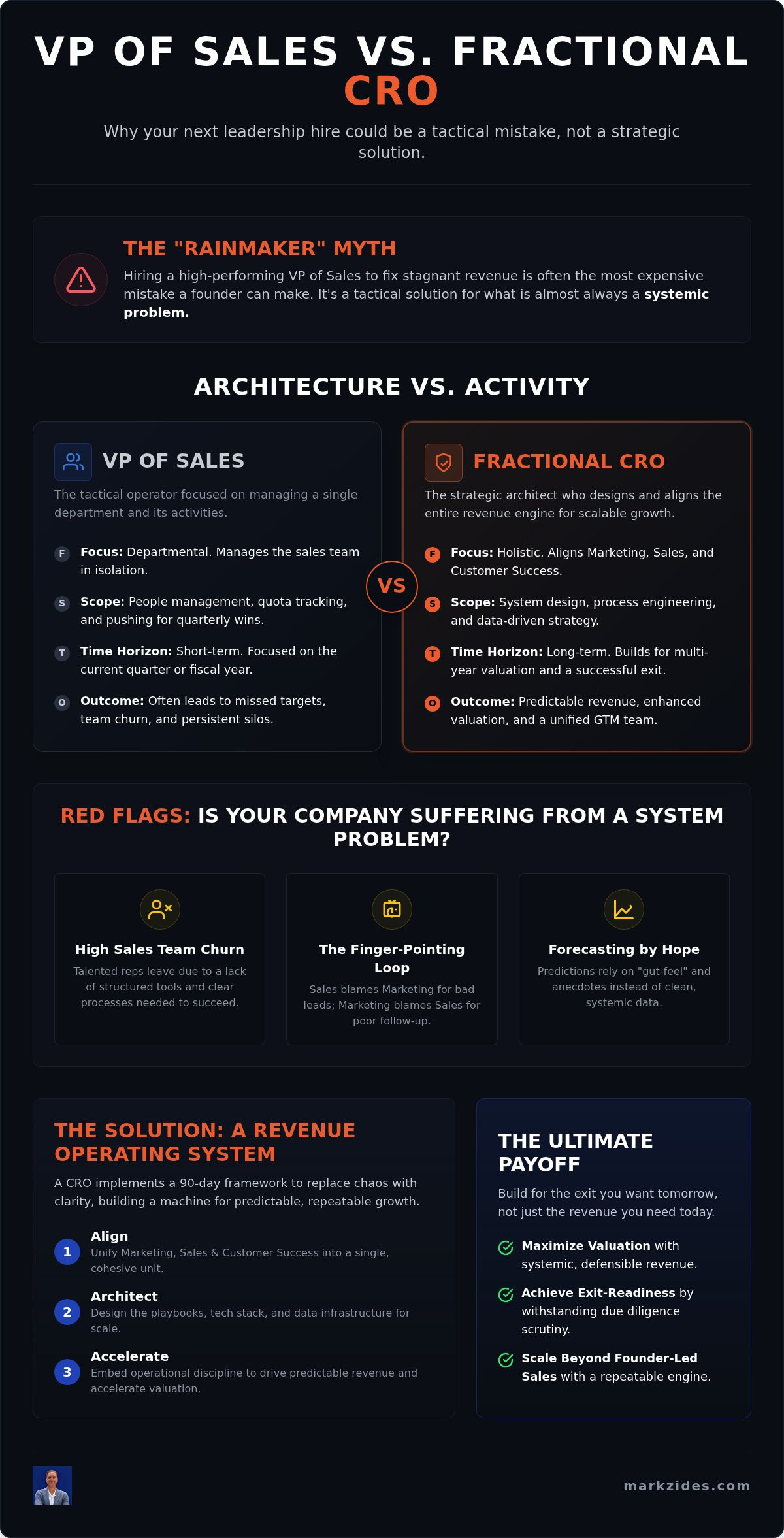
VPs of Sales are tactical operators. They manage people, track quotas, and push for the quarterly "win." While essential in a mature company, this activity-based management is dangerous in a pre-scale environment where the sales motion hasn't been proven. A Fractional CRO acts as a strategic architect. They don't just look at the sales floor; they align marketing, sales, and customer success into a single, cohesive unit. The Revenue Operating System serves as the definitive antidote to tactical chaos by embedding repeatable mechanics into every stage of the customer lifecycle.
Symptoms of a Premature VP Hire
Identifying a mismatch early can save your company from a death spiral. Look for these specific red flags in your organization:
- High sales team churn: Talented reps leave because they lack the structured tools and clear processes required to hit their numbers.
- The finger-pointing loop: Sales blames Marketing for "bad leads" while Marketing blames Sales for "poor follow-up," signaling a lack of departmental alignment.
- Forecasting by hope: Your revenue predictions rely on "gut-feel" and anecdotal updates from reps rather than clean, systemic data-driven RevOps.
If these symptoms sound familiar, you don't have a talent problem. You have a system problem. Hiring a tactical manager to fix a structural flaw is like painting a house with a crumbling foundation; it might look better for a month, but the collapse is inevitable. Understanding when to hire a fractional CRO is the critical first step toward diagnosing whether your organization is facing a structural systems failure rather than a simple talent gap.
VP of Sales vs. Fractional CRO: A Structural Comparison
If you view a Chief Revenue Officer as merely a "supercharged" VP of Sales, you're fundamentally miscalculating the structural needs of a high-growth organization. While a VP of Sales focuses almost exclusively on the sales department, a CRO operates across the entire revenue lifecycle. Choosing a fractional CRO instead of VP of sales allows a business to bridge the gap between marketing, sales, and customer success, creating a unified front that drives valuation. This isn't just about closing more deals; it's about engineering a system where every dollar spent on customer acquisition (CAC) is optimized by a corresponding increase in lifetime value (LTV).
A VP of Sales is typically hired to manage people and hit quarterly quotas. Their time horizon is short, often limited to the current fiscal year. In contrast, a Fractional CRO designs for the long term. They focus on multi-year valuation and exit strategy, ensuring that the revenue generated is high-quality, recurring, and systemic. By opting for a fractional model, you gain access to this C-suite expertise at a fraction of the cost of a full-time executive. This allows you to deploy capital more efficiently toward execution and demand generation while the architect builds your foundation.
Defining the Scope of Influence
A VP's scope is often limited to the sales floor. A CRO, however, architects the entire ecosystem. This includes Sales Enablement, where the focus shifts from telling reps to "work harder" to providing them with the exact playbooks and tools they need to win. It also encompasses Demand Generation, ensuring that top-of-funnel marketing efforts are perfectly aligned with sales execution. Finally, a CRO builds Partnerships and Alliances, creating indirect revenue streams that most tactical VPs overlook because they don't produce immediate, direct-sales "wins."
Metrics That Matter: Quotas vs. Unit Economics
Success for a VP is measured in bookings. Success for a CRO is measured in net retention and unit economics. While a VP might push for any deal to hit a number, a CRO ensures that the deals signed are the right ones for long-term health. This requires a robust RevOps framework to create a "single source of truth" for the board, replacing anecdotal updates with hard data. Understanding the fractional CRO vs full time CRO trade-offs is essential when deciding how to structure your leadership team. If you're ready to move from tactical management to strategic architecture, exploring fractional revenue leadership is your next logical step toward a predictable, exit-ready engine.
The Revenue Operating System: Architecture Over Activity
Scaling a sales team without a solid foundation is a recipe for expensive failure. If you hire a VP of Sales to "figure it out," you're essentially outsourcing your strategy to someone hired for execution. Scaling a mess only creates a bigger, more expensive mess. A Strategic Architect understands that architecture must precede headcount. By choosing a fractional CRO instead of VP of sales, you ensure that you aren't just adding bodies to a broken process, but rather building a foundation that makes growth inevitable.
The 90-day Revenue Operating System framework provides a structured path from chaos to clarity. Within this window, the focus shifts from "gut-feel" updates to high-precision forecast accuracy. You stop guessing which deals will close and start relying on a repeatable revenue engine. This methodology replaces the anxiety of the quarterly scramble with the calm of a disciplined, data-driven Go-To-Market (GTM) strategy. It transforms your revenue from a series of lucky breaks into a predictable construction project.
Building the Sales Execution Engine
A true execution engine doesn't depend on individual heroics or the charisma of a single "closer." It relies on designing repeatable sales processes that any competent rep can follow to achieve success. This involves embedding sales enablement tools that actually get used by the team rather than sitting idle in your tech stack. For those in high-growth technology sectors, implementing a fractional CRO for SaaS is the most efficient way to move beyond founder-led sales and establish a professional, scalable operation.
Integrating Demand Gen and Marketing
The traditional divide between "leads" and "revenue" is where growth goes to die. A Fractional CRO bridges this gap by aligning top-of-funnel demand generation with boots-on-the-ground sales execution. This alignment creates a sustainable sales funnel that scales alongside the business, ensuring every marketing dollar is working toward the same objective. A CRO ensures marketing ROI is measured strictly by the volume and velocity of closed-won deals rather than surface-level vanity metrics. When marketing and sales operate as a single system, the path to the next level of performance becomes clear and unobstructed.
Transitioning from Founder-Led Sales to Scalable Engines
Most founders are the best salespeople their company will ever have. That is exactly the problem. Your personal network, charisma, and deep product knowledge are enough to reach the first million in revenue, but they're impossible to replicate across a growing team. This is the Founder's Dilemma: the very traits that fueled your early success now act as a bottleneck for scale. Choosing a fractional CRO instead of VP of sales ensures that your unique intuition is translated into a repeatable Revenue Operating System that works even when you aren't in the room.
The transition from founder-led sales to a systemic engine requires a methodical, four-step blueprint. First, we audit the current "system" to identify where the founder is manually bridging gaps in the process. Second, we codify the sales playbook, turning abstract knowledge into a documented sequence for new hires. Third, we implement a RevOps tech stack that provides the board with real-time visibility rather than anecdotal updates. Finally, we hire the tactical team. By waiting to add headcount until the architecture is designed, you avoid the high cost of hiring AEs into a vacuum of leadership. Recognizing the specific operational triggers that signal when to hire a fractional CRO can mean the difference between a stalled engine and a scalable, exit-ready asset.
Removing the Founder from the Day-to-Day
Delegation is not abdication. To step out of the daily sales grind without losing the "founder's touch," you must embed your brand voice into the sales execution playbooks. This process often requires executive coaching to help a founder transition from a primary operator to a strategic leader. We establish accountability through data-driven KPIs that measure leading indicators, not just lagging results. When you have a single source of truth, you can manage the outcomes without needing to micromanage every individual conversation.
Scaling the Team: When to Add Headcount
Hiring more AEs into a broken system is a waste of capital. If your sales motion isn't repeatable, adding more people only increases your burn rate without a guaranteed lift in performance. The fractional approach allows you to build a full-time sales bench under the guidance of a Strategic Architect who understands the broader organizational mechanics. To understand how these roles interact with your existing structure, read our guide on where does chief revenue officer fit in business functions. If you are ready to stop being the only person who can close a deal, partner with an operator who can build your engine.
Maximizing Valuation: Exit Readiness and Fundraising
Investors do not buy potential; they buy predictability. When venture capitalists or private equity firms conduct due diligence, they look for systemic revenue that exists independently of any single individual. A VP of Sales often creates a "hero culture" where revenue is tied to their personal performance or a few key relationships. Choosing a fractional CRO instead of VP of sales signals to the market that your organization is built on a professional architecture. A Strategic Architect ensures that your RevOps stack is clean, your data is verifiable, and your growth is a result of a repeatable engine rather than a series of lucky breaks.
Proving predictability is the fastest way to increase your company's valuation. While a tactical manager focuses on the current month's bookings, a CRO designs partnership and alliance strategies that act as a competitive moat. These indirect revenue streams diversify your income and demonstrate to investors that your business can scale through multiple channels. By the time you reach the due diligence process, your revenue systems should be so well-documented that they become a primary asset of the company, not just a byproduct of daily activity.
The 90-Day Exit Readiness Audit
The path to a successful fundraise or acquisition begins with a rigorous 90-day audit of your revenue systems. We identify hidden "revenue leaks" in your customer journey that decrease your total valuation. This process involves optimizing your unit economics, specifically the LTV/CAC ratio, to ensure your business model meets the benchmarks required for a high-multiple exit. We build a clear roadmap that replaces "gut-feel" projections with a history of structured, data-driven performance. If your systems are transparent and your growth is predictable, you enter negotiations from a position of absolute strength.
Positioning for the Next Level
Founders who win are those who know when to bring in specialized expertise. Mark Zides acts as a battle-tested mentor for leadership teams navigating high-stakes growth environments. The transition from a fractional leader to a full-time executive is a strategic handoff that occurs once the foundation is fully established. We ensure that the Revenue Operating System is embedded into the culture of the company before a permanent hire is ever made. To start building a business that is truly exit-ready, schedule a strategy session to audit your revenue architecture. Stop hiring for the problems you have today and start architecting the exit you want tomorrow.
Build for the Exit, Not the Quarter
Building a scalable company requires you to stop chasing individual closers and start architecting a repeatable engine. Choosing a fractional CRO instead of VP of sales provides the structural discipline needed to align your marketing, sales, and customer success teams into a single, cohesive unit. You don't need more activity. You need better architecture.
Through battle-tested mentorship for founders and the implementation of a 90-Day Revenue Operating System, we replace gut-feel anxiety with the calm of predictable growth. This approach doesn't just hit targets; it optimizes your unit economics and prepares your organization for a high-multiple exit or fundraise. By focusing on exit readiness and valuation optimization today, you ensure your business is attractive to investors tomorrow. It's about moving from founder-led chaos to a systemic machine that operates with precision.
Scale your revenue with a Strategic Architect—Explore Fractional CRO Services
Your path to the next level of performance is a construction project, not a gamble. Let's build something that lasts.
Frequently Asked Questions
What is the main difference between a VP of Sales and a CRO?
A VP of Sales is a tactical leader focused on managing the sales team and hitting quarterly quotas. A Chief Revenue Officer (CRO) is a structural leader responsible for the entire revenue lifecycle, including marketing, sales, and customer success. While the VP manages people and activity, the CRO designs the architecture that ensures that activity is repeatable, scalable, and profitable.
When is the right time to hire a fractional CRO instead of a VP of sales?
The right time to hire a fractional CRO instead of VP of sales is when your revenue growth plateaus despite having a solid product. If your marketing and sales teams operate in silos or you are struggling to move beyond founder-led sales, you need a strategic architect. This hire ensures your foundation is built for scale before you commit to the high cost of a full-time executive.
Can a fractional CRO really manage my sales team part-time?
Yes, because their primary objective is to build systems that run without constant manual intervention. A fractional CRO doesn't micromanage every sales call; instead, they embed a Revenue Operating System that provides clear playbooks and accountability frameworks. They empower your existing managers with data-driven KPIs, allowing the team to execute at a high level through disciplined processes rather than constant supervision.
How much does a fractional CRO cost compared to a full-time VP of sales?
A fractional CRO typically costs a fraction of the total employment cost of a full-time VP of Sales. When you factor in the base salary, bonuses, benefits, and significant equity required for a full-time hire, the fractional model is far more capital-efficient. This allows you to access C-suite expertise while preserving your budget for demand generation and sales execution.
Will a fractional CRO help with our upcoming fundraising round?
Absolutely. A fractional CRO specializes in fundraising and exit readiness by transforming anecdotal updates into verifiable, systemic data. Investors prioritize predictable revenue engines over "hero-led" sales performance. By optimizing your unit economics and cleaning up your RevOps stack, a CRO directly increases your company's valuation during due diligence for a capital raise or acquisition.
What should I look for when hiring a fractional CRO?
Look for a battle-tested operator who prioritizes architecture over activity. You need someone with a proven track record of transitioning companies from founder-led sales to scalable engines. Ensure they have a documented methodology, such as a 90-day framework, and deep expertise in cross-functional alignment. They should speak the language of unit economics and valuation, not just lead volume and closing techniques.
How long does it take to see results from a fractional CRO engagement?
You should expect to see structural improvements within the first 30 days and a fully embedded Revenue Operating System within 90 days. While top-line revenue growth depends on your specific sales cycle, the clarity in your funnel and the accuracy of your forecasting will improve almost immediately. The goal is to establish a predictable engine that accelerates valuation over the long term.
Do I still need a VP of Sales if I have a fractional CRO?
Not necessarily. In many high-growth environments, a fractional CRO provides the strategic leadership while existing sales managers handle the daily tactical execution. Once the revenue engine is repeatable and you reach a specific headcount, you might hire a full-time VP to manage the team under the CRO's established architecture. The CRO builds the blueprint; the VP manages the construction crew.
Ready to build a revenue engine that runs without you?
Mark works alongside founders as a player-coach — not a slide deck.
Book a 30-minute call