
2026 Guide: Hyperscaler Co-Selling with AWS, Azure & GCP

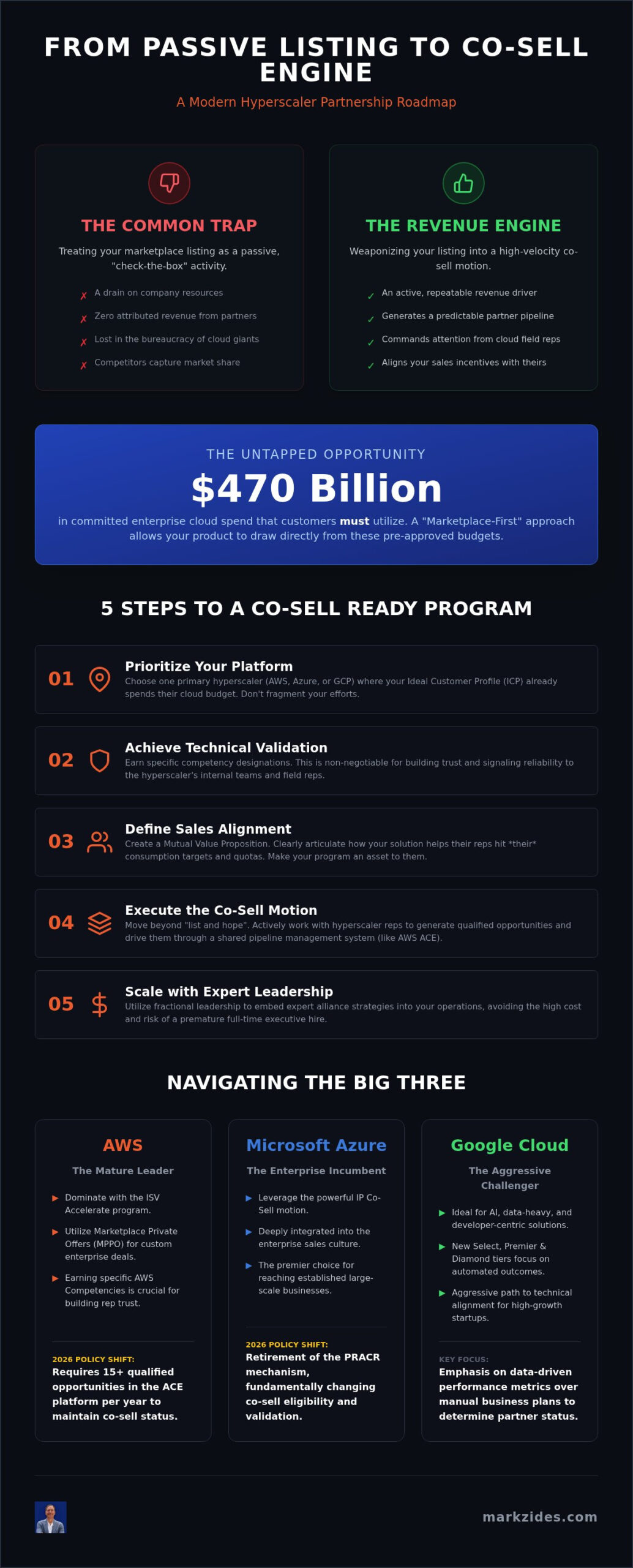
A marketplace listing is not a strategy. It's a drain on your resources if you don't know how to weaponize it. Most executives treat their presence on AWS, Azure, or GCP as a "check-the-box" activity, yet they're surprised when their B2B partnership program development efforts result in zero attributed revenue. You've likely felt the frustration of navigating complex partner portals only to get lost in the bureaucracy of cloud giants while your competitors tap into the $470 billion in committed enterprise cloud spend.
It's a common trap. You're following the manual but failing the alignment test because you aren't speaking the language of the hyperscaler's field sales team. This guide transforms that dynamic. You'll learn how to pivot from a passive listing to a high-velocity co-sell engine that commands attention from cloud reps. We'll examine the critical 2026 policy shifts, including the retirement of Microsoft's PRACR mechanism and the new AWS ACE validation requirements. By the end, you'll have a repeatable motion to capture "cloud commit" budgets and a clear roadmap to reach the tiers that actually drive growth.
Key Takeaways
- Stop treating cloud marketplaces as passive catalogs and learn to weaponize them as active revenue drivers.
- Align your internal sales incentives with hyperscaler field reps to ensure your B2B partnership program development efforts generate a repeatable pipeline.
- Navigate the 2026 program shifts, including the retirement of Microsoft's PRACR and new AWS ACE requirements, to protect your co-sell eligibility.
- Adopt a structured five-step framework for technical integration and executive alignment to move beyond the "list and hope" phase.
- Utilize fractional leadership to embed expert alliance strategies into your operations, avoiding the high cost of premature executive hires.
What is a Hyperscaler Partnership Strategy?
Hyperscalers are no longer just infrastructure providers; they are the gatekeepers of enterprise procurement. If you are building a modern SaaS business, your B2B partnership program development must center on these giants. Hyperscale computing environments, dominated by Amazon Web Services (AWS), Microsoft Azure, and Google Cloud Platform (GCP), have moved beyond simple hosting. They have become massive commerce engines where enterprise buyers consolidate their spending and simplify their vendor stacks.
The traditional reseller model, where third-party vendors simply moved licenses for a margin, is dead. In 2026, the motion is cloud-native and ecosystem-driven. Enterprises have committed nearly $470 billion in cloud spend that they must utilize. A "Marketplace-First" approach allows your product to draw directly from these pre-approved budgets. This effectively bypasses the friction of new vendor setup and lengthy legal reviews. Just as navigating other specialized regulatory landscapes requires precision, you can find out more about managing corporate compliance in complex industries. Your objective is simple: align your revenue systems with their consumption models to accelerate your own growth.
The Evolution of Indirect Revenue
The old world of referral fees for a lead is dying. Modern B2B partnership program development focuses on integrated co-sell motions where the hyperscaler is a strategic sales partner. Cloud marketplaces have become the procurement standard because they offer a single invoice for all software needs. Buyers utilize their committed "cloud credits" to purchase your SaaS, which fundamentally changes the sales conversation. You aren't just selling a tool; you're helping the customer maximize their existing financial commitments to their cloud provider.
Key Components of a Hyperscaler Strategy
Success requires moving past the "list and hope" mentality of a passive marketplace presence. You need co-sell readiness, which is a state of operational maturity. This involves two critical pillars:
- Technical Validation: Earning specific competency designations that signal trust and reliability to the hyperscaler's internal teams.
- Sales Alignment: Defining a Mutual Value Proposition (MVP) that resonates with the hyperscaler's field reps.
If you cannot explain how your software helps an AWS or Azure rep hit their specific consumption targets, they won't help you close deals. It's a game of sales-incentive alignment. You must design your program to be an asset to their quota, not a distraction from it. When you align your product's value with the hyperscaler's revenue goals, you transform from a vendor into an essential part of their ecosystem.
Navigating the Big Three: AWS, Azure, and Google Cloud
Strategic B2B partnership program development demands that you prioritize one hyperscaler before attempting to scale across all three. While AWS, Azure, and GCP appear similar on a feature sheet, their sales cultures and procurement mechanisms differ wildly. AWS is the mature, high-volume leader. Microsoft Azure is the enterprise incumbent. Google Cloud is the aggressive challenger for AI and data-heavy workloads. Attempting to master all three simultaneously without a dedicated team often leads to fragmented results and zero revenue attribution. You must choose a primary partner where your Ideal Customer Profile (ICP) already spends their cloud budget.
Google Cloud Platform (GCP) has recently revamped its structure into Select, Premier, and Diamond tiers. Their focus is on automated customer outcomes rather than manual business plans. This reflects the shift toward The New Alliances where data-driven performance metrics dictate partner status. GCP is currently the ecosystem of choice for high-growth startups that need to leverage advanced AI and developer-centric tools to gain a market edge. If your product relies on heavy data processing or machine learning, GCP provides the most aggressive path to technical alignment.
AWS Partner Network (APN) Dynamics
AWS remains the mature choice for SaaS providers. To reach the top of the stack, you must navigate the ISV Accelerate program. In 2026, AWS requires partners to demonstrate at least 15 qualified opportunities in their ACE platform over a 12-month period. This isn't just paperwork. It's a measure of your sales team's ability to co-sell with AWS reps. You should also utilize AWS Marketplace Private Offers (MPPO) to create custom pricing for enterprise clients. Earning specific AWS Competencies is the only way to build lasting trust with field reps who are protective of their accounts.
Microsoft and the IP Co-Sell Motion
Microsoft Azure wins on enterprise connectivity. Most Azure partnerships are won or lost within the "Enterprise Agreement" (EA). By transacting through the Azure Marketplace, you help customers draw down their Microsoft Azure Consumption Commitment (MACC). This makes you a hero to the Microsoft Account Executive. However, the rules changed on July 1, 2026. Microsoft retired the PRACR mechanism. Marketplace transactions are now the only way to earn co-sell credit. If you're unsure how to pivot your sales motion to meet these new requirements, fractional CRO services can help align your team with these shifting mandates. You must ensure your sales team knows how to identify MACC-eligible accounts to prioritize your outreach effectively.
The Co-Sell Motion: Moving Beyond Passive Marketplace Listings
A marketplace listing is not a strategy; it's a digital tombstone. In 2026, simply "listing and hoping" is a guaranteed recipe for zero ROI. High-velocity growth requires an active co-sell motion where your sales team and the hyperscaler's field reps operate in lockstep. This is the core of effective B2B partnership program development. You must move from being a name on a portal to becoming a strategic asset that helps cloud reps hit their specific consumption targets.
Cloud reps are primarily incentivized by "Cloud Commit" draw-downs. When an enterprise customer spends their pre-committed budget on your software through the marketplace, the rep gets credit toward their quota. If you don't understand this mechanism, you'll never earn their attention. Building a partnerships and alliances strategy that cloud reps actually value means proving that your solution accelerates their deal cycles and increases the customer's overall cloud footprint.
Account Mapping and Overlap Analysis
Strategic alignment starts with data, not dinner. You must identify exactly where your prospect list overlaps with the hyperscaler's existing footprint. Modern operators use tools like Crossbeam or Reveal to automate this analysis. This allows you to find "warm" cloud accounts where the customer already has a massive committed spend. Focus on the "Give-to-Get" ratio. If you only ask for leads without providing intelligence or new opportunities back to the cloud rep, the relationship will stall. You need to bring a specific account plan to the table that shows exactly how a joint pursuit benefits both parties.
The Mutual Value Proposition (MVP)
Your marketing one-pager is likely useless for a cloud rep. They don't care about your software's user interface; they care about how it drives higher cloud consumption. Your MVP must be rep-facing. It should highlight three things: how your software burns their cloud credits, how it simplifies the procurement process through the Marketplace, and why it makes the customer "stickier" to their specific cloud platform. If you can simplify a rep's life by removing procurement friction, they will become your most effective external sales force. This alignment is the difference between a stagnant partnership and a repeatable revenue engine.
5 Steps to Developing Your Hyperscaler Partnership Program
Strategy without execution is an expensive hallucination. Successful B2B partnership program development requires a methodical build-out that aligns your internal operations with the hyperscaler's massive sales machine. You cannot skip steps. If you attempt to engage the field before your technical integration is seamless, you will burn your reputation with the very reps you need to win. Following a structured roadmap ensures you build a system that is both scalable and attractive to future acquirers.
Establishing the Foundation
Step 1: Internal Readiness and Executive Alignment. You must secure a mandate that treats the marketplace as a core revenue driver, not a side project. If your leadership team views this as a "marketing experiment," you won't have the resources to survive the ramp-up. Step 2: Technical Integration and Marketplace Onboarding. This involves more than just a listing; you must ensure your software is transactable and integrated into the hyperscaler's billing systems. Allocating a specific budget for a B2B channel sales strategy is critical for long-term sustainability. Setting realistic 12, 24 month revenue expectations prevents premature abandonment of the channel.
Execution and Field Engagement
Step 3: Creating the Co-Sell "Battlecard". This document must speak to the rep's incentives, not just the product features. Step 4: Field Engagement and Regional Pilot Programs. Conduct a "Partner Day" at a specific regional office to build personal relationships with Account Executives. Standardizing how to build a channel partner program allows you to replicate these regional successes globally. Step 5: Operationalizing and Scaling. Automate your deal registration and reporting to remove friction. This maturity level significantly increases your company’s exit readiness by demonstrating a diversified, indirect revenue stream.
Effective B2B partnership program development turns your business into a high-growth asset that operates with surgical precision. If you are ready to stop guessing and start scaling, our Partnerships & Alliances Strategy services provide the battle-tested blueprint you need to win.
Scaling Partnership Revenue with Fractional Leadership
Hiring a $250,000-a-year Head of Partnerships before you have a validated co-sell motion is a common, expensive mistake. Most organizations fall into the "Big Hire" trap, assuming a senior executive will magically build the infrastructure they lack. In reality, you end up with a high-priced strategist who has no systems to manage. Effective B2B partnership program development requires an architect first, not just a manager. You need someone to design the machine before you hire a full-time operator to run it.
This is where fractional CRO services become a strategic lever. A fractional leader provides the battle-tested blueprint for hyperscaler alignment without the long-term liability of a heavy executive salary. They bridge the gap between high-level alliance strategy and the granular execution required to move deals through the AWS or Azure pipeline. By embedding a proven framework into your sales culture, you ensure that your partnership efforts are focused on revenue, not just "logo soup" on a slide deck.
Building these systems is also a critical component of exit readiness. Acquirers and VCs look for diversified revenue streams that aren't solely dependent on expensive direct sales. A robust, indirect channel through cloud marketplaces signals a mature, scalable business model. It proves that your product has market pull within the most significant technology ecosystems on the planet. Transition to a full-time team only after your fractional leader has proven the repeatable nature of the co-sell motion.
The Operator Advantage
Guessing is not a strategy. An expert operator replaces "gut-feel" with a structured Revenue Operating System. This ensures every partnership activity is tracked, measured, and optimized for conversion. You need VC-ready data that shows exactly how your B2B partnership program development contributes to your pipeline velocity and customer lifetime value. If your data is messy, your valuation will suffer. A fractional approach cleans up the operational debt before you scale.
Next Steps: From Strategy to Revenue
Don't wait for the market to move without you. Start with a cold-eyed audit of your current cloud marketplace presence. Identify the low-hanging fruit within your existing customer base where a marketplace transaction could simplify a renewal or an upsell. If you're ready to stop experimenting and start building a predictable revenue engine, contact Mark Zides for a strategic partnership roadmap. We provide the expertise you need to navigate the Big Three and turn your alliances into your most powerful growth channel.
Master the Hyperscaler Ecosystem
The shift toward cloud-native procurement is an operational reality you can no longer ignore. Success in 2026 requires more than a marketplace presence; it demands deep alignment with hyperscaler sales incentives and a repeatable co-sell motion. By transitioning from a passive catalog entry to a proactive partner, you unlock access to billions in committed enterprise spend. This level of B2B partnership program development is the difference between a stagnant channel and a high-velocity revenue engine.
You don't need a massive headcount to build this infrastructure. As a Strategic Architect with deep operational experience, Mark Zides provides the fractional CRO expertise and proven methodology required for hyperscaler alignment. We help you design the systems that turn alliances into predictable pipelines while maintaining the lean efficiency of a high-growth firm. Replace gut-feel guessing with a structured approach that drives measurable indirect revenue.
Ready to scale your indirect revenue? Book a strategy session with Mark Zides.
The roadmap to marketplace dominance is clear. Now it's time to execute.
Frequently Asked Questions
What is the difference between a cloud marketplace listing and a co-sell partnership?
A marketplace listing is a passive storefront where customers can buy your software, while a co-sell partnership is an active sales alignment. In a co-sell model, your sales team works in lockstep with hyperscaler reps to share leads and pursue mutual accounts. Listing is merely the technical prerequisite for transacting; co-selling is the strategic motion that actually drives repeatable revenue.
How much does it cost to build a hyperscaler partnership program?
Your primary costs involve technical integration labor and marketplace transaction fees, which are typically 3% for public offers and as low as 1.5% for large private renewals. You must also budget for partnership management. You can optimize these costs by utilizing fractional leadership instead of a full-time executive hire, which keeps your burn rate low while you validate the channel's ROI.
Do I need a technical integration before I can start co-selling with AWS or Azure?
Yes, technical validation is a mandatory requirement for most primary co-sell programs. For example, AWS requires a transactable marketplace listing and a history of qualified opportunities in their ACE platform before you can join the ISV Accelerate program. Hyperscalers won't put their reputation on the line with their enterprise customers unless your solution is technically vetted and ready for deployment.
How do cloud consumption commitments (MACC/EDP) affect my sales cycle?
Consumption commitments like Microsoft's MACC or AWS's EDP significantly accelerate your sales cycle. These programs allow enterprise buyers to use pre-approved cloud budgets to purchase your SaaS, which effectively bypasses the friction of new vendor setup and lengthy procurement reviews. If you align your product with these "cloud credits," you're tapping into funds that the customer is already contractually obligated to spend.
Can a startup realistically get attention from a hyperscaler sales team?
Startups get attention by proving they can drive "cloud burn" in high-priority accounts. Cloud reps prioritize partners who help them hit their consumption quotas. If your niche software makes an enterprise customer "stickier" to their specific cloud platform, the rep will advocate for you. Focus on a specific vertical where your B2B partnership program development can provide a clear competitive advantage for the hyperscaler's field team.
What metrics should I use to measure the success of a hyperscaler strategy?
Measure success through Partner-Originated Pipeline, Marketplace Transaction Volume, and the number of joint customer wins. In B2B partnership program development, the most critical metric is the percentage of total revenue attributed to co-sell motions. You should also track your time-to-close for marketplace deals compared to direct sales to prove the efficiency of the channel to your board.
Is it better to partner with all three hyperscalers or focus on one?
Focus on one primary hyperscaler until you establish a repeatable revenue motion. Each platform has unique bureaucratic hurdles, technical requirements, and sales cultures. Spreading your resources across AWS, Azure, and GCP simultaneously often leads to fragmented results. Once you've mastered the co-sell motion with your primary partner, you can then export that blueprint to the other two platforms.
How does a fractional CRO help with partnership development?
A fractional CRO acts as a Strategic Architect to design your partnership machine without the $250,000 annual overhead of a full-time hire. They implement battle-tested systems for revenue operations and ensure your data is VC-ready for future fundraising. This model provides the high-level expertise needed to navigate the Big Three while keeping your organization lean and focused on sustainable growth.
Ready to build a revenue engine that runs without you?
Mark works alongside founders as a player-coach — not a slide deck.
Book a 30-minute call