
When to Hire a Fractional CRO: 2026 Strategic Guide

Your current revenue plateau isn't a sales team problem; it's a structural systems failure that no amount of founder hustle can fix. You've successfully navigated the early stages through sheer intuition and grit, but now you're facing burnout and inaccurate forecasts that stall your momentum. It's a hard truth to accept: the gut-feel approach that got you to this level is the very thing holding you back from the next. Knowing exactly when to hire a fractional CRO is the strategic difference between a stalled engine and a scalable, exit-ready asset.
We understand the frustration of seeing marketing and sales teams working in silos while your customer acquisition costs continue to climb. You don't need another consultant to give you a slide deck; you need a strategic architect to embed a professional revenue operating system into your organization. This 2026 guide identifies the specific operational triggers that signal it's time to move beyond founder-led sales. We'll detail the path to predictable growth, repeatable sales engines, and the strategic alignment across all GTM functions required for a high-valuation future.
Key Takeaways
- Learn to replace fragmented silos with a unified Revenue Operating System that aligns every GTM function for rapid, sustainable scale.
- Identify the specific operational triggers, like the founder-led sales plateau, that signal exactly when to hire a fractional CRO to protect your growth.
- Distinguish between tactical sales management and holistic revenue strategy to ensure you're hiring for long-term valuation rather than just short-term wins.
- Prepare for high-stakes fundraising or exits by professionalizing your data room with accurate forecasts and repeatable revenue engines.
- Follow a structured 90-day blueprint to move from an initial operational audit to a fully embedded, data-driven sales system.
Understanding the Role of a Fractional Chief Revenue Officer in 2026
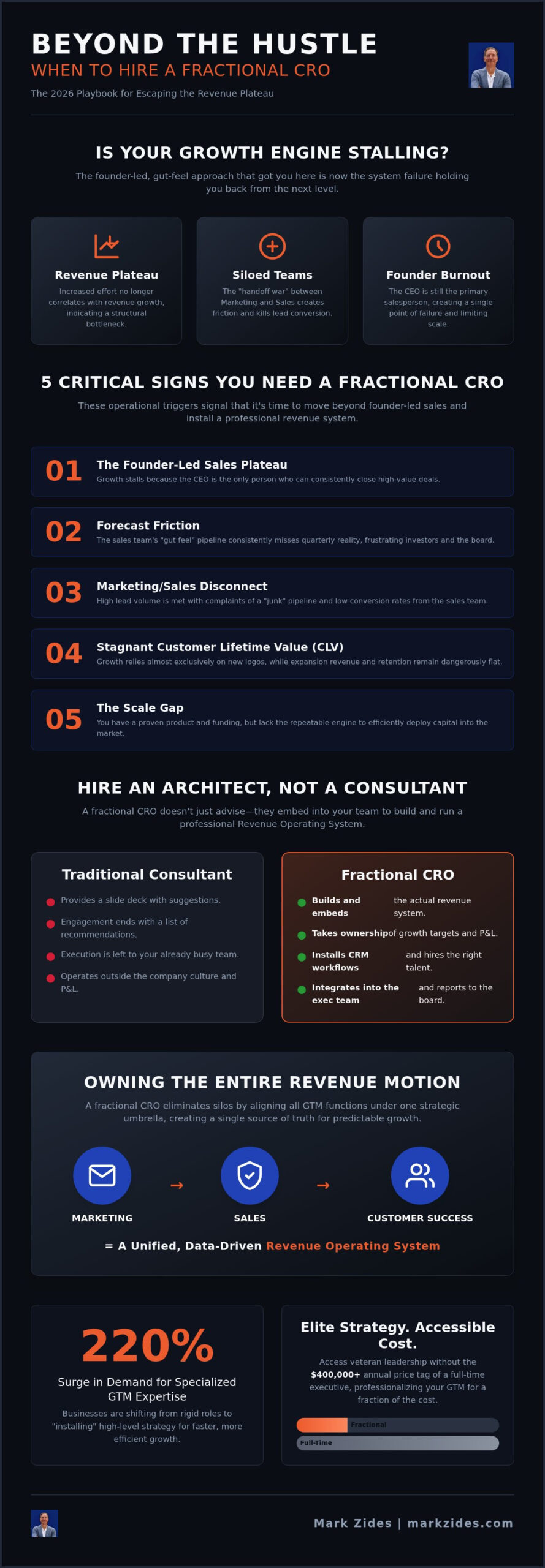
The traditional executive hiring model has reached a breaking point. By 2026, mid-market firms have realized that growth doesn't require a permanent, seven-figure executive suite to achieve professional results. Instead, they're turning to a hybrid leadership model where high-level strategy is "installed" rather than just hired. A fractional Chief Revenue Officer (CRO) serves as the strategic architect of this shift. They aren't just part-time advisors; they're battle-tested operators who provide the structural blueprint for your entire revenue engine. This model allows companies to access elite GTM (Go-To-Market) expertise without the $400,000 annual price tag of a full-time veteran. Understanding when to hire a fractional CRO starts with recognizing that your revenue isn't a collection of departments; it's a single, continuous motion that requires a unified system to scale.
In the current environment, the demand for specialized expertise has surged by 220% as businesses move away from rigid, role-based hiring. You're no longer looking for a manager to watch the clock. You're looking for an architect to design a repeatable, data-driven machine. While a traditional sales leader focuses on the "close," the fractional CRO focuses on the entire lifecycle. They bridge the gap between marketing, sales, and customer success, ensuring that every dollar spent on lead generation translates into predictable, long-term valuation.
Fractional CRO vs. Traditional Sales Consulting
Consultants provide a deck; fractional CROs build and embed the actual revenue operating system. This is a critical distinction. A consultant's engagement usually ends with a list of suggestions that your team may or may not have the capacity to execute. In contrast, a fractional leader joins your executive team. They take ownership of growth targets and P&L performance. They don't just suggest a better sales process; they install the CRM workflows, hire the right talent, and report directly to your board. They are integrated into the culture, providing accountability that no project-based consultant can match.
The Core Responsibility: Owning the Entire Revenue Motion
The most significant failure in growth-stage companies is the "handoff war" between marketing and sales. Marketing claims they've delivered leads; sales claims those leads are low quality. A fractional CRO eliminates this friction by aligning all GTM functions under one strategic umbrella. They establish a single source of truth for revenue data, replacing "gut feel" with forensic accuracy. By designing a system where customer success informs marketing and sales fuels retention, they create a feedback loop that lowers customer acquisition costs and accelerates the path to exit readiness.
5 Critical Signs Your Business Needs Fractional Revenue Leadership
Recognizing the transition point from startup grit to enterprise excellence is the hallmark of a disciplined leader. Many CEOs hit a wall where increased effort no longer correlates with revenue growth. This plateau is usually the primary indicator of when to hire a fractional CRO. You aren't failing; you're simply outgrowing your current infrastructure. When the systems that got you to $5M in revenue start to fracture at $10M, you need an architect, not just more sales reps. Here are the five definitive signals that your business has reached this inflection point:
- The Founder-Led Sales Plateau: Growth has stalled because the CEO is still the only person capable of closing high-value deals.
- Forecast Friction: The sales team's "gut feel" regarding the pipeline consistently misses the quarterly reality, leaving the board frustrated.
- Marketing/Sales Disconnect: You're seeing high lead volume from marketing, but the sales team characterizes the pipeline as "junk" with low conversion rates.
- Stagnant Customer Lifetime Value (CLV): Growth is coming almost exclusively from new logos, while expansion revenue and retention remain dangerously flat.
- The Scale Gap: You have a proven product and adequate funding, yet you lack a repeatable engine to efficiently deploy that capital into the market.
The Scale Gap is the point where tactical execution can no longer compensate for a lack of strategic architecture. If you find your team working harder but achieving diminishing returns, the underlying system is the bottleneck.
Breaking the Founder-Led Sales Cycle
Relying on the CEO's charisma to drive revenue creates a single point of failure that significantly devalues your company. During the fundraising or exit process, this "tribal knowledge" is viewed as a massive risk by investors. Transitioning this knowledge into a documented, repeatable sales process is non-negotiable for exit readiness. You must learn how to build a sales team without founder-led selling to ensure the business survives your eventual transition. A fractional leadership model provides the senior-level oversight needed to build this independence without the overhead of a full-time hire.
Identifying Inefficient Customer Acquisition Costs (CAC)
Many founders try to "spend their way out" of a growth plateau by increasing marketing budgets. However, if your demand generation isn't aligned with sales execution, you're just accelerating waste. A fractional CRO audits the entire revenue motion to identify where the friction lies, lowering CAC by increasing lead velocity and conversion accuracy. If you're ready to replace intuition with a structured, data-driven engine, exploring fractional CRO services can provide the operational clarity required to scale efficiently.
Fractional CRO vs. Full-Time VP of Sales: Choosing Your Strategic Hire
Hiring the wrong leader at the wrong stage is an expensive mistake that can set your growth back by eighteen months. Many founders confuse a high-performing VP of Sales with a strategic revenue leader. While both roles are essential, they solve entirely different problems. A VP of Sales is a tactical manager designed to lead a team through a defined playbook. A CRO is a strategic architect who builds the playbook itself. Deciding when to hire a fractional CRO versus a full-time VP depends on whether you need someone to run the race or someone to build the track. For a deeper dive into the metrics, review our Fractional CRO vs Full Time CRO: The ROI and Execution Comparison for 2026.
Don't fall into the "interim" trap. A temporary manager merely keeps the seat warm, maintaining existing momentum without addressing underlying structural flaws. A fractional architect, however, rebuilds the engine. They identify revenue leakage, align fragmented departments, and install a repeatable operating system that survives their departure. If your current challenge is a lack of process rather than a lack of effort, a tactical hire will only accelerate your existing inefficiencies.
Strategic Architecture vs. Tactical Management
VPs of Sales manage people; CROs design the systems those people use to win. A VP of Sales often fails when asked to fix marketing or partnership silos because their expertise is rooted in closing, not cross-functional alignment. They are coaches focused on individual performance. In contrast, a CRO is an engineer focused on the entire GTM machine. When choosing your next leader, ask yourself: Do you need a coach to motivate the reps, or an engineer to fix the pipeline? If you're struggling with high customer acquisition costs or siloed data, a tactical manager won't have the tools to solve the problem.
The Cost Efficiency of the Fractional Model in 2026
The financial reality of 2026 makes the fractional model an undeniable strategic advantage. A full-time executive hire often carries a $300,000 to $450,000 annual burden when you factor in base salary, bonuses, and equity. This is a high-stakes gamble on an unproven leader. Research shows that a fractional executive can cost 40% to 60% less than a full-time VP, with typical annual costs ranging from $90,000 to $300,000. This model provides a "try before you buy" period, allowing you to assess long-term executive fit while receiving immediate senior-level output. You gain the expertise of a veteran operator without the long-term liability of a heavy executive contract. To understand why this shift is happening, read about why a Fractional CRO Instead of VP of Sales is often the smarter move for growth-stage firms.
Preparing for High-Stakes Events: Fundraising and Exit Readiness
High-stakes financial events require a level of operational precision that most founder-led businesses simply don't possess. If you're planning a Series B round or eyeing an acquisition within the next 18 to 24 months, that is the definitive moment when to hire a fractional CRO. Investors and acquirers don't just buy your current revenue; they buy the predictability of your future growth. A fractional leader professionalizes your "Data Room" by replacing fragmented spreadsheets with forensic, system-generated data. They ensure that when a Private Equity firm or Venture Capitalist looks under the hood, they see a repeatable machine rather than a series of heroic, one-off sales efforts.
Valuation is directly tied to the reliability of your forecast. A business that hits its numbers through a structured system is worth significantly more than one that relies on a founder's charisma. By installing a professional revenue operating system, a fractional CRO builds the institutional confidence required to defend a premium valuation during due diligence. They eliminate the "founder dependency" risk that often leads to heavy earn-outs or discounted offers.
Building Predictable Revenue for VC Due Diligence
Investors look for a "Revenue Cascade" rather than random wins. This means showing a clear, documented path from lead generation to closed-won deals. A fractional CRO takes ownership of this narrative, defending the GTM strategy during high-stakes board meetings and due diligence calls. They provide the strategic architecture that proves your growth is a choice, not a lucky streak. Exit Readiness is the state where a business remains high-performing after the original architect departs. Achieving this state is the ultimate goal of any strategic revenue engagement.
Optimizing the Revenue Operating System for Maximum Valuation
Clean data is the foundation of a successful exit. A fractional CRO audits your CRM to ensure attribution models accurately prove marketing ROI and sales velocity. By implementing a 90-day revenue operating system, they can show immediate trajectory shifts that demonstrate the business is primed for scale. Additionally, they leverage partnerships and alliances strategy, particularly with hyperscalers, to show massive market reach without a proportional increase in headcount. This structural efficiency is exactly what high-level acquirers look for in 2026. If you're ready to maximize your company's value, it's time to professionalize your revenue engine for exit readiness.
How to Implement Fractional Leadership for Scalable Growth
Transitioning from the "why" to the "how" requires a disciplined framework. You've identified when to hire a fractional CRO; now you must integrate them effectively to avoid wasting the investment. This isn't a passive engagement where you wait for reports. It's a high-velocity partnership where the CEO provides the vision and the CRO provides the operational architecture. For the engagement to succeed, the fractional leader must have the authority to break down silos and the access required to audit every facet of your GTM motion.
Accountability in a fractional model is measured through forensic precision. You aren't paying for a warm body in a seat; you're paying for a specific set of outcomes. Success looks like a 20% improvement in forecast accuracy or a measurable reduction in customer acquisition costs within the first two quarters. This level of impact is only possible when the fractional CRO collaborates deeply with both the CEO and the CMO, ensuring that demand generation and sales execution are two halves of the same coin.
The First 30 Days: The Revenue Audit
The first month is about uncovering the "leaky bucket" in your current funnel. Every organization has hidden friction points that drain revenue, whether it's a breakdown in lead routing or a lack of sales enablement materials. By interviewing key stakeholders and auditing the tech stack, the CRO identifies exactly where the system is failing. This phase is essential for creating the Fractional CRO Services: The Strategic Blueprint for Scaling Revenue in 2026 that will guide the rest of the engagement.
Days 31-90: Embedding the Revenue Operating System
Moving into the second phase, the focus shifts from diagnosis to construction. The CRO begins standardizing sales execution and ensuring that your enablement tools actually support the reps in the field. They align demand generation with the new sales process, establishing a weekly cadence for pipeline reviews and forecast updates that replaces "gut feel" with data. This period is where the tribal knowledge of the founder is finally converted into a repeatable, scalable engine.
Eventually, the system should become robust enough to support a permanent hire. The transition from fractional to full-time typically occurs when the revenue engine is predictable enough to justify the long-term executive overhead. By then, the fractional CRO has already built the track; your full-time hire just needs to run the race. If you're ready to stop guessing and start scaling, the implementation of a professional revenue system is your next logical step.
Architecting Your Path to Predictable Revenue
The transition from founder-led sales to a professionalized revenue engine is the most critical pivot your business will ever make. By now, you recognize the triggers for when to hire a fractional CRO, from stagnant pipelines to the "Scale Gap" that stalls even the best products. You've seen that success isn't about working harder; it's about designing a system where marketing, sales, and alliances work in perfect alignment. Whether you're preparing for a high-stakes exit or simply tired of inaccurate forecasts, the solution lies in structured accountability and strategic architecture.
Mark Zides brings the discipline of a battle-tested operator to your leadership team. With a proven track record in building repeatable sales pipelines and a deep specialization in exit readiness, he ensures your revenue engine is a high-valuation asset rather than a liability. From leveraging hyperscaler alliances to professionalizing your data room for VC due diligence, the goal is sustainable, scalable growth. Don't let operational friction dictate your ceiling. Schedule a Strategic Revenue Audit with Mark Zides today and turn your revenue motion into a predictable machine. Your next level of growth is waiting.
Frequently Asked Questions
What is the difference between a fractional CRO and a sales consultant?
A fractional CRO is an embedded executive, not an external advisor. While a consultant delivers a strategy deck and leaves, a fractional leader takes ownership of the GTM outcomes. They integrate into your leadership team, manage your people, and are accountable for the P&L. It's the difference between receiving a blueprint and hiring a site foreman to build the structure.
How much does it cost to hire a fractional CRO in 2026?
The cost is significantly lower than a full-time executive hire, typically saving a business 40% to 60% in total compensation. You avoid the heavy burden of equity grants, high base salaries, and signing bonuses. This model allows you to deploy capital into lead generation and sales talent while still accessing top-tier strategic leadership. It's a high-ROI alternative for companies navigating growth plateaus.
How many hours a week does a fractional CRO typically work?
Engagements are generally structured around one to two days per week. The specific cadence depends on your organizational complexity and the urgency of your growth targets. Some leaders work in dedicated blocks to audit systems, while others maintain a consistent weekly presence to lead pipeline reviews. This flexibility ensures you're paying for strategic impact rather than just time spent in a chair.
Can a fractional CRO help with fundraising and VC due diligence?
Professionalizing your data room is a core function of the role. A fractional CRO ensures your revenue data is forensic, your forecasts are accurate, and your GTM strategy is defensible during due diligence. This level of operational maturity is exactly what investors look for when assessing risk. By removing founder dependency, they help maximize your valuation and streamline the entire fundraising process.
Will a fractional CRO manage my existing sales and marketing teams?
Yes, they provide unified leadership across all GTM functions. They eliminate the "handoff war" between marketing and sales by aligning both teams under a single revenue operating system. This ensures that every marketing dollar spent translates into a high-quality sales opportunity. You'll see better collaboration and clearer accountability once a professional revenue leader is at the helm.
When should I transition from a fractional CRO to a full-time hire?
Transition when your revenue engine becomes predictable and your growth justifies a permanent, heavy executive contract. This usually happens once the fractional architect has built the repeatable systems and the business has scaled to a point where a five-day-a-week presence is essential. A common trigger for when to hire a fractional CRO is reaching a stage where you need to maintain momentum rather than build the initial machine.
Do fractional CROs work with startups or established mid-market companies?
Both, though the most impact is seen in companies with at least $3M in annual revenue. Startups with significant funding use fractional leaders to build their initial sales engine. Mid-market firms use them to fix broken systems or prepare for an exit. If your business is complex enough to require strategic alignment but not yet ready for a heavy executive salary, the fractional model is a fit.
What industries benefit most from fractional revenue leadership?
B2B technology, SaaS, and professional services benefit most from this model. These industries often face complex sales cycles and high customer acquisition costs that require sophisticated revenue systems. Any business where marketing, sales, and customer success must work in perfect sync to drive growth will see a high ROI. Knowing when to hire a fractional CRO in these sectors can prevent costly churn and stalled expansion.
Ready to build a revenue engine that runs without you?
Mark works alongside founders as a player-coach — not a slide deck.
Book a 30-minute call