
How to Build Rapport: Strategic Connection Guide 2026

Only 3% of buyers say they trust the person selling to them. This staggering lack of confidence isn't just a social hurdle; it's a structural leak in your revenue engine. If your team views building rapport as a "soft skill" or a collection of scripted pleasantries, you're likely battling bloated sales cycles and persistent friction between your sales and marketing departments. You know that forced engagement often feels fake, yet without a genuine connection, your strategic initiatives stall before they even reach the board.
You're right to demand more than just "getting along." True rapport is a strategic architecture designed to bridge the trust gap and accelerate high-stakes decision making. This guide promises to transform connection from an intuitive "gut-feel" into a repeatable system for sales execution and leadership alignment. We'll examine the methodology for embedding trust into your organizational mechanics, allowing you to lead with more influence and shorten sales cycles through disciplined, human-centered systems. It's time to stop guessing and start scaling through operational excellence.
Key Takeaways
- Redefine rapport as "Predictable Trust," moving beyond social pleasantries to create a psychological bridge necessary for high-stakes C-suite collaboration.
- Leverage the science of mirror neurons and active listening to turn every interaction into a high-value data collection exercise rather than just a polite exchange.
- Distinguish between tactical quick-hits for discovery calls and the strategic building rapport required for long-term enterprise partnerships and alliances.
- Deploy a disciplined 5-step framework for C-suite engagement, utilizing "Pre-Flight" research and a 60-second "Contextual Opening" to establish immediate operator credentials.
- Integrate connection into your Revenue Operating System by transforming rapport from an intuitive "gut-feel" into a repeatable Standard Operating Procedure (SOP).
What is Building Rapport? Redefining Connection for the C-Suite
Rapport is the psychological bridge that transforms a cold prospect into a strategic collaborator. It is the specific moment where skepticism yields to cooperation. In the high-stakes business environment of 2026, Rapport serves as the foundation of Predictable Trust. This isn't about social harmony or being "nice." It's about creating a stable, structured platform for high-velocity decision-making. When trust is predictable, the anxiety of the unknown disappears, replaced by the clarity of a shared objective.
The 2026 landscape is defined by a growing crisis of insularity. Current data indicates that 7 in 10 people are hesitant or unwilling to trust those with different values or backgrounds. If your team relies on transactional selling, they'll hit a wall of resistance. The market has shifted toward consultative partnership, where the ability to bridge this trust gap is a survival skill. You must move from being a vendor to being a Strategic Architect of your client's success. This requires a sharp distinction between being liked and being trusted. Being liked is a social byproduct; being trusted is a professional requirement for any strategic advisor. One is a preference, the other is a mandate for execution.
The ROI of Rapport in Revenue Operations
Effective building rapport directly accelerates the Sales Velocity equation by reducing friction at every stage of the funnel. When trust is established early, buyers are 2 to 3 times more likely to share the critical context you need to close the deal. This data allows you to tailor solutions with precision, effectively shortening the sales cycle. Internal rapport is equally vital for organizational health. It aligns sales and marketing teams, replacing "gut-feel" friction with a unified revenue system that scales. Within the framework of fractional CRO services, rapport serves as a strategic asset that embeds operational discipline and accelerates growth across the entire organization.
Rapport vs. Small Talk: Avoiding the 'Weather' Trap
Generic ice-breakers are a liability when dealing with C-suite executives. Asking about the weather or weekend plans signals that you lack professional depth and value for their time. Executives are impatient with inefficiency. They don't want a new friend; they want an expert operator who understands their specific pain points and can provide a blueprint for improvement.
Strategic building rapport requires a deliberate transition from social chatter to Professional Alignment. You establish authority by leading with insights rather than questions. Consider these tactical shifts:
- Identify a specific industry challenge or regulatory shift before the call begins.
- Connect that challenge directly to their current operational goals or revenue targets.
- Demonstrate through your vocabulary that you've been in the trenches and understand the high-stakes energy of their role.
This insight-led approach proves you're a peer, not a solicitor. It replaces empty talk with immediate professional value, setting the stage for a repeatable system of connection that drives revenue.
The Psychology of Connection: How to Build Rapport Scientifically
Connection is not a matter of luck. It's a biological event. To master building rapport, you must understand the Mirror Neuron System. These neurons fire both when we act and when we observe someone else acting. In a professional setting, this means your physiological state directly influences your prospect. If you are anxious, they feel tension. If you are focused and calm, you create a space for collaboration. You are effectively "hacking" the brain's social circuitry to establish a baseline of comfort.
Active listening is often taught as a social courtesy. That's a mistake. For the expert operator, it is a high-speed data collection tool. High-performing salespeople listen more than they talk, often maintaining a 70/30 split. This isn't about waiting for your turn to speak. It's about identifying the specific business logic behind a prospect's pain. When you use powerful strategies for building rapport, you leverage the Similarity-Attraction effect. You find authentic commonalities, such as shared operational philosophies or industry battle scars, to signal that you are part of the same tribe. Cognitive Empathy takes this further. It's the ability to understand a prospect's business pain as if it were your own. You aren't just feeling their stress; you're analyzing the structural failures causing it.
Non-Verbal Cues in a Digital-First World
In 2026, the "Camera Protocol" is your first impression. Eye contact in a virtual room means looking at the lens, not the screen. This small adjustment signals presence and authority. Vocal Mirroring is another critical layer. Calibrate your pace and tone to match the prospect. If they speak quickly and with urgency, dragging your speech will create friction. Reading the "Digital Room" requires monitoring micro-expressions. A slight frown or a lean away from the screen is a data point that demands a tactical pivot. These signals are the blueprints of the conversation.
The Power of Vulnerability in Leadership
Perfection is a barrier to trust. Admitting a "Strategic Gap" or a past failure can actually build more rapport than a polished facade. This is known as the Pratfall Effect. Competent leaders who show a minor flaw are perceived as more likable and trustworthy than those who appear flawless. It humanizes the executive presence. Mastering these nuances often requires executive coaching for sales leaders to ensure vulnerability is used as a tool, not a weakness. If you want to refine these interpersonal systems, engaging with a professional mentor can accelerate your progress.
Tactical vs. Strategic Rapport: Choosing Your Approach
Connection is a spectrum, not a single point of entry. To master building rapport in a high-growth environment, you must distinguish between the immediate needs of a discovery call and the long-term architecture of an enterprise alliance. Tactical rapport is about speed and alignment. It utilizes the non-verbal cues and mirroring techniques discussed previously to lower a prospect's guard in the first fifteen minutes. If you fail here, the conversation never moves past the surface. Strategic rapport, however, is about durability. It is the process of embedding yourself into the client's decision-making framework as a permanent fixture rather than a temporary vendor.
There are moments when traditional rapport must be discarded for "Challenge-Based" connection. In 2026, C-suite leaders are often insulated by their own internal biases. If you only agree with them, you aren't providing value. Disrupting their status quo with a well-timed, insight-led provocation can build a deeper level of respect than constant agreement. However, you must avoid the "Over-Rapport" trap. When you become too friendly, you risk losing your authority as an expert operator. Only 3% of buyers trust salespeople; if you prioritize being liked over being a source of stable, predictable results, you validate that skepticism and effectively kill the deal.
Building Rapport in High-Stakes Sales
In complex buying committees, you aren't just connecting with one person. You're navigating a web of competing interests. Moving from a vendor to a strategic partner requires you to find the "Value-Based" common denominator that aligns every stakeholder. This is where your credentials as a seasoned peer matter most. By demonstrating a deep understanding of their structural friction, you position yourself as the architect of their solution. This level of sophisticated connection is a core component of the work done by a business coach for entrepreneurs, where scaling requires moving beyond founder intuition into disciplined systems.
Rapport in Internal Leadership and Scaling
Internal building rapport is the lubricant for your Revenue Operating System. High-growth teams often suffer from "Founder-Led" fatigue, where the initial energy of the startup has been replaced by the chaos of unscaled processes. Your role as a leader is to build a repeatable system for connection that survives in a remote-first environment. This isn't about virtual happy hours. It's about creating professional alignment through clear accountability and shared objectives. When you scale rapport internally, you eliminate the friction between sales and marketing, ensuring that every department is moving toward the same fixed point of success with clarity and urgency. For organizations ready to move beyond this bottleneck, scaling beyond founder-led sales requires embedding these same trust-building principles into an autonomous revenue system that operates without constant founder intervention.
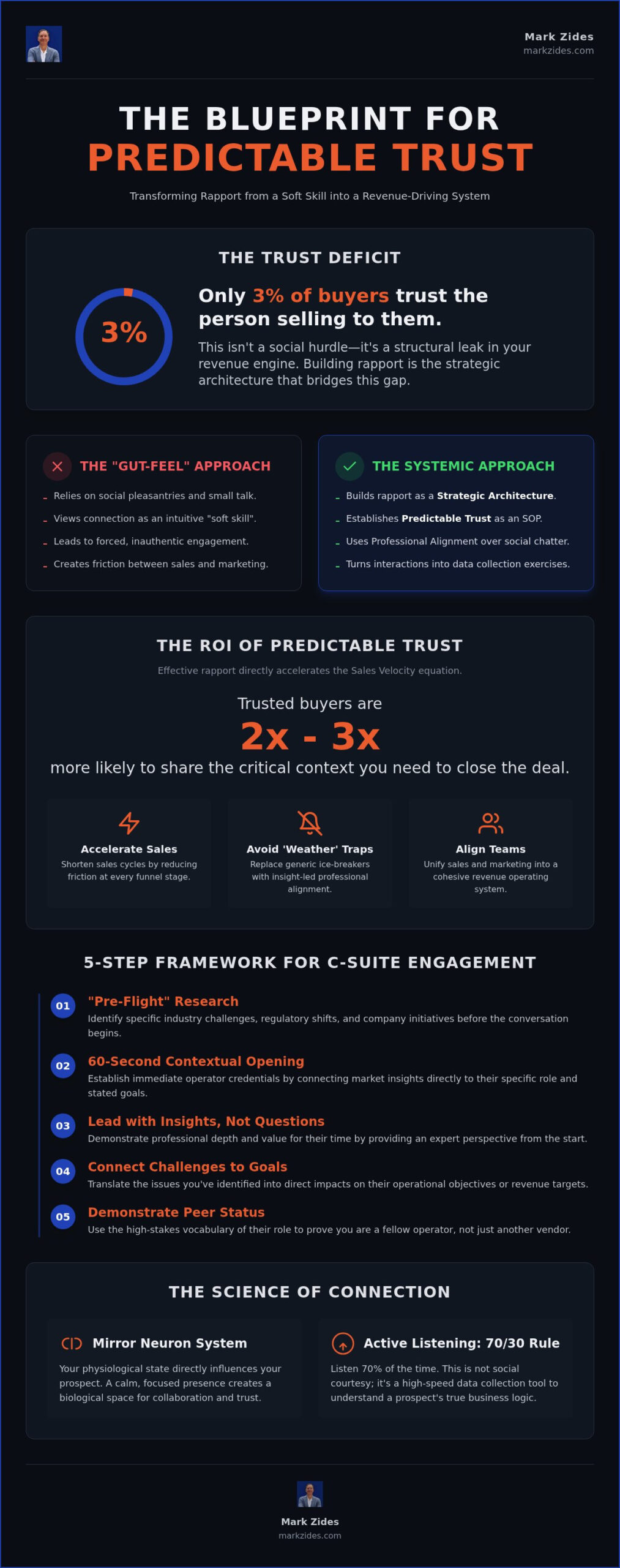
A 5-Step Framework for Building Rapport with C-Suite Decision Makers
Building rapport with a CEO isn't about finding common ground; it's about proving you're worth the time. C-suite executives are constantly bombarded by transactional requests, making them highly sensitive to wasted minutes. If you want to penetrate this level of leadership, you must replace social pleasantries with a disciplined framework for professional alignment. This isn't a "soft" process. It's a high-stakes operational sequence designed to establish immediate authority and predictable trust.
- Step 1: The 'Pre-Flight' Research. Use public data and professional histories to find authentic commonalities. Don't look for hobbies. Look for shared operational philosophies or past industry challenges.
- Step 2: The 'Contextual Opening'. You have 60 seconds to establish your operator credentials. Start with a specific insight about their business that proves you've done the work.
- Step 3: The 'Curiosity Pivot'. Transition into high-level strategic questions. These should demonstrate deep empathy for their structural pain rather than a desire to pitch a product.
- Step 4: The 'Active Validation'. Confirm that you understand their friction better than they do. Use their own terminology to mirror the complexity of their environment.
- Step 5: The 'Mutuality Close'. Align your goals with their specific success metrics. If they win, you win. This creates a foundation for a long-term partnership rather than a one-off sale.
The 'Research-First' Approach to Connection
Authentic connection starts long before the meeting begins. Scouring professional data platforms and public filings allows you to identify the "Hidden Pain" that corporate PR often masks. You aren't looking for trivia; you're looking for the structural gaps in their revenue engine. When you lead with this knowledge, you signal that you are a peer who understands the high-stakes energy of their role. Engaging in CEO coaching for revenue growth helps leaders master this framework, ensuring that every interaction is backed by a scalable revenue operating system.
Asking 'High-Yield' Questions
The quality of your building rapport is determined by the quality of your questions. Transactional sellers ask about budget. Strategic partners ask how a specific project impacts 2026 exit readiness or market positioning. Use open-ended structures to let the executive feel heard, then deploy the "Echo Technique." By repeating a key strategic phrase they've used, you deepen the conversation without being intrusive. This proves you are listening with the intent to solve, not just the intent to reply. It transforms a standard meeting into a collaborative strategy session.
If you're ready to move beyond "gut-feel" sales and build a repeatable system for connection, explore our Fractional CRO Services to accelerate your revenue execution.
The Zides Method: Integrating Rapport into Your Revenue Operating System
Rapport is the interpersonal layer of your Revenue Operating System. It cannot be left to chance or personality. If connection is accidental, your revenue is accidental. The Zides Method treats building rapport as a rigorous Standard Operating Procedure (SOP). This means defining exactly how your team identifies pain, validates stakeholder concerns, and establishes authority in every interaction. We move connection from the "gut-feel" of a talented individual to a repeatable system that the entire organization can execute.
Stop handing your team scripts. Scripts create "fake" interactions that C-suite buyers detect instantly. Instead, train them for strategic connection. This involves embedding the psychological frameworks of active listening and mirror neurons into their daily cadence. A Fractional CRO ensures that this isn't just a sales tactic but a core leadership competency modeled from the top down. When the executive team leads with predictable trust, the rest of the organization follows. It creates a culture where every meeting is a deliberate step toward a defined objective.
You can't manage what you don't measure. In a disciplined system, rapport is tracked through specific KPIs that signal deal health:
- Deal Velocity: High-rapport deals move through the funnel significantly faster because trust eliminates the "stalling" caused by skepticism.
- Champion Sentiment: Are your internal advocates using your vocabulary to sell the solution to their own board?
- Context Sharing: Are prospects providing deep, non-public data early in the discovery cycle?
Building a Culture of Strategic Connection
Institutionalizing empathy isn't about feelings; it's about alignment. When marketing and sales share a unified view of the customer's structural pain, your demand generation becomes more precise. This synergy is essential for a robust Partnerships and Alliances Strategy. Connection is the glue that turns a vendor-client relationship into a long-term enterprise asset. It ensures that every touchpoint, from the first ad to the final exit readiness check, feels like a continuous conversation with a trusted advisor.
Next Steps: Auditing Your Connection Strategy
It's time for a no-nonsense evaluation. Is your team building "Social" rapport based on trivial commonalities, or "Strategic" rapport based on business outcomes? Gut-feel relationships are a liability in a high-growth environment. You need forecastable trust. Audit your current sales execution and identify exactly where the trust gap is slowing your growth cycles. If your revenue engine is stalling due to friction or a lack of predictable trust, you need a blueprint for excellence. Optimize your sales execution with a fractional CRO and transform your connection strategy into a scalable system for success.
Architecting Your Future Through Predictable Trust
In 2026, the gap between a successful exit and a stalled sales cycle is measured by the strength of your professional alignment. We've moved beyond the era of surface-level pleasantries into a landscape where building rapport is a disciplined, scientific requirement for revenue execution. By shifting from social "liking" to "Predictable Trust," you replace the anxiety of uncertain outcomes with the stability of a repeatable system. You've mastered the 5-step framework and the neurobiology behind connection; now you must embed these methodologies into your organizational DNA.
Transitioning from gut-feel intuition to operational excellence requires a battle-tested blueprint. Whether you need a Fractional CRO for high-growth SaaS or executive coaching for visionary founders, the objective is scaling through precision. Ready to scale your revenue operations? Connect with Mark Zides today. We provide the sales execution strategies and mentorship required to turn human connection into a forecastable revenue engine. Your next level of performance is no longer a matter of luck; it's a matter of architecture.
Frequently Asked Questions
What is the fastest way to build rapport with a new client?
The fastest route to connection is demonstrating immediate professional value through "Pre-Flight" research. Skip the generic ice-breakers and lead with a specific insight about their industry or operational friction. This proves you've done the work and establishes you as a peer rather than a solicitor. When you lead with value, you bypass the skepticism that usually stalls new relationships.
Can you build rapport effectively over Zoom or Microsoft Teams?
Yes, but it requires a disciplined "Camera Protocol" to replace physical presence. You must maintain eye contact with the lens, not the screen, to signal engagement and authority. Use vocal mirroring to calibrate your pace and tone to the prospect's energy level. In a digital environment, these small physiological adjustments are the primary tools for building rapport and establishing trust.
Is mirroring actually effective, or does it feel manipulative?
Mirroring is a biologically grounded technique rooted in the brain's mirror neuron system. It only feels manipulative if it lacks authentic intent or professional substance. When used correctly, it creates a subconscious baseline of comfort that allows both parties to focus on strategic outcomes. It's a tool for alignment, not a trick for deception, and is essential for high-stakes negotiation.
How do you build rapport with someone who is being difficult or cold?
Deploy cognitive empathy to understand the structural logic behind their resistance. A "cold" prospect is often just an executive protecting their time or managing internal friction. Use a "Challenge-Based" approach to disrupt their status quo with a provocative, insight-led statement. This shifts the dynamic from a transactional struggle to a collaborative strategy session where you are the expert operator.
What is the difference between rapport and empathy in sales?
Rapport is the psychological bridge that enables connection, while empathy is the data that flows across it. Rapport creates the space for a conversation, but empathy allows you to understand the prospect's pain as if it were your own. You need rapport to get in the door, but you need empathy to design a solution that actually solves their structural failures.
How do you build rapport without being 'salesy' or pushy?
Focus entirely on professional alignment rather than a product pitch. High-level decision makers are repelled by scripted enthusiasm but attracted to expert operators who understand their revenue systems. If you prioritize solving their problems over closing a deal, the connection happens naturally. True building rapport feels like a consultation between peers, never a pursuit by a vendor.
Can building too much rapport actually hurt a sales deal?
Yes, "Over-Rapport" is a common trap that can erode your professional authority. If you become too friendly or agreeable, the prospect may view you as a social peer rather than a strategic advisor. This loss of distance makes it difficult to challenge their assumptions or hold them accountable during the closing process. You must maintain a professional distance to remain a trusted expert.
How do you teach a sales team to build better rapport?
Move your team away from scripted pleasantries and toward a repeatable Standard Operating Procedure (SOP). Training should focus on high-yield questioning and research-first engagement strategies. When you institutionalize connection as a core competency of sales execution, you replace "gut-feel" interactions with a disciplined system. This ensures that every team member can create predictable trust across the entire sales cycle.
Ready to build a revenue engine that runs without you?
Mark works alongside founders as a player-coach — not a slide deck.
Book a 30-minute call