Top of Funnel Lead Generation: The 2026 Executive Checklist for Scalable Growth

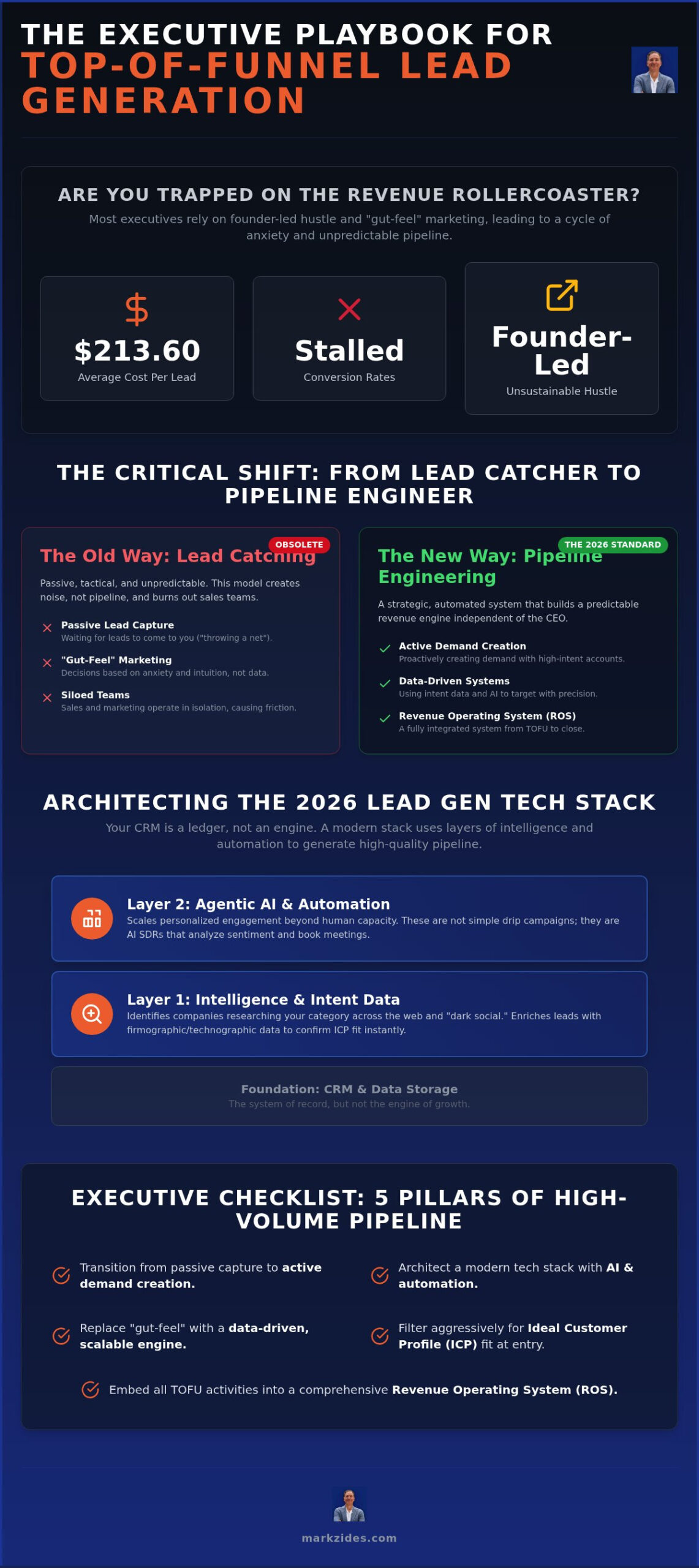
Top of funnel lead generation isn't a marketing campaign; it's a structural engineering project for your revenue engine. If you're still relying on founder-led hustle to fill the pipeline, you don't have a scalable business; you have a high-stakes job. Most executives are currently trapped on a revenue rollercoaster, watching the average cost per lead climb to $213.60 while conversion rates stall. It's a cycle of "gut-feel" anxiety that stems from sales and marketing silos and a lack of repeatable, automated systems.
You know that scaling requires more than just a higher volume of contacts. You need a predictable revenue operating system that delivers high-quality pipeline with or without the CEO's direct involvement. This article provides the strategic frameworks and operational checklists required to build a high-volume, high-quality engine that functions independently. We will preview the 2026 executive checklist, covering everything from AI-driven data enrichment to the operational alignment needed to drive down cost-per-qualified-lead metrics and accelerate your growth trajectory.
Key Takeaways
- Transition from passive lead capture to active demand creation by treating your top-of-funnel strategy as the primary entry point for a structured revenue system.
- Architect a modern tech stack that utilizes agentic AI and automation to deliver personalized engagement at a scale that was previously impossible for lean teams.
- Master the strategic frameworks for top of funnel lead generation to replace inconsistent "gut-feel" marketing with a data-driven, scalable engine that works independently of the CEO.
- Determine when to leverage outsourced lead generation as a force multiplier and when to maintain in-house operations to protect core intellectual property.
- Embed your lead generation activities into a comprehensive Revenue Operating System (ROS) to ensure high-volume interest aligns perfectly with bottom-of-funnel sales capacity.
What is Top of Funnel Lead Generation in a 2026 Revenue Operating System?
In 2026, the traditional view of the funnel as a passive filter is obsolete. Most executives still treat the top of the funnel as a net thrown into the ocean, hoping to catch anything that swims. This is a tactical error that leads to wasted spend and exhausted sales teams. Top of funnel lead generation is the strategic alignment of brand authority and data-driven targeting designed to initiate high-intent relationships within a scalable revenue system. It is the precise moment where market demand meets your operational infrastructure. If your lead volume is high but your pipeline is thin, you aren't growing; you're just making noise. True scale requires moving from "capturing" whatever traffic comes your way to "creating" specific demand among the accounts that actually matter.
The Core Objectives of Modern TOFU
Modern TOFU objectives have shifted from simple contact acquisition to strategic positioning. You must establish category authority long before a prospect enters a formal buying cycle. This requires filtering for your Ideal Customer Profile (ICP) fit at the very first point of entry. By doing so, you build a rigorous foundation for what is demand generation, ensuring that every dollar spent on awareness is an investment in future revenue. High-performing systems prioritize lead quality over raw numbers, treating the top of the funnel as a precision-weighted gateway rather than an open door.
From Lead Catching to Pipeline Engineering
The "spray and pray" models of 2020 have been replaced by high-intent engineering. In the broader context of Lead generation, the focus has moved toward identifying behavioral signals that indicate a readiness to engage. We no longer wait for leads to find us; we use agentic AI and intent data to embed our solutions exactly where the problems are being discussed. This proactive approach feeds the broader B2B demand generation strategy, turning a chaotic top-of-funnel into a disciplined, predictable engine. When you stop catching leads and start engineering pipeline, you remove the "gut-feel" anxiety that plagues inconsistent sales organizations. You replace it with a system that identifies, qualifies, and accelerates prospects with clinical precision.
Building the Infrastructure: The 2026 Lead Gen Tech Stack
A CRM is a ledger, not an engine. To scale top of funnel lead generation in 2026, you must architect a stack that prioritizes intelligence over storage. Your infrastructure needs layers that identify intent, enrich data in real-time, and automate engagement without sacrificing the human touch. If your systems aren't identifying prospects before they even hit your website, you're already behind the market leaders who use these tools to generate more top-of-funnel leads through predictive modeling. High-performance stacks now move beyond basic contact info, focusing on the behavioral signals that indicate a genuine buying window.
Intelligence and Intent Layers
The first layer of a modern stack is intent intelligence. You need to know which companies are researching your category on third-party sites and across "dark social" channels where traditional tracking fails. Real-time data enrichment is no longer optional; it's the filter that prevents your sales team from chasing low-value leads. By the time a lead reaches your revenue system, it should already be appended with firmographic and technographic data that confirms an Ideal Customer Profile fit. This level of precision ensures your TOFU efforts target decision-makers with the authority to move the needle, rather than just gathering clicks from curious browsers.
Automation and Outreach Tools
Automation in 2026 has evolved into agentic AI. We've moved past simple drip campaigns to AI SDRs that can handle initial inquiries and schedule meetings with clinical efficiency. These tools don't just send emails; they analyze prospect responses and adjust the cadence based on sentiment. To achieve maximum leverage, many executives are integrating their internal stack with B2B lead generation services to bridge the gap between technology and execution. This hybrid approach allows you to maintain high-volume outreach while ensuring that every sequence feels personalized and relevant to the recipient's specific business challenges.
Attribution and analytics must serve as the foundation for these activities. If you can't trace a closed-won deal back to the specific top-of-funnel trigger that created the interest, your spend is a gamble. Measuring revenue impact rather than vanity metrics like open rates or page views allows you to reallocate budget to the channels that actually fuel your pipeline. Aligning these tools requires a seasoned eye; consider how fractional CRO services can audit your current stack for hidden inefficiencies and help you build a more predictable revenue engine.
Strategic Resource Allocation: Outsourced vs. In-House Lead Generation
Deciding whether to build or buy your top of funnel lead generation engine is a critical inflection point for any scaling organization. Many founders remain tethered to the sales process, acting as the primary source of new deals. This creates a bottleneck that prevents the transition from a "hustle-based" company to a professionalized revenue system. If you want to scale, you must decide where your team's energy is best spent. In-house operations make sense when your sales cycle involves highly sensitive intellectual property or an extremely narrow, high-touch niche. For everything else, the operational burden of building a cold-start engine is often a distraction from your core mission.
The ROI of Outsourced Lead Generation
The true cost of an internal SDR team is often underestimated. You aren't just paying a salary; you're funding recruitment, management, and the expensive tech stack required to compete in 2026. Outsourced lead generation acts as a force multiplier by providing immediate access to elite playbooks and automation systems. It shaves months off your growth timeline by eliminating the typical three-month ramp-up period for new hires. You gain the ability to test markets and messaging with speed, allowing you to pivot based on data rather than gut-feel. This model replaces high fixed costs with a flexible, results-oriented investment that scales with your ambition.
The Fractional CRO Advantage
Even the best builders need a blueprint. Hiring a team without a strategic architect leads to silos and the "rollercoaster" revenue cycles that plague young companies. This is why fractional CRO services are essential for organizations moving beyond the founder-led stage. A fractional leader aligns your top-of-funnel volume with long-term goals like fundraising or exit readiness. They provide the discipline and accountability needed to professionalize your lead generation engine. By embedding professional leadership into your operations, you ensure that your resource allocation drives actual pipeline rather than just activity. You transition from a state of uncertainty to a structured environment where every lead is a deliberate step toward your next growth milestone.
The Executive TOFU Checklist: 10 Pillars of High-Volume Pipeline
A checklist is only as strong as its weakest link. To build a high-performance top of funnel lead generation engine, you need more than a list of tasks; you need a set of non-negotiable operational pillars that ensure every dollar spent translates into pipeline. If these pillars aren't embedded into your culture, your lead generation will remain a series of disconnected experiments rather than a predictable system. Discipline starts with the fundamentals of who you are targeting and why they should care.
- Pillar 1: ICP and Persona Crystallization. You must know if you are hunting the right whales. If your definition of a "good" lead is vague, your results will be equally inconsistent.
- Pillar 2: Content-Value Alignment. Every piece of content must solve a specific executive problem. If your TOFU material doesn't provide immediate utility, it's just noise.
- Pillar 3: Multi-Channel Distribution. Your audience doesn't live in a single silo. You must map your distribution to where they actually consume information, whether that's specialized industry forums or algorithmic social feeds.
- Pillar 4: Lead Scoring and Qualification Governance. Stop the "gut-feel" debates between sales and marketing. Establish hard data points that define when a lead is ready for human intervention.
- Pillar 5: Data Integrity and CRM Hygiene. The engine cannot run on dirty fuel. Regular audits of your database ensure that your automation tools are reaching real people with accurate titles.
Operational Execution Pillars
Execution is where strategy meets reality. Pillar 6 is the "Speed to Lead" rule; in 2026, responding within 5 minutes is the baseline for maintaining prospect interest. Pillar 7 requires rigorous feedback loops between sales and marketing to enforce a "No Junk" rule, ensuring that low-quality sources are cut immediately. The friction created when these feedback loops break down is precisely the problem that marketing and sales alignment consulting is designed to solve, replacing departmental silos with a unified revenue operating system. Finally, Pillar 8 focuses on tech stack integration. You must eliminate manual data entry by ensuring your intent signals, enrichment tools, and CRM are perfectly synchronized. If your team is still copy-pasting lead data, you aren't scaling.
Growth and Optimization Pillars
Once the foundation is stable, you must look for force multipliers. Pillar 9 involves leveraging a Partnerships and Alliances Strategy to generate indirect demand through trusted third parties. This allows you to tap into existing ecosystems and accelerate trust. Pillar 10 is the commitment to continuous A/B testing and revenue attribution. You should never stop questioning your best-performing channels. By measuring what actually drives closed-won deals rather than just clicks, you can reallocate resources with clinical precision. To see how these pillars fit into your specific growth stage, consider an audit of your current Outsourced Lead Generation workflows to identify hidden bottlenecks.
Beyond Tactics: Integrating TOFU into Your Revenue Operating System
Top of funnel lead generation is a liability if it exists in a vacuum. Most organizations fail because they treat awareness as a standalone marketing goal rather than an integrated component of a broader Revenue Operating System (ROS). If your lead volume exceeds your sales team's capacity to follow up with precision, you aren't scaling; you're creating operational debt. True growth requires a synchronized alignment where top-of-funnel volume matches bottom-of-funnel capacity. The CEO's role must evolve from being the primary lead generator to the clinical overseer of these systems. By shifting focus from the hustle of individual deals to the health of the engine, you prepare the organization for the scrutiny of fundraising or a high-value exit.
Building a predictable engine means moving beyond the "rollercoaster" of monthly performance. When sales and marketing operate in silos, the resulting friction creates inconsistent lead flow and high cost-per-lead metrics. An integrated ROS eliminates these silos by embedding accountability into every touchpoint, and investing in marketing and sales alignment consulting is one of the most direct ways to install that accountability across your GTM teams. It ensures that the high-quality interest generated at the top is nurtured through a disciplined sequence that leads directly to pipeline. This isn't just about better marketing; it's about designing a construction project where every brick supports the weight of your revenue goals.
Measuring What Matters to the Board
Boardrooms don't care about Marketing Qualified Leads (MQLs) or social engagement metrics that lack commercial intent. They care about Pipeline Contribution and the efficiency of your Customer Acquisition Cost (CAC). A robust TOFU engine reduces business risk for investors by providing a transparent and repeatable map of future revenue. When you can prove that a specific dollar amount invested at the top results in a predictable pipeline value at the bottom, your company valuation shifts from speculative to structural. You're no longer selling a product; you're selling a machine that produces revenue with clinical accuracy.
The Path Forward: Scaling with Precision
Scaling requires you to identify the specific bottleneck in your current revenue engine. It's rarely a lack of effort; it's usually a lack of alignment or a broken handoff between systems. If you're a founder ready to step out of the daily sales grind, you must replace your personal intuition with documented, automated processes that work while you sleep. This transition is the difference between a business that plateaus and one that reaches exit readiness. It's time to stop guessing and start building with the discipline of an expert operator. To begin professionalizing your engine and removing the burden of founder-led selling, schedule a revenue strategy session with Mark Zides today.
Architecting Your Scalable Revenue Engine
Scaling your organization requires a decisive move from the chaos of "gut-feel" marketing to the precision of a Revenue Operating System. You've seen that top of funnel lead generation is not just about raw volume; it's about building a repeatable infrastructure that filters for quality and operates independently of the CEO. By embedding the 2026 tech stack and the ten pillars of pipeline execution, you replace the revenue rollercoaster with a structured path toward sustainable growth.
The transition from founder-led selling to a professionalized engine is the most critical step toward exit readiness. It requires a strategic architect who understands how to align demand generation with long-term valuation goals. If you're ready to remove the bottlenecks holding your team back, it's time to implement a proven framework that delivers forecast accuracy and removes the burden of manual deal-finding. You can't rely on luck to hit your next milestone; you need a blueprint built for speed and accountability.
Scale your revenue with a Fractional CRO and Strategic Lead Gen to leverage a proven Revenue Operating System framework designed for fundraising and exit readiness. Let's design the engine that drives your next level of performance.
Frequently Asked Questions
How much should we spend on top of funnel lead generation?
Budget allocation depends on your target customer acquisition cost and desired growth velocity. While the average cost per lead across all industries has climbed to $213.60 in 2026, enterprise software companies often see qualified lead costs exceed $400. You should calculate spend based on your specific lifetime value (LTV) and the pipeline volume required to hit your revenue targets without compromising margins.
What is the difference between lead generation and demand generation?
Lead generation is the tactical process of capturing contact information for direct follow-up. Demand generation is a broader strategic framework designed to build category authority and brand desire before a prospect enters the sales cycle. One focuses on filling the database, while the other ensures the market understands your value proposition and actively seeks your solution.
Is outsourced lead generation better than building an in-house SDR team?
Outsourcing is often the superior choice for companies requiring rapid scale and specialized expertise without the overhead of internal management. It serves as a force multiplier by providing immediate access to elite tech stacks and proven playbooks. Building an in-house team makes sense only when your sales process requires deep, non-transferable technical knowledge or unique intellectual property protection.
How long does it take to see results from a new TOFU strategy?
You should expect to see behavioral intent signals within the first 30 days of implementing a new strategy. A fully professionalized pipeline typically requires 90 days to stabilize as feedback loops between sales and marketing refine the qualification process. Rapid wins often come from optimizing existing outbound sequences, while content-led demand creation requires a longer horizon to establish authority.
What are the most effective TOFU channels for B2B in 2026?
High-intent search ads and professional social platforms remain the primary drivers for traffic, though their costs continue to rise. High-performance teams are increasingly leveraging partnerships, alliances, and AI-driven data enrichment to identify prospects within a specific buying window. Success in 2026 requires a multi-channel approach that meets decision-makers where they consume "dark social" content and industry-specific insights.
How do we ensure lead quality doesn't drop as we scale volume?
Maintaining quality during a volume surge requires rigorous lead scoring and qualification governance. You must embed real-time data enrichment into your entry points to filter for Ideal Customer Profile fit automatically. By establishing a "No Junk" rule and tightening the feedback loop between sales and marketing, you ensure the engine only passes high-intent prospects to your closing team.
Can a fractional CRO help with top of funnel lead generation?
A fractional CRO is essential for architecting the systems that drive top of funnel lead generation. They provide the strategic leadership necessary to align marketing volume with sales capacity and long-term revenue goals. This expert oversight replaces "gut-feel" decision-making with a structured, predictable operating system that prepares your business for scaling, fundraising, or an eventual exit.
What metrics should a CEO track for top of funnel performance?
CEOs should ignore vanity metrics like clicks or impressions and focus on Pipeline Contribution and Sales Velocity. Track your cost per qualified lead (CPQL) and the conversion rate from initial touchpoint to discovery meeting. These figures provide a clinical view of your marketing efficiency and its direct impact on your company's valuation and long-term health.
Ready to build a revenue engine that runs without you?
Mark works alongside founders as a player-coach — not a slide deck.
Book a 30-minute call