
The 2026 Exit Readiness Checklist: Maximising Your Company Valuation

75% of business owners have no formal exit strategy, which means most founders walk into the most significant transaction of their lives with nothing but a gut feeling. It's a high-stakes gamble that often results in leaving millions on the table because the business remains an extension of the leader rather than a scalable machine. You've spent years building a high-growth company, and you deserve a valuation that reflects that effort. But if your revenue data is inconsistent or your sales process relies entirely on your personal touch, a professional audit will expose those cracks immediately.
Engaging in strategic exit readiness consulting is the only way to bridge the gap between what you think your company is worth and what an acquirer will actually pay. This article provides the operational stress test you need to secure a higher EBITDA multiple and navigate a stress-free due diligence process. We'll detail a comprehensive framework to de-risk your business, from eliminating key man risk to aligning your infrastructure for the record-breaking 2026 M&A market.
Key Takeaways
- Identify and close the "Valuation Gap" by transforming fragmented, manual processes into a structured, audit-ready operational infrastructure.
- De-risk your company by shifting away from founder-led sales toward a repeatable revenue operating system that functions independently of executive intuition.
- Utilize expert exit readiness consulting to design a strategic blueprint that maximizes your EBITDA multiple before entering the competitive 2026 M&A market.
- Execute a rigorous 5-pillar checklist focusing on financial hygiene and sales execution to ensure your revenue data survives intense due diligence.
- Discover why fractional CRO leadership is the most efficient mechanism for accelerating exit velocity and embedding scalability into your growth engine.
Closing the Valuation Gap: Why Exit Readiness Consulting is Non-Negotiable in 2026
An exit is not a single point in time. It's the final result of a deliberate, multi-year operational runway. For high-growth founders, exit readiness is the rigorous process of aligning your operations, finance, and sales systems to survive the microscopic scrutiny of institutional buyers. In the current market, simply having a great product isn't enough to secure a premium payout. You must prove that your business is a repeatable machine that can thrive without your daily intervention.
Most companies suffer from a significant "Valuation Gap." This is the spread between your company's current market value and its potential value if every system were optimized for a buyer's perspective. Closing this gap requires more than just a clean balance sheet; it demands a total audit of your revenue infrastructure. Professional exit planning and readiness work ensure that when you finally sit at the negotiating table, you aren't defending your numbers; you're presenting an undeniable case for a top-tier multiple.
Engaging in exit readiness consulting positions you as the Strategic Architect of your own payout. It transforms your business from a founder-led project into a de-risked asset that buyers compete to acquire. In 2026, where capital is more discerning, this preparation is the difference between a successful sale and a deal that collapses during due diligence.
The Shift from Growth to Profitability Multiples
The M&A environment has fundamentally shifted. Buyers are no longer paying prestige prices for top-line revenue alone; they're prioritizing sustainable EBITDA and predictable cash flow. If your growth is expensive or erratic, your multiple will suffer. Operational efficiency is now the primary lever for value creation. Exit Velocity is the speed at which a company moves through the due diligence process without friction or red flags.
Identifying Your Current Valuation Leaks
Valuation leaks are operational inefficiencies that allow buyers to "chip" away at your price during the closing phase. Relying on "gut-feel" forecasting or a black-box sales pipeline signals high risk to institutional investors. Waiting until an LOI is signed to address these gaps is a mistake; by then, you've lost your leverage. You must embed discipline into your systems now to protect your final payout.
The Revenue Engine Stress Test: Auditing Your Sales and Marketing Infrastructure
Acquirers don't pay for what you've already accomplished; they pay for the future performance of your systems. A revenue engine that relies on luck, unmapped referrals, or individual heroics is a liability in a high-stakes transaction. During exit readiness consulting, we treat your sales and marketing infrastructure as a product under a microscopic stress test. If your pipeline is sporadic, you aren't selling a scalable business; you're selling a collection of unpredictable events.
Buyers look for a unified revenue front where marketing and sales share a common language. If your tech stack is a fragmented series of siloed tools, your reporting will likely fail a rigorous financial audit. An integrated RevOps system provides the visibility required to justify your growth projections. Without this, you're asking a buyer to take a "leap of faith" on your forecast. In the 2026 market, buyers don't take leaps; they take data. You must prove that your unit economics are durable and that your customer acquisition cost is sustainable at scale.
Predictable Pipeline: The Buyer's Favourite Asset
Scalability is the cornerstone of a high multiple. If your leads are primarily "founder-led" or come from a black box, the buyer sees a high-risk asset. You must transition to a demand generation engine fueled by data-driven decision making to prove that market fit is systemic, not personal. This level of transparency is a core part of the guidance on selling your business, as it ensures the asset is transferable. During the exit readiness consulting process, we focus on documenting the entire lead-to-close journey. This allows auditors to see exactly how your marketing spend converts into predictable revenue, replacing "gut-feel" with a mathematical certainty that commands a premium.
Sales Enablement as a Value Multiplier
A collection of "hero" reps who exceed quota through sheer force of will is a red flag for institutional buyers. They want a repeatable playbook that any competent hire can execute with precision. This transferability is what drives the EBITDA multiple higher. Sales enablement tools provide the transparency that buyers demand during due diligence, showing that the sales process is a science rather than an art. They want to see that your team can maintain performance even while you are distracted by the complexities of the exit. Implementing a structured revenue operating system ensures your team remains focused on execution while the deal moves toward the finish line.
De-risking the Asset: Transitioning from Founder-Led Sales to Scalable Systems
The greatest threat to your valuation is often your own brilliance. If you are the primary driver of revenue, you haven't built a company; you've built a high-paying job. In the world of M&A, this is known as "Key Man risk," and it is the single most common reason deal values are slashed during due diligence. Acquirers aren't buying your charisma. They're buying a revenue operating system that functions independently of your executive intuition.
To de-risk the asset, you must institutionalize the knowledge currently living in your head. This means building a leadership layer capable of executing the strategy without your intervention. Professional exit readiness consulting focuses on this transition, ensuring that the business remains stable long after you've exited. If the revenue stops when you go on vacation, the buyer will demand a massive earn-out or a lower multiple to compensate for the risk.
Removing the Founder from the Sales Funnel
Transitioning from founder-led sales to a scalable team is a three-step process: shadowing, participation, and total delegation. You cannot simply hand over a Rolodex and expect success. You must hire and coach sales leaders to take over the "big deals" using a repeatable framework. Our fractional CRO services act as the strategic bridge for this transition. We provide the "Expert Operator" perspective needed to build the pipeline and manage the team, allowing you to step back without sacrificing growth. This ensures that the sales engine continues to fire even when the founder is focused on the transaction. For a comprehensive architectural approach to this challenge, our guide on scaling beyond founder-led sales provides the strategic blueprint to build an autonomous revenue engine that delivers predictable, forecastable results.
Institutionalising Customer Relationships
Personal relationships are fragile; systemic loyalty is durable. Buyers look for contract-based revenue and multi-threaded relationships within your key accounts. If your only point of contact at a major client is a personal friend of the CEO, that account is at risk the moment the deal closes. You must embed your company into the client's workflow through multiple touchpoints. This shift directly impacts your churn rates and LTV/CAC ratios, which are the primary metrics buyers use to judge your exit readiness. A business with diverse, multi-level relationship threads is significantly more valuable than one built on a single point of failure.
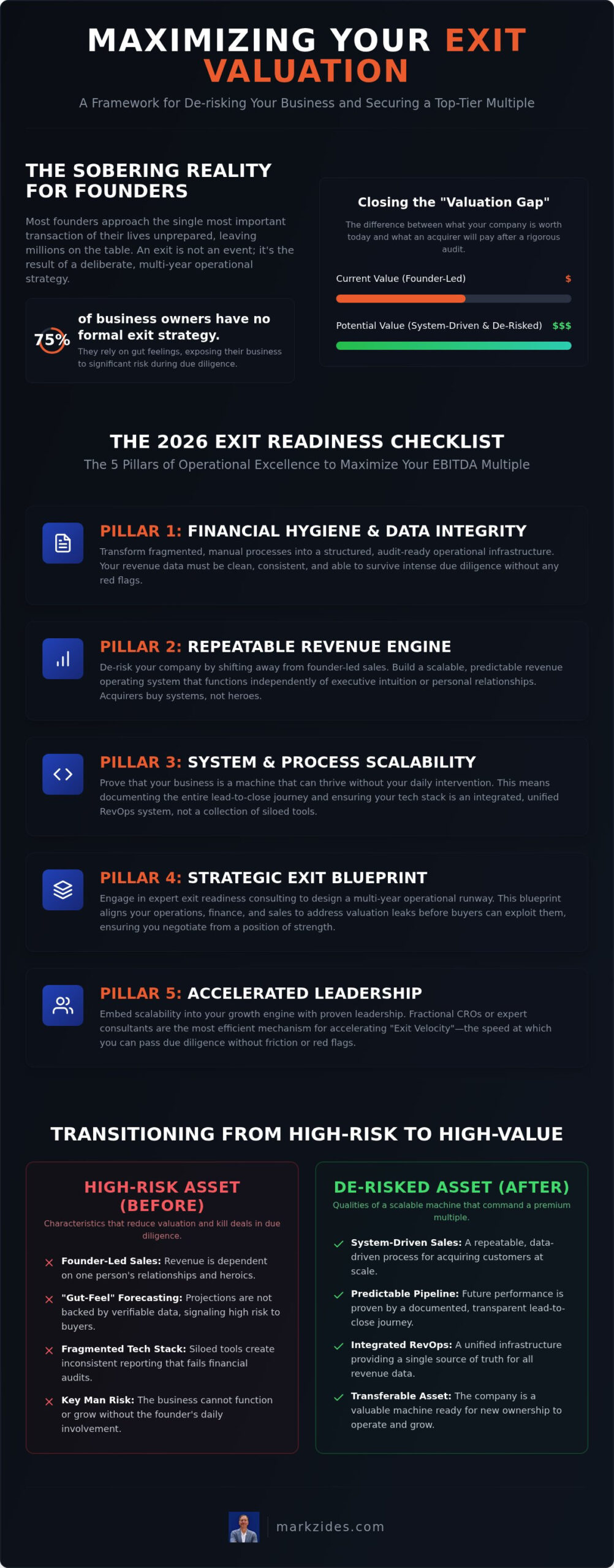
The 2026 Exit Readiness Checklist: 5 Pillars of Operational Excellence
Transitioning from theory to execution requires a structured framework that buyers can trust. While financial audits are standard, exit readiness consulting provides the operational stress test that actually moves the needle on your multiple. If your internal systems are held together by spreadsheets and manual workarounds, you're signaling high risk to potential acquirers. You must clean up the P&L by strictly separating personal expenses and ensuring every line item on your balance sheet is defensible. This financial hygiene is the foundation upon which your operational rigour is built. For founders with international ties, Israel Cross Border Law Firm offers insights into complex legal frameworks; learn more about how these considerations impact your long-term planning.
Legal and compliance matters must be watertight well before the data room opens. Verify that all intellectual property is properly assigned, employment agreements contain the necessary non-competes, and customer contracts are standardized. Additionally, your fundraising readiness consulting should have already prepared you for this by ensuring your strategic alignment matches the next stage of growth. Data integrity is your final safeguard; your CRM and ERP must serve as the undisputed single source of truth for the entire organization. If you can't trust your data, neither will the buyer.
Pillar 1: Revenue Operations & Tech Stack
Buyers look for integrated systems that drive measurable ROI rather than a collection of siloed tools. Confirm your CRM hygiene and attribution accuracy to prove that your growth is a result of strategy, not luck. For hospitality-based businesses, optimizing yield management is a key step in this process; click here to learn how specialized dynamic pricing can enhance your revenue engine. You must conduct a rigorous audit of your Revenue Velocity metrics to demonstrate how efficiently capital moves through your sales funnel. If your tech stack doesn't provide this transparency, you're asking the buyer to take an unnecessary risk on your future performance.
Pillar 2: Talent & Leadership Bench Strength
An acquirer is buying your future, and that future rests on your mid-management layer. You must evaluate their ability to scale the company post-exit without your daily guidance. Review your incentive structures to ensure they align with the long-term goals of a potential buyer. A high-performing, stable team culture is a premium asset that significantly de-risks the transition. If your leadership bench is thin, your valuation will likely suffer a "Key Man" discount that is difficult to recover.
Build your blueprint for a high-value sale by exploring our exit readiness solutions today.
Executing the Blueprint: How Fractional Leadership Accelerates Exit Velocity
Preparing for a high-stakes sale isn't the time for experimentation. It requires a battle-tested blueprint that designs your systems today for the specific buyer of tomorrow. Hiring a full-time CRO twelve months before an exit is often a costly mistake; it's slow, expensive, and difficult to offboard. A Fractional CRO provides the most cost-effective mechanism to prepare for an acquisition by injecting high-level expertise exactly where it's needed most. Mark Zides acts as the Expert Operator who bridges the gap between your current operational reality and the rigour required for a record-breaking exit.
The first stage of this engagement is a 90-day sprint designed to secure immediate wins that boost your valuation before the formal process even begins. We focus on high-impact areas like pipeline hygiene, contract standardization, and the removal of founder-led dependencies. These rapid improvements signal to potential buyers that the business is already on a trajectory of professional excellence. By embedding these systems early, you ensure that your company doesn't just survive due diligence but moves through it with maximum velocity.
Strategic Architect vs. Transactional Broker
A transactional broker focuses on the deal; a Strategic Architect focuses on the engine. To maximize your payout, you need an operator who understands how to fix the revenue systems that drive your multiple. Fractional leadership provides the objective, outside-in view that is impossible for a founder to maintain while being deep in the daily trenches. This perspective allows us to identify and repair valuation leaks that you might have overlooked. Having a mentor who has navigated these exits before provides the stability and confidence required to manage the high-stakes energy of an M&A transaction.
Your Next Step: The Exit Readiness Audit
The scope of a professional exit readiness consulting engagement is comprehensive. It moves beyond simple financial reporting to include a deep-dive audit of your RevOps, sales enablement, and leadership bench strength. This process is designed to replace your "gut-feel" anxiety with the calm of structured, predictable systems. We provide a clear roadmap that identifies exactly what needs to be fixed, aligned, or accelerated to close your valuation gap. A rigorous strategic planning process ensures your 2026 revenue goals translate directly into the operational discipline that commands a premium multiple. Don't leave your final payout to chance by waiting until the LOI is signed to begin this work.
Contact Mark Zides to begin your Exit Readiness Audit
Securing Your Legacy through Operational Precision
Your exit is the ultimate validation of your work as a founder. It's the moment your vision transforms into a liquid asset. But a high valuation isn't a gift; it's the result of rigorous preparation. By removing founder dependencies and institutionalizing your revenue engine, you move from "hope-based" selling to a predictable machine that acquirers trust. Professional exit readiness consulting ensures that your documentation, data, and leadership bench are audit-ready long before the first offer arrives.
You've built the engine; now it's time to optimize it for the highest possible payout. Mark Zides serves as the Strategic Architect of the 90-Day Revenue Operating System and is a specialist in de-risking high-growth B2B assets. As an Expert Operator with battle-tested exit experience, he provides the blueprint to close your valuation gap. Book Your Exit Readiness Strategy Session with Mark Zides today to start your journey toward a stress-free due diligence process. The market rewards those who are prepared; don't leave your legacy to chance.
Frequently Asked Questions
What is exit readiness consulting and how does it differ from M&A brokerage?
Exit readiness consulting focuses on operational alignment and de-risking the asset before it hits the market. While a broker manages the transaction and buyer outreach, a consultant acts as an operator to ensure the business survives the microscopic scrutiny that follows. It's the difference between preparing the blueprint and signing the deed. Consulting fixes the engine; brokerage merely sells the car to the highest bidder.
When should a founder start the exit readiness process?
Start at least 12 to 18 months before your target exit date. This timeframe allows for the implementation of repeatable systems and the collection of clean, audited revenue data. If you wait until you're ready to sell, you won't have the runway to fix operational leaks or remove founder-led dependencies. Early preparation ensures that your EBITDA multiple reflects a scalable machine rather than a sporadic series of wins.
How much can exit readiness consulting actually increase my company's valuation?
Strategic operational improvements can increase enterprise value by 30% to 50% over a multi-year period. By closing the "Valuation Gap" through optimized revenue systems and de-risking the asset, you command a higher multiple than founder-led competitors. Acquirers pay a premium for predictability and scalability. If your systems are audit-ready and independent of executive intuition, you're positioned for a top-tier payout that reflects a professionalized organization.
What are the biggest 'red flags' buyers look for during due diligence?
Buyers look for inconsistent revenue data, high customer concentration, and "Key Man" risk. If the founder is the primary salesperson or the sole holder of institutional knowledge, the asset is considered high-risk. Other red flags include sporadic demand generation and a fragmented tech stack that lacks a single source of truth. These issues lead to "price chips" or deal collapses during the final stages of due diligence.
Can a Fractional CRO help with both fundraising and exit readiness?
Yes, a Fractional CRO is uniquely positioned to handle both. Whether you're preparing for a Series B or a total acquisition, the underlying requirement is a scalable revenue operating system. They design the infrastructure that proves market fit and growth potential to investors and acquirers alike. This dual capability ensures your company remains attractive to capital at every stage of the high-growth journey.
What happens if I skip the exit readiness phase and go straight to market?
Skipping this phase often leads to deal fatigue, lower multiples, and high earn-out requirements. Without a rigorous operational stress test, you'll likely discover critical leaks only when a buyer's auditor finds them. This shifts the leverage to the acquirer, allowing them to chip away at the purchase price. You risk leaving millions on the table or seeing the transaction fail entirely due to a lack of structural transparency.
Is exit readiness consulting only for large enterprise companies?
No, exit readiness is critical for any high-growth company seeking a premium valuation. Small and mid-market businesses often face higher risks regarding founder dependency and manual processes. Implementing structured systems through exit readiness consulting allows these organizations to punch above their weight class during negotiations. Whether your EBITDA is $2M or $20M, the principles of operational excellence and data integrity remain the primary drivers of your final multiple.
How do I measure the ROI of an exit readiness engagement?
Measure success through the expansion of your EBITDA multiple and the reduction of friction during due diligence. A successful engagement results in a higher "Exit Velocity," where the business moves quickly through audits without significant price adjustments. You can also track internal metrics like reduced churn, lower customer acquisition costs, and the successful transition of sales responsibilities from the founder to the leadership team.
Ready to build a revenue engine that runs without you?
Mark works alongside founders as a player-coach — not a slide deck.
Book a 30-minute call