
Fundraising Readiness Consulting: Scaling Your Revenue Engine for Maximum Valuation

Investors don't write checks for your vision. They fund the engine that makes that vision inevitable. In a market where global VC investment reached $510 billion in the first half of 2026, capital is abundant, but it's also more selective than ever. If you're still closing every major deal yourself or staring at a CRM that looks like a graveyard of gut-feel projections, you aren't ready for a raise. Professional fundraising readiness consulting isn't about polishing a pitch deck. It's about auditing the structural integrity of your sales execution and demand generation.
You've likely felt the anxiety of an upcoming due diligence process that might expose messy data and a lack of repeatable systems. It's time to stop reacting and start building. This guide details how to transform your organization from founder-led chaos into a predictable, investor-ready revenue machine. We'll explore how to embed operational excellence into your sales process through a structured Revenue Operating System. By aligning your partnerships, marketing, and sales execution, you can replace uncertainty with clarity. To help manage the intricacies of such transitions, you can discover Swiss Alpha Matrix for specialized due diligence and project management of complex financial programs. You'll learn how to command high investor confidence and secure the maximum valuation your business deserves during your next exit or capital raise.
Key Takeaways
- Eliminate "Key Person Risk" by transitioning from founder-led selling to a scalable, documented sales engine that functions independently of the CEO.
- Utilize professional fundraising readiness consulting to identify operational gaps and revenue leaks before they surface during investor due diligence.
- Establish the four pillars of investment readiness, prioritizing robust unit economics and healthy CAC to LTV ratios to justify a premium valuation.
- Move from gut-feel projections to forecast accuracy by embedding a Revenue Operating System that utilizes optimized CRM workflows and repeatable playbooks.
- Deploy a Fractional CRO to provide executive-level execution, ensuring your revenue engine scales while you focus on the strategic demands of the capital raise.
What is Fundraising Readiness Consulting? Beyond the Pitch Deck
Most founders believe they are ready for a capital raise the moment their pitch deck is finalized. They're wrong. A deck is a promise; a business is a system. Fundraising readiness consulting is the strategic process of auditing and optimizing your operations, financials, and revenue systems before you ever step into a boardroom. It's the difference between asking for money and offering an institutional-grade investment opportunity. Professional consultants identify the blind spots you're too close to see, such as fragmented data or a sales process that collapses without the founder's direct involvement.
Investors in the Venture capital ecosystem are looking for engines, not just ideas. They want to see that your revenue growth is a repeatable output of a designed system, not a series of lucky breaks. If your success depends on a single person's intuition, you aren't a company; you're a high-performing individual with a staff. Transitioning from a startup mindset to an institutional-grade operation requires a clinical look at your internal mechanics.
The Shift from Storytelling to Proof
In 2026, narratives alone no longer command premium valuations. While a compelling story captures attention, only "traction evidence" closes the deal. The market has shifted toward rewarding operational maturity. If you can't prove how a dollar of capital becomes three dollars of revenue through documented playbooks, your valuation will suffer. Fundraising readiness consulting builds a data-backed story. It replaces "we think" with "we know," providing the rigorous evidence required during the due diligence process. This ensures your narrative is built on a foundation of verifiable facts rather than aspirational goals.
The ROI of Pre-Fundraising Optimization
Preparation is a force multiplier for your time and capital. By optimizing your revenue engine early, you significantly reduce the time spent in the "fundraising tunnel." This efficiency allows you to return to operating the business faster. More importantly, it prevents "valuation haircuts" where investors discount your price due to perceived operational risks or messy data. Optimization creates a foundation for post-raise scaling. You aren't just preparing to get a check. You're building the infrastructure to deploy that capital effectively on day one. This involves:
- Fixing the leaks in your demand generation funnel to improve conversion.
- Standardizing your sales execution to remove founder dependency.
- Aligning marketing spend with specific, predictable revenue outcomes.
This level of discipline ensures that once the funds hit your account, your engine is already tuned for maximum acceleration. It turns the raise from a survival event into a growth catalyst.
The 4 Pillars of Investment Readiness: Proving Scalability
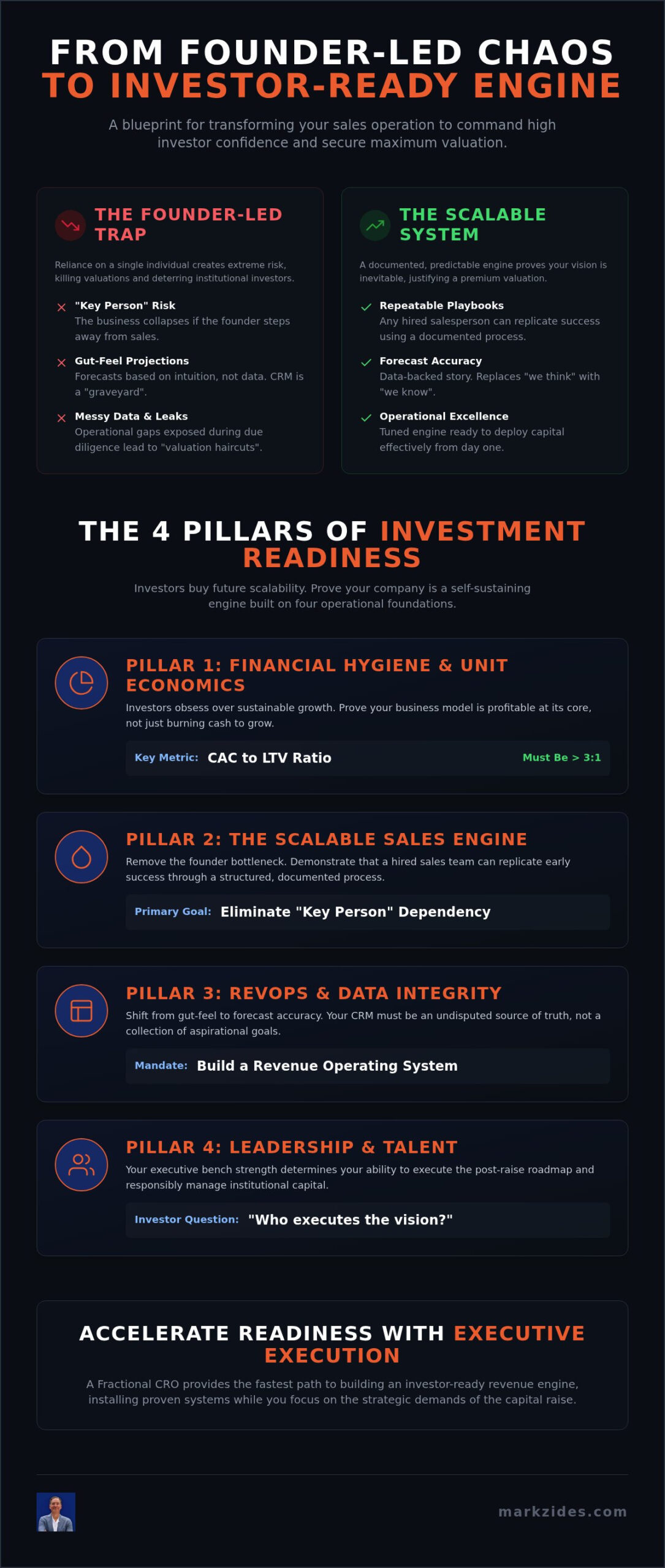
Investors aren't just buying your current revenue; they're buying the future scalability of your entire organization. To secure a maximum valuation, you must demonstrate that your company is a self-sustaining engine. This is where professional fundraising readiness consulting provides the most value, by stress-testing the structural integrity of your business before a single due diligence document is signed. The Strategic Architect framework focuses on building a business that stands on its own, independent of any single individual's heroics.
A truly investable company is built on four distinct operational foundations:
- Financial Hygiene and Unit Economics: Investors obsess over CAC to LTV ratios to ensure your growth is sustainable rather than subsidized by burning cash.
- The Scalable Sales Engine: You must remove the founder-led bottleneck to prove that a hired sales team can replicate your early success without your direct intervention.
- RevOps and Data Integrity: This involves shifting your culture from gut-feel to forecast accuracy, ensuring your CRM is a reliable source of truth.
- Leadership and Talent: Your executive bench strength determines your ability to execute the post-raise roadmap and manage institutional capital.
The Revenue Operating System
An investable company doesn't operate in silos. It integrates sales, marketing, and customer success into a single, cohesive engine. This shift toward data-driven decision making is the hallmark of an organization that is ready for institutional capital. It allows you to define repeatability with surgical precision. If you can't describe your sales process as a series of measurable, repeatable steps, you don't have a system; you have a series of coincidences. Understanding how to prepare your business for investors means proving that your revenue is a predictable output of your internal architecture.
Market Positioning and Moat
Your competitive advantage must be quantifiable to command a premium multiple. Beyond the product itself, VCs look for a robust partnerships and alliances strategy as a force multiplier for growth. Proving your demand generation through predictable revenue channels demonstrates that you own your market position. If you're looking to professionalize these systems before your next round, adopting executive-level revenue leadership can help you install these pillars without the overhead of a full-time hire. This level of preparation identifies competitive advantages that VCs can actually quantify and value.
The Cost of Unpreparedness: Why Founder-Led Sales Kill Valuations
Founder-led revenue is the ultimate ceiling on your valuation. While your ability to close early deals was essential for survival, it now represents a significant "Key Person Risk" that sophisticated investors will aggressively discount. If the CEO is the only person who can navigate a complex deal, the business is not a scalable asset; it's a job. Fundraising readiness consulting exposes these dependencies before an investor does. It forces a transition from tribal knowledge, where sales tactics live in the founder's head, to documented playbooks that any competent hire can execute.
Missing your projected numbers while in the middle of a capital raise is often a fatal blow to the deal. It signals to the market that you don't have a firm grip on your revenue levers. A lack of forecast accuracy suggests that your growth is accidental rather than engineered. Professional fundraising readiness consulting acts as a stress test for your sales execution, identifying where your process might crumble under the pressure of increased volume. By fixing these gaps early, you ensure that your performance during the raise matches the ambitious story you're telling in the boardroom.
Identifying the Founder-Led Bottleneck
You know you're the bottleneck when the sales cycle stalls the moment you focus on other executive duties. Signs of a lack of system include inconsistent pricing, "gut-feel" deal stages, and a lack of a standardized discovery process. Letting go of the "close" requires a psychological shift. You must move from being the lead actor to being the director of the revenue engine. Sales enablement tools and structured playbooks provide the bridge, allowing you to replicate your success through others without losing quality or momentum. This transition proves to investors that the business can grow without your constant, direct intervention.
The Diligence Disaster: Common Red Flags
Messy CRM data is the first red flag an investor will spot. Inconsistent entries and empty fields signal a lack of operational discipline. VCs also look for a clear leadership structure that owns the revenue number. If you aren't ready for a full-time hire, utilizing fractional CRO services can bridge the leadership gap and signal to investors that you take operational excellence seriously. Ultimately, diligence risk is the gap between what you claim and what your data proves. Closing that gap is the primary objective of your preparation phase. Founders who want to eliminate this risk entirely should follow a structured exit readiness consulting process that stress-tests every operational layer before a deal is on the table.
Executing the Readiness Roadmap: From Gut-Feel to Forecast Accuracy
Execution is the bridge between a visionary pitch and a closed round. Transitioning your business into an investment-grade asset requires a methodical approach that replaces founder intuition with operational precision. Fundraising readiness consulting provides the framework for this hardening process. It isn't a cosmetic fix; it is a fundamental restructuring of how your company generates and accounts for revenue. This roadmap follows a deliberate five-step sequence to ensure your engine is tuned for the scrutiny of institutional investors.
- Step 1: Conduct a Comprehensive Revenue Audit. Map every touchpoint across sales, marketing, and RevOps to identify structural weaknesses.
- Step 2: Embed Operational Discipline. Standardize your CRM workflows, formalize playbooks, and define the KPIs that actually move the needle.
- Step 3: Align Marketing and Sales. Ensure demand generation efforts are directly feeding the sales goals with high-intent leads.
- Step 4: Institutionalize Knowledge. Build a sales enablement engine that makes your best closer's tactics available to the entire team.
- Step 5: Final Simulation. Run a mock due diligence phase to pressure-test your data and your leadership team's responses.
Auditing Your Revenue Operating System
An audit reveals the reality behind your spreadsheets. You must identify where prospects are dropping out of your funnel and determine if those leaks are due to poor process or poor lead quality. High lead volume is a vanity metric if the conversion rates don't hold up under pressure. You need to validate that your marketing spend is generating the right type of traction. Forecast accuracy is the ability to predict revenue within a 5% margin based on system data. If your current system can't provide that level of certainty, you aren't ready for a high-stakes raise. A rigorous strategic planning process ensures your revenue targets are engineered from operational data rather than optimistic assumptions.
The Mock Due Diligence Process
The "Data Room" is your evidence locker. It should be fully prepared before you take your first investor meeting. This prevents the frantic, last-minute scramble for documents that signals a lack of organization. You must anticipate the hard questions regarding churn, CAC, and expansion opportunities. Professional executive coaching prepares your leadership team for the hot seat, ensuring they can defend the numbers with confidence. If you want to ensure your revenue engine is built to withstand the most rigorous audit, you need to partner with an expert operator who understands the mechanics of scale. This simulation phase identifies remaining gaps, allowing you to fix them on your own terms rather than during a live deal negotiation.
Optimizing for Exit: How a Fractional CRO Accelerates Success
The difference between "Advisory" and "Operating" is the difference between a map and a driver. While traditional consultants provide a list of recommendations and exit the building, an execution-focused approach to fundraising readiness consulting embeds a leader directly into your engine room. A Fractional CRO doesn't just identify gaps; they close them. They function as the strategic architect who installs the Revenue Operating System while you are occupied with the high-stakes demands of investor roadshows and board meetings. This ensures that your revenue engine continues to accelerate even when your attention is focused elsewhere.
Operational polish is the ultimate signal of maturity to a potential acquirer or VC. If you can show that your revenue growth remained steady or even accelerated during the intense pressure of a raise, you prove the system is truly independent of your daily heroics. This level of stability replaces the anxiety of "key person risk" with the calm of a professionalized leadership structure. It positions the company for a maximum valuation by demonstrating that your growth is a predictable, engineered output rather than a series of founder-led miracles.
The Expert Operator Advantage
Leveraging battle-tested experience allows you to avoid the common scaling traps that drain capital and kill momentum. Startups often fail because they scale their problems instead of their successes. An expert operator brings "big company" discipline to the agile environment of a high-growth business. They align your partnerships, demand generation, and sales enablement into a single, cohesive unit. This doesn't just prepare you for an exit; it builds a legacy of growth that continues long after the check clears. It's about installing the infrastructure that makes future success inevitable rather than accidental.
Your Next Move: Securing Your Valuation
Readiness is not a weekend project. If you want to maximize your valuation, you need to begin the hardening process at least six months before you plan to go to market. This timeline allows you to gather the necessary data points to prove repeatability and resolve any operational leaks discovered during the initial audit. Waiting until you need the capital to fix your systems is a recipe for a discounted valuation or a failed round. It's time to stop relying on gut-feel and start relying on a designed system. You can Prepare your company for maximum valuation with Mark Zides through a strategic consultation that identifies your specific path to scale. Secure your future by building a revenue engine that investors can't ignore.
Secure Your Future: From Founder Heroics to Scalable Systems
The path to a maximum valuation isn't paved with better slides; it's built on the structural integrity of your revenue engine. Transitioning from founder-led heroics to a documented, repeatable system eliminates the "key person risk" that investors aggressively discount. By hardening your unit economics and embedding operational discipline across your sales and marketing teams, you transform your business into an institutional-grade asset. It is the difference between a startup that hopes for growth and an organization that engineers it.
Engaging in professional fundraising readiness consulting ensures that your data stands up to the most rigorous scrutiny. It replaces the anxiety of the due diligence process with the calm of structured, predictable systems. You don't have to navigate this transition alone. With direct access to executive-level "Operator" expertise, you can install the infrastructure required for sustainable, high-velocity growth that lasts long after the check clears.
While you optimize your business for institutional capital, don't overlook your personal financial readiness for the resulting windfall; for founders and couples looking to manage their transition to long-term wealth, visit Nexa Wealth Planning.
Secure your valuation with a Fundraising Readiness Audit from Mark Zides. Mark brings battle-tested revenue operating systems and a proven track record of preparing companies for high-value exits. It's time to stop guessing and start scaling with precision. Your next level of performance is within reach.
Frequently Asked Questions
What is the primary goal of fundraising readiness consulting?
The primary goal is to transform your business from a founder-dependent startup into a scalable, institutional-grade engine. This involves auditing your revenue systems to ensure they can withstand the scrutiny of institutional investors. By identifying and fixing operational gaps, you prove that your growth is a result of a designed process rather than a series of lucky breaks.
How long does a fundraising readiness assessment typically take?
A comprehensive assessment typically takes between four and six weeks, depending on the complexity of your current revenue engine. This timeline allows for a deep dive into your CRM data, sales playbooks, and demand generation channels. Starting this process at least six months before your target raise date ensures you have enough time to implement improvements and gather performance data.
Can I handle fundraising readiness in-house without a consultant?
You can handle the preparation in-house, but you run the risk of missing critical blind spots that external operators are trained to identify. Founders are often too close to the daily operations to objectively critique their own systems. Professional fundraising readiness consulting provides a clinical, third-party perspective that stress-tests your sales execution against the high standards of the current market.
What is the biggest "red flag" investors look for during due diligence?
The most significant red flag is "Key Person Risk," where the majority of revenue generation depends entirely on the founder's direct involvement. Investors view this as a lack of scalability and a major operational hazard. Other high-risk signals include inconsistent CRM data and a lack of documented sales playbooks, which suggest that your revenue success is not repeatable.
Is fundraising readiness consulting only for Series A and beyond?
Readiness preparation is valuable at any stage, but it becomes critical during Seed and Series A rounds when you move from proving a product to proving a business model. Early-stage companies that install a Revenue Operating System early avoid the operational debt that slows down later scaling. Establishing these systems signals to investors that you have the discipline required to manage capital.
How does a Fractional CRO help with the fundraising process?
A Fractional CRO acts as the strategic architect of your revenue engine, installing repeatable systems while you focus on the raise. They bridge the leadership gap by embedding operational excellence into your sales and marketing workflows. This allows you to demonstrate to investors that you have executive-level execution power without the immediate overhead of a permanent, full-time hire.
What documents should be in my investor data room?
Your data room should contain detailed financial models, unit economics reports including CAC and LTV ratios, and documented sales playbooks. It must also include your marketing strategy, customer churn analysis, and an organizational chart showing your leadership bench strength. Having these documents prepared and validated ensures you can respond to due diligence requests with speed and accuracy.
Will fundraising readiness consulting help improve my company's valuation?
Yes, optimizing your operations directly impacts your valuation by reducing the risk discount investors apply to disorganized businesses. A company with a predictable revenue engine and documented systems commands a higher multiple than a similar business relying on gut-feel. Professional fundraising readiness consulting prevents the "valuation haircuts" that occur when investors find operational leaks or inconsistent data during a deal.
Ready to build a revenue engine that runs without you?
Mark works alongside founders as a player-coach — not a slide deck.
Book a 30-minute call