
Build a Repeatable Sales Process: Scaling Beyond Founders

If 14% of your sellers are generating 80% of your total revenue, you don't have a sales strategy; you have a collection of heroes. Relying on individual brilliance creates a fragile foundation where growth is a matter of luck rather than design. You've likely experienced the frustration of unpredictable monthly revenue and the exhaustion of being the primary salesperson for every critical deal. When the founder remains the bottleneck, scaling becomes an impossible task. It's time to move away from gut-feel anxiety and toward the clarity of structured systems.
To achieve sustainable growth, you must build repeatable sales process that functions as a high-performance revenue operating system. This article provides the blueprint to transition from heroic sales to a scalable engine that delivers consistent, predictable results. We'll detail how to architect a hiring plan that works, lower your customer acquisition costs, and install the visibility needed for accurate forecasting. By embedding discipline into your sales mechanics, you prepare your organization for its next major milestone, whether that's a successful fundraising round or a high-value exit.
Key Takeaways
- Identify the "Heroic Selling" trap and learn how to replace individual brilliance with a scalable, system-driven revenue engine.
- Establish non-negotiable operational stages and rigorous exit criteria to ensure pipeline hygiene and accurate revenue forecasting.
- Follow a 5-step blueprint to build repeatable sales process by auditing successful deals and mapping the journey from the buyer's perspective.
- Master the distinction between process and methodology to ensure your team understands both the "what" and the "how" of high-stakes execution.
- Leverage the expertise of a Fractional CRO to embed these systems, driving the operational excellence required for a successful fundraising round or exit.
From Gut-Feel to Forecast: Why "Heroic" Selling Fails at Scale
A repeatable sales process is not a suggestion; it's a standardized, data-driven framework designed to convert prospects into customers with surgical precision. Many early-stage firms fall into the "Heroic Selling" trap. In this scenario, growth depends entirely on the individual brilliance of the founder or a single star performer. While this might generate initial traction, it is a structural liability. If your revenue relies on "gut-feel" and "hustle" rather than a documented modern sales engine, your business is inherently fragile. Scaling requires moving beyond these individual heroics to build repeatable sales process where success is an inevitable outcome of the system design.
Investors and buyers look for "revenue durability." They don't want to buy a founder's personality or a handful of lucky breaks; they want to buy a machine that produces cash predictably. There is a direct, measurable correlation between process repeatability and company valuation. A business with a structured Revenue Operating System is worth significantly more than one where the CEO is the only person who can close a five-figure deal. By replacing intuition-based sales with a rigorous methodology, you transform your company from a risky bet into a scalable asset.
The Hidden Costs of an Unstructured Pipeline
Operating without a blueprint carries heavy, often invisible, costs that drain your resources. First, you'll face high churn among sales hires. If you bring in talent but don't provide a roadmap, they'll grow frustrated and fail within months. Second, your forecasting will be consistently inaccurate. Without standardized stages, a "50% chance" means something different to every rep, leading to disastrous strategic planning and missed targets. Finally, you hit the "Founder Bottleneck." If you're the only one who can navigate the complexities of your product, you aren't a CEO; you're a high-priced salesperson with no time to actually lead the organization.
Moving Toward Forecast Accuracy
When you build repeatable sales process, you turn revenue generation into a predictable math problem. You stop guessing and start calculating. This shift allows you to move from "closing deals" by force of will to managing a high-velocity engine where every input has a known, expected output. You can finally identify exactly where the pipeline is leaking and fix it with operational precision rather than panic. This level of clarity is what separates stagnant firms from those ready for a massive exit. The Revenue Operating System is the foundation for 2026 growth.
The Architecture of Repeatability: Core Stages of a Modern Sales Engine
Structure is the only antidote to the volatility of founder-led selling. To build repeatable sales process, you must move beyond a simple list of tasks and design a rigid architecture of operational stages. Each phase of the engine serves a specific purpose, and movement between these phases must be governed by strict "exit criteria." Without these guardrails, your pipeline becomes bloated with low-probability deals that inflate your forecast and waste your team's time. Rigorous pipeline hygiene is not a luxury; it's a prerequisite for scaling a business toward a successful exit.
Effective sales funnel optimization requires aligning your internal stages with the actual B2B buyer journey. Modern buyers are more informed and move through complex committees, often making the traditional linear path obsolete. Your process must be flexible enough to accommodate this reality while remaining disciplined enough to ensure no critical steps are skipped. When your stages mirror the buyer's decision-making process, you reduce friction and accelerate the path to a signed contract. This discipline is the first step when you build repeatable sales process at scale.
Top-of-Funnel: Prospecting and Lead Qualification
The foundation of a scalable engine is a crystal-clear Ideal Customer Profile (ICP). If you don't know exactly who you are solving for, your outbound efforts will be a costly exercise in futility. You must define the sharp distinction between a Marketing Qualified Lead (MQL) and a Sales Qualified Lead (SQL) to prevent sales reps from chasing "noise" rather than "signal." Implementing a framework like MEDDPICC ensures that your team asks the hard questions early. With sales rep turnover currently at 36%, providing a clear qualification roadmap is essential to keep your talent focused on winnable deals rather than dead-end conversations.
Middle-of-Funnel: Discovery and Solution Mapping
The discovery call is the most critical stage in the entire repeatable process. It is the moment where you transition from being a vendor to a strategic partner. Instead of a generic pitch, your reps must perform deep research to map your product's value to the prospect's specific pain points identified during the call. With average B2B win rates hovering between 20% and 30%, you cannot afford to waste time on deals that don't fit your ICP. Standardizing the "demo" ensures that every prospect receives a consistent, high-impact experience regardless of which rep is on the call. If you are struggling to move prospects through these middle stages, our fractional CRO services can help you architect the necessary systems to unblock your pipeline and drive consistent growth.
Methodology vs. Process: Aligning Strategy with Execution
Confuse process with methodology, and your revenue engine will stall. While a process outlines the "what"—the specific stages and milestones a lead must pass through—a methodology defines the "how." It's the communication framework and tactical skill set your team uses to navigate those stages. To build repeatable sales process, you must align these two forces. Without a consistent methodology, your sales stages are just empty buckets, and your reps will revert to the "heroic" intuition-based selling that limits your ability to scale.
Selecting the right methodology depends on your market and the complexity of your deal cycle. Whether you adopt the Challenger model, Sandler, or Gap Selling, the goal is to create a unified language across your entire organization. This alignment ensures that when a deal moves from discovery to solution mapping, every rep is using the same high-stakes execution techniques to drive value. Bridging this gap between strategy and tactical reality is exactly where B2B sales enablement services become indispensable for high-growth firms.
Embedding the Methodology into the Workflow
One-off workshops don't create repeatability; they create temporary enthusiasm that fades within weeks. True enablement requires embedding your chosen methodology into the daily workflow. You must document these tactics in a comprehensive Sales Playbook that serves as the "Architect's" blueprint for every conversation. Discipline is reinforced through consistent coaching and role-play sessions. If you don't practice the methodology in a controlled environment, your reps will practice on your most valuable prospects, leading to inconsistent win rates and wasted pipeline.
The Role of Technology in Process Enforcement
Your CRM must function as a "single source of truth" rather than a passive database. It should be the engine room that enforces your process and methodology at every turn. By utilizing sales tech stack consulting, you can design a system that prompts reps for specific methodology-driven data at each stage. Automation should handle the "busy work"—data entry, scheduling, and follow-up reminders—to keep your sellers focused on high-value activities. When technology and methodology are aligned, you remove the friction that prevents a business from scaling beyond its founders.
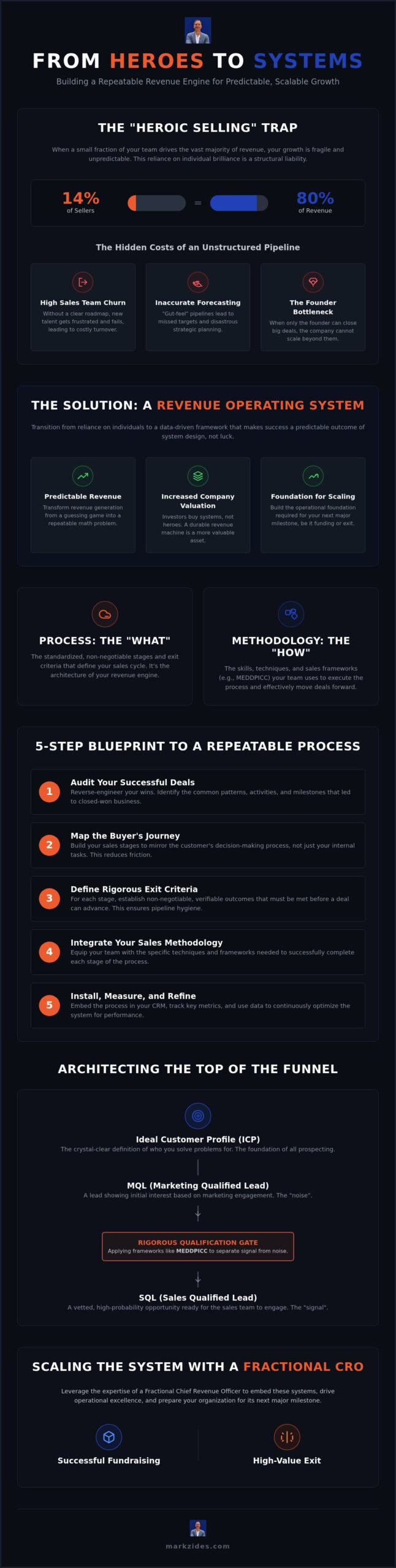
A 5-Step Blueprint to Build Your Repeatable Sales Process
Scaling a revenue engine isn't a matter of hiring more "closers" and hoping for the best. It requires a tactical blueprint that removes the guesswork from the equation. To build repeatable sales process, you must act as a strategic architect, designing a system where every movement is documented and every outcome is analyzed. This five-step methodology provides the framework needed to transition from founder-led chaos to operational excellence.
- Step 1: Audit Winning Deals. Stop speculating about your value proposition. Examine your last ten successful closes to identify the common thread. What was the specific trigger that moved them from "interested" to "invested"?
- Step 2: Map the Buyer's Journey. Document every touchpoint from the initial discovery to the final signature. If you don't understand the internal hurdles your buyer faces, you can't help them navigate the purchase.
- Step 3: Define "Stage Gates." Establish rigorous exit criteria for every pipeline stage. A deal shouldn't move forward unless specific data points are verified and the prospect has taken a "micro-commitment" action.
- Step 4: Build Enablement Assets. Arm your team with the necessary weapons. This includes stage-specific pitch decks, email templates, and objection-handling scripts that reflect your chosen methodology.
- Step 5: Implement a Feedback Loop. The process isn't static. You need a "Sales-to-Success" handoff that ensures the promises made during the sale are kept during implementation, creating a virtuous cycle of customer advocacy.
Auditing and Mapping the Journey
Don't rely on your sales reps' notes for your audit. Interview your best customers directly to understand why they actually bought. You'll often find that the "pain" they solved wasn't what you thought you were selling. Use these insights to identify friction points where deals typically stall or fall out of the funnel. Drafting this initial process map on a whiteboard allows you to see the logic of the flow before you hard-code it into your CRM. If your current pipeline feels like a black box, it's time to consult with a Fractional CRO who can architect these systems for you.
Operationalizing the Feedback Loop
Continuous improvement requires a shift in management style. Move your weekly pipeline reviews away from "interrogation" and toward "strategic coaching." Use win/loss analysis to refine the process in real-time, ensuring that the "lessons from the front lines" reach your marketing and product teams. When sales and marketing are aligned through a shared feedback loop, your cost of acquisition drops and your win rates climb. This is how you turn a collection of individuals into a high-velocity revenue engine that survives and thrives beyond the founder's direct involvement.
Scaling the System: How a Fractional CRO Embeds Operational Excellence
Hiring a high-performing VP of Sales to build your revenue infrastructure is a common strategic error. Most sales leaders are "operators" who excel at managing people and closing deals once the machine is already running. They are rarely "architects." To build repeatable sales process, you need a leader who can design the systems, embed the methodology, and align the technology before the team begins to scale. A specialized expert identifies the blind spots that internal teams often miss, such as misaligned incentives or fragmented data, ensuring the foundation is built for durability rather than just speed. Understanding how to build a sales team that functions as a structured, high-velocity engine—rather than a collection of individual performers—is the critical first step before any scaling effort can succeed.
For mid-market and scaling firms, fractional CRO services provide the high-level strategic leadership required to professionalize the revenue engine without the overhead of a full-time executive. This approach allows you to install a "Strategic Architect" who has seen these patterns across dozens of organizations. By implementing a rigorous Revenue Operating System, you move away from the anxiety of unpredictable monthly targets and toward a business that is structurally prepared for a high-value exit.
The Architect vs. The Operator
The distinction between an architect and an operator is the difference between building a blueprint and following one. You need a visionary leader to design the "Stage Gates" and data requirements discussed earlier before a manager can effectively run the daily pipeline. Fractional leadership provides this executive-level strategy at a fraction of the cost of a permanent hire. A CRO focuses on the KPIs that indicate system health, such as weighted pipeline accuracy, conversion rates by stage, and CAC payback periods. If the system is healthy, the results become a mathematical certainty.
Preparing for the Next Level: Exit and Fundraising
Repeatability is the primary driver of "Exit Readiness." During due diligence, VCs and acquirers don't just look at your top-line revenue; they audit the process that produced it. They are searching for revenue durability—proof that the sales engine will continue to produce results long after the founder has moved on. A documented, system-driven approach commands a "Repeatability Premium," leading to significantly higher valuation multiples. When your sales process is a predictable machine, your business becomes a much more attractive asset for acquisition. Mark Zides specializes in helping firms bridge this gap, transforming unpredictable "heroic" selling into a structured, scalable engine ready for the next level of performance.
Architect Your Revenue Future
Transitioning from founder-led heroics to a structured system is the most critical evolution your business will undergo. It's the shift from working in the business to working on the machine. By defining rigorous stage gates and aligning your methodology with operational reality, you replace gut-feel anxiety with the calm of predictable growth. When you build repeatable sales process, you aren't just fixing a pipeline; you are designing a durable asset that commands a higher valuation during fundraising or exit. This structural discipline ensures that your revenue engine continues to accelerate long after you've stepped away from the daily sales calls.
Mark Zides serves as a battle-tested "Strategic Architect" for firms ready to professionalize their revenue execution. As a specialist in Sales Execution and Enablement, he provides the executive-level strategy needed to remove bottlenecks and maximize valuation. Ready to scale beyond founder-led sales? Explore how Fractional CRO services can build your repeatable revenue engine. It's time to stop relying on luck and start building for scale. Your next level of performance is within reach.
Frequently Asked Questions
What is the difference between a sales process and a sales funnel?
A sales process is the internal, step-by-step roadmap your team follows to move a prospect from initial contact to a closed deal. In contrast, a sales funnel is a visual representation of lead volume and conversion rates across different stages. While the funnel shows you the "where" and "how many," the process defines the "what" and "how" of daily execution.
How long does it take to build a repeatable sales process?
You can typically install a baseline Revenue Operating System within 90 days. This timeframe allows for a comprehensive audit, mapping the buyer journey, and embedding a core methodology into your team's workflow. While the system requires ongoing refinement, this three-month window is sufficient to remove the founder bottleneck and establish the foundation for predictable forecasting.
Can a complex, enterprise sales process really be made repeatable?
Complexity doesn't preclude repeatability. Even in high-stakes enterprise environments with long cycles, you can standardize critical milestones, stakeholder mapping, and exit criteria. By focusing on the structural logic of the deal rather than individual tactics, you build repeatable sales process that functions effectively across complex, multi-stakeholder decision-making units.
What are the most important KPIs to track in a repeatable sales process?
Focus on actionable indicators like weighted pipeline accuracy, stage-to-stage conversion rates, and average sales cycle length. You should also monitor your Customer Acquisition Cost (CAC) payback period, aiming for the gold standard of under 12 months. These metrics provide the visibility needed to manage your revenue engine with mathematical precision rather than relying on intuition.
How do I know if my current sales process is broken?
Your process is broken if your monthly revenue targets are a "gut-feel" guess rather than a predictable forecast. Other red flags include the founder remaining the primary closer for every major deal or a high turnover rate among new sales hires. If your team can't explain the specific structural reasons why a deal was won or lost, you lack a system.
Does a repeatable sales process mean my reps should use scripts?
Repeatability is about frameworks, not robotic scripts. You want your reps to have the autonomy to navigate complex conversations while staying within the guardrails of a proven methodology. Scripts often stifle the authentic discovery needed in B2B sales; instead, provide playbooks that document the required data points, value propositions, and objection-handling strategies for each stage.
How often should we update our sales process?
You should conduct a strategic review of your sales process every quarter. Market conditions and buyer behaviors shift rapidly, requiring you to refine your "Stage Gates" and update enablement assets. Regular audits allow you to incorporate real-world feedback from the front lines, ensuring your system remains aligned with the tactical reality of your sales conversations.
Who should be responsible for building the sales process?
The responsibility belongs to a "Strategic Architect," typically a Chief Revenue Officer or a Fractional CRO. While a Sales Manager focuses on daily operator tasks, the CRO designs the underlying systems and ensures alignment between sales, marketing, and customer success. This executive-level focus is essential for creating a machine that scales independently of the founder's direct involvement.
Ready to build a revenue engine that runs without you?
Mark works alongside founders as a player-coach — not a slide deck.
Book a 30-minute call