The 2026 Sales Funnel Optimization Checklist: Building a High-Velocity Revenue Engine

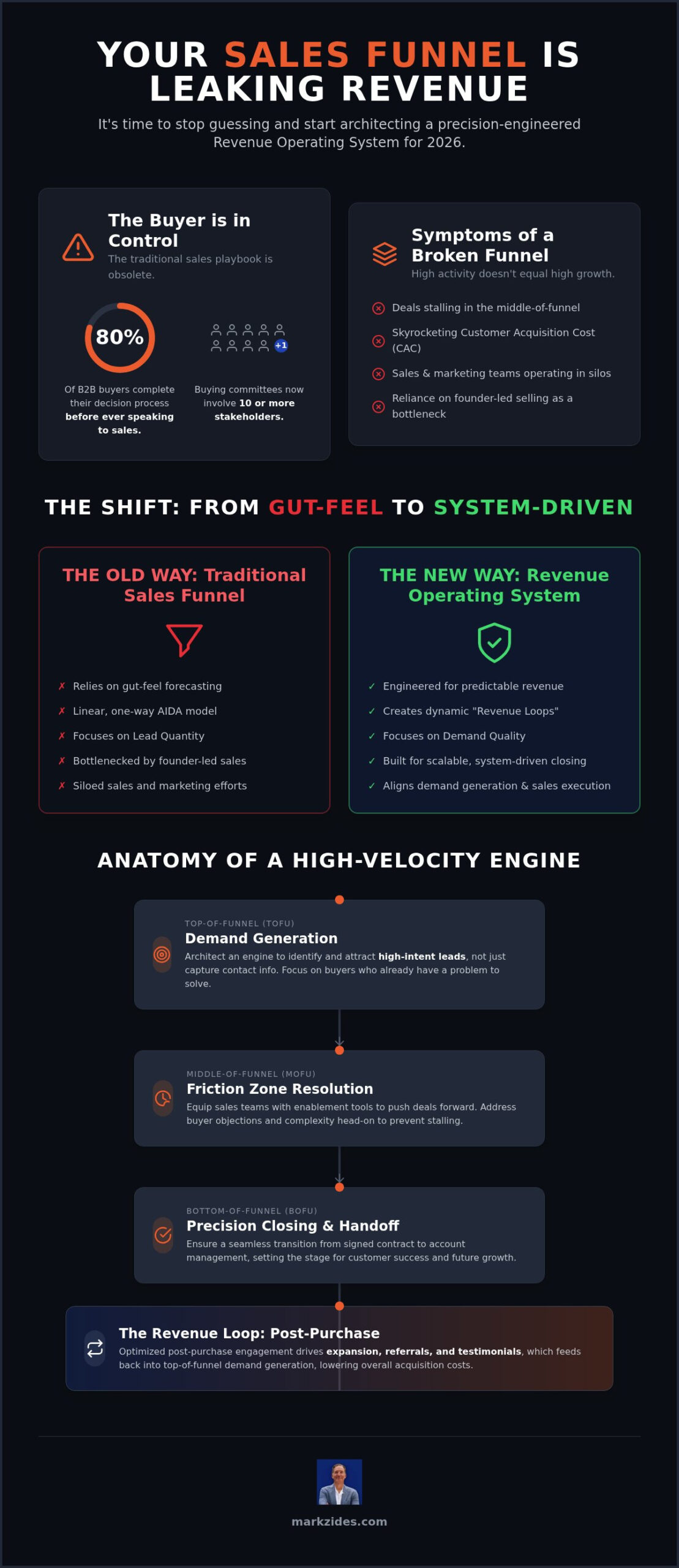
Research shows that 80% of B2B buyers complete their entire decision-making process before they ever speak to your sales team. In a market where buyers involve ten different stakeholders and rely on GenAI chatbots for vendor shortlists, your traditional sales funnel is likely leaking more revenue than it captures. You've probably felt the weight of unpredictable cycles and the frustration of sales and marketing teams operating in silos. Relying on founder-led selling is a bottleneck that prevents true scale and suppresses your company's valuation. It's time to transition from gut-feel anxiety to the calm of a structured, predictable system.
You need a revenue operating system built for the realities of 2026, not a static diagram from a decade ago. This guide will show you how to audit your current architecture and replace intuition with a precision-engineered engine. This checklist provides the exact framework to align demand generation with sales execution; ensuring every stage of your pipeline is visible, predictable, and scalable. We're moving beyond simple lead generation to engage entire buying committees with surgical accuracy. By the end of this article, you'll have the blueprint to build a high-velocity system that justifies a premium exit and delivers consistent growth.
Key Takeaways
- Shift your perspective from a traditional sales funnel to a precision-engineered "Revenue Operating System" designed for the complex buying committees of 2026.
- Learn how to conduct a comprehensive audit to pinpoint specific friction points where high-intent prospects are leaking from your pipeline.
- Discover the methodology for aligning demand generation with sales execution to ensure every marketing dollar translates into predictable revenue.
- Identify the critical steps to remove the founder-led sales bottleneck and build a scalable, system-driven closing engine.
- Position your organization for higher valuations and exit readiness by architecting a pipeline that proves growth is systemic rather than accidental.
Beyond the Basics: Why Your Sales Funnel is Your Revenue Operating System
A sales funnel is not a passive illustration or a static marketing tool. It is a precision-engineered operating system that must be architected for velocity, not just volume. In 2026, the primary killer of scaling startups is a reliance on gut-feel forecasting. When your revenue depends on the intuition of a few star players or the founder's personal network, your business lacks the structural integrity required for high-stakes growth. A high-velocity funnel replaces this uncertainty with a repeatable mechanism that converts market demand into predictable revenue. This system is the single most important asset for founders pursuing exit readiness. Sophisticated investors don't buy hustle; they buy the stability of a scalable pipeline that functions independently of any one individual. If your funnel is healthy, your valuation follows.
Defining a high-velocity funnel in a B2B context requires looking beyond simple conversion rates. It's about the speed and precision with which a prospect moves from initial awareness to a signed contract. This requires a shift in mindset: you aren't just filtering leads, you're accelerating them. By embedding data-driven visibility into every stage of the pipeline, you transform a mysterious process into a transparent engine. This clarity allows you to identify exactly where to apply pressure to increase output without increasing headcount proportionally.
The Shift from Linear Funnels to Revenue Loops
The traditional AIDA model fails to account for the modern B2B customer journey. Today, buyers navigate a complex path involving approximately 10 unique decision-maker functions before a contract is signed. This complexity requires a shift from linear stages to revenue loops where customer success and post-purchase engagement feed back into demand generation. You can't rely on a one-way street anymore. A Revenue Operating System is the strategic alignment of technology, people, and process to ensure no momentum is lost between stages. When your post-purchase funnel is optimized, it drives expansion and referrals, effectively lowering the acquisition burden on your top-of-funnel activities.
Identifying the Symptoms of a Broken Funnel
A broken system often masquerades as a marketing success. High lead volume is meaningless if those leads fail to convert. This is the classic "Quality vs. Quantity" trap that inflates costs without driving growth. You might notice deals stalling in the middle-of-funnel phase, where prospects lose interest or sales teams lack the enablement tools to push them toward a decision. This friction is expensive. When sales and marketing are misaligned, your Customer Acquisition Cost (CAC) skyrockets, eroding your margins and lowering your overall company valuation. The median B2B website conversion rate is 2.9%, yet many firms struggle to reach even this baseline because their systems are built on silos rather than integrated execution. To see how ZW Studios can help you exceed these benchmarks with professional brand identity and hand-built custom websites, click here. If your pipeline feels like a black box, it's time to stop guessing and start architecting.
The Anatomy of a High-Velocity B2B Sales Funnel
To build a high-velocity engine, you must first understand its structural components. A modern sales funnel isn't just a series of stages; it's an integrated system where each layer reinforces the next. In 2026, Top-of-Funnel (TOFU) isn't about casting a wide net. It's about architecting a demand generation engine that identifies and attracts high-intent leads before they even signal their interest. Middle-of-Funnel (MOFU) is the friction zone where deals often stall without proper support. Finally, Bottom-of-Funnel (BOFU) requires precision closing and a seamless handoff to account management to fuel the revenue loops discussed previously. You must also account for the 'Dark Funnel'. A significant portion of the buyer's journey now happens in untraceable spaces like private Slack communities and social proof threads. You can't track every touchpoint, but you can influence them by maintaining a high standard of professional excellence and category leadership.
Demand Generation vs. Lead Generation
Capturing existing demand is always more efficient than trying to create it from scratch. While lead generation focuses on the tactical collection of contact information, understanding what is demand generation is about building long-term desire and brand authority. In 2026, content-led growth is the backbone of this strategy. Buyers complete roughly 80% of their journey independently. If your content doesn't answer their specific technical and organizational questions during the early stages, you'll never make the shortlist. This is where you embed your expertise into the market, ensuring that when a prospect is ready to buy, your solution is the obvious choice. It's about moving from a volume-based approach to a value-based architecture.
Sales Enablement: The Bridge Between Lead and Deal
Once a lead enters your pipeline, the focus shifts to velocity. Stalled deals are often a symptom of inadequate support. Equipping your team with B2B sales enablement services ensures they have the collateral, data, and training to navigate complex buying committees. This is where your sales tech stack becomes a force multiplier. By automating administrative friction, your reps can spend more time on consultative problem solving rather than data entry. Remember, 79% of B2B purchases now require formal CFO approval. Your enablement materials must speak the language of ROI and risk mitigation to win that final sign-off. If your team is still relying on generic pitches, you're leaving revenue on the table. A Fractional CRO can help you design these systems to ensure your sales funnel operates with surgical precision.
The Sales Funnel Audit: Identifying Leakage and Friction
Most audits fail because they prioritize internal milestones over external buyer behavior. To build a high-velocity engine, you must map your sales funnel against the actual buyer's journey, not your internal CRM stages. If your process requires a prospect to jump through hoops that don't align with their decision-making logic, you've created a friction point. These points are where high-intent prospects drop off at disproportionate rates, often due to unnecessary complexity or a lack of timely information. Identifying these gaps is the first step in moving from a leaky bucket to a precision-engineered system.
Measuring the health of your pipeline requires understanding its velocity. Pipeline velocity is the heartbeat of your revenue operation; it tells you how quickly money moves through your system. In 2026, benchmarking "good" performance is critical. For instance, top-quartile SaaS teams achieve a 38% MQL-to-SQL conversion rate. If your audit reveals you're significantly below this benchmark, you likely have a misalignment between your demand generation efforts and your sales execution. You aren't just looking for volume; you're looking for the speed of revenue.
Measuring What Matters: Beyond Vanity Metrics
Raw lead numbers are vanity metrics that often mask deeper systemic issues. Instead, focus on the conversion rates between stages, particularly the MQL to SQL handoff. This transition is the ultimate test of lead quality and sales responsiveness. You must also analyze your Average Contract Value (ACV) and how it fluctuates across different lead sources. A high-velocity system prioritizes efficiency over raw activity. Sales Velocity is the product of opportunities, deal value, and win rate divided by cycle length. By optimizing any one of these variables, you can significantly accelerate your total revenue output without adding a single lead to the top of the funnel.
Tech Stack Alignment and Data Integrity
Your systems are only as effective as the data they process. A poorly configured sales tech stack consulting project can be the difference between a failing funnel and a scalable engine. You need a single source of truth where sales and marketing platforms are perfectly synchronized. Without this alignment, you're susceptible to "dirty data," which renders your predictive forecasting useless and creates friction between teams. When your tech stack is architected correctly, it automates the mundane, preserves data integrity, and provides the visibility needed to make high-stakes decisions with total confidence. If your data is fragmented, your growth will be too.
The 2026 Sales Funnel Optimization Checklist
Transformation requires more than a shift in strategy; it demands a rigorous, step-by-step audit of your organizational mechanics. To move from a fragmented pipeline to a high-velocity engine, you must apply a disciplined framework that leaves no room for ambiguity. This checklist serves as your blueprint for architecting a sales funnel that delivers predictable results in a market where buyers are more informed and autonomous than ever before. If your current system feels like a collection of disjointed tactics, these five steps will help you rebuild it into a cohesive revenue operating system.
- Step 1: Define Your Ideal Customer Profile (ICP) and Buyer Personas. Precision starts with knowing exactly who you serve. In 2026, a generic ICP is a liability. You must identify the specific firmographic and technographic traits of accounts that deliver the highest lifetime value and shortest sales cycles.
- Step 2: Align Demand Generation with Sales Targets. Marketing shouldn't just deliver leads; it should deliver revenue potential. Ensure your demand generation spend is directly tied to the sales quota, creating a unified front that eliminates the "us versus them" mentality.
- Step 3: Implement a Multi-Channel Lead Qualification Framework. Whether you utilize BANT, MEDDIC, or a hybrid model, your qualification must account for the 10 unique decision-maker functions involved in the modern B2B journey. If you aren't qualifying for CFO approval early, you're building a house on sand.
- Step 4: Architect a Repeatable Sales Process with Clear Milestones. Every stage of your funnel must have defined exit criteria. This prevents deals from drifting and ensures your team knows exactly what is required to move a prospect to the next phase.
- Step 5: Embed Continuous Sales Coaching and Enablement. Systems don't run themselves. You must provide ongoing support and resources to ensure your team can execute the consultative problem-solving required to win in a rep-free buying environment. Understanding how to build a sales team that operates as a high-velocity, repeatable revenue engine is essential to making this step work at scale.
Operationalizing the Checklist
A checklist only works if it is embedded into your daily operations. You must assign clear ownership for every stage of the funnel to prevent "Lead No-Man's Land," where prospects fall through the cracks during handoffs. Set up automated alerts within your CRM for stalled deals or pipeline gaps that threaten your quarterly targets. Reviewing the funnel must become a weekly ritual. This "Revenue Operating System" meeting cadence ensures that your leadership team remains focused on the granular details that drive big-picture success. If you're ready to build this infrastructure, consult with a Fractional CRO to accelerate your progress.
Scaling Through Partnerships
Direct sales are only one part of the equation. Integrating a robust partnerships and alliances strategy into your funnel allows you to tap into indirect revenue streams and leverage the trust of established market players. Partner-led leads typically exhibit higher conversion rates and faster velocity because the initial barrier of trust has already been cleared. By leveraging hyperscalers and strategic alliances, you can significantly expand the top of your funnel without a linear increase in marketing spend. This is the ultimate multiplier for any high-growth organization looking to dominate its category. When you treat partners as an extension of your sales engine, you create a sustainable path to market leadership.
Scaling the Engine: Removing the Founder from the Funnel
The founder-led sales ceiling is the silent killer of enterprise value. If you are still the primary closer for every major deal, your business isn't a scalable asset; it's a high-paying job. Investors and buyers don't pay a premium for your personal charisma or your individual network. They pay for a sales funnel that functions as a repeatable, predictable engine independent of any one person. Transitioning from "hustle" to a professionalized system is not just an operational upgrade. It is a strategic necessity for anyone pursuing exit readiness. You must move from being the lead actor to being the architect of a revenue operating system that thrives on discipline rather than individual heroics.
Building this culture of accountability requires clear milestones and a rejection of gut-feel intuition. When your sales process is codified, you create a foundation for sustainable growth. This shift allows you to replace yourself with high-performing reps who follow a proven blueprint. To build a repeatable sales process that scales beyond the founder, you must document every stage, define clear exit criteria, and install the accountability structures that prevent revenue from depending on any single individual. A professionalized funnel provides the transparency needed to spot pipeline gaps before they become revenue crises. By removing the founder from the daily grind of the funnel, you free up executive bandwidth to focus on the high-level strategy that drives valuation. This is also the moment when knowing how to build a sales team structured around engineering rather than individual heroics becomes your most critical competitive advantage.
The Role of a Fractional CRO in Funnel Architecture
Most startups reach a point where they need executive revenue leadership but cannot yet justify the cost of a full-time, seasoned Chief Revenue Officer. This is where fractional CRO services become a force multiplier. A fractional leader provides the strategic blueprint for a professional sales organization without the long-term overhead. They bridge the gap between high-level strategy and granular execution, ensuring that your demand generation efforts are perfectly aligned with your sales targets. By embedding an expert operator into your team, you gain access to battle-tested methodologies that accelerate your path to a high-velocity engine. They don't just advise; they design and embed the systems that make growth inevitable.
The Path to Predictable Revenue
Predictability is the ultimate currency in B2B SaaS. To achieve it, you must standardize your sales playbook to allow for the rapid onboarding of new reps. A well-documented process ensures that every member of the team is speaking the same language and following the same rigorous qualification steps. This standardization provides the data integrity needed to justify fundraising rounds and increase company valuation. When you can point to a dashboard and show exactly how a dollar of marketing spend translates into a predictable amount of revenue, you've built a system that justifies a premium exit. Moving from a gut-feel approach to a forecasted future is the final step in architecting a business that is truly built to scale. This applies whether you are optimizing a subscription model or looking to explore One-time hardware and software license sales for specialized deployments. Your funnel is no longer a mystery; it is a precision instrument for wealth creation.
Architecting Your Path to Market Leadership
Building a high-velocity revenue engine is not a one-time project; it's a commitment to operational excellence and systemic discipline. You've seen how a precision-engineered sales funnel replaces the anxiety of gut-feel forecasting with the stability of a repeatable operating system. By auditing for friction, aligning demand generation with sales execution, and removing the founder-led bottleneck, you transform your company from a collection of individuals into a scalable asset. This transition is what separates startups that plateau from organizations that achieve premium valuations and successful exits.
The complexity of the 2026 B2B landscape demands more than just software. It requires the strategic oversight of an expert operator who has built these frameworks in the trenches. Whether you're architecting a new pipeline or fixing a leaky one, the goal remains the same: predictable, sustainable growth that justifies a higher valuation. Stop guessing and start scaling. Schedule a consultation with Mark Zides today. With specialized fractional CRO expertise and battle-tested sales execution frameworks, you can finally build the revenue engine your business deserves. The blueprint is ready. It's time to execute.
Frequently Asked Questions
What is a sales funnel and why is it important for B2B businesses in 2026?
A sales funnel is the architectural framework that guides a prospect from initial awareness to a signed contract. In 2026, it serves as your primary revenue operating system. Because buyers now complete roughly 80% of their journey independently, your funnel must provide the self-serve content and digital touchpoints necessary to influence decision-makers before they ever interact with a sales representative.
How do I know if my sales funnel is broken?
You know your system is broken if you see high lead volume but negligible conversion rates. Stalled deals in the middle of the pipeline are a major red flag. If your forecasting relies on gut-feel rather than data-driven milestones, or if the founder is still closing the vast majority of deals, your engine has reached its structural limit and requires an audit.
What is the difference between a sales funnel and a marketing funnel?
The marketing funnel traditionally focuses on demand generation and awareness, while the sales funnel handles execution and closing. In a high-velocity environment, these shouldn't be separate silos. They function as a continuous loop where marketing attracts high-intent buying committees and sales converts that demand into predictable revenue through consultative problem-solving and technical enablement.
How can I improve my sales funnel conversion rate?
Improving conversion requires surgical precision at specific friction points. Start by tightening your lead response time; responding within five minutes makes you 21 times more likely to qualify a prospect than a 30-minute wait. You must also align your content with the technical needs of the 10 unique decision-maker functions involved in the modern B2B purchase process to build consensus early.
When should a founder stop being the primary salesperson in the funnel?
A founder should step back once the business requires repeatable, scalable growth that isn't tethered to a personal network. If you're preparing for an exit, this transition is mandatory. Buyers pay a premium for systems that function independently. If the revenue stops when you stop selling, your valuation will suffer because the business lacks a professionalized sales engine.
What role does a Fractional CRO play in sales funnel optimization?
A Fractional CRO acts as the strategic architect of your revenue engine. They provide the executive leadership needed to design the blueprint, align marketing and sales teams, and embed accountability. This role is critical for high-growth startups that need professionalized systems and battle-tested sales execution frameworks but aren't yet ready for the overhead of a full-time, permanent executive hire.
How do I align my sales tech stack with my sales funnel?
Alignment starts with mapping your tools to the actual buyer's journey rather than your internal milestones. Your tech stack should automate administrative friction and provide a single source of truth for all customer data. If your CRM and marketing platforms aren't perfectly synchronized, you'll end up with dirty data that renders your forecasting and pipeline visibility entirely useless.
What are the most important KPIs to track in a modern sales funnel?
Focus on sales velocity, which measures the speed at which revenue moves through your pipeline. Track your MQL-to-SQL conversion rates; top-tier SaaS teams achieve a 38% benchmark. You must also monitor your Average Contract Value and Customer Acquisition Cost. These metrics ensure your growth is sustainable, predictable, and attractive to investors during fundraising or exit readiness phases.
Ready to build a revenue engine that runs without you?
Mark works alongside founders as a player-coach — not a slide deck.
Book a 30-minute call