
Sales Tech Stack Consulting: Architecting a High-Velocity Revenue Operating System in 2026

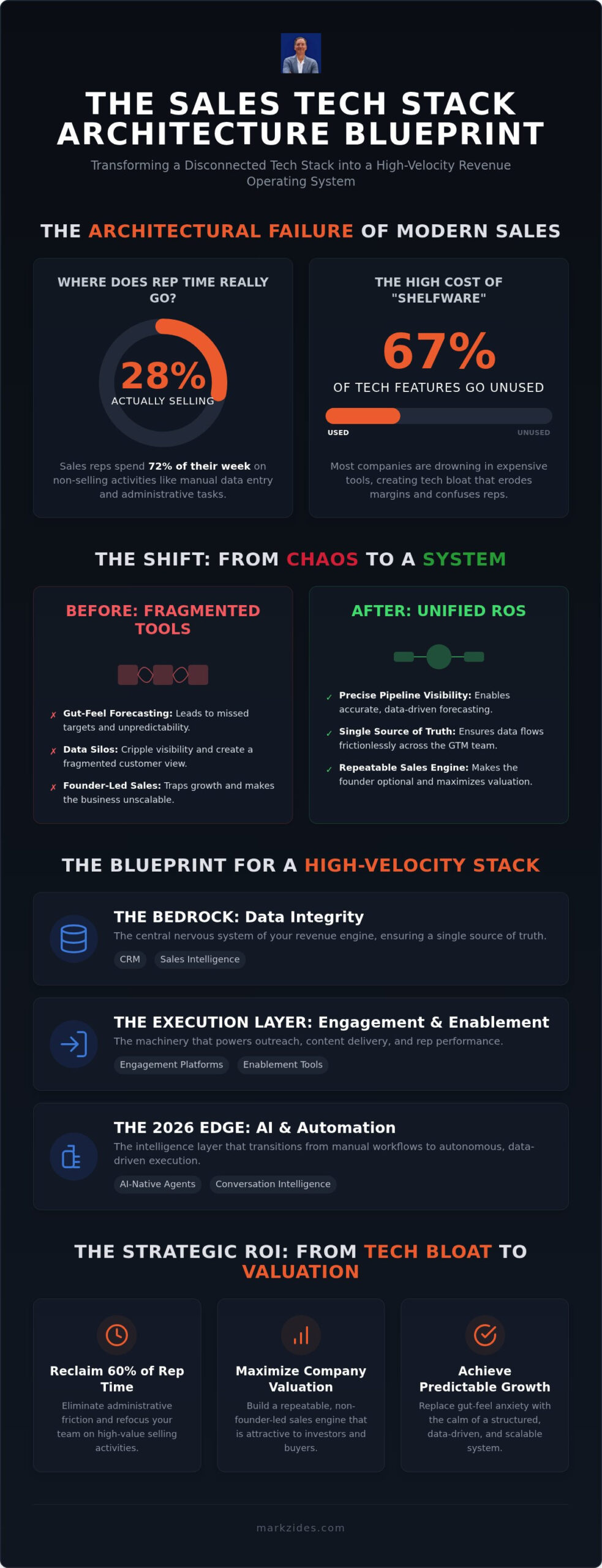
If your sales reps are spending just 28% of their time actually selling, you don't have a talent problem; you have an architectural failure. Most organizations in 2026 are drowning in expensive "shelfware," with 67% of their tool features going completely unused. You've likely felt the frustration of paying for premium licenses while your data remains fragmented and your forecasting still feels like a guessing game. This is why strategic sales tech stack consulting has become the critical differentiator for high-growth firms. It's the process of replacing "gut-feel" anxiety with the calm of a structured, predictable system.
In this article, you'll learn how to transform your disconnected tools into a unified Revenue Operating System that drives predictable growth and maximizes your company's valuation. We'll explore the methodology for auditing your current infrastructure, reclaiming 60% of your team's time from admin tasks, and embedding the AI-native systems required to win. From streamlining RevOps to making the founder optional in the sales process, we provide the blueprint for building a repeatable, high-velocity engine that scales without friction.
Key Takeaways
- Architect a unified Revenue Operating System (ROS) that moves beyond fragmented point solutions to create a scalable digital foundation.
- Utilize professional sales tech stack consulting to eliminate tech bloat and reclaim the 60% of rep time currently lost to administrative friction.
- Deploy AI-native agents and conversation intelligence to transition from manual workflows to autonomous, data-driven execution.
- Transform your CRM into a high-integrity central nervous system that replaces gut-feel forecasting with precise, predictable pipeline visibility.
- Align your technical infrastructure with your exit strategy to maximize valuation through a repeatable, non-founder-led sales engine.
Beyond the Arms Race: Why Sales Tech Stack Consulting is the New ROS
The sales tech market is projected to hit $65 billion by 2026, yet most organizations are merely accumulating "shelfware" rather than building a strategic asset. Buying software is easy. Architecting a Revenue Operating System (ROS) is difficult. We define the ROS as the integrated digital architecture that powers your sales engine. It is the difference between a collection of independent tools and a synchronized machine. High-performing teams in 2026 have moved away from the arms race of single-point solutions. They now prioritize an integrated ecosystem where data flows without friction. Without professional sales tech stack consulting, you aren't building a business; you're just paying for a very expensive digital junkyard.
The transition from point solutions to an integrated ROS is not just a technical upgrade. It is a fundamental shift in leadership. You are moving from gut-feel management, where "hustle" is the primary KPI, to systemized, data-driven execution. In this new model, every tool must justify its seat by contributing to a unified view of the customer. If a tool creates a silo, it is a liability. If it automates a bottleneck, it is an asset. This clarity is what allows a company to move from the chaos of high-growth to the calm of professional excellence.
The Cost of a Disconnected Sales Stack
Data silos remain the primary enemy of forecast accuracy. When your buyer intent data doesn't talk to your CRM, or your engagement platform is isolated from your contract management, you lose visibility. Research shows that the average company now has over 12 sales tools, yet 67% of those features remain unused. This tech bloat erodes your margins and confuses your reps. When sellers feel overwhelmed by their tools, they spend less time selling. In fact, many reps now spend roughly 72% of their week on non-selling activities like manual data entry and "swivel-chairing" between platforms.
This fragmentation also creates a ceiling on growth. If your sales process relies on tribal knowledge or founder intuition because the tech stack is too confusing to use, you cannot scale. A fragmented stack effectively traps you in founder-led sales. This makes a clean exit or a successful fundraise nearly impossible because the revenue isn't tied to a repeatable system; it's tied to a specific person. To maximize valuation, your technology must be the "operator" that makes the founder optional.
The Role of the Strategic Architect
True sales tech stack consulting requires an operator's perspective, not a software vendor's pitch. A software salesperson wants to sell you a license. A strategic architect wants to build a system that produces a predictable result. This involves aligning your digital infrastructure with your broader partnerships and alliances strategy to ensure your ecosystem supports external growth levers. By optimizing sales operations through this lens, you move from buying software to embedding methodology.
The goal is a repeatable engine that functions with military precision. This means every tool in the stack must be mapped to a specific stage of the buyer journey. We look at the stack as a construction project. The CRM is the foundation, the intelligence tools are the sensors, and the engagement platforms are the machinery. When these layers are aligned, you don't just close deals faster; you create a resilient organization that is attractive to investors and buyers alike.
The Bedrock: CRM and Sales Intelligence for Data Integrity
Your CRM is the central nervous system of your revenue engine. It's the singular source of truth that dictates whether your growth is sustainable or a house of cards. Most leaders treat the CRM as a digital filing cabinet. This is a mistake. In a high-velocity system, the CRM must function as an active data hub that powers every other tool in your arsenal. Without data integrity, your sophisticated automation becomes a liability that scales your errors at the speed of light. You aren't just storing names; you're building the digital architecture of your future exit.
Sales intelligence is the strategic layer that informs precisely who to target and exactly when to strike based on real-time behavioral signals. This intelligence moves you beyond static lists and into dynamic prospecting. Effective sales tech stack consulting ensures that this layer isn't just an extra tab on a browser but a deeply embedded feed that triggers action. By automating data enrichment, you can eliminate 75 to 85 percent of manual data entry for your high-value reps. This allows them to focus on closing deals rather than updating records. If your reps are still manually typing in job titles, you're burning margin on tasks that a machine should handle.
Choosing a CRM That Scales with Your Ambition
Evaluating a CRM requires looking past the marketing gloss. You must prioritize API flexibility and reporting depth above all else. If your CRM cannot talk to your marketing automation or your financial systems, it's a bottleneck. Rep user experience is the most critical metric for data accuracy. If the tool is hard to use, your reps won't use it. High-performing teams typically spend only 2 to 3 hours per week on CRM admin, while struggling teams waste 8 to 12 hours. You're moving from simple lead tracking to full revenue lifecycle management. Every data point should serve a purpose in your broader forecast.
Intent Data: The 2026 Prospecting X-Factor
Cold calling into a void is a relic of the past. In 2026, you must use technographic and firmographic data to refine your Ideal Customer Profile (ICP) in real-time. Intent data provides the signals you need to reach buyers at the peak of their interest. These tools identify when a prospect is researching your category or viewing a competitor's page. Integrating these intelligence tools directly into your rep's daily workflow ensures they're always working the warmest opportunities. If you're struggling to align these tools with your growth goals, engaging a fractional CRO can provide the strategic oversight needed to fix your data architecture and accelerate your pipeline.
The Execution Layer: Sales Enablement and Engagement Platforms
If the CRM is your foundation, the execution layer is the high-performance machinery that drives deal velocity. While intelligence identifies the target, engagement platforms orchestrate the actual conversation across every touchpoint. Strategic sales tech stack consulting ensures these tools don't just add noise; they provide the precision required to cut through a saturated market. By providing a centralized, branded hub for all stakeholders, Digital Sales Rooms (DSRs) eliminate the friction of buried email threads and lost attachments. This professional approach does more than just organize documents; it signals operational excellence to your prospects and provides the clarity needed for complex, multi-person purchasing decisions.
This layer is where your strategy meets the reality of the buyer's journey. When your execution tools are properly aligned, your reps stop "swivel-chairing" between disconnected platforms and start following a streamlined, data-backed path to the close. The focus here is on reducing the cognitive load on your sellers, allowing them to focus on high-value activities while the system manages the logistical hurdles. By embedding playbooks directly into the daily interface, you ensure that every rep, regardless of tenure, is executing at the level of your top performers.
Mastering Sales Engagement at Scale
Multi-channel sequence management is the non-negotiable standard for 2026. You cannot rely on a single outreach method; you must coordinate efforts across professional social networks, email, and phone in a synchronized rhythm. A/B testing your messaging is no longer a luxury but a requirement for finding the high-velocity "hook" that resonates with your specific market. The goal is to balance automated efficiency with high-stakes personalization. It's about using technology to handle the repetition so your humans can handle the relationship. When sequences are properly architected, your reps stop guessing and start following a path that identifies exactly when to pivot their approach based on prospect engagement.
The Strategic Blueprint for Sales Enablement
Execution fails without the right assets delivered at the right time. You must align your marketing team's demand generation efforts with specific sales stages to ensure reps have the right content at the right moment. Modern sales enablement tools provide the visibility required to see which case studies or whitepapers actually move the needle in the final stages of a deal. This data-driven feedback loop allows you to kill what doesn't work and double down on what does. This transition is critical for moving away from "hero selling," where revenue depends on a few superstars, to a repeatable, systemized process that works for the entire floor, effectively reducing the "ramp-up" time for new hires by weeks. Organizations that invest in structured B2B sales enablement services achieve a 49% win rate on forecasted deals, compared to just 42.5% for those operating without a formal framework.
The 2026 Edge: AI Agents and Conversation Intelligence
The era of the passive tool is over. In 2026, the competitive edge belongs to those who move beyond basic automation into the world of autonomous agents and conversation intelligence. This isn't just about recording calls. It is about deploying a system that analyzes every interaction for coaching opportunities and hidden risk. Professional sales tech stack consulting focuses on turning these signals into a repeatable advantage. When you analyze every sales call for risk detection, you identify pipeline leaks before they become churn statistics.
AI Agents have evolved from simple chatbots into autonomous operators. Custom deployments from Stevendev Marketing now manage scheduling, handle CRM updates, and qualify top-of-funnel leads with precision. By offloading these administrative burdens, you allow your human reps to focus on high-stakes negotiation. This shift is what drives the 77% revenue increase seen in AI-embedded teams. We are moving from "best guess" forecasting to data-backed probability. Predictive models now use historical performance and real-time intent signals to provide board-level reporting accuracy that was previously impossible.
A 4-Step Roadmap for AI Implementation
Implementing AI requires a methodical approach to avoid adding more "noise" to your system. Every step must be a deliberate move toward a more efficient engine.
- Step 1: Audit your current manual tasks to identify high-friction areas with high automation potential.
- Step 2: Deploy conversation intelligence to identify winning talk tracks and risk patterns across the floor.
- Step 3: Integrate AI-driven forecasting to replace "gut-feel" projections with data-backed probability.
- Step 4: Use AI agents to handle top-of-funnel qualification, ensuring your human SDRs only touch high-intent opportunities.
This structured progression ensures your team adopts the technology rather than resisting it. It builds confidence through small, measurable wins that prove the system works.
AI's Impact on Revenue Operations (RevOps)
RevOps is no longer just about fixing broken processes. It is now about unifying signals across sales, marketing, and customer success to create a single, predictive view of the revenue lifecycle. AI transforms RevOps from a reactive function to a proactive growth driver. Real-time performance dashboards have effectively ended the era of the "weekly status meeting." Instead of looking in the rearview mirror, leadership can now see exactly where the engine is overheating in real-time. Strategic sales tech stack consulting ensures these AI layers are deeply integrated into your digital architecture. If you are ready to architect this level of operational excellence, our fractional CRO services provide the blueprint for your AI transition.
From Tech Bloat to Valuation: The Consulting ROI
The true ROI of your digital infrastructure isn't found in a rep's productivity chart; it's found on your balance sheet. Professional sales tech stack consulting is the mechanism that converts raw software into enterprise value. Most companies treat their stack as a cost center. We treat it as a capital asset. When your tools are architected into a unified system, they provide the visibility and predictability that investors demand. If your revenue engine is a black box of "gut-feel" and manual effort, your valuation will suffer the consequences.
The path to a leaner, more effective system begins with a rigorous 90-day tech stack audit. This isn't a surface-level review. It is a deep dive into data integrity, tool adoption, and workflow efficiency. We identify what to keep, cut, or consolidate to eliminate the bloat that erodes your margins. By removing the 67% of features that go unused in a typical organization, you reclaim capital and mental bandwidth. This strategic oversight is the hallmark of a Fractional CRO, providing executive-level precision without the full-time overhead.
Maximizing Valuation Through Systemization
Investors pay a premium for certainty. If your sales process relies on a founder's "magic touch" or a handful of "hero" reps, you are a high-risk investment. A systemized tech stack provides the "Proof of Scale" required during due diligence. It demonstrates that your revenue is the result of a repeatable machine rather than individual luck. By establishing digital guardrails through your CRM and engagement platforms, you ensure long-term sustainability. This makes your organization "Acquisition Ready" by offering clean, systemized data—and you can explore Virtual Data Room (VDR) organization standards to ensure your files are prepared for a buyer to easily integrate and accelerate.
Next Steps: Blueprinting Your 2026 Revenue Engine
Transitioning from a fragmented collection of tools to a high-velocity Revenue Operating System requires a deliberate roadmap. You must start with a comprehensive gap analysis of your current sales tools and processes. Identify where data is leaking and where reps are losing time to administrative friction. To ensure your tech stack investments translate into actual pipeline performance, follow a structured sales funnel optimization checklist that aligns your demand generation with sales execution at every stage. If you want to move beyond "gut-feel" leadership, you need an architect who has been in the trenches. The next step is clear. Contact a Fractional CRO to audit your current infrastructure and architect your path to predictable growth. Stop buying software; start building a system that wins.
Future-Proof Your Revenue Architecture
The transition from a collection of fragmented tools to a high-velocity Revenue Operating System is the single most important move you can make in 2026. You've seen how data integrity in your CRM and the strategic deployment of AI agents can reclaim your team's time and replace "gut-feel" anxiety with operational clarity. By systemizing your execution layer, you don't just close deals faster; you build an asset that is attractive to investors and ready for a high-value exit. This is the ultimate objective of sales tech stack consulting: turning your digital infrastructure into a repeatable growth engine.
Mark Zides brings a battle-tested methodology to every engagement, focusing on removing the founder from the sales process to ensure your growth is truly scalable. If you're ready to stop the tech bloat and start architecting a system that maximizes your company's valuation, the blueprint is within reach. Ready to architect a repeatable revenue engine? Book a consultation with Mark Zides today.
Your path to professional excellence starts with a single, disciplined step toward systemization. You have the vision; we provide the digital architecture to make it a reality.
Frequently Asked Questions
What is sales tech stack consulting and why is it necessary?
Sales tech stack consulting is the strategic discipline of architecting a digital Revenue Operating System (ROS) that aligns your software with your specific growth objectives. It is necessary because most companies accumulate "point solutions" that create data silos rather than a unified engine. Without a professional architect, your technology becomes a source of friction that prevents you from scaling beyond manual, high-effort processes.
How do I know if my company has tech bloat?
Your company has tech bloat if your sales reps spend more time navigating between platforms than they do talking to prospects. Signs include paying for redundant features across multiple subscriptions and a general lack of tool adoption. If your data requires "swivel-chair" manual entry to move between systems, your stack is bloated and erodes your operational margins.
Can a sales tech stack really replace founder-led selling?
A well-architected stack replaces founder-led selling by embedding your unique methodology into a repeatable digital system. It provides the guardrails and playbooks that allow any qualified rep to perform at a high level without constant founder intervention. This systemization is critical for making your company "acquisition-ready" and maximizing its valuation during an exit.
What are the most important sales tools for a B2B startup in 2026?
In 2026, the essential stack consists of an API-flexible CRM, an AI-native engagement platform, and real-time intent data tools. High-performing organizations prioritize integration over quantity, typically utilizing only 4 to 6 core tools that are deeply connected. You need a central nervous system that connects your marketing signals directly to your sales execution layer without manual intervention.
How does a Fractional CRO help with sales tool selection?
A Fractional CRO provides the executive-level oversight needed to audit your current infrastructure without the full-time executive cost. They act as a strategic architect rather than a software vendor, ensuring your tech investments align with your demand generation and partnership strategies. Their goal is to build a repeatable engine that produces a predictable result, ensuring every tool justifies its seat in the stack.
What is the typical ROI of a sales enablement platform?
The ROI of a sales enablement platform is found in the drastic reduction of ramp-up time for new hires and the elimination of "hero selling" dependencies. It provides visibility into which content and talk tracks actually close deals, allowing you to optimize your assets. Effective sales tech stack consulting ensures these platforms transform your sales floor into a high-velocity engine with consistent, predictable performance.
How does conversation intelligence improve sales coaching?
Conversation intelligence moves coaching from "gut-feel" to data-backed precision by analyzing every interaction for risk and opportunity. It identifies the specific talk tracks that lead to closed-won deals and flags pipeline risks before they result in lost revenue. Managers use these insights to focus their energy on the specific behaviors that directly impact the bottom line, rather than relying on random call ride-alongs.
What is an AI Agent in the context of a 2026 sales stack?
An AI Agent is an autonomous operator designed to handle repetitive workflows like lead qualification, meeting scheduling, and CRM data entry. Unlike simple chatbots, these agents function as digital extensions of your reps, allowing your human talent to focus entirely on high-stakes negotiations. They are the primary drivers of efficiency in a modern Revenue Operating System, ensuring your reps spend their time selling rather than managing admin.
Ready to build a revenue engine that runs without you?
Mark works alongside founders as a player-coach — not a slide deck.
Book a 30-minute call