
How to Build a Sales Team: Scaling Revenue in 2026

If you believe that hiring a "star" salesperson is the cure for your stagnant revenue, you're actually building a house on sand. Relying on a single personality to drive growth isn't a strategy; it's a liability. You've likely spent years as the primary closer, carrying the weight of every deal because you fear no one else can articulate the value of your product like you can. It's exhausting, and it's the single greatest bottleneck to your company's exit readiness.
I understand the hesitation to let go, but scaling in 2026 requires a shift from intuition to engineering. This guide provides the methodical blueprint for how to build a sales team that functions as a high-velocity, repeatable revenue engine. You'll learn how to transition from founder-led sales to a predictable system where growth is a mathematical certainty rather than a stroke of luck. We will examine the architectural requirements of a modern Revenue Operating System, including the 2026 benchmarks for mid-market Account Executive OTEs, which now range between $160,000 and $220,000. It's time to replace "gut-feel" anxiety with the calm of structured, scalable systems that allow you to focus on strategy and fundraising.
Key Takeaways
- Break the "Founder Trap" by shifting from individual charisma to a documented, repeatable sales engine that ensures your business's survival beyond your personal involvement.
- Design a Revenue Operating System (ROS) that aligns marketing and sales, creating a stable infrastructure for predictable revenue growth.
- Learn the precise steps for how to build a sales team in 2026, starting with the critical roles of Sales Development Representatives and Account Executives.
- Implement a 5-step framework to audit your existing sales playbook and deploy the essential technology required to track and scale activity.
- Optimize your sales funnel to move from manual lead generation to high-velocity automation, positioning your company for maximum valuation and exit readiness.
The Founder Trap: Why Most Early Sales Teams Fail
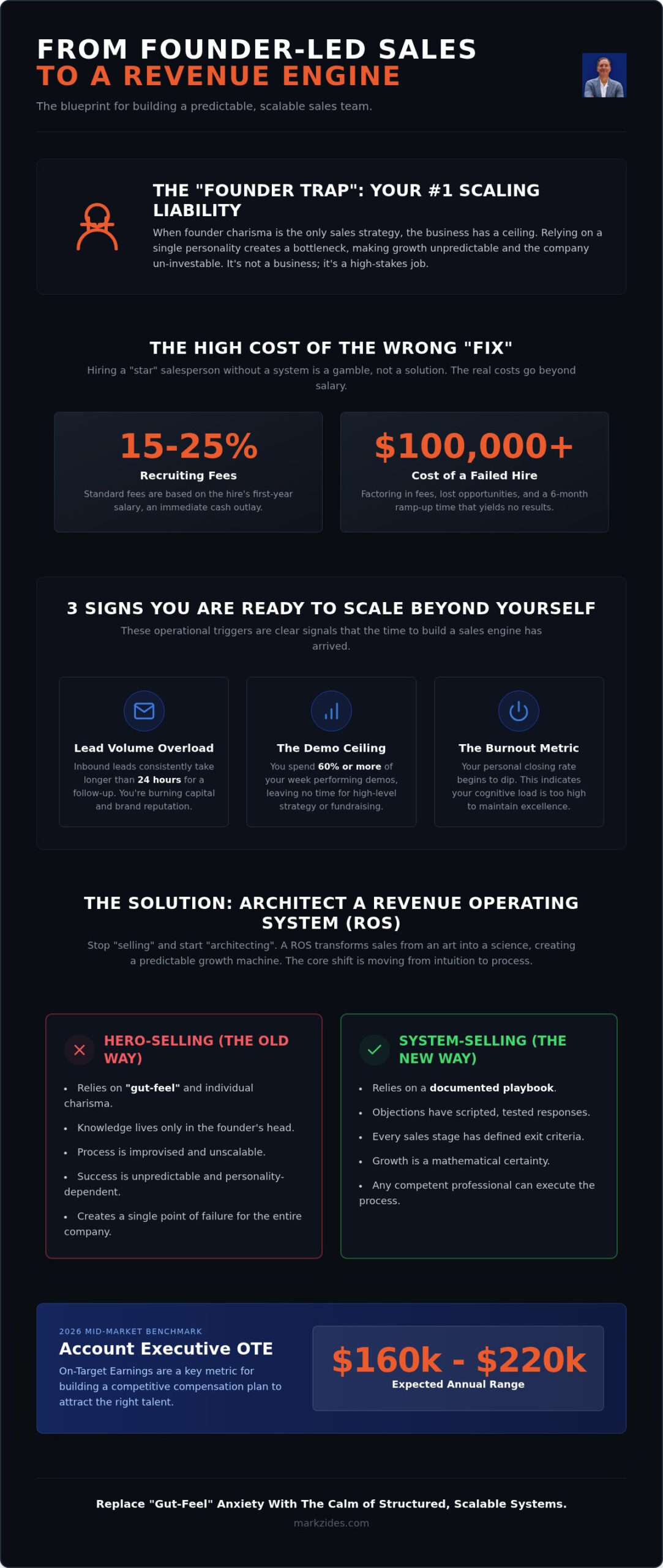
Your personal charisma is your company's greatest scaling liability. While your ability to close deals through sheer force of will got the business off the ground, it now acts as a ceiling. This is the "Founder Trap." You aren't building a business; you're maintaining a high-stakes job where everything breaks the moment you step away. Understanding how to build a sales team requires you to stop "selling" and start "architecting."
Many founders attempt to solve this by hiring a "Rockstar" salesperson. They look for a high-performer from a legacy brand, hoping that talent will translate. It rarely does. Without a system, that hire becomes a $100,000 mistake once you factor in recruiting fees, which currently sit at 15-25% of first-year salary, and the lost opportunity cost of a six-month ramp-up. You don't need a hero; you need a blueprint. Effective sales management isn't about finding people who can improvise; it's about designing a process so precise that any competent professional can execute it.
The Difference Between Intuition and Process
Hero-selling relies on "gut-feel" and deep product knowledge that lives only in your head. It's unscalable. To scale, you must document the "unwritten" playbook. If you can't explain why a deal closed without using the word "intuition," you don't have a sales engine yet. Transitioning from hero-selling to system-selling means every objection has a scripted response and every stage of the funnel has a defined exit criterion. You're no longer looking for someone to "figure it out." You're looking for someone to run the machine you built.
Signs You Are Ready to Scale Beyond Yourself
Scaling is a matter of timing and operational readiness. Look for these specific triggers to know when to start the transition:
- Lead Volume Overload: Your inbound lead volume exceeds your ability to follow up within 24 hours. If your response time is lagging, you are burning capital and damaging your brand.
- The Demo Ceiling: You spend 60% or more of your week performing demos. When you are buried in the "doing," you aren't leading. This prevents you from focusing on high-level strategy or fundraising.
- The Burnout Metric: Your personal closing rate begins to dip. This is a clear signal that your cognitive load is too high to maintain professional excellence.
If these signals are present, the time for how to build a sales team has arrived. You must move from being the primary operator to the strategic architect of your revenue systems. This shift is the first step toward achieving exit readiness and sustainable growth.
Architecting Your Revenue Operating System (ROS)
A sales team without a system is just a group of people hoping for the best. To scale, you must build a Revenue Operating System (ROS). This is the strategic infrastructure that transforms raw talent into a predictable growth machine. If you want to know how to build a sales team that survives your absence, you must first align your marketing and sales objectives. Misalignment at this stage creates friction that inflates your Customer Acquisition Cost (CAC) and stalls your Sales Velocity.
Success depends on a seamless transition between departments. Marketing must deliver qualified leads; sales must convert them; customer success must protect and expand the Lifetime Value (LTV). As detailed in the Harvard Business Review Sales Management Handbook, leading high-performing teams requires a disciplined approach to these hand-off points. Without defined protocols, leads fall through the cracks and revenue leaks out of your funnel before it can be realized.
Building a Repeatable Sales Process
You cannot manage what you cannot measure. Every stage of your sales funnel needs clear exit criteria. This ensures that an opportunity only moves forward when specific, verifiable actions have occurred. To build a repeatable sales process, you must identify the "Critical Path" to a closed deal. In your specific industry, this might involve a technical validation or a multi-stakeholder consensus meeting. Identifying these milestones allows you to forecast revenue with surgical precision rather than optimistic guesswork.
The 2026 Sales Tech Stack
In 2026, your tech stack acts as the nervous system of your sales organization. It's no longer enough to maintain a static database. With Salesforce increasing Sales Cloud Enterprise prices to $175 per user and Microsoft raising M365 tiers by up to 33% in 2026, your stack must be lean and high-impact. Specialized sales tech stack consulting focuses on embedding AI-driven prospecting and revenue intelligence into your operations. These tools accelerate your closers by removing the administrative burden that traditionally kills productivity. If your current systems feel disjointed, our Fractional CRO Services can provide the oversight needed to align your technology with your growth targets.
The 4 Essential Roles for a Scalable Sales Team
Specialization is the hallmark of a mature revenue engine. When you're determining how to build a sales team, you must move away from the generalist model. In 2026, the four pillars of a scalable team are the Sales Development Representative (SDR), the Account Executive (AE), Revenue Operations (RevOps), and Sales Leadership. Each role serves a distinct functional purpose within your Revenue Operating System, ensuring that no single person is a bottleneck for growth.
The SDR is your top-of-funnel engine, focused entirely on prospecting and qualifying leads. In 2026, an SDR's On-Target Earnings (OTE) typically range from $75,000 to $100,000. The AE is your closer, responsible for executing the sales playbook and securing signatures. Depending on your market, an SMB AE might command an OTE of $110,000 to $160,000, while an Enterprise AE can exceed $270,000. RevOps acts as the architect, managing the data and tech stack to ensure the system remains efficient. Finally, Sales Leadership provides the strategic mindset required to align every moving part toward a common revenue goal.
SDR vs. AE: Who Do You Hire First?
The decision to hire an SDR or an AE first depends on your current lead flow. If you're drowning in inbound leads, an AE is necessary to take demos off your plate. However, if your primary challenge is a dry pipeline, hiring an SDR first is often the more strategic move. This protects your time by ensuring you only speak with qualified prospects, allowing you to remain the primary closer while the SDR builds the machine. As you scale, maintaining a ratio of two or three SDRs to every one AE often provides the necessary volume to keep your closers productive.
The Case for Fractional Sales Leadership
Hiring a full-time, high-caliber Chief Revenue Officer is a massive capital commitment that many early-stage companies aren't ready to make. A fractional leader offers a sophisticated alternative. By engaging fractional CRO services, you gain access to executive-level expertise without the full-time overhead. This leader doesn't just manage people; they build the systems, embed the accountability, and design the commission structures that will attract your future full-time hires. It's the safest way to install a professional leadership layer while maintaining the agility needed to reach your next funding round or exit.
A 5-Step How-To for Building Your First Sales Engine
Stop searching for a savior and start building a system. Transitioning away from founder-led sales isn't a single event; it's a sequence of operational upgrades. If you want to master how to build a sales team, you must treat the process as an engineering project rather than a talent search. You're designing a machine where people are the components, not the source of power.
- Step 1: Audit the "Founder Playbook." Document every objection you've encountered and the exact rebuttal that closed the deal. If it's only in your head, it's not a playbook; it's a secret.
- Step 2: Build the Minimum Viable Tech Stack. Implement a CRM and activity tracking immediately. Avoid the "AI Tax" of bloated software; focus on tools that provide visibility into the sales funnel.
- Step 3: Hire for Coachability. Experience often brings legacy bad habits. Your first two hires must be willing to execute your specific methodology without deviation.
- Step 4: Implement Enablement. Leverage B2B sales enablement services to standardize your training. Professional enablement reduces the standard six-month ramp time by half.
- Step 5: Establish a 90-Day Loop. Review the process every quarter. If a stage in the funnel is leaking, fix the system before you blame the person.
Training and Enablement: Reducing Time-to-Value
The first 30 days are the "danger zone" for new hires. To ensure success, you must create a "Sales Library" containing recorded winning calls and top-performing email sequences. This allows new reps to shadow your best work asynchronously. Additionally, our Executive Coaching helps you transition from being the "Closer-in-Chief" to a strategic leader who develops internal talent.
Setting Realistic Quotas and Commission Structures
Setting quotas without historical data is a calculated risk. In 2026, the industry norm for quota-carrying Account Executives is a 50/50 split between base salary and variable commission. For a mid-market AE, expect an On-Target Earnings (OTE) framework between $160,000 and $220,000. Early in the process, consider "Behavior-Based" incentives. Reward the activities that lead to sales-such as discovery calls completed-rather than just the final signature. This ensures your team stays motivated while the engine is still being tuned for maximum velocity.
Scaling and Optimizing: Moving from 1 to 10
Scaling from your first two hires to a team of ten requires a fundamental shift in your operational philosophy. It's the transition from a manual "hustle" culture to an automated, data-driven engine. If you want to master how to build a sales team that sustains high-velocity growth, you must stop treating sales as a series of individual performances and start treating it as a unified system. At this stage, your role as the founder is to ensure the machine remains calibrated as you add more components.
As volume increases, manual lead generation becomes a strategic bottleneck. You must implement automated workflows and consider strategic levers like our Outsourced Lead Generation to maintain pipeline health without immediately bloating your payroll. This is where sales funnel optimization becomes critical. You aren't just looking for more leads; you're looking for higher conversion rates at every stage. Once you reach five to seven reps, move away from generalists and begin designing specialized vertical squads. This allows your team to develop deep domain expertise, which is essential for navigating the complex enterprise sales cycles of 2026.
The Role of Data in Strategic Decision Making
High-growth organizations don't guess; they forecast. Moving from "gut-feel" to "forecast accuracy" is the difference between a chaotic startup and a mature enterprise. Your board doesn't want to hear about "good vibes" in the pipeline. They want to see Pipeline Coverage ratios and Win Rates that prove your process is repeatable. If your win rate drops as you add reps, your system is breaking. Use these data points to identify where the friction lies, whether it's a breakdown in discovery or a failure in the closing sequence, and apply a strategic remedy immediately.
Preparing for the Next Level: Fundraising and Exits
When you approach VCs or potential acquirers, they aren't just buying your current revenue. They're buying your sales engine. A structured, documented team is a signal of stability and low risk. It proves that the business can grow without your direct involvement. Our Fundraising & Exit Readiness services focus on ensuring your revenue operations are audit-ready and your systems are transparent. Investors look for a machine that they can pour capital into to receive a predictable return. By focusing on how to build a sales team that is architected for scale, you aren't just increasing your revenue; you're significantly multiplying your company valuation.
Architecting Your Exit: The Path to Predictable Revenue
Building a high-velocity revenue engine is an engineering project, not a talent search. You've learned that the transition from founder-led sales to a scalable system requires a documented Revenue Operating System and specialized roles. By architecting these processes today, you aren't just increasing your monthly numbers; you're maximizing your company's valuation for a future exit. The uncertainty of "gut-feel" selling is the single greatest bottleneck to your growth. It's time to replace anxiety with the clarity of structured systems.
If you're ready to master how to build a sales team that functions independently of your personal charisma, you must install professional leadership. We specialize in removing founders from the sales seat through our proven 90-Day Revenue Operating System implementation. This structured approach ensures your organization is audit-ready and primed for fundraising or acquisition. Our track record in valuation maximization provides the stability you need amidst high-growth chaos.
Don't let operational friction stall your ambition. Stop founder-led selling and start scaling with a Fractional CRO today. You've built the product; now let's build the machine that sustains it. Success is inevitable when you follow the right blueprint.
Frequently Asked Questions
How much does it cost to build a sales team in 2026?
The total first-year investment for a mid-market Account Executive typically ranges between $200,000 and $260,000. When you're determining how to build a sales team, you must factor in OTEs of $160,000 to $220,000 plus recruiting fees. For Sales Development Representatives, expect OTEs between $75,000 and $100,000. These figures don't account for the tech stack or management overhead, making the initial capital requirement significant for early-stage companies.
Should I hire a VP of Sales or a Fractional CRO first?
You should hire a Fractional CRO first to architect the system before committing to a full-time executive. A VP of Sales often expects a pre-built engine to manage; if you haven't documented your playbook, they'll likely fail. A fractional leader installs the Revenue Operating System and establishes the KPIs. This ensures that when you do hire a permanent VP, they're stepping into a functional, predictable machine.
How long does it take for a new salesperson to become profitable?
A new salesperson generally takes four to six months to reach full productivity and become profitable. This ramp-up period covers technical training, pipeline building, and closing their first full cycles. You can accelerate this timeline by implementing structured sales enablement and recorded call libraries. Without these systems, the ramp-up often extends to nine months, which increases the financial risk of a failed hire.
Can I build a sales team if I don’t have a marketing department yet?
You can start the process, but your first hires must be outbound-focused SDRs rather than closers. If you don't have a marketing engine generating inbound leads, your strategy for how to build a sales team must prioritize pipeline generation from scratch. This requires a robust tech stack for prospecting and a different skill set than traditional inbound closing. Eventually, you'll need to align both departments to maintain a sustainable funnel.
What is the best way to handle lead generation for a new sales team?
The most efficient way is to combine internal outbound efforts with outsourced lead generation to bridge the gap. Relying solely on new hires to find their own leads often leads to burnout and inconsistent pipeline growth. By outsourcing the initial prospecting, you allow your new sales team to focus on discovery and closing. This accelerates their time-to-value and stabilizes early revenue during the team-building phase.
How do I know if my sales process is actually repeatable?
Your process is repeatable when a new hire can achieve a similar win rate as the founder using the same playbook. If your success still depends on your personal intervention or "gut-feel" decisions, the system isn't yet scalable. A truly repeatable process has defined exit criteria for every stage and consistent conversion rates that aren't tied to a specific personality or a single superstar closer.
What sales tools are essential for a startup sales team?
You need a CRM, a revenue intelligence platform, and an AI-driven prospecting tool. These form the nervous system of your operation. In 2026, tools like Sales Cloud Enterprise have seen price increases to $175 per user, so you must select a stack that provides high visibility without unnecessary bloat. Focus on tools that automate administrative tasks and provide clean data for board-level forecasting rather than just storing contacts.
How do I manage a remote sales team effectively?
Effective remote management requires radical transparency and a culture of accountability built on activity data. You must replace physical coaching with asynchronous feedback loops and recorded call reviews. Use your tech stack to track leading indicators, such as outbound volume and discovery meetings, rather than just lagging revenue numbers. This structured approach replaces physical oversight with the calm of a predictable, data-driven system that functions across time zones.
Ready to build a revenue engine that runs without you?
Mark works alongside founders as a player-coach — not a slide deck.
Book a 30-minute call